Add one proprietary data point to recover from Google's March 2026 core update
The March 2026 Google core update nearly doubled the page-vanishing rate by elevating "Information Gain" as the dominant signal. One afternoon's fix: add one proprietary data point above the fold to each affected page.
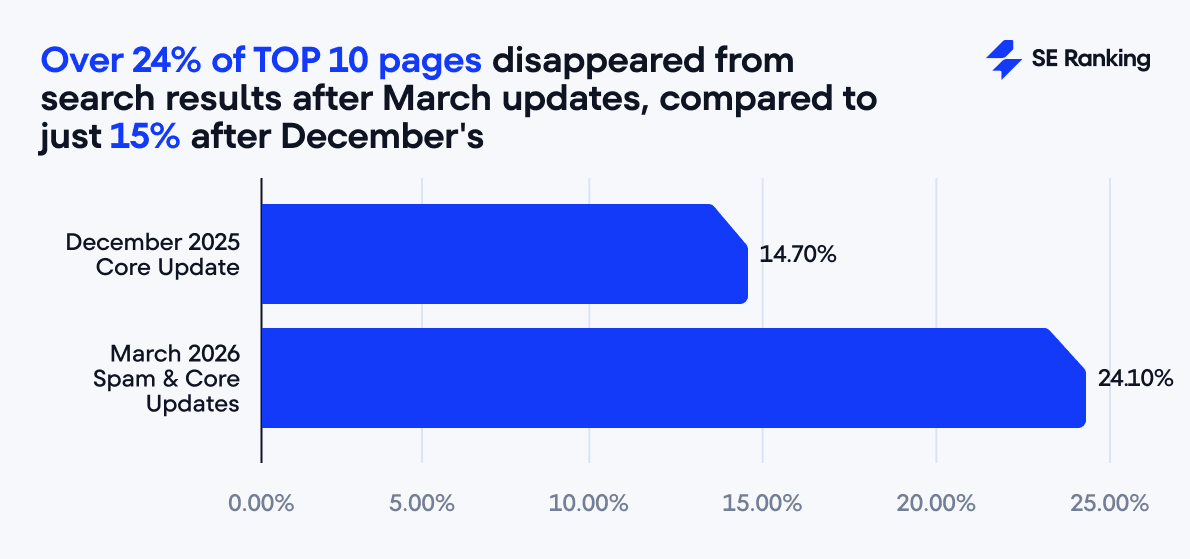
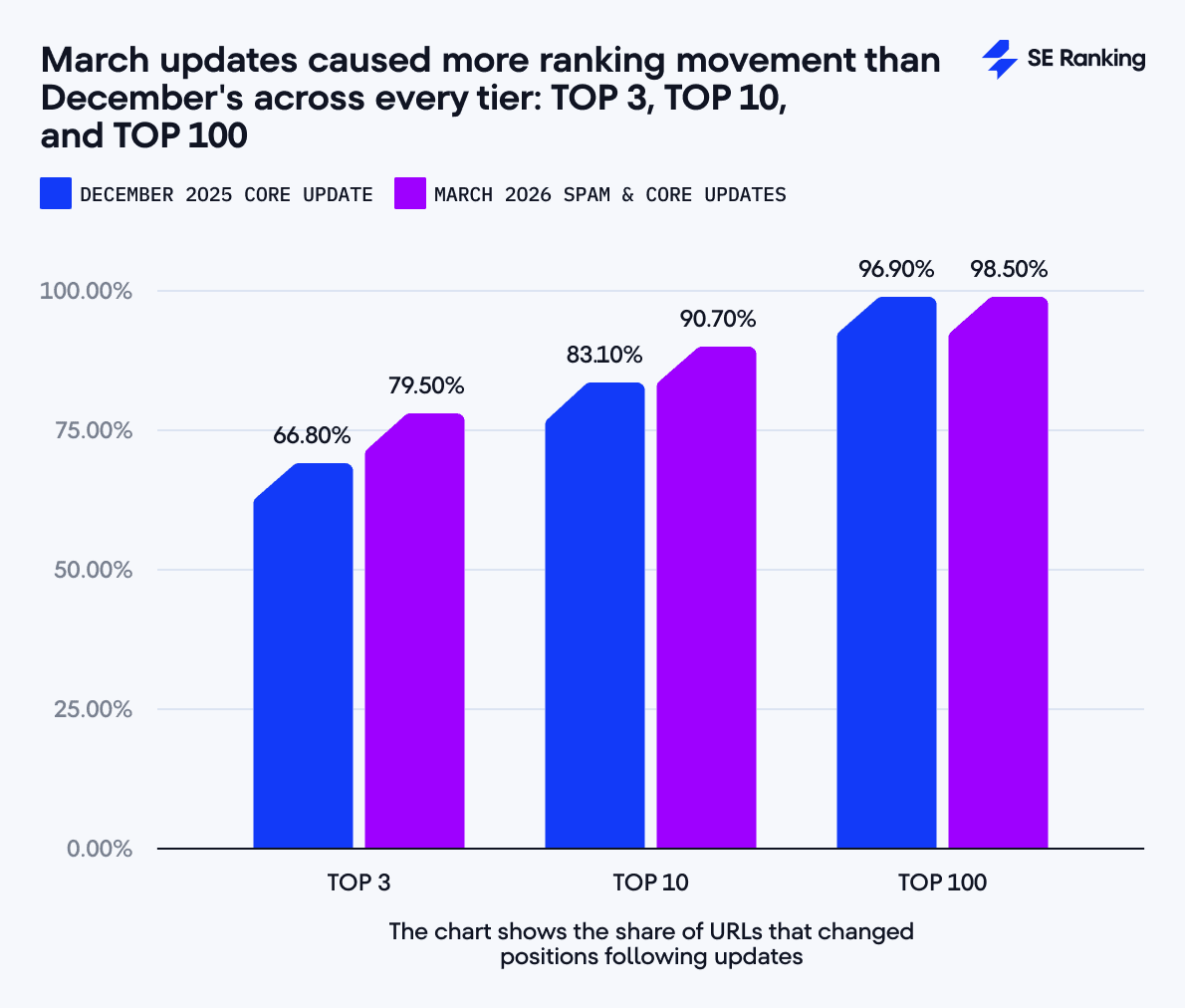
The March 2026 Google core update (March 27 – April 8, 2026) reshuffled search results more violently than any prior broad core update on record. SE Ranking analyzed 100,000 keywords across 20 niches and found that 90.7% of all URLs previously ranking in the top 10 changed positions during the combined March spam update (March 24-25) and core update window — up from 83.1% after the December 2025 core update. 1
The more startling number: 24.1% of pages that held a top-10 position before the update fell completely out of the top 100 afterward, nearly double the 14.7% drop-off rate seen after December 2025. 1
Among affiliate-heavy sites, 71% lost traffic, with typical declines running 20-35%. Sites that published original research gained 22% on average. 2
If your site lost traffic and you're seeing stable (or even improved) rankings in Google Search Console, the picture is even bleaker than it looks. Single Grain's analysis of 12 B2B SaaS sites found impressions up 8% but clicks down 41% — Google's AI Overviews are intercepting traffic before users reach your page. 3 As their team put it: "Google kept the ranking. Took the click. You kept nothing."
Why this update hit content-heavy indie sites hardest
The mechanism behind the March update is a signal called Information Gain — a measure, based on a Google patent filed in 2018 and granted in 2022, of how much genuinely new knowledge a page contributes beyond what already ranks for the same query. In the March update, this signal moved from being one factor among many to the primary content-quality evaluator. 4
Content that lost the most visibility fell into three categories: AI-generated text produced at scale (-60% to -80% visibility), templated or rewritten content (-30% to -50%), and thin affiliate pages. 4 What won? Pages with at least one piece of data, measurement, or observation that no other result on page one contained.
Jason Poonia, managing director at Lucid Media, put it plainly: "Information gain is the new signal that matters most. Google is rewarding pages that add something the rest of the web does not already have. Recycled summaries are being demoted." 5
Cassie Wilson Clark, a fractional content strategist whose LinkedIn analysis circulated widely post-update, made the timeline clearer: "The March 2026 Core Update didn't invent Information Gain. Google has been thinking about this for years. But this update made it undeniable: the era of content that rephrases the top ten results is ending." 6
The fix: add one proprietary data point per affected page
Digital Applied's post-update audit calibration — scoring 10 pages across a 9-point Information Gain rubric — showed that a 600-word post containing a single original benchmark can now outrank a 3,000-word comprehensive guide that paraphrases existing sources. Length became a tiebreaker, not a ranking input. 7
Here's how to apply this this week:
Step 1: Find your affected pages.
In Google Search Console, go to Performance → Pages and compare March 1-31 vs. February 1-28, 2026. Export sorted by clicks, descending. Any page with a significant click drop is your target list.
Step 2: Ask the one question.
For each page on your list: "What does this page say that no other result on the first page of Google says?" If you can't answer that question clearly, the page has no Information Gain — and Google's classifier likely scored it the same way.
Step 3: Add one of the following data types to each page.
| Data type | What it looks like for an indie dev |
|---|---|
| Internal benchmark | "Across 12 apps we shipped, adding X reduced churn by Y%" |
| Small survey result | Poll your mailing list or Twitter followers on a relevant question; report the raw numbers |
| Customer metric | Anonymized aggregate from your user base (e.g., "users who enabled X completed onboarding 34% faster") |
| First-hand test | Run a controlled test yourself and publish exact results with screenshots |
One data point is enough to start. The goal is not a full research paper — it's one thing that page one doesn't already have.
Step 4: Place the data point near the top.
Put it above the fold — before the first scroll — on both desktop and mobile. Digital Applied's recovery guide lists content that "answers the query immediately and then provides supporting depth" as the consistent pattern among pages that gained visibility after March. 7
Step 5: Resubmit in Search Console.
After updating the page, go to the URL Inspection tool in GSC, paste the page URL, and click "Request Indexing." This tells Google to recrawl sooner rather than waiting for its normal crawl schedule.
A few things this won't fix
Adding a data point won't help if the data itself is AI-generated or fabricated — Google's classifiers distinguish measured data from generated text. 7 If your page covers health, finance, legal, or any YMYL (your money or your life) topic, you'll also need a named author with verifiable credentials; the data point alone won't carry the page. 5
On timeline: Lily Ray, VP of SEO strategy and research at Amsive, analyzed 2,076 domains post-update and found that pages with original data gained 15-25% visibility, while recovery for impacted sites typically takes 3-6 months — full reversal usually doesn't happen until Google's next core update. 8 The update also completed only on April 8, 2026, so if you start this week, you're roughly 5-6 weeks in. The 4-8 week crawl window for the first ranking signals means changes you make now could show up in late June.
One page with one real data point, resubmitted today. That's the week's assignment.
Cover image from: Google March and April 2026 Core Updates: Why Your Traffic Dropped
参考ソース
- 1March 2026 Google Core Update was far more volatile than December's
- 2Google's March 2026 Core Update was the MOST VOLATILE broad update in the company's history
- 3Google's March 2026 core update just rolled out — rankings stable, clicks collapsing
- 4Information Gain: Google's #1 Ranking Signal in 2026
- 5Google March and April 2026 Core Updates: Why Your Traffic Dropped
- 6The Spotlight is back on 'Information Gain.' Here's What That Means for Your Content.
- 7Surviving the March 2026 Core Update: Recovery Guide
- 8Google March 2026 Core Update: Winners, Losers & Analysis
このコンテンツについて、さらに観点や背景を補足しましょう。