The poem Petrarch kept rewriting until his death
Vatican manuscript Ott.lat.2892, newly digitized June 9, 2026, is a 15th-century paper codex of Francesco Petrarch's complete I Trionfi (The Triumphs) — the allegorical epic in terza rima that was once Petrarch's most widely read work, inspiring Renaissance tapestries, wedding-chest paintings, and possibly the structure of early tarot. The manuscript, 57 folios with a single decorated initial, passed through Queen Christina of Sweden's legendary collection before entering the Vatican's Ottoboniani holdings in 1748. It is now freely viewable on DigiVatLib.

There is a version of Petrarch that most people never meet. Everyone knows the sonnets — the 366 love poems addressed to Laura, the Canzoniere, the work that turned him into the patron saint of romantic longing. What almost no one knows is that Petrarch himself spent the last two decades of his life on a different poem entirely, a long allegorical epic he kept revising until his death in 1374 and never quite finished. In the 15th century, that second poem was the one that made him famous. It inspired cycles of tapestries across Flanders, decorated the carved panels of Italian marriage chests, and may have given the tarocchi card game its name. Then, gradually, it was eclipsed by the sonnets, and most of its six hundred surviving manuscripts ended up in library stacks, unread.
One of those manuscripts — Vatican shelfmark Ott.lat.2892, a 15th-century Italian paper codex containing the complete text of Petrarch's I Trionfi (The Triumphs) — was digitized on June 9, 2026, as part of the Vatican Apostolic Library's Week 23 batch. It is the first new Vatican manuscript release in 22 days, and it is now freely viewable on DigiVatLib. 1
Six triumphs, each swallowing the last
The Trionfi is structured as a dream-vision: the poet falls asleep and watches a series of processional triumphs, each conquering the one before it. Love conquers mankind; Chastity conquers Love; Death conquers Chastity; Fame conquers Death; Time conquers Fame; Eternity conquers Time. 1 Written in terza rima — the interlocking three-line stanzas Dante used in the Divine Comedy — the poem is less a collection of lyrics than a single sustained meditation on what survives when everything falls. Eternity alone holds the field.
Petrarch began working on it around 1351 and kept revising through 1374, leaving the final canticle unfinished at his death. The poem was circulating in manuscript before the first printed editions appeared, and it was in that Quattrocento manuscript circulation that it reached its peak influence. More than 600 manuscript copies survive from the 14th through 16th centuries. 1 The six triumphs gave Renaissance artists a complete iconographic program: Flemish weavers produced grand tapestry cycles, Florentine craftsmen painted the processions onto wedding cassoni, and painters returned to the allegories repeatedly through the 15th century. The "trionfi" card game — the early ancestor of tarot — appears to have borrowed both its name and its hierarchical trump structure from the poem's ascending chain of victories. 1
What the manuscript looks like
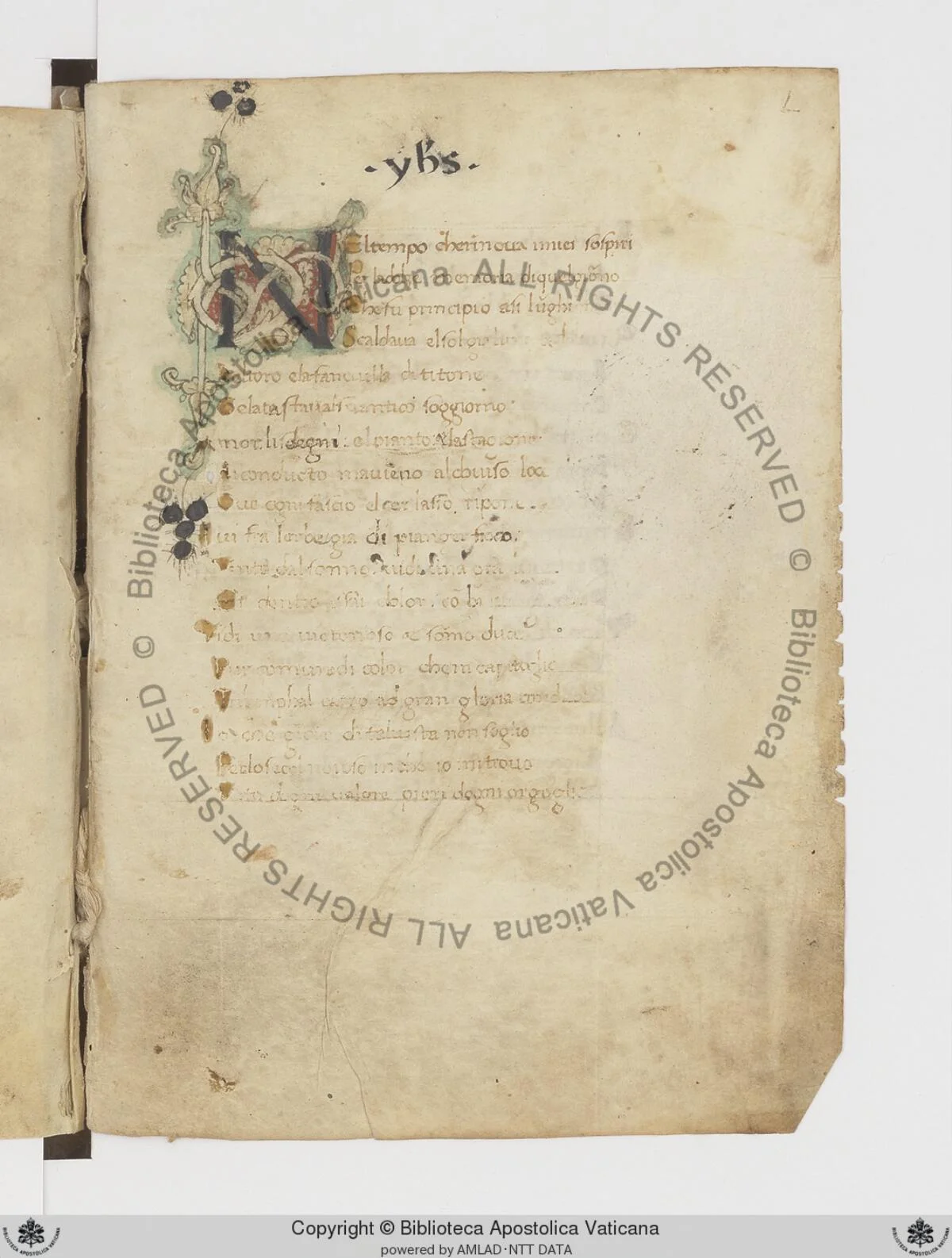
Ott.lat.2892 is 57 folios of paper — 114 written pages — in a single-column layout, written in an Italian vernacular hand. 1 It is a working copy, not a presentation piece: no miniatures, no panel illuminations, no ornamental borders. What it does have, at the very top of f.1r, is one decorated initial — the letter "N," rendered in red and blue with light green vine-work, the kind of restrained but careful ornament a literate Quattrocento household would commission for a volume meant to be read and re-read rather than displayed.
Above the initial, in a neat smaller hand, sits the inscription "·yhs·" — the IHS Christogram, a common piety marker at the top of manuscripts from this period.
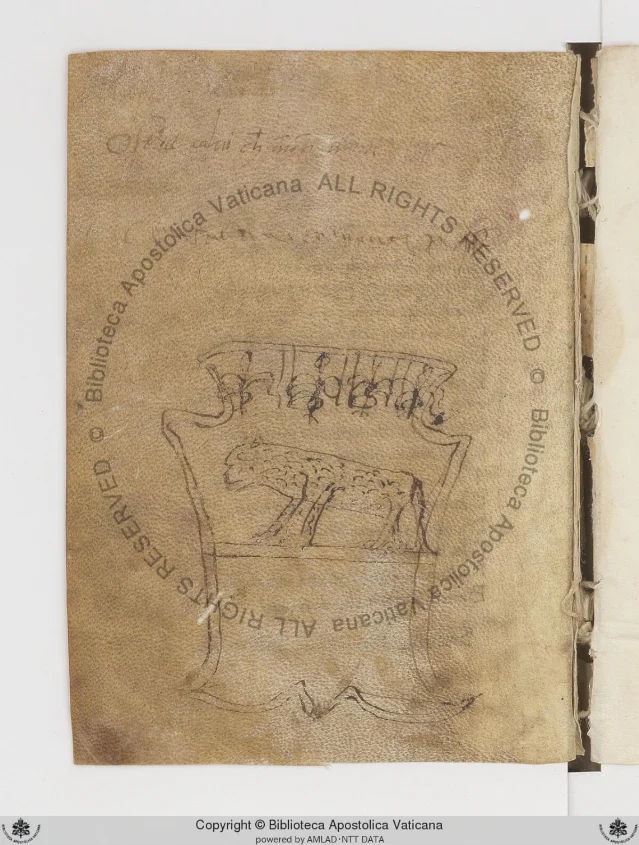
The full IIIF manifest captures 128 canvases in total, including the binding boards, pastedowns, flyleaves, all 57 text folios, the spine (visible on the Vatican's label as "Ottob. lat. 2892"), and the fore-edge and bottom-edge details — a complete physical record of the object, not just its pages. 2
Manuscript specialist Gemma Guerrini Ferri, in two studies on the Trionfi's manuscript tradition (1986 and 2006), examined the Quattrocento circulation of the poem in manuscripts like this one — what she termed the prevulgata tradition, meaning the manuscript distribution that predated and in many ways shaped the first printed editions. 1 The specific scribe who wrote Ott.lat.2892, and where and when it was produced within the 15th century, are not known from the public catalog record.
The library that traveled across Europe
The shelfmark prefix "Ott.lat." stands for Ottoboniani Latini, the name of the 3,379-item Latin manuscript collection that entered the Vatican in 1748 after being purchased from the estate of Cardinal Pietro Ottoboni (1667–1740). Before Ottoboni, the core of that collection belonged to someone far more theatrically compelling. 3
Queen Christina of Sweden (1626–1689) was, by the assessment of her contemporaries, one of the most erudite women of the 17th century, someone who wanted Stockholm to become "the Athens of the North." 3 She learned seven languages, corresponded with Descartes, and collected manuscripts with what one account describes as something close to obsession. She employed the Dutch scholars Isaac Vossius and Nikolaes Heinsius to catalog and acquire manuscripts from across Europe. During the Thirty Years' War, Swedish troops looted libraries in conquered territories; their haul — including manuscripts from Prague in 1648 — was sent back to enrich her Stockholm collection. 3
Then, in 1654, Christina abdicated. She converted from Lutheranism to Catholicism, shipped approximately 6,000 books and manuscripts to Antwerp ahead of her departure, and eventually settled in Rome — bringing her library with her. After her death in 1689, the collection passed by purchase to the Vatican, forming the Ottoboniani. The 15th-century Italian paper codex containing Petrarch's Trionfi followed that same path: from somewhere in Quattrocento Italy, through Christina's Roman household, to the Ottoboniani shelves, to the Vatican's permanent care. 3
Pope Alexander VII reportedly called Christina "a queen without a realm, a Christian without faith, and a woman without shame." 3 The books she kept are still here.
Now open on DigiVatLib
Ott.lat.2892 is part of the Vatican Week 23 batch released on June 9, 2026 — the first new DigiVatLib material in 22 days, according to Wiglaf.org, which monitors DigiVatLib for new additions. The batch contains four manuscripts, all from the Ottoboniani Latini collection; Ott.lat.2892 is the headline item. 4
The full manuscript is viewable in the DigiVatLib IIIF viewer with page-level zoom:
コンテンツカードを読み込んでいます…
The opening folio — f.1r with its decorated initial "N" and the IHS inscription — is the most visually arresting page in the codex. But the manuscript rewards browsing all the way through: the poem's final Triumph, of Eternity over Time, ends mid-argument in a 15th-century anonymous hand, on a page Petrarch himself never saw finished.
Cover image: folio 1r of Vatican manuscript Ott.lat.2892, © Biblioteca Apostolica Vaticana — all rights reserved.
このコンテンツについて、さらに観点や背景を補足しましょう。