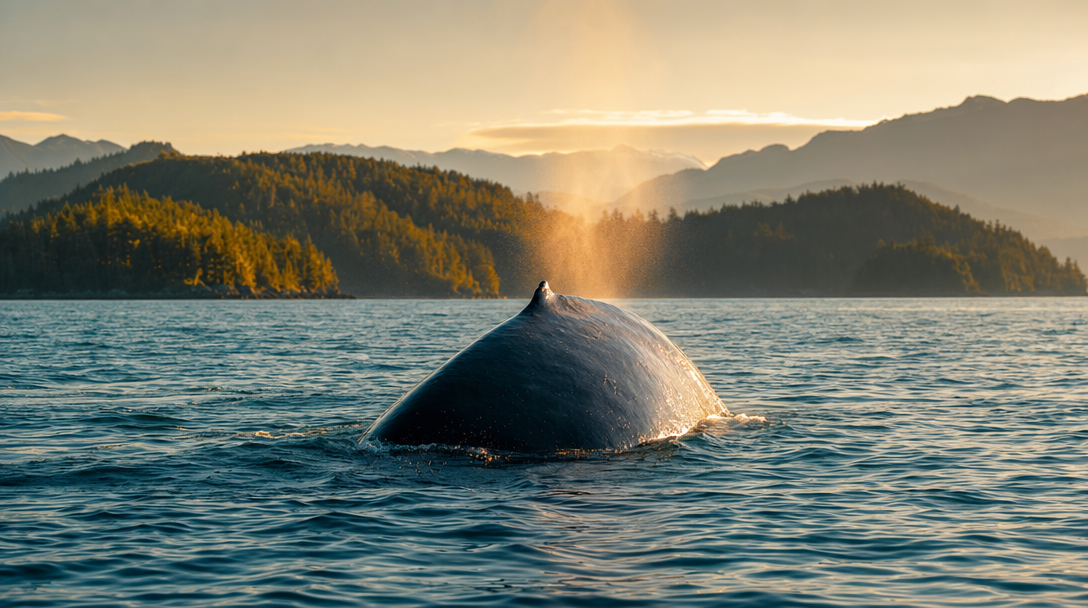
April–May 2026: Pacific Migration Sweep

The great northward migration is on — Hawaii empties, Monterey erupts with 20-whale feeding frenzies, and the first humpbacks reach Alaska's Ship Creek.

April–May 2026: Pacific Migration Sweep
The great northward migration is on — Hawaii empties, Monterey erupts with 20-whale feeding frenzies, and the first humpbacks reach Alaska's Ship Creek.

April–May 2026 Pacific Migration Sweep

The humpback whale migration is in full swing. This month's episode tracks the leading edge of the northward movement — from Hawaii's nearly-empty breeding grounds to the first arrivals in Alaska — and catches some extraordinary feeding frenzies along the Pacific coast.

Hawaii: The Great Departure

The 2026 Sanctuary Ocean Count confirms the mass exodus is well underway. January's peak count of 1,954 humpbacks off Hawaii had dropped 77.7% by March as the whales turned north. 1 The 30-year count program — over 1,200 volunteers across 60+ observation sites — recorded 4,325 total humpbacks across the full January–March window. 1 A single humpback was still photographed breaching off Hawaii Island cliffs in April, a late-season straggler. 1

Pacific Coast: Monterey & Santa Barbara Surge

Monterey Bay has been producing spectacular feeding action all month. On April 27, 20 humpbacks were observed lunge-feeding in a coordinated frenzy on the 10 AM trip, with 15 more doing the same on the 9 AM departure — sighting success rates above 80% for the month. 2 Earlier in the month, April 7 produced a single "extremely friendly" whale and a separate group of 25. 2
In the Santa Barbara Channel, 10 humpbacks spread across glassy indigo water on April 24 — one individual displaying an unusually long dive — and 3 more were confirmed on May 4. 3 4 Newport, California added 2 humpbacks on April 19 and a solo individual on April 2. 5

Salish Sea Corridor: Named Whales Return

The Pacific Northwest migration corridor lit up in April. On April 13, the first documented returning humpback of 2026 — Slits (BCY0946) — was photographed in Trincomali Channel, British Columbia. 6 Named individuals Zig Zag (CRC-15969) and companion were tracked heading north through Haro Strait on April 19. 7 By May 3, a humpback was confirmed near Friday Harbor and Thatcher Pass in Rosario Strait. 8 HappyWhale photo-ID records logged 10 individual identifications between May 2–3 alone, including Slits' 2024 calf Ulli. 9

Alaska: Season Opens

Six humpbacks — including an adult, four sub-adults, and a calf — were spotted milling at Ship Creek, Knik Arm, Anchorage on April 14 before heading toward Point Woronzof. 10 Upper Lynn Canal near Glacier Bay is receiving its first arrivals of the season as whales follow forage fish runs northward. 11 NOAA confirms the North Pacific population completes the 3,000-mile Hawaii-to-Alaska crossing in as few as 28 days. 12

Research Spotlight: "Timmy" Survives 40-Day Stranding

A humpback dubbed "Timmy" — severely entangled in fishing gear — stranded near Lübeck, Germany in late March. After a 40-day international rescue effort involving the IWC Strandings Expert Panel, Timmy was released into the North Sea on May 2 with a satellite transmitter for recovery monitoring. 13 14 The IWC noted that fishing gear entanglement causes hundreds of large whale deaths annually worldwide. 14
Separately, a new NOAA PLOS Climate study found that the "Habitat Compression Index" — a cold-water upwelling metric — can predict humpback entanglement risk on the West Coast with 89% accuracy, offering a new tool for fisheries managers. 15

What to Watch in June

  • Gulf of Alaska bubble-net season: GEMM Lab research links humpback aggregations in Sitka Sound directly to herring spawning timing — watch for feeding reports as herring runs peak. 16
  • Juneau tour operators opening their full summer schedules — named individuals like "Flame" are already logging arrivals.
  • Hawaii Island stragglers: A few late-departing whales may still be photographed through mid-May.

All sightings and data sourced from April–May 2026 whale watching reports, NOAA records, and marine research publications. Humpbacks only — no other species covered.

このコンテンツについて、さらに観点や背景を補足しましょう。

  • ログインするとコメントできます。