
Anthropic Launches Claude Fable 5 and Mythos 5: The Mythos Class Goes Public
Anthropic released Claude Fable 5 on June 9, 2026 — the first public model in its Mythos class, held back since April on cybersecurity grounds. Fable 5 is state-of-the-art on nearly all tested benchmarks, ships with safety classifiers that route sensitive requests to Opus 4.8, and is priced at $10/$50 per million tokens. Claude Mythos 5 (same weights, classifiers lifted) goes only to vetted Project Glasswing partners. The launch comes eight days after Anthropic's confidential S-1 filing.

Anthropic shipped Claude Fable 5 and Claude Mythos 5 on June 9 — the first public release from the Mythos model family that the company had held back for months on the grounds that its cybersecurity capabilities were too dangerous to expose broadly. Fable 5 is the general-availability version, hardened with safety classifiers that reroute sensitive requests to Opus 4.8. Mythos 5 is the same underlying model with those classifiers relaxed, available only to vetted cyberdefense and infrastructure partners through Project Glasswing. 1
What Fable 5 actually is
Fable 5 sits in what Anthropic calls the Mythos class — a tier above the Opus line. Both Fable 5 and Mythos 5 share the same weights; the difference is which safety classifiers are active. 2
Anthropic's own benchmarks show Fable 5 is state-of-the-art on nearly every tested benchmark: software engineering, knowledge work, vision, long-context reasoning, and life sciences research. A few numbers from the launch:
- Stripe reported that in a 50-million-line Ruby codebase, Fable 5 completed a migration that would have taken a full engineering team over two months — in a single day. 1
- Cursor named Fable 5 the top model on CursorBench, "opening up a class of long-horizon problems that were out of reach for earlier models." 1
- On Cognition's FrontierCode evaluation — which tests whether models pass production-quality coding tasks — Fable 5 scores highest among frontier models even at medium compute. 1
- GitHub says Fable 5 handled "complex, long-horizon coding tasks with a level of autonomy and reliability that exceeded previous benchmarks." 1
- On Harvey's BigLaw Bench, Fable 5 scored 93.4% — a new Anthropic high. On Harvey's Legal Agent Benchmark, which scores end-to-end legal-task completion under an all-pass standard, it scored 13.3%, up from Opus 4.8's 10.4%. 3
The performance gap over previous Claude models widens as task complexity and duration increase — the benchmark data Anthropic provided consistently shows Fable pulling ahead more sharply on the hardest, longest tasks.

The safety architecture
The safety story is the structural core of this release. Anthropic was explicit: Mythos-class models have reached a threshold where their cybersecurity capabilities present a genuine uplift risk for malicious actors.
Fable 5 ships with a new classifier layer that routes requests touching three domains to Opus 4.8 instead:
- Cybersecurity — exploitation, offensive operations, defense evasion
- Biology and chemistry — dual-use research where the model's biological reasoning could assist dangerous applications
- Distillation — requests that pattern-match known attempts to extract Claude's capabilities for training competing models
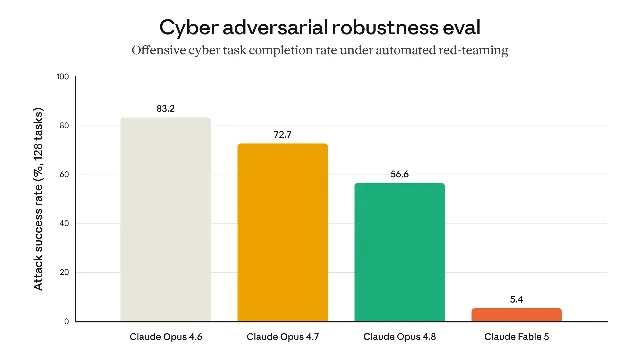
Anthropic says these classifiers trigger in less than 5% of sessions, and that when they do fire, users see a notification. The company ran a bug bounty that produced no universal jailbreaks after over 1,000 hours of testing; external red-team organizations also failed to find universal jailbreaks on long-form agentic tasks, though the UK AISI made partial progress within a short initial window. 1
A separate policy change applies to Mythos-class models for enterprise customers: 30-day data retention on all Mythos-class traffic, for safety monitoring. Anthropic says it won't use this data for training, will log all human access, and will delete it after 30 days in almost all cases. This has commercial implications for SaaS companies that rely on zero data retention (ZDR) guarantees to meet GDPR or CCPA obligations. 1
Mythos 5 and Project Glasswing
Claude Mythos 5 — the version with classifiers partially lifted — is available now to the group of organizations currently accessing Claude Mythos Preview through Project Glasswing: cyberdefenders, critical infrastructure providers, and selected biomedical research partners. Anthropic said it plans to expand access through a broader trusted-access program.
In Anthropic's internal testing, Mythos 5 demonstrated drug-design capabilities that match or exceed skilled human operators: it selected binding sites, ran protein design tools autonomously, and recovered from failures. Nine of 14 protein targets yielded strong drug candidates now under investigation. On genomics, Mythos 5 assembled single-cell data for millions of cells across 138 animal species over a week of largely autonomous work, then trained a custom machine learning model that outperformed a recently published Science journal model — at 1/100th the size. 1
Pricing and availability
Both models are priced at $10 per million input tokens and $50 per million output tokens — double the rate of Claude Opus 4.8, but less than half the price of Claude Mythos Preview. 2
Fable 5 is available immediately via the Claude API, claude.ai, and Amazon Bedrock. On Pro, Max, Team, and Enterprise subscription plans, Fable 5 is included free until June 22, after which usage credits apply as capacity expands. Rate limits initially run at half of Opus, doubling after the two-week introductory window. 4
コンテンツカードを読み込んでいます…
Where this fits in the IPO story
The timing is not incidental. Anthropic filed a confidential S-1 with the SEC on June 1 — eight days before this launch. The company raised $65 billion at a $965 billion post-money valuation on May 28. Releasing the most capable public model in its history, carrying the clearest demonstration of frontier AI biology and cybersecurity capabilities, in the window between the S-1 filing and the expected public roadshow, shapes the investor narrative Anthropic wants to set.
The product story aligns neatly with the IPO story: Anthropic has models capable enough to restrict, governance sophisticated enough to tier access, and a pricing architecture that monetizes both the restricted and the public layers. Enterprise decision-makers evaluating Claude and investors tracking the Anthropic IPO are looking at the same release. 5
Also: Claude Partner Network expansion
On June 3, Anthropic announced a structural update to the Claude Partner Network: a tiered Services Track and a public Claude Partner Hub portal. The Services Track formalizes three tiers — Select (10+ certified practitioners, 2+ production deployments), Preferred (100+, 15+), and Global Premier (1,000+, 100+ deployments across 3+ regions). The Partner Hub gives enterprises a public directory to evaluate partner firms against these verified metrics. 6
The partner scale cited in the announcement: Accenture is training 30,000 professionals on Claude; Cognizant has rolled it out to roughly 350,000 associates; Deloitte has 470,000 employees on the program; KPMG covers 276,000; PwC is deploying Claude Code and Claude Cowork starting from US teams. More than 10,000 consultants have earned a Claude certification as of the announcement date. 6
What to watch next
Three threads to track:
- IPO timeline: The S-1 was filed confidentially on June 1. Watch for amendments, SEC review completion, and roadshow pricing signals. OpenAI filed its own confidential S-1 on June 8, making this a two-horse race toward public markets.
- Trusted-access expansion: Mythos 5 with lifted classifiers is currently limited to Project Glasswing partners. Anthropic said it intends to expand through a broader trusted-access program — the pace of that expansion will define how quickly biomedical and security teams can access the model's full capability.
- Safeguard refinement: Anthropic acknowledged the current classifiers are deliberately conservative, triggering false positives. The company said it plans to reduce these as quickly as it can, particularly for biology and chemistry researchers.
このコンテンツについて、さらに観点や背景を補足しましょう。