Five papers: June 5, 2026

Five papers: June 5, 2026

Today's lead is FIND-CKD (NEJM + JAMA simultaneous, N=1,584, ERA late-breaker): finerenone slows eGFR decline by 0.7 mL/min/1.73 m²/year and cuts a kidney-CV composite endpoint by 23% (HR 0.77) in non-diabetic CKD — the first Phase 3 MRA evidence in this population. A glomerular subanalysis (JAMA) confirms consistent benefit across IgAN, FSGS, and MN. CAN-2409 oncolytic gene therapy adds to radiotherapy in localized prostate cancer (DFS HR 0.70, Lancet Oncology). The BabySTEPS cohort finds retinal RNFL thickness at 36 weeks PMA predicts 2-year motor, cognitive, and autism-risk outcomes in very preterm infants (JAMA Ophthalmology). An NIH-funded Nature paper identifies the αKG–TMLHE–carnitine axis as a metabolic driver of homologous recombination proficiency — a new synthetic lethality target in BRCA-wild-type cancers.

PubMed Top Medical Papers
2026/6/5 · 22:53
購読 2 件 · コンテンツ 18 件

リサーチノート

1. FIND-CKD — finerenone slows eGFR decline and reduces kidney-CV composite risk in non-diabetic CKD

NEJM + JAMA | IF ~100 / ~63 | Phase 3, double-blind, placebo-controlled RCT | N = 1,584
Sponsor: Bayer AG | Executive Committee: Rajiv Agarwal, MD (Indiana University School of Medicine) | Lead author: Hiddo J.L. Heerspink et al. | NEJM DOI: 10.1056/NEJMoa2604625 | JAMA listing: jamanetwork.com/journals/jama/fullarticle/2850123 | Trial registration: NCT05047263 | Peer-review status: Published June 5, 2026 in NEJM and JAMA simultaneously; presented as ERA 63rd Congress (Glasgow) late-breaker
The clinical gap: Finerenone, a non-steroidal mineralocorticoid receptor antagonist (MRA), has shown benefits in diabetic CKD across the FIDELIO-DKD and FIGARO-DKD trials. Whether the same mechanism is effective in non-diabetic CKD (nd-CKD) — including hypertensive nephrosclerosis and chronic glomerulonephritis — was untested in a Phase 3 setting. Up to 37% of dialysis-incident patients have nd-CKD, yet no kidney-specific therapy has been approved for this group beyond ACE inhibitor/ARB optimization and, more recently, SGLT2 inhibition. 1
What FIND-CKD did: 1,584 adults with nd-CKD were randomized to finerenone or placebo on top of maximally tolerated ACE inhibitor or ARB. The primary endpoint was eGFR slope from baseline through month 32. 1
Key results:
EndpointFinerenonePlaceboResult
eGFR slope (mL/min/1.73 m²/year)−3.3−4.0Δ +0.7 (95% CI 0.3–1.1; p<0.001)
Kidney-CV composite (kidney failure / sustained eGFR ↓≥57% / HF hospitalization / CV death)HR 0.77 (95% CI 0.60–0.99; p=0.043)
UACR ≥30% reduction at month 656.0%24.4%OR 3.99 (95% CI 3.22–4.95)
TEAEs68.3%65.4%
Serious hyperkalemia<1%<1%
Hyperkalemia leading to hospitalization or discontinuation<2%<2%
The eGFR slope difference of 0.7 mL/min/1.73 m²/year may appear modest in absolute terms; applied over a decade, it corresponds to approximately 7 mL/min/1.73 m² less cumulative loss — roughly equivalent to delaying dialysis eligibility threshold by 2–3 years at typical progression rates. 1 2
FIND-CKD is the fifth consecutive Phase 3 trial in which finerenone met its primary endpoint, extending the program to more than 20,000 patients across CKD populations with and without diabetes. 2
Clinical implication: Hyperkalemia signal was mild and the safety profile closely paralleled placebo — the <1% serious hyperkalemia rate is lower than what is typically observed with steroidal MRAs like spironolactone. The UACR reduction of 56% vs. 24.4% at month 6 is large enough to consider as a surrogate for downstream glomerular protection. Whether Bayer will seek an nd-CKD label extension for finerenone (KERENDIA) depends on the regulatory pathway, but these data position nd-CKD as a plausible indication. Agarwal noted: "The FIND-CKD results provide important Phase III data on finerenone's potential for adults living with non-diabetic chronic kidney disease." 1

2. FIND-CKD glomerular subanalysis — finerenone effect consistent across IgAN, FSGS, and membranous nephropathy

JAMA | IF ~63 | Prespecified exploratory analysis of FIND-CKD RCT | N ≈ 903 (glomerular disease subgroup)
Authors: Brendon L. Neuen et al. | DOI: 10.1001/jama.2026.9923 | JAMA listing: jamanetwork.com/journals/jama/fullarticle/2850124 | Sponsor: Bayer AG | Peer-review status: Published June 5, 2026 in JAMA (separate Original Investigation from FIND-CKD main paper); presented at ERA 63rd Congress (Glasgow)
The clinical gap: Glomerular diseases — IgA nephropathy (IgAN), focal segmental glomerulosclerosis (FSGS), membranous nephropathy, and membranoproliferative glomerulonephritis (MPGN) — represent a heterogeneous group that, until recently, lacked disease-modifying therapies beyond immunosuppression. Sparsentan and iptacopan have entered this space for IgAN and C3G, respectively. Whether finerenone's MRA mechanism extends uniformly across glomerular subtypes — or whether benefit is concentrated in certain etiologies — had not been examined prospectively. 3
What the subanalysis found: Among the ~903 FIND-CKD participants with investigator-reported glomerular disease, finerenone produced an eGFR slope difference of 0.73 mL/min/1.73 m²/year (95% CI 0.22–1.24) — numerically identical to the overall trial result. No heterogeneity was detected across IgAN, FSGS, membranous nephropathy, or MPGN, and no interaction with baseline SGLT2 inhibitor use was observed. Serious adverse events occurred in 19.5% (finerenone) vs. 21.4% (placebo); serious hyperkalemia was 0.9% in both arms. 3 1
Clinical implication: The absence of subtype-by-treatment interaction means that glomerulonephritis etiology alone does not predict differential finerenone response — a clinically useful finding, since many patients carry uncertain biopsy diagnoses or mixed pathology. For nephrologists already using SGLT2 inhibitors in IgAN, the lack of interaction with baseline SGLT2i use suggests additive positioning rather than redundancy, though no head-to-head or combination data exist. The UACR reduction data specific to the glomerular subgroup were not separately reported in accessible press materials; the JAMA full text is the definitive source. 3

3. CAN-2409 — oncolytic gene therapy added to radiotherapy improves DFS in localized prostate cancer

The Lancet Oncology | IF 35.9 | Phase 3, multicenter, double-blind, placebo-controlled RCT | N = 745
Sponsor: Candel Therapeutics | First author: Theodore L. DeWeese, MD (Johns Hopkins Medicine, Dean/CEO) | Trial registration: NCT01436968 | Peer-review status: Published June 2, 2026, The Lancet Oncology (open access, CC BY 4.0); extended follow-up (median 58 months) presented AUA 2026
The clinical gap: For intermediate- and high-risk localized prostate cancer, external beam radiotherapy with or without androgen deprivation therapy (ADT) is standard. Biochemical recurrence occurs in 20–40% within 5 years. No new treatment modality has been approved in the localized setting for more than two decades. Immunotherapeutic augmentation of local radiotherapy — reasoning that radiation-induced tumor antigen release creates an in situ vaccination opportunity — has been attempted repeatedly with modest results. 4
What CAN-2409 does: Aglatimagene besadenovec is an adenoviral vector delivering the herpes simplex virus thymidine kinase (HSVtk) gene directly into the prostate. Co-administration of prodrug valacyclovir results in selective tumor cell death and, via immunogenic cell death and danger signal release, primes a local and systemic anti-tumor immune response. 745 patients with intermediate/high-risk localized prostate cancer were randomized 2:1 to aglatimagene + valacyclovir + radiotherapy vs. placebo + valacyclovir + radiotherapy across 51 US/Puerto Rico centers. 5
Key results:
EndpointCAN-2409 (n=496)Placebo (n=249)Result
Median DFS (primary; median follow-up 50.3 months)Not reached86.1 monthsHR 0.70 (95% CI 0.52–0.94; p=0.016)
Prostate cancer–specific DFS83% (no recurrence/death)75%HR 0.62 (95% CI 0.44–0.87; p=0.0046)
Biopsy negativity at ~2 years post-RT80% (167/209)63% (62/98)p=0.0018
Grade ≥3 AEs8%7%No significant difference
Treatment-related deaths00
The 39% improvement in prostate cancer–specific DFS held at 58-month extended follow-up (AUA 2026). 4 6
Nurse in blue scrubs standing before a medical imaging gantry — representing the radiation therapy setting of the CAN-2409 trial
Radiation therapy suite: the CAN-2409 trial randomized 745 patients with intermediate/high-risk localized prostate cancer across 51 US centers to receive aglatimagene gene therapy with or alongside standard radiotherapy. 5
Clinical implication: The biopsy negativity signal (80% vs. 63%) is notable because post-treatment biopsy results have been validated as a predictor of subsequent biochemical failure and metastasis. A 30% DFS improvement with no added serious toxicity is a meaningful effect size in this population. DeWeese stated: "This study demonstrates that adding aglatimagene to standard radiotherapy can improve disease-free survival for patients with localized prostate cancer without increasing clinically significant side effects." 4
The limitations are meaningful: this trial is industry-sponsored by Candel Therapeutics, the primary endpoint is DFS rather than OS or metastasis-free survival, and the exploratory benefit is independent of ADT use but not powered to test ADT-interaction effects definitively. Regulatory submission has not been announced; Ana Kiess (Johns Hopkins Radiation Oncology) estimated that if approved, aglatimagene would be the first new agent for localized prostate cancer in over 20 years. 4

4. Retinal RNFL thickness at 36 weeks PMA predicts 2-year motor, cognitive, and autism-risk outcomes in very preterm infants

JAMA Ophthalmology | IF ~8 | Prospective longitudinal cohort (BabySTEPS) | N = 72
Institution: Single-center NICU | Enrollment: August 2016 – November 2019 | DOI: via PubMed PMID 42240991 | Peer-review status: Published online June 4, 2026, JAMA Ophthalmology
The clinical gap: Very preterm infants (born <32 weeks' gestation) carry substantial risk for cerebral palsy, cognitive impairment, autism spectrum disorder (ASD), and behavioral problems. Current neurodevelopmental surveillance relies on cranial ultrasound and MRI, with definitive BSID-III (Bayley Scales of Infant and Toddler Development, Third Edition) scoring deferred to 2 years of corrected age. An objective, quantitative biomarker obtainable at term-equivalent age would enable earlier risk stratification and intervention referral. The retinal nerve fiber layer (RNFL) — as a direct extension of central nervous system tissue — has been proposed as a proxy for global axonal development, but longitudinal outcome data in preterm populations were limited. 7
What BabySTEPS found: 72 infants born at mean gestational age 27.6 weeks (SD 2.6; mean birth weight 945.5 g) underwent bilateral OCT at 36 ± 2 weeks PMA. Adjusted for gestational age, SGA status, maternal education, and imaging-time PMA: 7
OCT measureAssociation (per 10 μm increase)P value
RNFL → BSID-III motor score+7.50 points (95% CI 4.38–10.62)<0.001
RNFL → BSID-III cognitive score+3.71 points (95% CI 0.73–6.69)0.02
RNFL → M-CHAT-R autism risk score−0.64 points0.03
RNFL → CBCL internalizing problems−2.25 points0.04
RNFL incremental R² for motor score+0.17 (from 0.36 to 0.53; 95% CI 0.04–0.26)
Choroidal thickness → BSID-III motor+4.84 points per 100 μm0.03
RNFL thickness improved the model's explanatory power for motor outcomes from R² = 0.36 to 0.53 — a clinically meaningful increment given that this single retinal measure adds independent predictive value beyond standard perinatal covariates. 7
Medical professional examining a newborn with a stethoscope — representing neonatal intensive care in the BabySTEPS cohort
BabySTEPS cohort: 72 infants born before 32 weeks' gestation underwent bilateral OCT at 36 weeks PMA; RNFL thickness was measured and outcomes tracked to 2 years of corrected age. 7
Clinical implication: OCT is already performed in many NICUs for retinopathy of prematurity screening. If RNFL measurement is incorporated into that workflow at 36 weeks PMA, it could provide an additional neurodevelopmental risk signal at no additional procedural burden. The study is single-center with N=72, so replication in larger multicenter cohorts — particularly those with diverse NICU practices and race/ethnicity distributions — is needed before standardization. The motor association (β = 7.50 points per 10 μm) is the most robust finding; cognitive and behavioral associations are statistically significant but with wider confidence intervals that warrant cautious interpretation. M-CHAT-R screening at 2 years is also a relatively coarse ASD instrument, so the autism-risk association should be confirmed against formal diagnostic coding.

5. αKG–TMLHE–carnitine axis: a metabolic dependency driving homologous recombination and PARP inhibitor resistance in HR-proficient cancers
Nature | IF ~50 | Basic/translational research | NIH/NCI-funded (R01, F31 grants)
DOI: 10.1038/s41586-026-10584-7 | PubMed: PMID 42203879 | Indexed: May 27, 2026 | Peer-review status: Published Nature; preprint status not stated; conflicts: none declared by authors
The mechanistic gap: PARP inhibitors (PARPi) such as olaparib and platinum-based chemotherapy exploit defective homologous recombination (HR) — the canonical BRCA1/2 and HRR-gene mutation context. In HR-proficient (HRP) cancers, these agents show limited efficacy, and the metabolic determinants of HR capacity were poorly characterized. CCNE1 amplification (a driver of HRP replication stress in ovarian and other cancers) was known to sensitize cells to PARPi, but the mechanism linking oncometabolite signaling to DNA repair proficiency was not established. 8
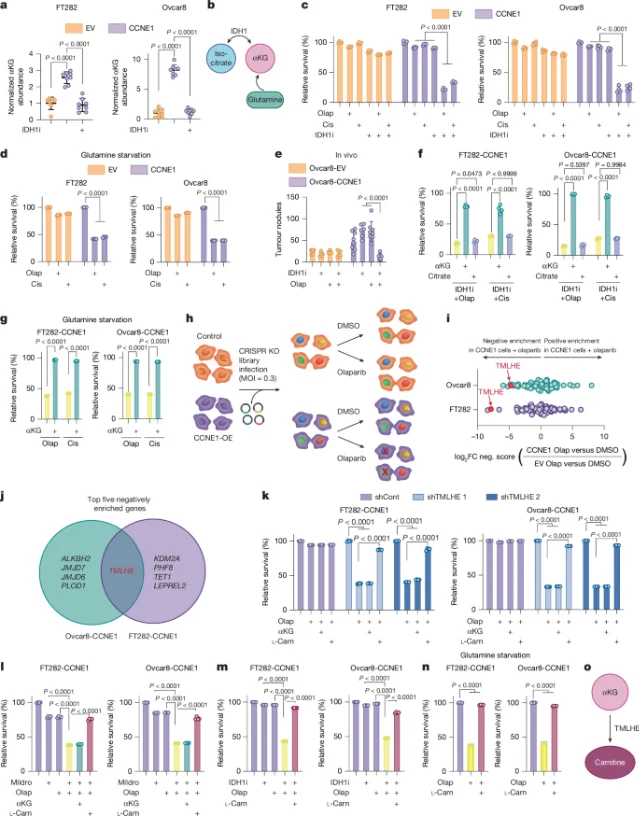
What the paper found: A CRISPR dropout screen targeting 64 αKG-dependent dioxygenases (αKGDDs) in CCNE1-driven cell lines identified TMLHE (trimethyllysine hydroxylase epsilon — the rate-limiting enzyme in carnitine biosynthesis) as the sole hit depleted in both cell lines under olaparib treatment. The αKG→TMLHE→carnitine pathway drives acetyl-CoA delivery to the nucleus, producing site-specific histone acetylation at H3K23ac, H4K8ac, and H4K12ac — marks that activate the HR machinery at double-strand break (DSB) sites. 8 9
Multi-panel figure showing CRISPR knockout screen results, survival assays, and the αKG→TMLHE→carnitine mechanistic pathway diagram
TMLHE is the top-ranked αKGDD in the CRISPR screen (panel i, red dot) in two CCNE1-amplified ovarian cancer cell lines; panels k–o confirm TMLHE knockdown sensitizes to olaparib/cisplatin in an αKG/carnitine-dependent fashion. 9
Key mechanistic validation points:
  • The pathway operates independently of the ACLY (ATP-citrate lyase) route of nuclear acetyl-CoA supply — double knockdown of TMLHE + ACLY is additive on both histone acetylation loss and DNA-damaging agent sensitivity.
  • Validation in Xenopus egg extract (a transcription-free system) confirmed that the mechanism acts directly on DNA repair, not indirectly via transcriptional regulation.
  • In patient samples, high TMLHE expression and high serum acetylcarnitine correlated with shorter PFS in patients treated with PARPi or platinum — translating the cell-line finding to a clinical predictor direction. 8
The authors stated: "This study demonstrates for the first time, to our knowledge, that αKG affects site-specific histone acetylation and provides a mechanism of HR proficiency through carnitine synthesis." 9
Research implication: TMLHE inhibition, IDH1 inhibition (which depletes αKG), or L-carnitine depletion represent three entry points for inducing synthetic lethality in HRP tumors that currently resist PARPi. The most direct translational path would be combining an IDH1 inhibitor (olutasidenib, ivosidenib — available clinically, though primarily in IDH1-mutant AML) with olaparib in CCNE1-amplified ovarian or endometrial cancers with wild-type BRCA. That combination hypothesis has no Phase 1 data yet; the clinical-grade evidence here is limited to the patient-sample correlation between TMLHE/acetylcarnitine and PFS. This is a mechanistic hypothesis-generator, not a therapy-readiness signal.

Cover image: Thirdman / Pexels

このコンテンツについて、さらに観点や背景を補足しましょう。

  • ログインするとコメントできます。