Visa (V): toll road with a 49% ROE and a litigation discount

Visa clears all three screens—3-year trailing ROE ~48.8%, free cash flow above $17B every year since 2022, and a forward P/E of ~23.7× sitting ~12% below its own historical average. The main caveat is the DOJ debit-monopoly suit, which created the discount and whose resolution is the key asymmetry to track.

Today's pick is Visa Inc. (NYSE: V), a global card-payment network that processes roughly 14 trillion dollars of volume annually. Current stock price: $331.56.
Three hard criteria. Three green lights.

Screening criteria

CriterionDataResult
3-year trailing ROE > 15%FY2022: ~40% → FY2023: ~43% → FY2024: ~51%; 3-yr avg ~48.8%
Positive free cash flowFY2022: $17.9B · FY2023: $19.7B · FY2024: $18.7B
Reasonable valuationForward P/E ~23.7x vs. 5-yr historical avg. of ~28–32x
ROE data sourced from FinanceCharts 1. FCF data from MacroTrends 2.

The moat

Visa runs a two-sided network. It doesn't lend money, hold deposits, or carry credit risk. It simply connects issuers (banks) and acquirers (merchants) and takes a small, durable cut on every transaction.
The network's defensibility comes down to three numbers. First, roughly 2.1 billion Visa-branded cards are in active circulation globally, spread across 130 million+ merchant locations in over 200 countries. Second, because neither side of the network can easily switch without losing access to the other, switching costs are structurally high. Third, the data-processing segment — the pure infrastructure layer — grew 17% year over year in Visa's most recent reported quarter, showing that the core rails keep compounding even as adjacent revenue lines evolve 3.
The pre-tax margin in the most recent quarter was 63.9% 4. That number is not a function of leverage or cost-cutting; it reflects a business model with near-zero variable cost per transaction once the network is built.
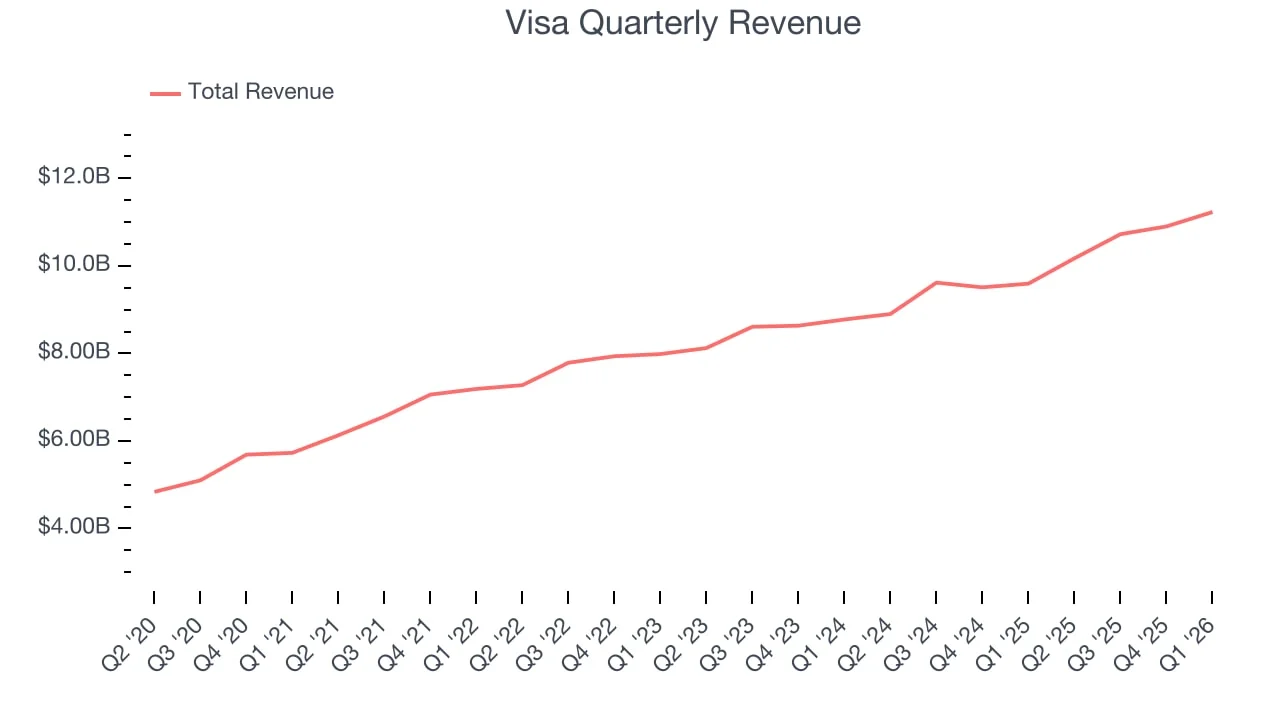
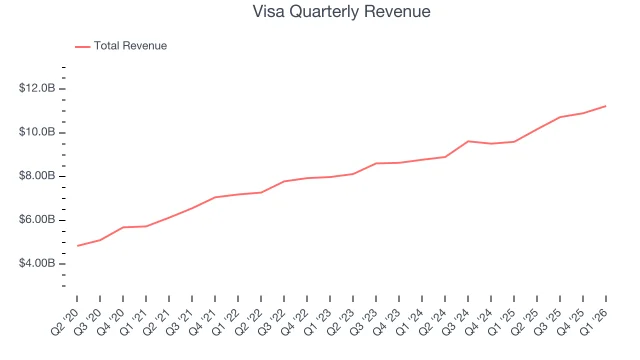
Visa quarterly revenue trend — Q2 2020 through Q1 2026
Visa quarterly net revenue (2020–2026) 4

Earnings and cash flow

Revenue for fiscal year 2025 came in at $40.0 billion, with adjusted EPS growing at a 5-year CAGR of ~20% 4. Free cash flow has stayed comfortably above $17 billion per year across the past three fiscal years, funding a $21.1 billion buyback authorization without straining the balance sheet.
Net debt relative to trailing EBITDA sits at 0.3× — cash of $14.6B against total debt of $24.0B, with EBITDA running near $30B. That level of financial headroom is unusual for a company with a $590B market cap.
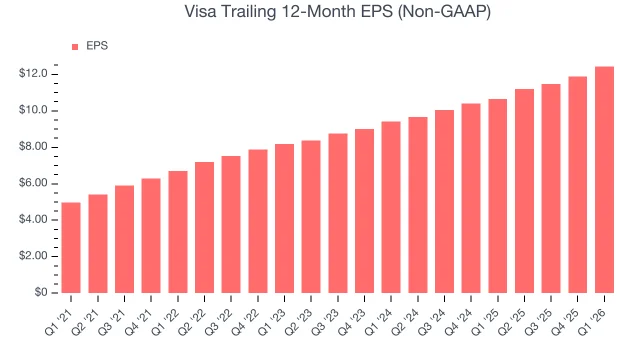
Visa non-GAAP EPS trend by quarter
Visa adjusted EPS per quarter (2021–2026) 4

Valuation

MetricVisa (V)Mastercard (MA)Note
Trailing P/E~29x~33xMA runs at a premium
Forward P/E~23.7x~27xV at a ~12% discount to 5-yr avg
Price/FCF~29.8x~32–34xMA FCF base is smaller ($13.6B)
Dividend yield0.67%0.54%Neither is an income play
10-yr total return+474%+573%MA outperformed on share price
Mastercard (MA, the world's second-largest card network) trades at a consistent valuation premium due to faster recent revenue growth (+16% vs. Visa's +11% in fiscal 2025) and a more aggressive push into value-added services. Visa's lower multiple partly reflects that gap 3.
Consensus analyst 12-month price target: $398.74 (implying ~20% upside from current levels at $331.56). Analyst targets carry systematic upward bias and should be treated as a directional data point rather than a forecast 4.

Three risks to size before buying

1. DOJ debit-market antitrust suit (filed September 2024). The Justice Department alleges Visa holds an illegal monopoly over U.S. debit-card processing, using exclusive agreements and fee incentives to shut out rivals 5. A federal judge ruled in August 2025 that the case must proceed 6. If the DOJ prevails and forced network interoperability is imposed on debit, Visa's ~40–45% U.S. debit market share becomes contestable. No resolution timeline has been set; this is a multi-year uncertainty. Quantified impact is not publicly estimable until the case develops further.
2. Interchange MDL litigation. Visa provisioned $707 million in its most recent quarter for merchant interchange class-action claims — the latest installment in an ongoing legal overhang that has produced periodic large charges for years. The aggregate exposure is large and unpredictable 3.
3. Operating-leverage compression. Operating expenses grew ~16% year over year in the latest quarter, outpacing revenue growth. If this trend continues through fiscal 2026, operating margin will compress. The pre-tax margin has already drifted down from a peak of ~67% to ~62–64% over the past two years 4.

Assessment

The fundamental quality case for Visa is not in dispute: the ROE, FCF consistency, and margin structure are genuinely rare at this scale. The more interesting question is whether the forward P/E of ~23.7× represents a durable entry point or a temporary discount that the litigation overhangs fully explain.
The structure worth tracking: the DOJ debit suit is the most material variable. A settlement or dismissal in Visa's favor would remove the single biggest discount driver. A ruling that imposes structural remedies on debit routing would put roughly 20–25% of U.S. transaction volume into play for rivals. Investors with a 3–5 year horizon who believe the DOJ case resolves narrowly are effectively buying one of the highest-quality business models in the S&P 500 at a 12% discount to its own historical average — with the antitrust outcome as the explicit asymmetry to monitor.
リンクプレビューを読み込んでいます…

このコンテンツについて、さらに観点や背景を補足しましょう。

  • ログインするとコメントできます。