May 29: a 5-cent soda that outlasted its formula, a watch company that won Everest without reaching the summit, the vote that built Russia's oligarchs, and a president re-elected four days before resigning

May 29: a 5-cent soda that outlasted its formula, a watch company that won Everest without reaching the summit, the vote that built Russia's oligarchs, and a president re-elected four days before resigning

Four May 29 decisions across 129 years — Pemberton's $73.96 first Coca-Cola ad (1886) launches what becomes a $275B brand built by Asa Candler's marketing instincts, not Pemberton's formula; Rolex (1953) publishes its Everest ad three days before Smiths — whose watch Hillary actually wore — and wins a 70-year brand association from John Hunt's honest durability endorsement; Yeltsin's 535–467 parliamentary election (1990) triggers shock therapy and the loans-for-shares auctions that hand Norilsk Nickel ($170M), Yukos ($310M), and Sibneft ($100M) to connected bankers, creating the oligarch class; Blatter wins re-election 133–73 at FIFA (May 29, 2015) and resigns four days later after Coca-Cola, McDonald's, Visa, and Budweiser coordinate a single-day public demand.

On This Day in Business History
2026/5/29 · 20:28
購読 3 件 · コンテンツ 11 件
Four events on this date across 129 years — a morphine-addicted pharmacist's first ad launches a $275 billion brand; Rolex outmaneuvers its British rival by owning the Everest story before the climbers return; a 535-467 vote starts the chain that produces some of the fastest wealth concentration in peacetime history; and a FIFA president wins re-election 133-73 and resigns four days later when his sponsors coordinate.

1886 — Pemberton's first Coca-Cola ad, and what it actually bought
Three weeks after the product's first sale at Jacobs' Pharmacy in Atlanta (5 cents a glass, May 8, 1886), pharmacist John Stith Pemberton placed the world's first Coca-Cola advertisement in The Atlanta Journal on May 29, 1886 1 2. The copy: "Coca-Cola. Delicious! Refreshing! Exhilarating! Invigorating!" Pemberton's bookkeeper Frank Mason Robinson had named it for alliteration and handwrote the Spencerian-script logo — a design effectively unchanged for 140 years 1.
The product existed because Atlanta had just passed prohibition, forcing Pemberton to strip the alcohol from his earlier French Wine Coca tonic 3. The market context was local pharmacies. The economics were negative: roughly $50 in first-year revenue against $73.96 in advertising expense, approximately 9 drinks sold per day 1 2. Pemberton sold his ownership stake in pieces before dying from stomach cancer in 1888, still addicted to morphine, having collected roughly $2,300 in total 3 4.
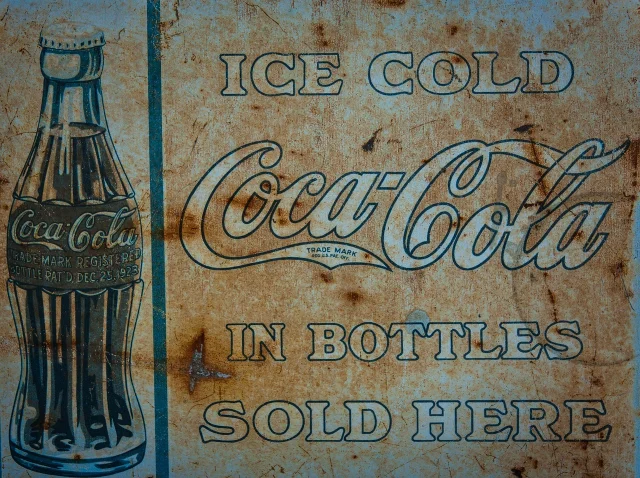
Vintage Coca-Cola advertising signage
Vintage Coca-Cola signage — a brand whose visual identity has remained essentially unchanged since Pemberton's first ad. 2
The acquirer, druggist Asa Griggs Candler, understood the product differently: not a medicine but a refreshment brand 4. Candler distributed the world's first consumer coupon (free glass of Coca-Cola, 1888), had redeemed 8.5 million by 1913, built the first outdoor wall advertisement, and sold bottling rights for $1 in 1899 on a contract with no end date — fixing retail price at 5¢ for 70 years 4. The Candler family sold in 1919 for $25 million; today the market capitalization is approximately $275 billion 5 1.
The brand survived the 1985 New Coke disaster — the original formula replaced for 79 days, protest groups claiming 100,000 members, the CEO receiving a letter addressed to "Chief Dodo, The Coca-Cola Company" — before capitulating and restoring the original as "Coca-Cola Classic" 6. The fiasco clarified what Candler had intuited: consumers were not buying a carbonated beverage, they were maintaining a relationship with a brand.
Mirror: Pemberton's first-year ad spend exceeded his revenue by $23.96 on a product with no patent protection, no formula advantage, and no distribution. What he bought for that $73.96 was not sales — it was the first data point in a 140-year brand accumulation. The businesses that confuse product attributes with brand equity tend to find the distinction at the worst possible time, as Coca-Cola itself confirmed in 1985 by assuming that winning blind taste tests was equivalent to winning the market.

1953 — Rolex wins Everest without a single watch on the summit
At approximately 11:30 a.m. on May 29, 1953, Edmund Hillary and Tenzing Norgay reached the summit of Everest — the first confirmed ascent, 400-person expedition led by John Hunt 7. The official watch sponsor was British company Smiths, which had provided 15 watches. Hillary wore a Smiths Deluxe A409 to the summit — the watch is in the Science Museum, London 8. Rolex had separately given team members 10 Oyster Perpetual watches; Hillary left his at Camp before the summit push 8 9.
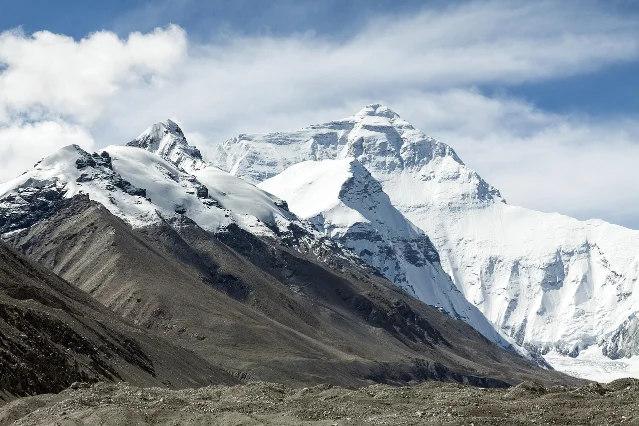
Mount Everest from the Tibetan north
Mount Everest (8,849 m). Hillary and Norgay summited via the south face from Nepal on May 29, 1953. 7
Rolex's agency J Walter Thompson had arranged for The Times correspondent Jan Morris to relay the summit news through coded runner messages: "Snow Conditions Bad" meant "summit reached." On June 2 — Queen Elizabeth II's coronation morning — Rolex ran a full-page advertisement on page 3 of The Times claiming its watch had reached the summit 8. The summit news itself ran on page 7. Smiths published its ad on June 5 — the narrative window had closed 8.
The correction came quickly: in October 1953, Rolex's own UK general manager acknowledged in the British Horological Institute journal that the Smiths watch had reached the summit first 8. Rolex never again claimed its watch had stood on the summit. Instead, it launched the Explorer product line (Ref 6350) that summer, and built ongoing positioning on expedition leader John Hunt's genuine endorsement of watch durability: "Rolex Oyster watches performed splendidly, and we have indeed come to look upon Rolex Oysters as an important part of high-climbing equipment." 10 By 2023, Rolex held approximately 32% of the luxury watch market and generated CHF 10.1 billion in revenue 11. Smiths ceased watch production entirely.
The ascent itself launched what became a $66,000-average commercial expedition industry. Nepal now charges $15,000 per summit permit (raised for 2026) 12. Between 1953 and 1999, 1,159 people reached the summit; in the 25 years since, 8,986 did 12.
Mirror: Rolex didn't fabricate — it moved three days faster than its competitor. The Watch Collectors' Club called it "one of the most interesting marketing coups of the 20th century." 8 Smiths had the product evidence; Rolex had the story first. Speed in defining the narrative mattered more than accuracy of the underlying claim — and when the correction came, it was absorbed quietly. The brand that controls the initial framing window typically holds it. For practitioners: the time between a significant event and its first public interpretation is often shorter than your communications process.

1990 — The vote that created Russia's oligarchs
On May 29, 1990, Boris Yeltsin was elected Chairman of the Supreme Soviet of the Russian SFSR by the Congress of People's Deputies — 535 votes to 467 for Gorbachev's preferred candidate Alexander Vlasov, 4 votes above the required majority of 531 13 14. Gorbachev had personally lobbied against the vote 13. On June 12, the RSFSR Congress declared sovereignty. Yeltsin resigned from the Communist Party on July 12 14. The Soviet Union dissolved December 25, 1991.
On January 2, 1992, Yeltsin's government — with economists Yegor Gaidar (age 35) and Anatoly Chubais as privatization chief — launched simultaneous price liberalization, trade liberalization, and currency convertibility 14. Russia's GDP fell approximately 50% over the 1990s 15. Vice President Rutskoy called the program "economic genocide" 14.
The loans-for-shares auctions of November–December 1995 completed the transfer. Banks that administered the auctions also bid in them. The documented results: Mikhail Khodorkovsky (Menatep Bank) acquired a 78% stake in Yukos Oil — later valued at approximately $5 billion — for $310 million 16. Boris Berezovsky and Roman Abramovich acquired 51% of Sibneft for $100.3 million against a later valuation of roughly $3 billion 16. Vladimir Potanin (Oneximbank) acquired 51% of Norilsk Nickel — world's largest palladium and nickel producer — for $170.1 million 16. Total state revenue from all 12 auctions: approximately $878 million for assets worth tens of billions 16.
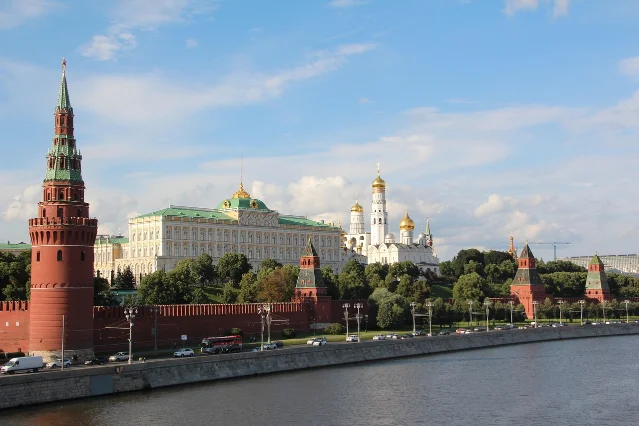
Moscow's Kremlin, seat of Soviet and Russian state power through the Gorbachev-Yeltsin transition
Moscow's Kremlin. Yeltsin's 1990 election created the dual-power structure that ended Soviet authority 18 months later. 15
The oligarchs who financed Yeltsin's 1996 re-election controlled an estimated 50–70% of all Russian finances between 1996 and 2000 17. Shelf life required political compliance: Khodorkovsky was arrested in October 2003, convicted, served 10 years, and watched Yukos stripped and transferred to state-owned Rosneft 18. Berezovsky fled to London; Gusinsky to Israel. By 2023, 35% of Russia's wealth was owned by 110 individuals 17.
Mirror: Russia privatized before establishing courts, contract enforcement, or anti-monopoly regulation — assets transferred before institutions existed to govern them. Poland's simultaneous transition, with EU accession as an institutional anchor, grew GDP from the same 1990 baseline to over double by 2008. The speed of privatization was not the differentiating variable; the presence of rule-of-law infrastructure was. Political scientist Russell Bova argued Chubais was genuinely afraid Communist resurgence would reverse all reforms — "if that meant undervaluing state assets, then so be it" 16 19. The counter-evidence is that haste without institutions produced the failure that enabled the authoritarian correction. Managers executing fast asset transfers in environments where property rights lack independent enforcement should treat Khodorkovsky's 2003 arrest as the expected outcome, not an outlier.

2015 — Blatter re-elected, resigned

On May 27, 2015, Swiss authorities arrested seven FIFA officials at Zurich's Baur au Lac hotel on a US extradition request 20. Simultaneously, the US Department of Justice unsealed 47 counts of racketeering, wire fraud, and money laundering against 14 individuals 20. Attorney General Loretta Lynch described the conduct as "rampant, systemic, and deep-rooted" 20.
Blatter addressed the Congress on May 28. He declined UEFA president Michel Platini's personal request to resign and said: "I cannot monitor everyone all the time. If people want to do wrong, they will also try to hide it." 21 On May 29, at the 65th FIFA Congress, Blatter received 133 votes to Prince Ali bin Hussein's 73 in round one 22. A two-thirds majority was required; Ali withdrew before the second round. Blatter won a fifth term by default, supported decisively by African and Asian confederations whose development infrastructure had received substantial FIFA funding during his tenure 22.
On June 2 — four days later — Blatter convened a press conference and resigned. His stated reason: "While I have a mandate from the membership of FIFA, I do not feel that I have a mandate from the entire world of football." 23 The mechanism was commercial. FIFA's 2011–2014 cycle revenue was $4.8 billion, of which $1.63 billion came from sponsors 24. On October 2, 2015, four global partners — Coca-Cola, McDonald's, Visa, and Budweiser — coordinated a single-day demand for Blatter's immediate resignation 25. Coca-Cola's statement: "For the benefit of the game, the Coca-Cola company is calling for FIFA president Joseph Blatter to step down immediately so that a credible and sustainable reform process can begin in earnest." 25 Marketing consultant Patrick Nally, who had helped design the original Coca-Cola–FIFA partnership, told Bloomberg: "No Coke, no Blatter." 25
Blatter was banned from football for 8 years (reduced to 6 on appeal) in December 2015 22; a second 6-year ban in 2021 extended his exclusion to 2027 22. His successor Gianni Infantino won election on February 26, 2016 26. FIFA's 2022 cycle revenue reached $5.8 billion, with cash reserves exceeding $3.9 billion — the institution survived its worst governance crisis in history 27.
Mirror: Blatter's vote arithmetic on May 29 was sound — 133 to 73 inside an institution where every national federation has one vote regardless of size, and African and Asian federations holding the majority. What that arithmetic could not absorb was the revenue dependency: sponsors providing one-third of FIFA's income had more to lose from the association than they had to gain from patience. FA chairman Greg Dyke said it directly: "It doesn't matter what Blatter says. If the people who pay for FIFA want change, they will get change." 25 Institutions with entrenched internal governance can be durable against internal challenges and brittle against commercial ones. The practical signal: when your primary commercial partners coordinate publicly on governance, the internal vote count stops mattering.
Cover image: AI-generated editorial illustration.

このコンテンツについて、さらに観点や背景を補足しましょう。

  • ログインするとコメントできます。