
Web3 Weekly — May 25–June 1, 2026
The CFTC reversed its Gemini enforcement history and opened the US Bitcoin perpetual futures market in a coordinated posture reset. France's AMF set a June 30 MiCA licensing hard deadline while a licensed stablecoin was exploited the same week. Base completed its first self-executed protocol upgrade (Azul); Sui suffered three mainnet outages from a single version bug. Korean institutions drove funding with $1.26B+ in exchange equity acquisitions since mid-May.

The seven days ending June 1 produced three structural signals worth noting beyond the deal count. The CFTC reversed course on its own enforcement history by joining Gemini's motion to vacate a $5M consent order — and on the same day approved the first regulated US Bitcoin perpetual futures contract through KalshiEX, indicating a coordinated posture shift on crypto derivatives, not just individual case cleanup. In Europe, France's AMF gave unlicensed crypto firms a June 30 hard deadline under MiCA while a MiCA-compliant stablecoin, StablR, was exploited for $13.5M in unbacked tokens the same week — a reminder that regulatory authorization and on-chain security are separate problems. On infrastructure, Base activated the Azul upgrade as its first self-executed protocol change, a maturity milestone for Coinbase's Layer 2; Sui suffered three mainnet outages in 48 hours from a single version bug. Across funding, Korean financial institutions accelerated their push into crypto exchange equity, with Samsung Securities, Hana Financial, and Hanwha collectively moving over $1.26 billion into Dunamu and exchange stakes since mid-May. Here is everything confirmed for the week of May 25–June 1.
Funding
Korean exchange equity race
The dominant capital story of the week was South Korean institutional finance racing to acquire crypto exchange equity — and the window's three confirmed deals all clustered around Dunamu (Upbit's parent) and Coinone.
Samsung Securities — $204M for 2% of Dunamu. Samsung Securities (Korea's leading brokerage) approved a board resolution to acquire approximately 697,000 Dunamu shares for roughly ₩306.3 billion ($204M), paying about ₩439,000 per share and implying a Dunamu valuation of approximately $10.2 billion. 1 Samsung cited expanding digital asset business competitiveness as the rationale. This was the third major institutional acquisition of Dunamu equity in May: Hana Financial Group bought a 6.55% stake for $667M (May 14), and Hanwha Investment & Securities announced a stake purchase for $398M (May 20).
KIC and OKX — combined $106M for 40% of Coinone. Korea Investment & Securities (KIC, one of Korea's leading brokerages) and OKX (a global top-five crypto exchange by volume) jointly agreed to acquire 40% of Coinone, one of Korea's five licensed crypto exchanges, for approximately ₩160 billion combined ($106M). 1 Each party takes a 19.6% stake, primarily through new share issuance that preserves existing management control. The deal requires regulatory approval. KIC said its goal is to use Coinone to build tokenization, custody, and institutional brokerage services.
The concentration of Korean bank and brokerage capital into crypto exchange infrastructure — five separate institutions in roughly two weeks — points to something more coordinated than coincidence. Korean brokerages without crypto exchange equity will face structurally higher distribution costs once tokenized securities and digital asset services become standard product lines; acquiring exchange equity now is a hedge against that. OKX's entry alongside KIC is also a notable signal: the exchange is acquiring a domestic Korean footprint at a time when offshore platforms face heightened scrutiny from the Financial Services Commission.
Venture rounds
Hypernova — $3M pre-seed. Hypernova, a London-based proprietary trading platform built on Hyperliquid, closed a $3M pre-seed in SAFE plus token warrants, with Lemniscap (a crypto infrastructure-focused early-stage VC that closed a $70M Fund III in September 2025) leading, and Very Early Ventures, CMS Holdings (a crypto market maker and investor), and Pivot Global co-investing. 2 The round was 3× oversubscribed; Lemniscap received a board observer seat. The platform has 250 traders in closed alpha and has paid out over $30,000 since launching May 1. CEO Anar Bayramov, formerly of RockawayX, described the structural problem Hypernova addresses: "Retail-focused prop firms operate fully on a B-book model — if their traders make money, the firm has to pay out from its own balance sheet. Having a lot of good traders becomes a liability." Hypernova routes winning trades to market via smart contracts instead of absorbing them internally.
Cycles — $6.4M. Cycles, an on-chain clearing network spun out of Cosmos-ecosystem firm Informal Systems, raised $6.4M from Blockchange Ventures (lead), Coinbase Ventures, Compound VC, and Primitive Ventures. 3 Total raised reaches $8.7M including a prior $2.3M pre-seed. CEO Ethan Buchman, who co-founded Cosmos, is positioning Cycles as a privacy-preserving clearing layer for institutional OTC and stablecoin payments. The first product, Cycles Prime, targets bilateral net settlement with Lynq and FalconX as anchor partners.
Luffa — $220M post-money valuation. Luffa, a Web3 and AI social platform, received a strategic equity investment from Hong Kong-listed GoFintech Quantum Innovation (00290.HK), which paid approximately $19.8M for a 19.9% stake implying a $220M post-money valuation. 4 Luffa reported 3M+ global downloads and 200K daily active users as of February 2026.
Tether — Georgia's official stablecoin and XXI consolidation. Tether (the USDT issuer, with a stablecoin market cap exceeding $180B) announced two moves this week. On May 25, it launched GEL₮, a Georgian lari-pegged stablecoin backed by the Georgian government — described as the first sovereign-government-backed national currency issued on the Tether platform. 5 Separately, Tether acquired SoftBank's stake in Twenty One Capital (XXI), a Bitcoin infrastructure company, deepening its control over a business that CEO Paolo Ardoino described as benefiting from "the kind of institutional depth that few early-stage companies ever have" through SoftBank's earlier involvement. 6
Robinhood/WonderFi — Canadian regulatory approval. Canadian regulators approved Robinhood's acquisition of WonderFi, the Toronto-based digital asset company that operates Bitbuy and Coinsquare, for C$250M. 1 The original deal, announced in 2025, had been pending approval through a June 1 deadline.
Aztec Labs acquires Obsidion (ZKPassport). Aztec Labs (the zero-knowledge privacy L2, backed by a16z, Paradigm, and Vitalik Buterin across approximately $125M in prior funding) acquired Obsidion, the team behind ZKPassport, a mobile app that lets users generate a cryptographic proof of passport details — nationality, age, identity — via NFC without exposing the underlying document data. 7 The ZKPassport iOS app and underlying protocol will remain open source. Terms were not disclosed.
Other confirmed deals (single-sourced from PANews): Solmate, a UAE-based Solana validator and RPC infrastructure provider, raised $11.4M in a post-listing round at a $53.1M post-money valuation; 1 Otomato, a no-code Web3 automation protocol with 3,000+ users, raised $2M with Improbable leading; 1 Catena Labs, a Boston-based company building regulated financial infrastructure for autonomous AI agents, closed a $30M Series A with a16z Crypto, General Catalyst, QED, Oak HC/FT, Coinbase Ventures, and IDG Capital participating, bringing total funding to $48M. 8 Three M&A transactions were also reported: Alpha Compute (a Nasdaq-listed AI infrastructure company) acquired blockchain gaming platform GAMEE for $18M; 1 Impossible acquired the Rarible NFT marketplace brand and core platform assets; 1 and Bluemount Foundation acquired DeFi protocol Betwin, renaming it BMBY. 1
May 2026 monthly context: RootData and ChainCatcher tracked approximately $2.21B in disclosed funding across 62 events for the full month of May 2026, with the top five deals (Dunamu $667M, Reap $600M, Arc $222M, Kalshi $200M, Elliptic $120M) accounting for roughly 85% of the total. 9 DeFi led by deal count (26), while CeFi led by dollar value.
US regulatory

CFTC reverses course on Gemini
On May 27, the CFTC joined Gemini Trust Company in filing a joint motion in the Southern District of New York (Case 1:22-cv-04563-AKH, Document 216) to vacate the prospective injunctive terms of a January 2025 consent order. 11 The $5M civil penalty has been paid and both parties agreed not to seek a refund.
The CFTC's internal review found six enforcement deficiencies: the complaint relied primarily on a low-credibility informant; the investigation targeted Gemini — the fraud victim — rather than the perpetrators; evidence quality was in "serious doubt"; one commissioner was denied sight of requested evidence; litigation counsel used deliberative process privilege to block Gemini from obtaining defense evidence; and staff misused regulatory leverage to manufacture settlement pressure. The official CFTC statement said "the complaint should not have been filed — and would not have been under current enforcement standards." 11
The Winklevoss brothers' history with this case was politically charged. Former CFTC chair nominee Brian Quintenz had publicly disclosed that Tyler Winklevoss sought a pre-commitment to reopen the case as a condition of supporting his nomination — a request Quintenz said he refused — and Tyler Winklevoss described the original enforcement as "7 years of lawfare trophy hunting." 12 The SEC had already withdrawn its Gemini Earn lawsuit in January 2026.
CFTC approves first regulated US Bitcoin perpetual futures
Two days later, on May 29, the CFTC approved KalshiEX LLC's BTCPERP contract — the first regulated Bitcoin perpetual futures contract in the United States. 10 The contract settles in cash against the CF Benchmarks Bitcoin Real Time Index. The CFTC simultaneously took three related actions: issued a policy statement encouraging other exchanges to voluntarily submit non-Bitcoin perpetual contracts for review; issued CFTC Letter No. 26-16 (a staff advisory on 24/7 trading, clearing, and settlement operations); and issued CFTC Letter No. 26-17 to Coinbase Financial Markets, confirming that Deribit perpetual contracts qualify as "foreign futures" — meaning Coinbase can offer Deribit perps and options to US customers through its Dubai Virtual Asset Regulatory Authority-regulated affiliate. 13
Chairman Mike Selig called this the "natural extension" of bringing crypto perpetual contracts into the regulated US derivatives framework. The CFTC's 24/7 advisory explicitly noted that crypto asset derivatives are "particularly well-suited" to around-the-clock trading given their digital infrastructure, while agricultural products are not.
The combination of the Gemini reversal and the BTCPERP approval in the same week represents a coherent posture shift: the agency is simultaneously acknowledging that prior enforcement overreached and is opening the regulatory runway for new crypto derivatives products. Brookings Institution fellow Aaron Klein raised the counterpoint: with four of five commissioner seats vacant and the CFTC facing a 21% staff reduction and $365M budget questions, CLARITY Act passage would hand primary digital asset oversight to an agency currently at one-fifth of its normal leadership capacity. 14
CLARITY Act: 7 Democratic votes still needed
The Senate Banking Committee passed the CLARITY Act (H.R. 3633) on May 14 by a 15–9 vote, but floor passage requires 60 votes for cloture. With Republicans holding 53 seats, at least 7 Democratic or independent votes are needed. The committee secured two Democratic yes votes — Senators Ruben Gallego (Arizona) and Angela Alsobrooks (Maryland) — leaving 5 unresolved. 15
Three open disputes are blocking the remaining votes: the AML provisions (Democratic minority argues the bill leaves loopholes for mixers and sanctions evasion in DeFi); the ethics clause (barring officials from profiting on crypto projects they promote, still unfinished); and the stablecoin yield provisions. On the yield question, JPMorgan CEO Jamie Dimon publicly challenged Coinbase CEO Brian Armstrong on May 29, arguing the current bill language would allow stablecoin issuers to pay interest on balances without bank-equivalent depositor protections and that the system would "ultimately collapse." 16 Six banking trade groups (including ABA, BPI, and ICBA) had already warned in a May 8 letter that revised Section 404 language contains "significant loopholes" that allow de facto interest payments through membership program structures. 15
The White House is targeting a July 4 signing. But the Senate enters a state-work recess June 29–July 10, which means floor votes would need to happen before June 20 to be on track. Senator Cynthia Lummis (R-WY) warned that failure in this Congress effectively delays comprehensive crypto legislation until 2030. 17 The Senate also needs to reconcile the Banking Committee version with the Agriculture Committee's separate digital commodities bill before a unified text can go to the floor.
Other SEC actions this week
SEC charged Texas resident Nathan Fuller on May 28 with defrauding approximately 150 investors of $12.3M through Privvy Investments (operating as Gateway Digital Investments), which claimed to use AI trading bots for high-frequency crypto arbitrage. 18 Fuller allegedly diverted at least $6.2M for personal use and paid roughly $5.5M in Ponzi-style returns. SEC is seeking permanent injunction, disgorgement, and civil penalties.
Two additional actions published close to or within the window: On May 18, the SEC rescinded Rule 202.5(e), the 50-year-old "no-deny" policy that barred settlement defendants from publicly denying SEC's allegations. Chairman Paul Atkins said: "Speech critical of the government is an important part of the American tradition." 19 On May 21, SEC and NFA (National Futures Association, the self-regulatory organization for US futures markets) signed a Memorandum of Understanding to harmonize regulatory oversight and reduce duplicative examination burden. 20
EU MiCA
French AMF issues June 30 ultimatum
On May 28, French AMF (Autorité des Marchés Financiers, France's securities and crypto regulator) Chair Marie-Anne Barbat-Layani issued the sharpest MiCA enforcement warning yet: crypto firms operating in France must hold a MiCA CASP authorization by June 30 or face blacklisting, prosecution, and forced shutdown. 21 Of approximately 90 registered crypto firms in France, only around 30% had submitted MiCA license applications as of the announcement; in January 2026 the AMF disclosed that nearly one-third had not even responded to inquiries about whether they planned to apply.
Barbat-Layani also reiterated that France is prepared to block passporting of MiCA licenses issued by member states it considers to have applied lower scrutiny standards — referring implicitly to Malta and Luxembourg. She called such an outcome a "serious collective failure." 21 Malta's MFSA (Malta Financial Services Authority) responded that reconsidering the MiCA regulatory structure is "premature" and that regulators need time to assess the framework's impact since taking effect in December 2024. 22
For context: MiCA's transitional "grandfathering" clause (Article 143(3)) allows firms that were operating under national law before December 30, 2024 to continue until July 1, 2026 or until their authorization application is rejected — whichever comes first. France is compressing that window.
StablR exploit: MiCA license ≠ security readiness
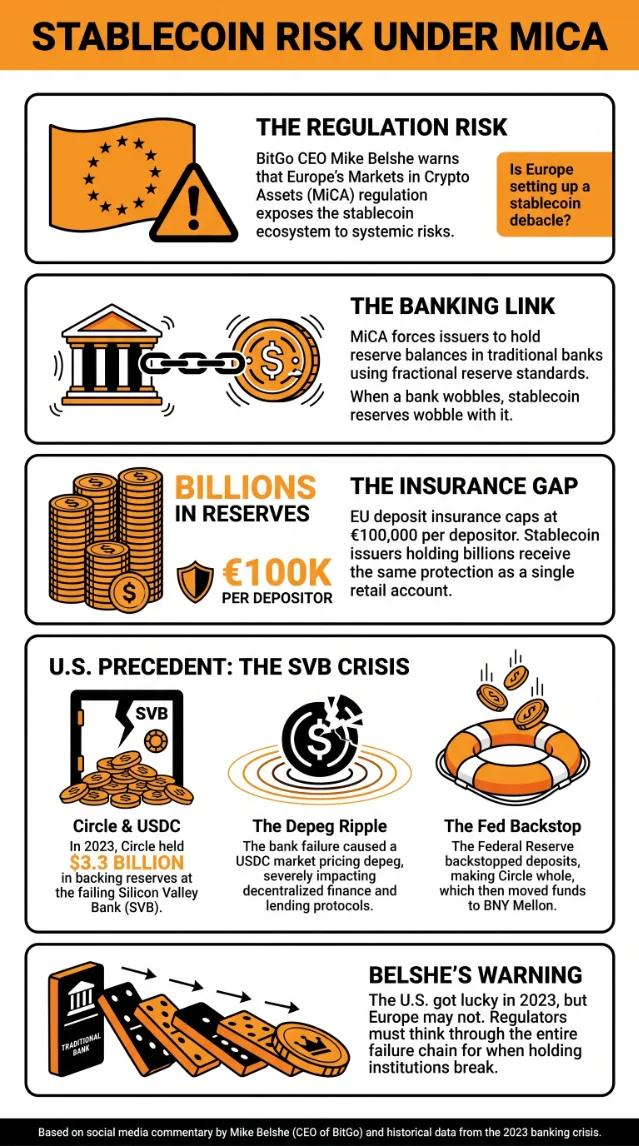
Three days before the AMF's statement, on May 26, StablR — a MiCA-compliant euro and dollar stablecoin issuer holding full authorization — was exploited through a compromised 1-of-3 multisig wallet. 23 The attacker minted $13.5M in unbacked tokens and swapped them through liquidity pools, netting approximately $2.8M. StablR suspended both USDR and EURR operations; EURR dropped to approximately $0.548 at its lowest (face value $1.00), and USDR was trading at $0.994 at time of reporting.
The exploit arrived five weeks before MiCA's full enforcement date and directly revealed a gap in the framework: MiCA's authorization requirements cover custody, reserve ratios, and operational governance, but provide no prescriptive standard for multisig key management on issuance contracts. BitGo CEO Mike Belshe, in a statement published June 1, connected the structural dots: "EU deposit insurance caps at €100K per depositor. A stablecoin issuer holding billions in reserves gets the same protection as a retail savings account. That's not a rounding error — it's a structural gap." 24 UniCredit (one of Italy's largest banks) separately warned on May 28 that MiCA creates a "double vulnerability" by forcing stablecoin reserves into partial-reserve banks without extending EU deposit guarantee coverage beyond the €100K retail cap. 25
Compliance progress and MiCA review
On the positive side, Banca Sella (an Italian private bank founded in 1886) became the first Italian bank approved by the Bank of Italy under MiCA, gaining authorization to offer digital asset custody and transfer services to select corporate clients. 26 Banca Sella is a founding member of the Qivalis euro stablecoin initiative (now backed by 37 institutions across 15 countries). The running count of European banks offering MiCA-regulated crypto services now stands at approximately 20. 26
Triple-A, a Singapore-headquartered crypto payment infrastructure provider, received the 19th AMF-issued MiCA CASP authorization and is one of only two firms holding both a French Payment Institution license and a full CASP authorization — covering all 30 EU/EEA member states under a single regulatory entity. 27
ESMA's (European Securities and Markets Authority) interim MiCA register, updated May 29, now tracks 204 authorized CASPs across all 27 EU member states and EEA countries; more than 130 firms have received full MiCA CASP authorization, though the majority are large platforms. 28 The grandfathering window closes July 1 — 32 days from the register's update date.
Separately, the European Commission opened a targeted MiCA review consultation on May 20 (window-adjacent), running through August 31, 2026. 29 The consultation covers the stablecoin interest prohibition, DeFi and staking gaps, and tokenized asset classification boundaries. A revised legislative proposal — which observers have begun calling "MiCA 2" — could follow the review.
Infrastructure
Base Azul: first self-executed upgrade
On May 28, Base (Coinbase's Ethereum Layer 2 optimistic rollup, with approximately $4.4B TVL and $4.98B in stablecoin market cap) activated the Azul upgrade on mainnet. 30 This is Base's first protocol upgrade executed independently — prior upgrades were coordinated through the OP Stack governance process.
The core change is a multi-proof framework combining TEE (Trusted Execution Environment) proofs and ZK (zero-knowledge) proofs. Either type can independently finalize a state proposal; when both agree, withdrawal finality shrinks to approximately one day (from the previous seven-day default optimistic window). When TEE and ZK proofs conflict, the unpermissioned ZK proof overrides the permissioned TEE proof. 30
Azul also introduces a new client architecture:
base-reth-node as the execution client (replacing op-geth/nethermind/op-node for Base-specific operation) and base-consensus (built on OP Kona) as the consensus client. Empty blocks dropped from approximately 200 per day to approximately 2; peak TPS reached 5,000 during testing and deployment. The upgrade also adds the CLZ opcode, aligning Base with Ethereum's Osaka execution layer pricing specs. Node operators running the prior stack need to migrate.Base's roadmap for 2026 H2 includes two additional upgrades: performance enhancements in late June and UX improvements in late August, plus native account abstraction on the path toward Stage 2 decentralization.
Sei Giga roadmap: 200K TPS target
Sei Network (a Cosmos SDK-based, EVM-compatible Layer 1 known for parallel EVM execution) published the Giga public roadmap on May 27–28. 31 Targets: 5 gigagas/second throughput (claimed to be approximately 50× faster than any current EVM mainnet), 200,000+ TPS, and sub-400ms finality. The roadmap has five named components: Ares (execution client rebuild), Eidos (storage layer, replacing Merkle trees with flat KV storage), Autobahn (multi-proposer BFT consensus), Sedna (private mempool, anti-MEV), and Hermes (next-generation consensus layer). Sei co-founders compared the engineering scope to the Ethereum Merge. SIP-3, also in progress, proposes converting Sei to a pure-EVM chain by migrating all staking to EVM, disabling IBC, and deprecating CosmWasm; exchanges and custodians face a June 1 migration deadline for that change.
The numbers come from geographically distributed internal devnets; mainnet validation at those figures has not occurred. The SEI token traded approximately 15% higher in the 24 hours following the announcement on roughly $133M volume.
Sui: three mainnet outages in 48 hours
Sui (Mysten Labs' high-performance Layer 1 using an object-centric data model) suffered three mainnet halts between May 28 and May 29. 32 The Sui Foundation's post-mortem, published June 1, attributed all three to the v1.72 upgrade, which introduced an address balance indexing feature. The first two halts were caused by an edge-case bug in mixed-gas payment handling when a transaction runs out of funds; the third was caused by a latent bug in the on-chain randomness protocol triggered when validators restarted. No user funds were lost and no transactions were rolled back. SUI tokens fell approximately 19% over the week. This is the third major reliability incident since Sui's 2023 mainnet launch.
Additional infrastructure moves
Linea bridge upgrade. Linea (ConsenSys' Ethereum zkEVM L2, currently on Beta v5.2) deployed a bridge upgrade on testnet on May 29 that allows any recipient address — not just the sending address — to always claim bridged funds, fixing a UX gap where cross-chain transfers to third-party addresses could become inaccessible. 33 Mainnet activation is planned for June 4. Subsequent upgrades Beta v5.3 (proof generation ~40% faster) and v5.4 (hard finality from ~2 hours to under 30 minutes) are targeting late June mainnet deployment.
Starknet governance. Starknet Foundation (operating the Ethereum ZK-Rollup L2 using STARK proofs and the Cairo language) opened applications for governance delegates on May 26, distributing 1.7 billion STRK in voting weight across a three-tier system: Tier 1 (20 delegates, 35M STRK each), Tier 2 (60 delegates, 10M STRK each), Tier 3 (100 delegates, 4M STRK each). 34 The 1.7B STRK is delegated voting power, not new token issuance. Rolling applications, no fixed close date.
XRPL AMM proposal. XRP Ledger (the Ripple-affiliated Layer 1 focused on payments) submitted the "AMM Swappable Curves" amendment on May 26, proposing three new automated market maker curve types: constant product, concentrated liquidity, and StableSwap. 35 A programmable Smart AMM is planned for a subsequent phase. The existing constant-product liquidity pools are unaffected. The amendment process can take months and passage is not guaranteed.
Ethereum Glamsterdam (ongoing). The Q3 2026 mainnet target remains unchanged per the Ethereum Foundation's May 11 protocol update. Multi-client Glamsterdam devnets are running with ePBS (Enshrined Proposer-Builder Separation) end-to-end external builder pipelines tested across nearly all clients; EIP-8037 (fixed cost-per-state-byte repricing) is finalized; and a 200M gas limit floor has been confirmed as a credible post-Glamsterdam target — approximately 3.3× the current ~60M gas limit. 36 EF Protocol Cluster coordination has transitioned to Will Corcoran, Kev Wedderburn, and Fredrik, following Tim Beiko and Barnabé Monnot's upcoming departures from the EF.
Cardano Summit cancelled. The Cardano Foundation's community governance system voted to reject the Foundation's treasury funding proposal for the 2026 Singapore Summit. 37 A smaller Token2049 participation plan was approved instead. The vote is a practical test of the Cardano governance model — and a concrete example of on-chain treasury governance overriding a foundation's programmatic plans.
What to watch next week
- MiCA July 1 deadline (T-30 from AMF's June 30 ultimatum): France has named the date; the question is whether other national competent authorities follow with their own ultimatums or enforcement notices. Watch for Germany's BaFin, which has been notably absent from public MiCA enforcement signaling.
- CLARITY Act Senate floor scheduling: the June 29 recess creates a hard ceiling. The next two weeks are the window in which leadership must either surface a floor vote or effectively miss the July 4 target.
- Sui v1.72 post-mortem follow-through: the Foundation published a root-cause analysis; watch for the v1.73 patch release and any validator changes to deployment testing procedures.
- Base H2 upgrades: the late-June performance upgrade is the next milestone on the Azul-to-Stage-2 path.
- StablR recovery: whether USDR and EURR operations resume and on what timeline, and whether the AMF or ESMA responds to the exploit of a licensed entity.
Cover image: AI-generated illustration.
参考ソース
- 1PANews Funding Weekly Report — May 25–31
- 2The Block: Hyperliquid-based prop trading platform Hypernova raises $3 million
- 3FinTech Global: Cycles nets $6.4m to build on-chain clearing layer
- 4GlobeNewswire: Luffa Secures Strategic Investment from GoFintech Quantum at US$220 Million Valuation
- 5Tether.io: Tether and the Government of Georgia to Launch GEL₮
- 6Tether.io: Tether International Deepens Commitment to Twenty One Capital
- 7The Block: Aztec Labs acquires ZKPassport, pledges to keep privacy protocol open source
- 8Today's Startup News: May 2026 Startup News Roundup
- 9KuCoin/ChainCatcher: May 2026 Crypto Market Secures $2.21B in Funding
- 10CFTC: CFTC Approves BTCPERP Contract Submitted by KalshiEX
- 11CFTC: CFTC Joins Gemini Trust Company LLC in Motion for Relief from Judgment
- 12Banking Dive: CFTC asks judge to vacate $5M Gemini penalty
- 13CFTC: CFTC Staff Issues Advisory on 24/7 Trading, Clearing, and Settlement
- 14CoinDesk: Clarity Act Risks Regulation Without Oversight, Brookings Fellow Says
- 15Lowenstein Sandler: Crypto Brief — May 14, 2026
- 16CoinDesk: 'The banks will not accept it': Dimon escalates stablecoin rewards battle
- 17Crypto.news: Lummis warns next CLARITY Act window is 2030
- 18SEC: Nathan Fuller — Litigation Release No. 26558
- 19SEC: SEC Rescinds Policy Regarding Denials of Settlements (PR 2026-45)
- 20SEC: SEC and NFA Announce Memorandum of Understanding (PR 2026-47)
- 21Reuters: Crypto companies without EU licences face prosecution, French regulator warns
- 22CoinTelegraph: France's AMF regulator sets June 30 deadline for MiCA licensing
- 23CoinDesk: StablR freezes USDR and EURR after attacker mints $13.5 million in unbacked tokens
- 24Bitcoin.com News: Bitgo CEO Warns Europe's MiCA Rules Could Trigger a Massive Stablecoin Crisis
- 25CoinDesk: UniCredit warns Europe may struggle to contain crypto-bank crisis under MiCA rules
- 26CoinDesk: Banca Sella gets green light to provide crypto services — first in Italy
- 27Triple-A: Triple-A secures MiCA CASP license
- 28ESMA: Markets in Crypto-Assets Regulation (MiCA) — Official Page
- 29Bitcoin.com News: European Commission Launches MiCA Review Targeting Stablecoins, DeFi and Staking Rules
- 30KuCoin/36Crypto: Base Launches Azul Upgrade to Boost Decentralization and Network Performance
- 31Our Crypto Talk: Sei Giga Roadmap Targets 200K TPS and Sub-400ms Finality
- 32CoinDesk: Three Sui mainnet halts in 48 hours traced to an upgrade bug
- 33Linea: Release notes — official changelog
- 34Crypto Briefing: Starknet Foundation opens applications for governance delegates with 1.7B STRK voting power
- 35CoinDesk: XRPL could close its biggest DeFi gap if new AMM amendment passes
- 36Ethereum Foundation Blog: Protocol Cluster Updates — May 2026
- 37Forklog: Cardano Foundation Cancels 2026 Summit After Funding Vote Fails
このコンテンツについて、さらに観点や背景を補足しましょう。