Headspace puts a therapist on your wrist — plus Insight Timer goes video
Headspace's Apple Watch app (May 13) now reads your HRV to deliver haptic breathing nudges and SOS sessions. Insight Timer launched a full video library and a Claude AI connector. Calm had a deal-heavy week with no native product launches; Reflectly remains dormant. Plus: what r/Meditation is really talking about this week.
Week of May 10–17, 2026
This week at a glance
Headspace shipped its biggest hardware integration yet: a redesigned Apple Watch app that reads your heart rate variability (HRV) to nudge you toward a breath before you realize you need one. Insight Timer, meanwhile, quietly reshaped itself from an audio library into a full video platform — and wired 300,000 tracks directly into Claude. Calm had a partnership-heavy week with no new native features. Reflectly has now gone without a visible update for at least three months. And r/Meditation spent the week less excited about apps than wrestling with philosophy: is calmness itself the wrong goal?
Headspace: the Apple Watch becomes a stress sensor
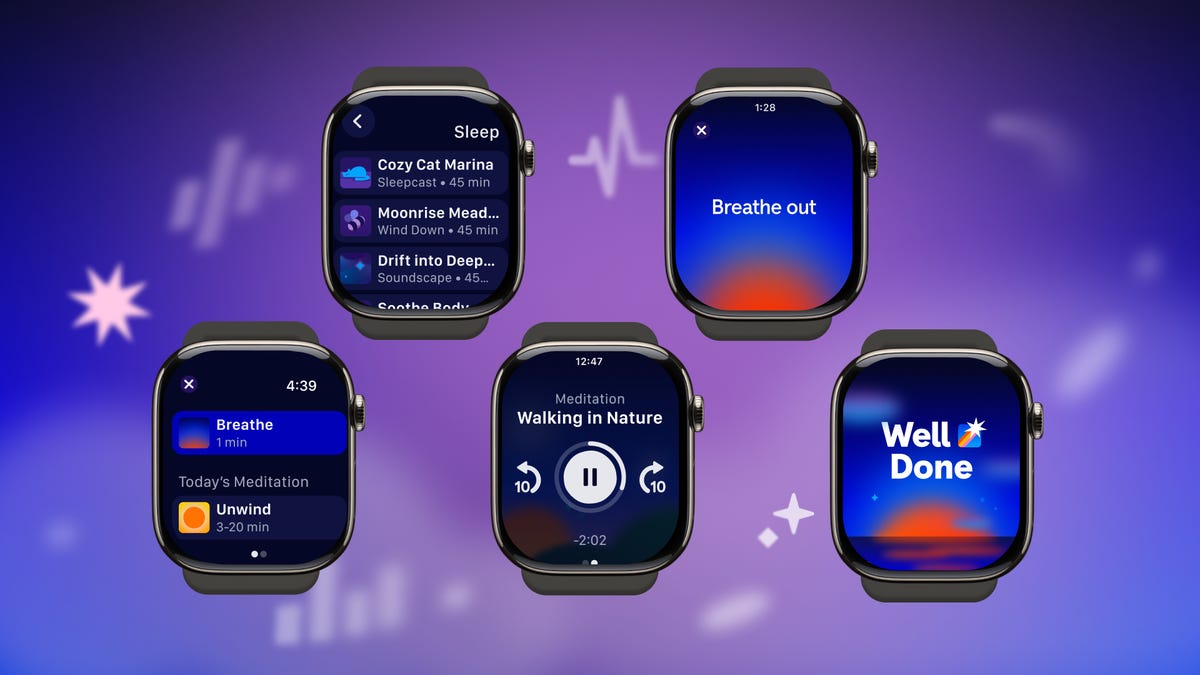
The feature Headspace has been building toward for years shipped on May 13: an Apple Watch app that uses HRV data from Apple Health to detect moments when your nervous system is primed for a mindfulness check-in — and taps your wrist before you decide to open your phone. 1
The mechanics are straightforward. When HRV patterns suggest you're stressed or distracted, the watch delivers a haptic nudge and walks you through a 60-second breathing exercise: four seconds in, four seconds out, guided by gentle vibrations rather than audio. No phone required. 2
Beyond the breathing trigger, the app covers three additional use cases:
- Morning: a personalized meditation surfaced on the watch face each day
- Stress: an SOS mode where you pick your current state (Panicking, Burned Out, or Losing Your Temper) and get a matched session
- Sleep: wind-downs and sleepcasts that play directly from the watch — and can auto-activate if the watch detects you're awake at night
That last feature drew the most enthusiasm in Headspace's own usability testing. Fay Kallel (Headspace Chief Product and Engineering Officer) described it this way: "Being able, through the Apple Watch, to detect an awake moment and automatically activate a sleep cast really helps the customer soothe and get back to sleep, which in our usability study was the use case raved about the most by our members." 3
Kallel also gave the business case for the platform choice plainly: "50% of our member base has the Apple Watch. So it really is along the lines of this very simple vision of meeting the customer where they are." 3
Compatibility and price: The app requires Apple Watch Series 6 or later (including SE 2nd/3rd gen and Ultra models) running watchOS 26.1, plus iPhone 11+ on iOS 26. It's available in 190 countries. Pricing stays at $13/month (7-day free trial) or $70/year (14-day free trial). Non-subscribers get access to only the haptic breathing exercise — which is actually the app's most novel feature, so that's not nothing. 2
The catch: a rocky launch week
The update rolled out with problems. On May 14, Reddit users in r/Headspace reported that a recent Headspace update broke soundscape length selection entirely — soundscapes locked to 8 hours with no way to shorten them. One user who described being a subscriber for years wrote: "Since the update, most of the Soundscapes that say 45-500 minutes cannot actually be used for 45 minutes. They default to 8 hours and there is no longer a way to change it. I'm starting to wonder if it's time to investigate another app instead." 4
A day later, May 15, multiple users reported the app failing to open entirely — with a workaround that involved toggling airplane mode. 5 Both issues appear linked to the Watch app rollout. As of the end of this window, no official fix had been publicly acknowledged.
Bottom line for this week: If you have an Apple Watch Series 6 or newer and an active Headspace subscription, the app is worth enabling now. The sleep wake-detection and SOS mode are genuinely new capabilities — not features ported from the phone. The soundscape bug is real but affects a specific use case; check whether your use patterns would hit it before deciding to wait.
Insight Timer: a platform, not just an app
Two announcements on May 13 signal that Insight Timer (a meditation platform with 30 million members) is done being just an audio library.
Video is now live — with strict limits
Insight Timer published official Video Guidelines for Teachers, marking the platform's formal entry into video content. 6 The library now includes yoga, Pilates, breathwork, somatic movement, and educational talks — all from the same teachers already publishing audio on the platform.
The structural rules: free videos are available to all users; premium videos require a MemberPlus subscription (Insight Timer's paid tier; teachers must publish 5 free videos first); video courses are behind a paywall. Quality baseline is 720p minimum, stable camera, clean audio. One line in the guidelines is worth noting: AI-generated narration and fully AI-generated videos are prohibited.
Insight Timer framed the expansion on Twitter: "Thousands of yoga, pilates, breathwork, stretching, tai chi, sauna and educational videos. Free for our 30 million members. No ads. No AI. No paywall on the practice." 7
Claude connector: 300,000 tracks in your AI chat
Simultaneously, Insight Timer launched a connector for Anthropic's Claude — an AI assistant developed by Anthropic, the AI safety company — that lets you search 300,000+ meditation, sleep, and wellbeing tracks using plain-language queries, without leaving your Claude conversation. 8
You can filter by type (guided meditations, talks, music), format (audio or video), duration, language, voice gender, and specific teacher. Results appear as interactive playable cards with built-in controls. No Insight Timer account required, no login. A parallel version for ChatGPT also launched the same day.
The one meaningful limit: the connector searches only free content. Plus-only premium tracks don't appear in connector results.
Bottom line: The video library is a genuine platform expansion — but give it a month before evaluating. Content is still thin at the edges (most published videos so far are short movement practices like the 6-minute Spacious Shoulders by Benita Miciulis, a debut under the new guidelines). 9 The Claude connector is immediately useful if you already use Claude for other tasks — it's a frictionless way to queue a session mid-workday without context-switching to the app.
Insight Timer: new courses and meditations this week
Eight pieces of new content appeared in the May 10–17 window. All appear to be free-tier. Release dates were confirmed for two items (May 16 and May 11); the rest were detected via search signals during this window.
| Title | Teacher | Format | Duration | Availability | Rating |
|---|---|---|---|---|---|
| Calm Your Gut | Dr. Kim Lye | 8-day course | 6 min/day | Free | 5.0 ★ (53 students) |
| The Binge Eating Recovery Journey | Bea Lecours | 10-day course | 17 min/day | Free | No ratings yet |
| Sleep Deeply | Meditations By Karl | 7-night course (Portuguese) | 20–30 min/night | Free | 4.61 ★ (3,000+ reviews) |
| Enjoying Life Without Guilt | Mariana Oyaga | 2-day course | 14 min/day | Free | 4.8 ★ (13 students) |
| Dealing With Uncertainty | Helen Pengelly | 4-day course | 4 min/day | Free | 4.0 ★ (12 students) |
| Come As You Are: Audio Preface Pt. 1 | Emily Nagoski, PhD | Talk (25:50) | 26 min | Free | Not rated |
| Remembered By Beauty | Nicola Roberton | Guided meditation | 9 min | Free | Not rated |
| Spacious Shoulders | Benita Miciulis | Video practice | 6 min | Free | 5.0 ★ (19 plays) |
A few worth flagging:
Calm Your Gut by Dr. Kim Lye (a holistic chiropractor based in Chiang Mai with 10+ years of practice) is the highest-rated new course of the week. It targets the gut-brain axis — specifically how nervous system dysregulation worsens digestion — through breathwork, body scans, and diaphragm release. Six minutes a day for eight days is a low-friction entry point for anyone dealing with stress-related digestive symptoms. 10
Sleep Deeply by Karl H. (Meditations By Karl), a sound designer and voice artist based in Madrid with over 74,000 plays across the platform, is a 7-night frequency-based program that progresses through solfeggio frequencies (432 Hz → 528 Hz → delta binaural beats on nights 6-7). The course is in Brazilian Portuguese, so English-only listeners should know that upfront. Teacher track record is the strongest in this week's batch. 11
Come As You Are is the audio preface to the revised edition of Emily Nagoski's book of the same name, addressing responsive desire and sexual intimacy. It's a talk, not a guided meditation, and is tagged under sexual health and relationships — a topic rarely surfaced in mainstream meditation apps. 12
Calm: two deals, no new features
Calm had no native product launches this week. The two developments are both external partnerships.
Natrol × Calm (May 14): Natrol — the #1 drug-free sleep aid brand in the US by its own description — launched new Ultra Sleep and Ultra Energy supplements alongside a curated Calm in-app collection called "Back to Rest, Back to You." The collection includes Sleep Stories, meditations, music, and soundscapes. Actress Michelle Monaghan is the campaign voice and will narrate a Sleep Story later in 2026. Through the Natrol partnership page, users can activate a 3-month free Calm Premium trial. 13
Disney+ Perks × Calm (available through Aug 13, 2026): Active Disney+ subscribers in the US who haven't previously used a Calm free trial can claim 6 months of Calm Premium through Disney+ Perks, as part of Mental Health Awareness Month. After the trial, the subscription auto-renews at $79.99/year. Sign-up deadline is September 10, 2026; trial access ends August 13. 14
Bottom line: Neither partnership changes what Calm's app actually does. The Disney+ deal is the more actionable one — a 6-month trial is a meaningful window to evaluate the full library before paying. If you're a Disney+ subscriber who hasn't tried Calm, this week is a low-cost time to do it.
Reflectly: still quiet
No new features, content releases, or product announcements from Reflectly were found in the May 10–17 window — or in an extended 3-month lookback through February 17. 15 The app (maintained by Kodeon, a Copenhagen-based company) has no blog, changelog, or news section, making it structurally opaque to external monitoring. The app remains available on iOS and Android as "Reflectly - Journal & AI Diary."
If you're waiting for a Reflectly update before committing to it: no signal to act on this week.
r/Meditation community pulse
Twenty-four posts surfaced in the r/Meditation hot feed during May 10–17. The mood this week was more wrestling than celebrating.
The dominant theme: calmness as the wrong goal. Four separate posts — roughly 17% of the in-window batch — converged on a version of the same question: what if chasing calm is itself the problem? The most direct version came from u/IgnoreYourThoughts: 16
"Calmness is illusory like everything else. When you attach to calmness as the desired state, you unintentionally create suffering out of other states that isn't calm."
A related thread described what happens when someone does let go: inner peace, but facial expressions that contort into depression or anger, drawing negative reactions from people around them. The poster's theory: "mindfulness is revealing something much darker that is stuck inside me." 17
The consistency struggle. At least five posts this week were explicitly about motivation — not technique, but just showing up at all. The starkest framing came from u/cacklingwhisper: "I just wish I could force myself to do it I find it hard for my analytical mind and emotional mind to agree at the same time to do this." 18 Related threads covered phone-scrolling compulsion, falling asleep during longer sits, and inability to "let go" after quitting drugs — all different expressions of the same friction point.
DPDR and meditation. One post raised a mental health edge case that doesn't appear often: a practitioner with depersonalization/derealization disorder (DPDR) since December 2025 who resumed meditation and found themselves crying and feeling depressed — but also reconnecting with emotions after months of numbness. "I don't feel very good, but at the same time, it's been such a long time since I truly cried." 19 For anyone working through dissociative symptoms, this thread is worth reading: it captures the ambiguity responsible practitioners should acknowledge rather than flatten.
App mentions: Headspace was referenced in at least two posts as the default benchmark — the app people mention when looking for alternatives, or describe having "used to use." Insight Timer received one direct positive endorsement ("Insight Timer is my favorite meditation app"). Calm and Reflectly had no presence in community discussion this week.
Cover image from Headspace for Apple Watch — breathing & mindfulness app
参考ソース
- 1Headspace for Apple Watch — breathing & mindfulness app
- 2Headspace's New Apple Watch App Uses Your Heart Rate to Know When You Need a Break
- 3Q&A: Headspace debuts new Apple Watch app for mental health support
- 4r/Headspace: Suddenly no option to select Soundscape length
- 5r/Headspace: Headspace app down
- 6Insight Timer Video Guidelines for Teachers
- 7Insight Timer video launch announcement on X
- 8Insight Timer Connector for Claude
- 9Spacious Shoulders: A Grounding Movement & Breath Practice
- 10Calm Your Gut course page
- 11Sleep Deeply course page
- 12Come As You Are: Audio Preface Part 1
- 13Natrol Launches Ultra Sleep and Ultra Energy; Partners with Calm and Michelle Monaghan
- 14Disney+: See What's New This May With Disney+ Perks
- 15Reflectly / Kodeon: The World's First Intelligent Journal
- 16Don't attach to calmness
- 17Conflict of letting go
- 18What's your best tips to motivate yourself to meditate?
- 19Meditation and DPDR. Should I keep going?
このコンテンツについて、さらに観点や背景を補足しましょう。