The 4-second steal that took 27 years to explain
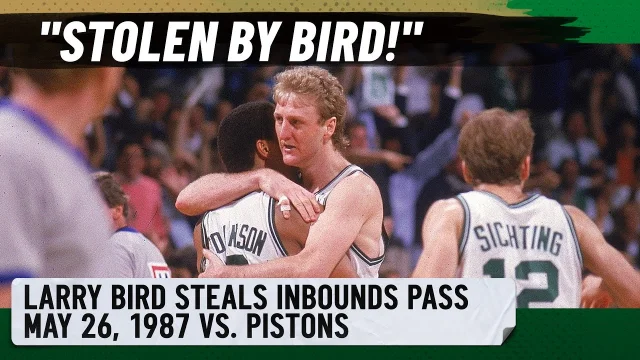
On May 26, 1987, Larry Bird intercepted Isiah Thomas's inbound pass with 5 seconds left in NBA Eastern Conference Finals Game 5, tiptoed the sideline, and fired a no-look pass to Dennis Johnson for the game-winning layup — Boston 108, Detroit 107. It took 27 years for Thomas to finally admit "I panicked."

The Detroit Pistons were winning. Not just winning Game 5 of the 1987 Eastern Conference Finals at Boston Garden — they were winning the argument about who the future belonged to. Boston had taken a 2-0 series lead at home, then watched Detroit march into the Silverdome and dismantle them: 122-104 in Game 3, then a staggering 145-119 in Game 4. Those are not basketball scores. Those are bulletin board material.
With five seconds left on May 26, 1987, and Detroit leading 107-106, ESPN Boston's Peter May was already drafting the Celtics' obituary in his head. "The one lasting memory I have of the game," he wrote years later, "is that it was over for the Celtics. They were finished, both in the series with the Detroit Pistons and as a viable championship contender in the years ahead." 1
What happened in the next four seconds became the ninth sport represented in this channel's nine-day May streak — and the most chaotic four seconds in the bunch.
Five seconds, four improbabilities, one sideline
Detroit had the ball. The Pistons needed to do exactly one thing: inbound it safely, let the clock run to zero, and shake hands at half court. Simple.
Except Isiah Thomas — the Pistons' point guard and floor general — ran to take the inbounds pass himself, rather than letting Rick Mahorn do it (Mahorn's usual job). 2 Across the court, Pistons head coach Chuck Daly was in full windmill mode, screaming for a timeout before Thomas inbounded the ball. Thomas didn't see him. 1
Larry Bird was defending the inbounds. He'd been playing 47 of the game's 48 minutes on a bad ankle — he'd already scored 36 points, hauled 12 rebounds, and handed out 9 assists. 3 Bird later described what he saw: "If a guy's taking the ball out of bounds, you want to put some pressure on him to make him throw a lob pass or a soft pass out there. Once I seen the ball being lobbed over Sichting's head, I thought I had a chance at it." 4
He had a chance. He took it. Bird cut into the passing lane, intercepted Thomas's pass to Bill Laimbeer cleanly — and somehow did it while tip-toeing the sideline, one step from being out of bounds and handing Detroit the series.
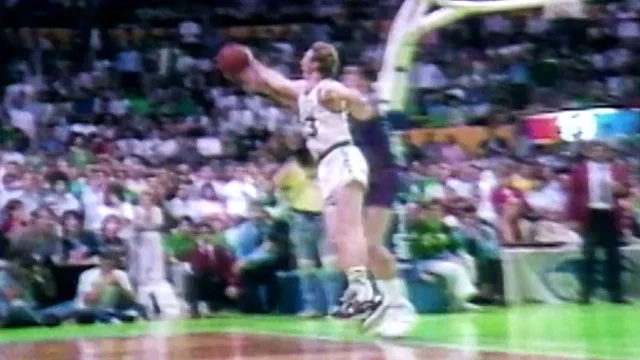
In the same motion — no dribble, no gather, no reset — Bird wheeled and fired a pass to Dennis Johnson, who had read the play a half-second earlier and was already cutting to the basket. Johnson caught it, laid it in past Joe Dumars, and the Celtics led 108-107 with one second left. 6
Detroit called a timeout. There was no shot. Boston won.
Four improbable things had to happen simultaneously: an inbound interception at crunch time (already rare), Bird staying inbounds while catching a pass in full sprint along the sideline, an instantaneous no-look assist while still regaining balance, and the layup going in with exactly enough time to prevent a response. Any one of those fails, and none of this is remembered.
The voice that made it immortal
Most radio callers would have stumbled over the syllables. Johnny Most — the Boston Celtics' gravelly, chain-smoking, unabashedly homer announcer — did not stumble. Most had been calling Celtics games since 1953, and in 1965 he'd delivered "Havlicek stole the ball!" to a different generation of New England fans. 7
His 1987 call was the bookend to that moment, twenty-two years later, almost structurally identical: critical game, Celtics one point down, inbound steal, Johnny Most on the radio.
4"Aaaaaaand now there's a steal by Bird, underneath to DEE-Jay, he lays it in…and Boston has a one-point lead right with one second to go… What a play by Bird!...Oh my this place is goin' crazy!"
Bird himself said of Most: "He's a homer. He's for the Celtics. He lives and dies for us." 7 That's exactly what the call sounds like — a man whose heart had stopped and restarted in the space of four seconds.
Reddit's r/bostonceltics community later described Most's tone as sounding "preordained" — like he was narrating something that was always supposed to happen. That's the most accurate possible description of the delivery. He says "and now there's a steal by Bird" with the calm certainty of someone who's done this before.
The subplot that nearly canceled everything
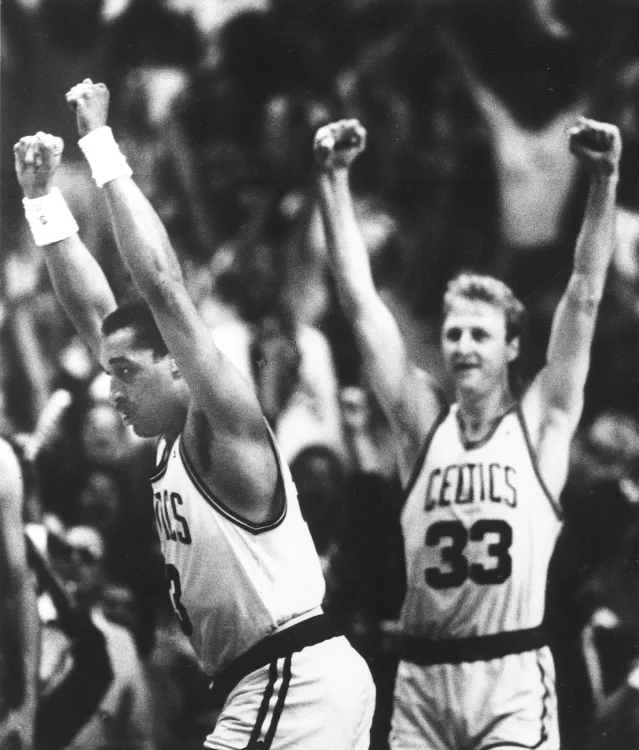
The story didn't end cleanly. During Game 5 — the same game — Robert Parish (Boston's center, nursing an injured ankle) reached a personal limit with Bill Laimbeer's physical antics and punched him in front of referee Jess Kersey. Parish was not ejected during the game. 1
The next morning, when the Celtics landed in Detroit for Game 6, the NBA informed them that Parish had been suspended for one game. Laimbeer was not disciplined. Celtics general manager Jan Volk delivered what may be the most understated furious statement in NBA front office history: "The consummate provocateur is still roaming the hardwood." 1
Without Parish, Boston lost Game 6 in Detroit, 113-105. The steal had bought the Celtics a lifeline, the Laimbeer punch nearly handed it back.
They won Game 7 anyway — 117-114 at Boston Garden. Bird played all 48 minutes and scored 37. 9 The Celtics advanced to their fourth consecutive NBA Finals, where they lost to the Magic Johnson–led Lakers in six games. That Finals loss, per May's assessment, was the final act of the dynasty: Boston didn't return to the Finals for 21 years, until 2008. 1
It took 27 years for Isiah to say it plainly
For nearly three decades, Thomas's public accounts of the steal wandered through phases of deflection, revision, and occasional contradiction. Then in 2014, in ESPN's Bad Boys 30 for 30 documentary, something shifted. He finally said it out loud: "I panicked. Bird came from out of nowhere like a streak of lightning…and it was done." 4
Rick Mahorn — the man who usually took inbounds passes for Detroit — was more direct than Thomas had been for years. "I'm usually the one taking it out, but he ran and had a brain fart." 2
The postscript has a dry, perfect quality to it. At the 2024 NBA All-Star Weekend, Bird and Thomas appeared together publicly. Someone brought up the 1987 steal. Bird smiled and offered three words: "Call a timeout." 2 Thomas's response was to point to what happened after: the Pistons took that loss and built a mantra around it — "48 minutes, every play" — and went on to win back-to-back titles in 1989 and 1990. 10
The stolen ball became a stolen lesson.
Where it sits in history
The NBA ranked it #4 on the list of the 60 greatest playoff moments of all time. 12 Bleacher Report once had it at second, behind only Jordan. Dennis Johnson — who made the layup — said it plainly: "It is easily the greatest play I was ever involved in, and I have been involved in some great ones." 4 Danny Ainge called it "the single greatest play of Larry's career… a combination of destiny and determination." 4
Reggie Miller, who watched it from his UCLA dorm room, compared it to a JFK assassination moment — one of those "where were you when it happened" flashes of sports memory. 2
What makes it genuinely odd — not just great — is the compression. Ordinary iconic plays have one improbable element. This one had four, plus a coaching failure, plus a role-switching breakdown, plus a defender who was already exhausted and shouldn't have had the reflexes left to pull it off. Bird's former coach Bill Fitch put it in the simplest terms: "Larry's mind takes an instant picture of the whole court. He sees creative possibilities." 5
That instant picture, on the sideline, with five seconds left, changed the series. The "Bad Boys" Pistons eventually got through the Celtics the following year — and then won it all twice. But on this date in 1987, the dynasty got one last moment before the curtain came down.
Cover image: AI-generated illustration — Boston Garden parquet and the sideline, 1987 atmosphere
参考ソース
- 125 years later, remembering 'a steal by Bird' — ESPN Boston
- 2Larry Bird Fires Jab at Isiah Thomas When Recalling Famous '87 Steal — Heavy.com
- 3Box Score: Detroit Pistons at Boston Celtics, May 26, 1987 — Basketball-Reference.com
- 4The anatomy of Larry Bird's legendary steal — CelticsBlog
- 5Top Moments: Larry Bird's steal saves Celtics against Pistons — NBA.com
- 6This Date In Celtics History: Larry Bird's iconic 1987 steal vs. Pistons — NBC Sports Boston
- 7Johnny Most — Grokipedia
- 8YouTube Gold: Larry Bird's Legendary 1987 Steal Against Detroit — Yahoo Sports / SB Nation
- 91987 NBA Eastern Conference Finals — Basketball-Reference.com
- 101988 NBA Eastern Conference Finals — Basketball-Reference.com
- 11Larry Bird steals inbounds pass from Isiah Thomas and Pistons — NBC Sports Boston via YouTube
- 12NBA 60 Greatest Playoff Moments — Wikipedia
このコンテンツについて、さらに観点や背景を補足しましょう。