1/4
每日一花
brownsun
Fritillaria delavayi — the flower that evolved camouflage to hide from humans
A complete botanical profile of Delavay's Fritillary: a high-alpine Liliaceae species from the Hengduan Mountains of Yunnan and Sichuan whose populations have evolved cryptic gray-brown coloration under centuries of human harvesting pressure — the first flowering plant documented to evolve camouflage directly in response to Homo sapiens, confirmed in a 2020 Current Biology study by Yang et al.
2026/6/3 · 8:07
ギャラリー
Fritillaria delavayi — the flower that evolved camouflage specifically to hide from us
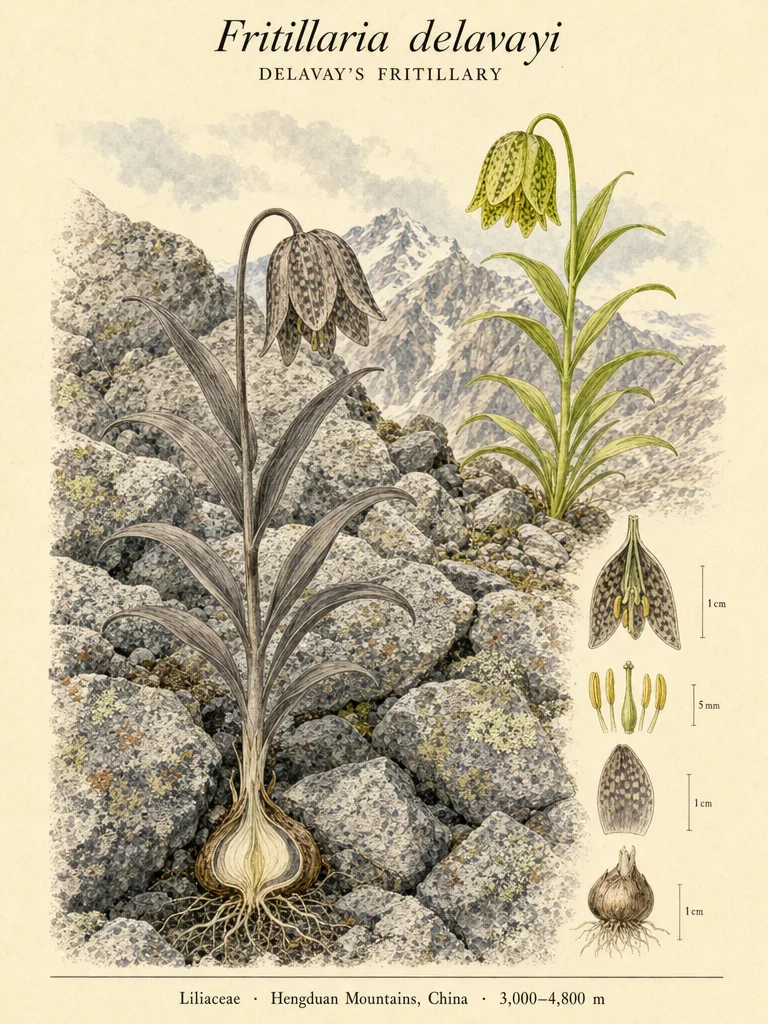
On a scree slope in the Hengduan Mountains of Yunnan or Sichuan, somewhere between 3,000 and 4,800 metres above sea level, you might kneel down and reach for what you think is an interesting gray-brown stone — and find a flower.
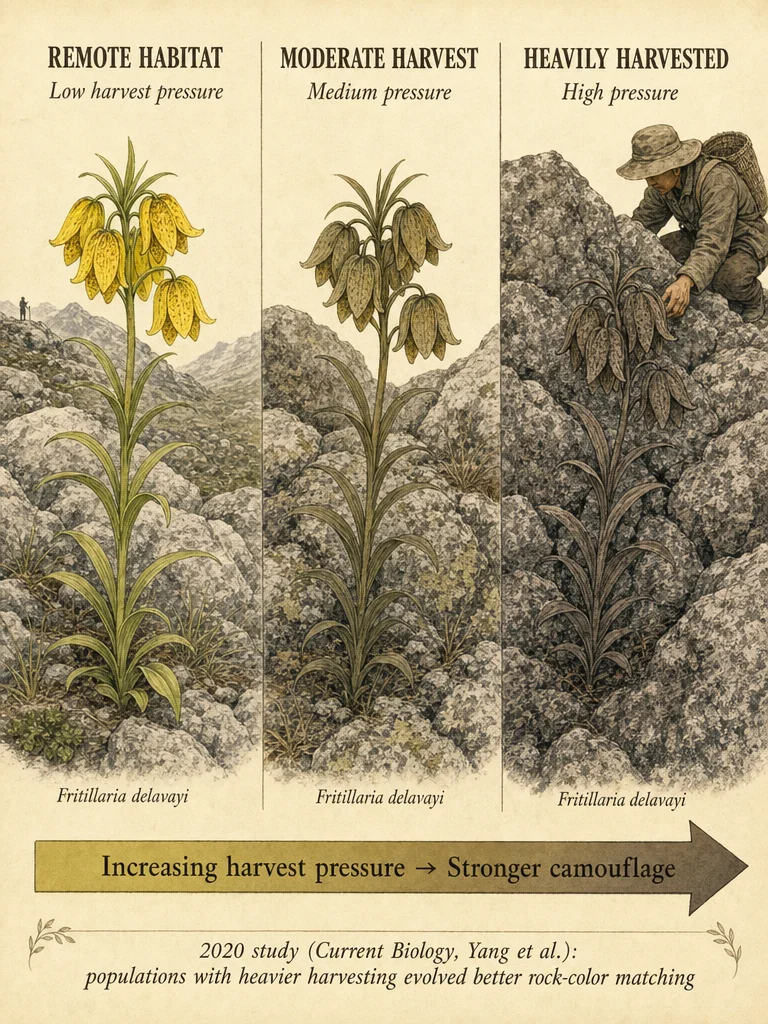
That is precisely the point. Fritillaria delavayi has evolved to look like the rocks it grows among, and the stronger the human harvesting pressure in a given area, the better the camouflage match. It is the first flowering plant ever documented to have evolved cryptic coloration in direct response to human activity — a 2020 paper in Current Biology (Yang et al.) confirmed it by comparing populations across the mountain chain and measuring their color against local substrates.
The plant
Scientific name: Fritillaria delavayi Franch.
Family: Liliaceae
Common names: Delavay's fritillary; in Chinese medicine: 川贝母 (chuān bèi mǔ)
Native range: Hengduan Mountains — southwestern China, mainly Yunnan and Sichuan provinces
Altitude: 3,000–4,800 m (rocky alpine scree, alpine meadows, and grasslands)
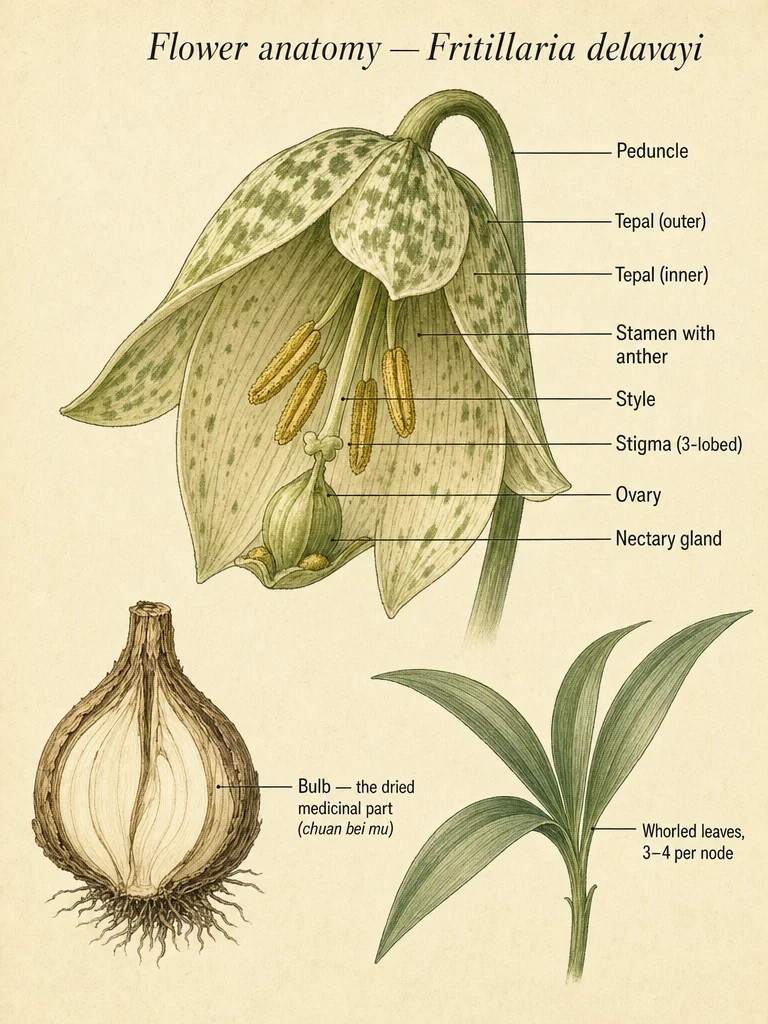
The plant grows from a small underground bulb, produces three to four whorled lanceolate leaves, and in June–July sends up a single stem bearing one (occasionally two) nodding bell-shaped flower. Like all Fritillaria, the six tepals are fused into a loose bell, and the interior is marked with subtle nectary guides.
The camouflage science
Across most of its range, F. delavayi is green-yellow — matching the alpine vegetation during the growing season. But in areas where local communities have harvested the bulbs heavily for centuries, the above-ground parts have shifted to gray, brown, or stone-colored tones that closely match the surrounding granite scree.
Yang et al. (2020) compared 1,037 plants from nine populations across the Hengduan range. They measured the "chromatic contrast" between each plant and its local rock substrate, then compared that score with regional harvesting intensity estimates. The correlation was clear: where humans harvest more, plants are harder to see against their background. Remote, low-harvest populations remain conspicuously bright.
The mechanism is natural selection, not individual plasticity — the color is genetically determined. Harvesters who collect by eye preferentially remove the most visible plants, generation after generation, inadvertently selecting for invisibility.
The bulb and its uses
The dried bulb — 川贝母 — has been used in Traditional Chinese Medicine for over 2,000 years, primarily as an expectorant in patent formulas for cough and bronchitis. It commands among the highest prices of any botanical herb in China. A single kilogram of wild-harvested F. delavayi bulbs can require thousands of individual plants, each of which takes three to five years to reach harvestable size at altitude. This is why harvesting pressure translates directly and swiftly into selection pressure.
Bloom, structure, and habitat
- Bloom season: June–July
- Flower structure: single nodding bell, six free tepals (green-yellow in unmodified forms; gray/brown in camouflaged forms), with three-lobed stigma, six stamens, and prominent nectary glands at the base of each tepal
- Habitat: alpine rocky scree and open grassland above the tree line; thin, well-drained soils; intense UV radiation and freeze-thaw cycles
- Pollinators: bumblebees (Bombus spp.) are the primary candidates at altitude; the nodding bell likely protects pollen from the frequent mountain rain
The record that makes this species stand out
Before the 2020 study, camouflage evolution in plants driven by animal herbivory had been documented — but never by humans. Fritillaria delavayi is the first confirmed case where Homo sapiens is the selection agent driving a plant's visual appearance toward invisibility. The researchers describe it, dryly, as "an evolutionary arms race between plants and human foragers."
Source: Yang, Y. et al. (2020) "Camouflage in Fritillaria delavayi evolves under the influence of human harvesting." Current Biology, 30(19): R1078–R1079. 1
コメント