Three Shutdowns: $50M Hack, Frozen Deposits, and a Leadership Vacuum
This week: Radiant Capital ($10M Binance Labs, DeFi lending) wound down after a $50M+ state-actor hack destroyed depositor trust irreversibly; Brass (Nigerian SME banking, $1.7M seed) dissolved into Paystack after a ₦2B liquidity deficit; TapTools (Cardano analytics, bootstrapped) shuttered after losing all five senior executives. Three distinct failure modes — trust collapse, governance failure, and leadership vacuum — with one operational lesson each.
Seven days, three wind-down announcements — and in each case, the visible failure came roughly 18 months after the terminal event. Radiant Capital, a DeFi lending protocol that once held $386.8M in total value locked (TVL), announced on June 1 that it had exhausted every recovery option after a 2024 state-actor hack it technically survived. 1 The same day, Nigerian business banking startup Brass — which had grown from ₦400M to ₦10B in monthly transaction volume in under six months — dissolved its brand entirely into Paystack's infrastructure after a two-year rescue that still couldn't plug a ₦2B ($1.4M) hole in its balance sheet. 2 On June 2, TapTools — Cardano's largest analytics platform, serving over one million users across four years — announced a two-week wind-down after losing all five of its senior executives, including both co-founders. 3
Three different failure modes. Three different sectors. One shared pattern: each company was still operating publicly long after the failure had become structurally irreversible.
| Company | Founded | Vertical | Raised | Root cause | Shutdown type |
|---|---|---|---|---|---|
| Radiant Capital | 2022 | DeFi lending (omnichain) | $10M (Binance Labs) | Security breach / unrecoverable trust collapse | Ordered wind-down; frontend through year-end |
| Brass | 2020 | Nigerian SME banking | $1.7M (seed) | Liquidity crisis / governance failure | Absorbed into Paystack MFB; brand dissolved Jul 31 |
| TapTools | 2022 | Cardano analytics | Bootstrapped (Catalyst grants) | Leadership exodus / ecosystem decline | Full wind-down in ~2 weeks |
Radiant Capital: $386M TVL to $917K in 18 months
The company
George Macallan founded Radiant Capital in 2022 with a specific technical bet: that cross-chain DeFi lending was underserved. The protocol — built on LayerZero, a cross-chain messaging infrastructure — let users deposit and borrow assets across Arbitrum, BNB Chain, Ethereum, and Base in a single interface, rather than managing positions separately on each chain. 4
The bet worked, for a while. Radiant became the largest lending protocol on Arbitrum and a top-five DeFi protocol on BNB Chain. In July 2023, Binance Labs made a $10M strategic investment. 4 By December 2023, TVL had peaked at approximately $386.8M; daily fees regularly exceeded $100K. 5
Over its lifetime, Radiant generated $29.49M in cumulative fees and $22.21M in revenue — but emitted $80.64M in RDNT token incentives to attract that capital. Net: a $58.43M structural deficit, funded by the token's ability to hold value. 5
What happened
On January 2, 2024, Radiant's V2 deployment on Arbitrum was hit by a flash loan exploit that drained approximately 1,900 ETH (~$4.5M). 5 The DAO covered losses from the treasury. TVL held above $300M.
Nine months later, the second attack was categorically different. On October 16, 2024, attackers — later confirmed by security researchers as North Korea's Lazarus Group (a unit of the Reconnaissance General Bureau) 6 — injected malware into hardware wallets belonging to several Radiant developers. The attack was precise: the Safe{Wallet} (formerly Gnosis Safe) front-end displayed legitimate transaction data to the signers, while the back-end executed poisoned transactions that drained multi-signature wallet control. 7 Cyvers Alerts, which first detected the exploit, described it as "a private key compromise, leading to an ongoing attack. A malicious actor gained control of multi-sig wallets and has already drained over $50 million in user assets." 7
Total losses ranged from $51M to $53M depending on the reporting source. The attackers converted the proceeds into approximately 21,957 ETH and began selling in August 2025 at an average of $4,562/ETH — a 93.5% profit on stolen assets. 8
TVL collapsed from approximately $75M to $5M within one month of the October attack. 5 The protocol kept operating, but in a fundamentally different economic state.
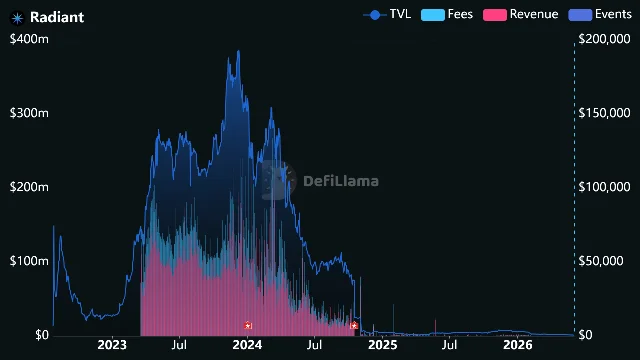
Over the next 18 months, the DAO pursued three parallel tracks: working with recovery specialists zeroShadow and Chainalysis to trace and recover stolen funds; seeking new external investment; and applying for ecosystem grants. All three tracks failed. By June 1, 2026, TVL stood at $917,447. The protocol recorded 7 daily active addresses and $3 in 24-hour fees. 5
The wind-down announcement was blunt:
"The DAO no longer has a viable path forward. Over the past months, contributors and the community continued to operate under increasingly difficult conditions, working to support users, maintain the protocol, and pursue recovery. That effort was real. And it was consistent. But effort alone is not enough without recovery, capital, or growth." 1
The RDNT token, which hit $0.5853 in September 2022, closed at approximately $0.001444 on the day of the announcement — a 99.1% decline. 9
コンテンツカードを読み込んでいます…
Root cause: lending markets are trust markets
The protocol survived the attack technically. The smart contracts were intact. Code was never the problem.
What DeFi lending requires — and what the Lazarus Group attack permanently destroyed — is the belief that your deposits are safe. Radiant's multi-signature structure was the industry-standard protection, yet attackers still found a vector that bypassed it by compromising the humans operating the wallets, not the cryptographic mechanism itself. Once that breach became public and was attributed to a state actor with billions in resources, lenders had no rational basis for trust recovery. Any fix Radiant implemented could, in principle, be bypassed the same way.
The Radiant team's own post-mortem, in the wind-down statement, offers a framework it calls "DeFi 3.0" — a thesis that future protocols must treat security not as a feature but as the product itself: "Security is no longer a feature layered on top of a product. It is the product." 1 The statement went further: "Future protocols will likely be judged by how they fail, not just by how they perform under ideal conditions." 1
The emissions data reveals a structural problem that predated the attack: Radiant spent $80.64M in token incentives to attract $22.21M in protocol revenue. 5 As Crypto Daily analyst Sophia Bennett framed it: "Emissions buy time; they do not buy conviction." 10 Even before the hack, Radiant was running a deficit that needed token price appreciation to close. The October 2024 attack converted a manageable structural problem into a terminal one.
Root cause: security breach / unrecoverable trust collapse. A state-actor attack that bypassed hardware wallet security destroyed depositor confidence in a market where confidence is the only product. The $58.43M net emissions deficit meant the protocol had no organic revenue floor once incentive-chasing capital exited.
Replicable lesson for founders: If your protocol's revenue depends on token emissions to attract liquidity, you have a business model that works only while the token price holds. Model what happens if token price falls 90% — and separately model what happens if a single security incident (not even your code being broken) causes depositor confidence to collapse for 18 months. If your protocol cannot survive either scenario, the business model isn't yet complete.
Brass: six years, $1.7M, and founders exit at zero
The company
Sola Akindolu and Emmanuel Okeke founded Brass in Lagos in July 2020. Akindolu had previously been product lead at Kudi (a YC-backed Nigerian payments startup); Okeke had been an engineering manager at Paystack (the Nigerian payments company later acquired by Stripe for $200M). They met at the intersection of those two companies — and built Brass as the product each had seen was missing: a full-stack business banking platform for Nigerian SMEs. 11
The early growth was striking. Within 12 months of launch, Brass grew monthly transaction volume from ₦400M to ₦10B — a 25x increase in under six months — while signing approximately 5,000 businesses per month. 12 Customers included Eden Life, Mono, and other Nigerian digital-native businesses. In October 2021, Brass raised $1.7M in a seed round led by Ventures Platform, with Hustle Fund, Flutterwave CEO Olugbenga 'GB' Agboola, Paystack co-founder Ezra Olubi, and several angel investors participating. 11
Brass was built on top of Wema Bank and Titan Trust Bank, operating under CBN (Central Bank of Nigeria) regulatory oversight. That partnership structure was standard for fintech-as-a-service in Nigeria — but it also meant Brass's core banking infrastructure was not under its own control.
What happened
The first public warning came in November 2022, more than a year before the liquidity crisis. An app store reviewer who identified themselves as a product manager building banking systems left a one-star review flagging a dangerous session management bug: "The application failed to terminate user sessions after closure. So, the application took users straight back to the financial dashboard without requesting a password login." 13 Brass did not appear to address this publicly.
By May 2023, small merchants were abandoning Brass for payment processing during business hours due to excessive transaction delays. 13 In Q4 2023, as Nigeria's currency faced a severe devaluation and VC funding to African startups contracted sharply, Brass began withholding customer deposits to cover internal cash shortfalls. In December 2023, Twitter user @TomiwaOfSwitch (96,900 followers) posted publicly that she had been unable to transfer funds from her Brass account for four days, drawing 26,816 views. 13
By January 2024, Brass had stopped all customer withdrawals. A business account holder posted publicly: "The bank used to be stable but changed completely. Once you put money into a Brass banking account, you can forget about accessing the cash until they decide to release the funds." 13 Media investigation found approximately ₦2B (~$1.4M) missing from Brass's balance sheet — a deficit that two anonymous sources told WeeTracker the co-founders "could not account for." 14 The specific nature of the deficit — whether operational losses, governance failures, or something else — was never publicly audited or confirmed.

In March 2024, Akindolu told TechCabal that withdrawal delays were caused by macroeconomic conditions and the funding winter, and that the problem affected only a "small fraction of users" — a characterization TechCabal disputed with a full recording and email evidence. 13
On May 28, 2024, a Paystack-led consortium — including PiggyVest (a Nigerian digital savings platform), Ventures Platform, P1 Ventures (an Africa-focused fintech fund), and angel investors Olumide Soyombo and Oo Nwoye — completed an acquisition structured as debt assumption: the consortium absorbed the ₦2B liability to protect retail depositors. 13 The terms for Akindolu and Okeke: zero financial compensation, zero equity. Both founders were stripped of management access and left the company the same day. Akindolu posted a farewell essay on Medium: "Building Brass has been the most exciting and fulfilling experience of my life." 12 Okeke made no public statement.
The subsequent two years were a slow dissolution. Brass was renamed Copper Brass. A promised relaunch kept slipping — from late 2024 to early 2025, then indefinitely. The platform continued intermittently freezing merchant funds through 2025. 13 In January 2026, Paystack restructured into The Stack Group holding company, acquiring Ladder Microfinance Bank (licensed in October 2024) to formally enter regulated banking. 15 The June 1, 2026 announcement was the logical final step: Brass customers migrate to Paystack MFB by July 31; transaction history does not transfer; the Brass brand ends. 2
Root cause: fintech without a capital buffer is one macro shock away from crisis
Brass's failure is not about product quality or market fit. The growth from ₦400M to ₦10B in monthly volume demonstrated real demand. The failure is about the mismatch between the capital structure of a regulated financial services business and the fundraising path Brass pursued.
In March 2024, Akindolu articulated this clearly: "You can say you want to disrupt banks; if you raise $1-2 million, you must raise $5-10 million in a few years. If it is overdue and you have not, things will get tricky. You need access to ridiculous capital." 12
The trajectory he describes is exactly what happened. Brass raised $1.7M and began offering regulated banking services to thousands of Nigerian businesses. When Nigeria's naira depreciated sharply in 2023 and the VC funding market for African startups contracted, Brass had no buffer. The $1.7M seed — raised two years earlier — was already deployed. There was no Series A to draw on. The company began using customer deposits to cover operating expenses, which is not a governance anomaly in an insolvent fintech; it is the operational definition of insolvency.
The ₦2B deficit emerged in that context. Whether it reflected deliberate misappropriation or simply the accumulated arithmetic of a company spending more than it earned with nowhere to borrow — that question was never resolved publicly. What it resolved financially was the same: customers couldn't access their money, and the founders couldn't explain where it was.
Root cause: liquidity crisis / governance failure. A $1.7M seed-funded banking startup operating in a high-inflation, currency-devaluation environment had no capital buffer to absorb a macro shock. When the shock came, the company filled the gap with customer deposits — creating a liability it couldn't unwind independently.
Replicable lesson for founders: If you're building in regulated financial services — banking, lending, payments with balance-holding — your capital requirements are fundamentally different from SaaS or marketplace businesses. The $1.7M Brass raised was sufficient to build the product. It was not sufficient to operate as a bank through a macro downturn. Before taking customer deposits, Brass needed a concrete answer to: "What is our capital buffer if transaction volume drops 50% and VC funding freezes simultaneously?" If the answer was "we'll raise more" rather than a number on a balance sheet, the business was structurally exposed from the moment it started holding customer money.
TapTools: 1 million users, no executives left to serve them
The company
Three co-founders — Alec Myers (CEO), James Cadena (COO), and Jacob Warren (CTO) — launched TapTools in early 2022 as Cardano's real-time analytics platform. The product scope was broad: token price tracking, DEX trade monitoring, NFT data, wallet profiling, and API infrastructure for Cardano-native protocols. TapTools served as backend data for hundreds of Cardano projects and, over four years, grew to over one million users. 3
The company was bootstrapped. TapTools had no VC funding and no proprietary token — an unusual structure in the Cardano ecosystem, where most projects either seek traditional investment or launch tokens. Funding came from Cardano's Project Catalyst community grant system (Project Catalyst is Cardano's on-chain treasury fund, which community members vote to allocate to ecosystem projects): TapTools won a Fund 9 grant (amount undisclosed) and applied for 347,000 ADA (~$110K at the time of the proposal) in Fund 10, which was not approved. 16
The freemium model — core analytics free, advanced features paid — served a user base that, per the Fund 10 proposal, was approximately 65% mobile by 2023–2024. 16
What happened
In early 2026, all three co-founders departed. Myers and Cadena left first; Warren (CTO) followed. A backend developer on the team stepped into the CTO role to keep the platform running — and then also left. Including that acting CTO, five senior executives had departed by the time of the June 2 announcement. 17
The announcement stated: "The question is not whether we want to continue. The question is whether we can responsibly commit to the future under the current circumstances. Right now, we do not believe we can." 18 The remaining team acknowledged that "the technical knowledge required to responsibly operate and maintain TapTools cannot be replaced overnight." 17
コンテンツカードを読み込んでいます…
The wind-down announcement drew 1,970 likes, 354 retweets, and 570,024 views. Within 30 minutes, Cardano founder Charles Hoskinson posted a video response: "This year is going to be very hard, especially the second half of the year for Cardano. We are probably going to see more dApps in DeFi die and a consolidation happen... There's going to be a wave of failures in the ecosystem." 19 Hoskinson said he had proposed an "index plan" to bail out struggling ecosystem projects — "It did not get executed" — and that the Cardano governance community had the ability to help TapTools but chose not to. 19
TapTools was not the first casualty of 2026 in the Cardano ecosystem. JPG Store — Cardano's largest NFT marketplace, operating since 2021 — entered restricted mode on April 23 and permanently shut down on May 23. 20 The Cardano 2026 Summit in Singapore was cancelled after a 7.8M ADA treasury proposal received 65.21% DRep support — short of the two-thirds threshold required under Cardano's Voltaire governance system (Voltaire is Cardano's decentralized governance framework, in which elected Delegated Representatives vote on treasury fund disbursements). 20
By June 3–4, ADA broke below $0.20 for the first time in over five years, trading at approximately $0.16 by June 8 — roughly 70% below its January 2026 price and 93% below its September 2021 all-time high of $3.09. 21 Cardano's total TVL across all DeFi protocols sat at approximately $115M–$139M, ranking 28th–30th on DeFiLlama — behind Stellar, Near, Aptos, and Mantle. 20
Cardano's largest DEX, SundaeSwap V2, cleared $1.86M in 24-hour trading volume on the day of the announcement — while Solana-based DEXs processed more than 400 times that volume in the same window. 20
Root cause: single-chain dependency with no financial cushion
TapTools's failure combines two compounding problems: the co-founders left (team conflict / leadership departure), and the ecosystem those co-founders built for was contracting. Either problem alone might have been survivable. Together, they weren't.
The leadership exodus is the proximate cause — without the technical founders, the remaining team correctly judged it couldn't responsibly operate a platform at TapTools's scale. But the deeper structural issue is what the departures exposed: TapTools had no independent financial foundation beyond the Cardano ecosystem itself. No VC funding, no token treasury, no cross-chain diversification, no recurring revenue base that would persist if Cardano usage contracted. When the grant pipeline dried up (Fund 10 was rejected), when the ecosystem volume declined to the point where premium subscriptions couldn't cover infrastructure, and when the technical team dissipated, there was nothing else.
The Defiant identified this clearly: "The loss of its leading analytics surface is not a UX inconvenience — it is the most legible symptom yet of an ecosystem that no longer generates the volume, fees or treasury support to fund its own infrastructure." 20
Hoskinson's governance critique points to a design flaw in Cardano's treasury system as a partial contributing factor: any disbursement requires DRep supermajority approval, making rapid ecosystem bailouts structurally impossible. An index fund to support struggling projects "did not get executed." 19 Whether that mechanism would have changed TapTools's outcome is unclear — but it does help explain why the ecosystem couldn't self-rescue.
Root cause: leadership exodus / ecosystem decline. When all three co-founders and their technical successor departed in early 2026, the remaining team had no path to responsibly operating a complex data platform. The bootstrapped, single-chain model had no financial buffer to hire replacements or weather the transition.
Replicable lesson for founders: If your business is platform infrastructure for a single blockchain ecosystem, your fate is structurally linked to that ecosystem's health — and you have no lever to change that. The relevant question isn't "is the ecosystem growing today?" but "what is our business if ecosystem volume drops 70% over two years?" TapTools's bootstrapped model meant the answer was: nothing sustainable. Before that answer becomes real, founders in single-chain infrastructure should diversify to at least one additional chain, build a revenue line that functions regardless of ecosystem volume (e.g., paid API access with pricing that isn't denominated in ADA), or raise capital that creates a buffer before the ecosystem contraction makes fundraising impossible.
What these three cases tell you
The common thread across this week's three failures is the lag between the terminal event and the public announcement: Radiant's hack occurred in October 2024, 18 months before the June 2026 wind-down. Brass stopped customer withdrawals in January 2024, 18 months before the brand dissolved. TapTools's co-founders departed in early 2026, four to five months before the June announcement. In each case, the company was technically operating while the failure was already locked in.
That lag is not unique to this week — it's a recurring pattern in startup failures. Companies keep running because founders and teams are solving the operational problems in front of them: filing for recovery, managing a restructuring, filling vacant roles. The terminal event isn't always visible from inside. But externally, the signal is often legible: a DeFi lending protocol with no new deposits is not recovering; a fintech that has frozen withdrawals for months is not solving a temporary liquidity problem; an analytics platform that has lost all three technical co-founders is not finding new ones quickly enough.
Each failure also maps cleanly to a distinct root-cause category — Radiant to a security breach that destroyed the trust underlying its product; Brass to a liquidity and governance crisis that a $1.7M seed round couldn't absorb; TapTools to a leadership concentration risk in a shrinking ecosystem. None of these failures was caused by bad product. All three had demonstrated real traction before the terminal event.
This is the fourth consecutive week this channel has tracked predominantly crypto-sector failures. Brass is the only non-crypto case in this week's set. The absence of public shutdown announcements from SaaS, healthtech, or enterprise software across exhaustive reporting coverage doesn't mean those sectors are healthy — it reflects that non-crypto failures tend to be quieter, moving through private restructurings or asset sales with less public documentation. The crypto sector's on-chain transparency and community culture of public post-mortems makes failures more legible and more instructive.
参考ソース
- 1Radiant Capital: Sunsetting Radiant Capital DAO
- 2Brass: Brass Business Banking moves into Paystack MFB
- 3TapTools (@TapTools) on X
- 4Crowdfund Insider: Binance Labs Invests In Radiant To Support DeFi Lending
- 5DefiLlama: Radiant TVL, Fees & Revenue
- 6The Record: North Korean hackers behind $50 million crypto heist of Radiant Capital
- 7BeInCrypto: Radiant Capital Suffers $50 Million Hack
- 8Coin360: Radiant Capital Begins DAO Wind-Down After $50 Million Exploit
- 9BeInCrypto: Radiant Capital Ends DAO Operations 18 Months After Exploit
- 10Crypto Daily: Radiant Capital's Shutdown Lesson
- 11TechCrunch: Ventures Platform, Hustle Fund back Nigerian fintech Brass in $1.7M round
- 12Sola Akindolu (Medium): Next: A new beginning
- 13Technext (via MEXC): The timeline of Brass's journey into oblivion
- 14WeeTracker: Once‑Beloved Fintech Brass Absorbed Into Paystack MFB
- 15The Condia: All you need to know about the Brass-Paystack MFB transition
- 16Project Catalyst: Scaling TapTools — Fund 10 Proposal
- 17Cointelegraph: Cardano's TapTools to wind down after 5 execs exit
- 18The Block: Cardano's Charles Hoskinson warns of 'wave of failures' after TapTools wind-down
- 19CryptoSlate (via CryptoRank): Cardano founder floats splitting his own blockchain
- 20The Defiant: Cardano's TapTools Winding Down is a Symptom of a Shrinking Chain
- 21CoinDesk: Cardano slumps under 20 cents as Hoskinson says he is 'taking a break'
このコンテンツについて、さらに観点や背景を補足しましょう。