
Win the lawsuit, lose the deal: AT&T, Time Warner, and the $85.4B vertical merger that was right in court and wrong in strategy

Win the lawsuit, lose the deal: AT&T, Time Warner, and the $85.4B vertical merger that was right in court and wrong in strategy

AT&T won a landmark DOJ antitrust lawsuit to close its $85.4B acquisition of Time Warner — then sold off the renamed WarnerMedia to Discovery for roughly half that amount four years later. The case reveals how a textbook antitrust victory can still be a strategic catastrophe, and teaches four reusable frameworks for reading break-up fee ratios, deploying preemptive regulatory concessions, filtering deals by comparative advantage, and guarding against winner's curse.

Business Negotiation Classics: One Case a Day
2026/5/31 · 21:26
購読 1 件 · コンテンツ 13 件
In June 2018, U.S. District Judge Richard J. Leon handed AT&T one of the most complete antitrust victories in decades. His 172-page opinion rejected every one of the DOJ's theories and sent a clear signal to corporate America: vertical mergers — where a buyer and seller operate at different levels of the same supply chain — are, in the government's hands, genuinely hard to kill in court. 1
By 2022, AT&T had quietly unwound the entire deal, handing off WarnerMedia to Discovery at a valuation of roughly $43 billion — about half what it paid. 2
This case is worth studying not because AT&T made obvious mistakes — the deal logic was defensible and the legal execution was excellent — but because it exposes a recurring trap: conflating regulatory clearance with strategic validation.

The parties, the stakes, and what each side actually wanted

AT&T / DirecTVTime WarnerDOJ
Stated objectiveVertical integration: own content to complement its distribution pipesMultiplatform distribution for HBO, Turner, Warner Bros.Block a deal that would harm pay-TV consumers
Hidden preferenceSlow Netflix and build a data-driven ad business to rival Google/FacebookAvoid the fate of traditional broadcast; extract maximum priceEstablish that vertical mergers can be litigated — a first in 40 years
BATNADirecTV losing 800K subscribers/year; wireless market saturatingFox had already offered $85/share; Time Warner walked away once beforeLose in court but reshape antitrust precedent
Leverage$40B bridge loan committed; largest pay-TV distributor with 25M subscribers"Must-have" content (CNN, TNT, HBO, NBA rights); no horizontal overlap with AT&TPresidential rhetoric and a first-mover on vertical merger litigation theory
Key asymmetryUnderpriced regulatory risk: only $500M reverse break-up fee on an $85.4B dealOverpriced competitive risk: $1.725B break-up fee if a higher bid emergedRelied on a quantitative model that the judge dismantled input-by-input
The fee structure tells the story before the trial even starts. AT&T's reverse break-up fee was $500 million — less than 0.6% of deal value — if regulators blocked the merger. Time Warner's break-up fee in the event it accepted a superior offer was $1.725 billion. 3 The asymmetry is a confession: AT&T was far more worried about a competing bidder (Apple had been in preliminary talks) than about the government.

How the deal got done

AT&T Chairman and CEO Randall Stephenson had watched streaming strip away DirecTV's subscriber base ever since the company paid $48.5 billion for it in 2015. His diagnosis was straightforward: the future of video is mobile, and the future of mobile is video. Owning content, he argued, was the only sustainable answer to a platform war with Netflix, Amazon, Google, and Facebook.
On October 22, 2016, AT&T and Time Warner announced an agreement under which AT&T would acquire Time Warner for $107.50 per share — half in cash, half in AT&T stock — with a collar mechanism protecting both parties if AT&T's share price moved outside the $37.41–$41.35 range. 4 Total equity value: $85.4 billion. Including Time Warner's net debt, the enterprise value came to roughly $108.7 billion.
Stephenson's public framing was confident: "Premium content always wins. It has been true on the big screen, the TV screen and now it's proving true on the mobile screen." 4 Time Warner CEO Jeff Bewkes, whose company had already rebuffed a $85-per-share approach from 21st Century Fox two years earlier, called it "a great day for Time Warner and its shareholders." 4
Two days after the announcement, an academic and former DOJ antitrust official named Makan Delrahim appeared on Canadian television. His assessment: "I don't see this as a major antitrust problem." 5 He explained that unlike horizontal mergers or a deal involving broadcast licenses, a content-plus-distribution combination raised different — and less severe — concerns.
Thirteen months later, Delrahim was confirmed as the Trump administration's Assistant Attorney General for Antitrust. And on November 20, 2017, he filed suit to block the same deal he had called unproblematic.
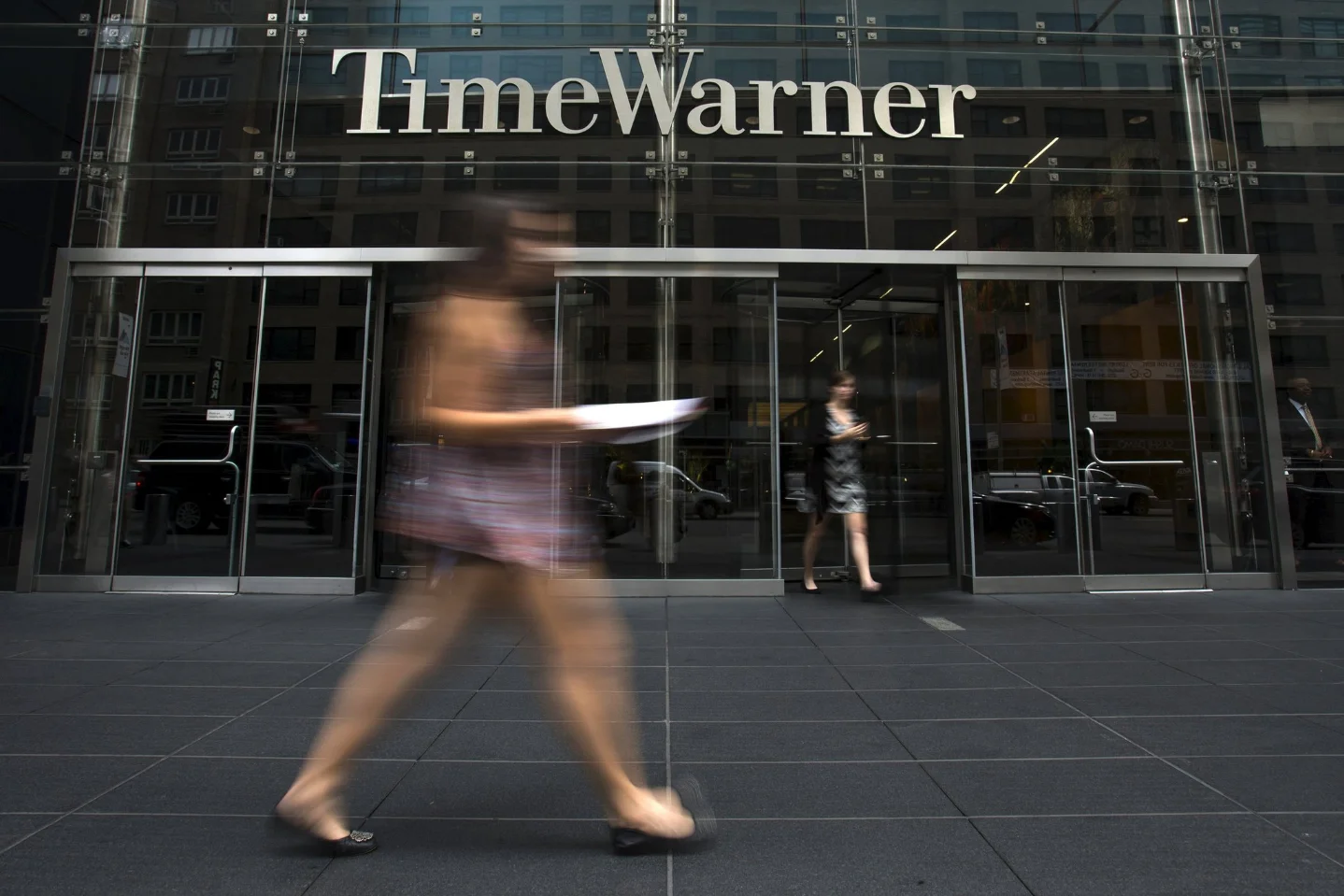
AT&T and Time Warner building signage in New York, 2018
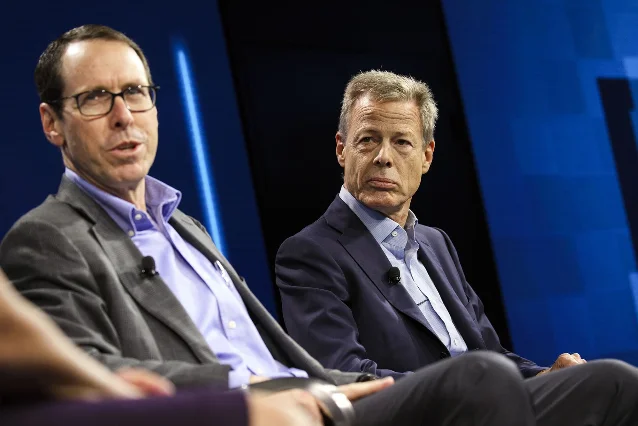
AT&T CEO Randall Stephenson and Time Warner CEO Jeff Bewkes at the 2016 merger announcement. 6

The CNN ultimatum and the decision not to settle

Before the lawsuit, the DOJ sent AT&T an ultimatum: divest either Turner Broadcasting (which includes CNN) or DirecTV as a condition of approval. Stephenson refused publicly and on the record: "Throughout this process, I have never offered to sell CNN and have no intention of doing so." 6
The CNN demand was impossible for AT&T to accept for two reasons. First, Turner Broadcasting was one of the three pillars of Time Warner's value — removing it would gut the strategic rationale. Second, Donald Trump had called the deal "too much concentration of power in the hands of too few" during his 2016 Gettysburg speech and had explicitly promised: "a deal we will not approve in my administration." 1 Any divestiture of CNN — the president's most publicly loathed news outlet — would look like capitulation to political pressure, and AT&T knew it.
AT&T's General Counsel David McAtee called the lawsuit "a radical and inexplicable departure from decades of antitrust precedent." 7 AT&T CFO John Stephens noted at a Wells Fargo conference that the government had not successfully litigated a vertical merger in over 40 years — and that AT&T had no intention of being the first to lose one.
The decision to fight rather than settle was the most consequential negotiating choice of the entire episode. Behavioral remedies (the approach used in the 2011 Comcast–NBCU deal, which involved mandatory baseball-style arbitration for content disputes) were available. AT&T rejected them. This confidence shaped everything that followed.

Six weeks before Judge Leon

The trial opened on March 19, 2018, in the U.S. District Court for the District of Columbia, presided over by Judge Richard J. Leon. 8
The DOJ's theory of harm, framed under Section 7 of the Clayton Act, rested on what antitrust economists call "raising rivals' costs." The argument: after the merger, the combined AT&T/Time Warner entity would use the threat of blacking out Turner channels (CNN, TNT, TBS) to extract higher affiliate fees from competing pay-TV distributors like Dish Network and Charter Communications. Those higher costs would ultimately pass to consumers. 9 DOJ's lead economist Carl Shapiro (University of California, Berkeley) built a Nash bargaining model quantifying the harm: competing distributors would pay an additional $587 million per year in Turner content fees; consumers would face a net annual cost increase of roughly $286 million. 10
AT&T's outside counsel Daniel Petrocelli of O'Melveny & Myers pushed back hard. His argument was simpler: "It's all speculation about what could happen." 8 AT&T's expert, University of Chicago economist Dennis Carlton, examined prior vertical integrations — Comcast–NBCU, News Corp–DirecTV, Time Warner Cable–Time Warner — and found that "the bulk of the results show no significant results at all, but many do show a decrease in content prices." 10
The trial's critical moment came when Turner Broadcasting — just one week after the DOJ filed suit — sent irrevocable offers of baseball-style arbitration to roughly 1,000 distributors. The offers guaranteed that any content-fee dispute would go to neutral arbitration rather than a blackout. When Judge Leon pressed Shapiro on whether his model accounted for this commitment, Shapiro acknowledged it would require "a completely different model." 10 That admission did serious damage.
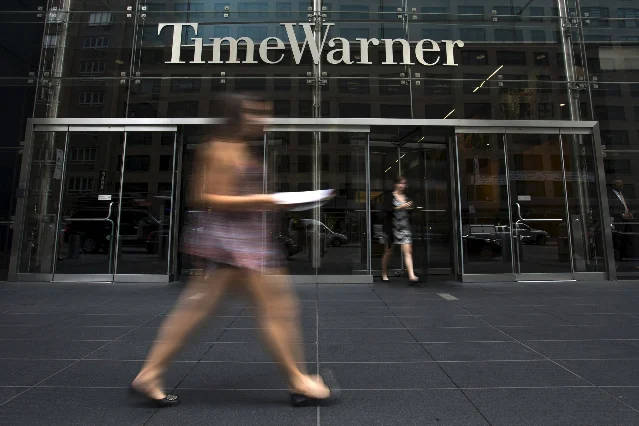
Time Warner headquarters building exterior in New York City, 2016
Time Warner headquarters in Manhattan, October 2016. 11

The ruling: Leon dismantles the model

On June 12, 2018, Judge Leon issued his 172-page opinion — a demolition job on Shapiro's quantitative framework, conducted one input at a time. 12 The three pillars of Shapiro's model each failed:
  • Subscriber churn rate: The underlying data had been modified after submission to a Charter Communications executive, without Shapiro's knowledge.
  • Diversion rate (how many subscribers who lose Turner content migrate to DirecTV): The calculation method was unreliable and underweighted cord-cutting.
  • Lifetime value of a subscriber: The figures were outdated and inflated, overstating the harm.
Leon described the resulting model as a "Rube Goldberg contraption." 13 His conclusion: "The Government has failed to meet its burden to establish that the proposed transaction is likely to lessen competition substantially." 1
Leon then did something unusual: he warned the DOJ against seeking a stay. Doing so, he said, would cause a "manifestly unjust outcome." AT&T closed the acquisition two days later, on June 14, 2018 — 20 months after the announcement, and 18 months behind the original schedule. 12
The DOJ appealed. On February 26, 2019, a three-judge panel of the D.C. Circuit unanimously affirmed Leon's ruling under the deferential "clearly erroneous" standard. The court accepted the Nash bargaining theory as valid economic doctrine but held that Leon had correctly rejected its specific predictions given the factual record — particularly the Turner arbitration commitments and Carlton's econometric analysis of prior deals. 10
Makan Delrahim, for his part, was "disappointed." The academic community split sharply. Georgetown's Steven Salop argued Leon had misunderstood Nash bargaining: the model does not require actual blackouts to show harm; it models how the threat of a blackout changes each party's reservation price. 14 Chris Sagers at Cleveland State University called the opinion "one of the worst antitrust opinions I've ever read," arguing Leon "accepts the defendants' evidence with a truly surprising, hook-line-and-sinker credulousness." 15 Joshua Wright at George Mason's Scalia Law School came to the opposite conclusion: the decision was "the triumph of economic analysis," applying existing standards carefully rather than creating new law. 13
The D.C. Circuit acknowledged a "dearth of modern judicial precedent on vertical mergers and a multiplicity of contemporary viewpoints about how they might optimally be adjudicated." 10 That line alone explains why the case still gets cited in antitrust classrooms.
リンクプレビューを読み込んでいます…

After the champagne: what actually happened

Time Warner became WarnerMedia. John Stankey, a career AT&T executive, was installed as CEO. Within one year, every executive who had built the brands AT&T paid $85.4 billion for was gone: HBO's Richard Plepler (27 years at the company), Turner's John Martin, Warner Bros.' Kevin Tsujihara (who departed amid a separate personal scandal), and others. 16 17
One anonymous WarnerMedia executive described AT&T's integration approach as a "plug-and-play mindset — you can put the best athlete in any position and they can win. That hasn't been historically the case in media." 16 Stankey disagreed with the framing. He said the harder problem was internal: not AT&T vs. WarnerMedia, but the three siloed cultures within WarnerMedia — HBO, Turner, and Warner Bros. — that had never been forced to coordinate. 16
Meanwhile, the distribution business AT&T had married to this content empire was collapsing. DirecTV shed approximately 8 million subscribers between 2016 and 2020, accounting for roughly 40% of total U.S. pay-TV losses over that period. 18 The skinny-bundle service DirecTV Now (later renamed AT&T TV Now) peaked at 1.86 million subscribers in Q3 2018 before AT&T eliminated price subsidies and watched it decline to 656,000 by end of 2020. 18 AT&T wrote down its pay-TV operations by $15.5 billion in Q4 2020 alone.
Strategy consultant Roger L. Martin, who had advised Verizon, had made three specific public predictions in 2019: the acquisition would be a disaster; Randall Stephenson would lose his job; and AT&T would recover at most half of what it paid. 2 Stephenson retired on July 1, 2020. In May 2021 — just under three years after the deal closed — AT&T announced it would spin off WarnerMedia into a new company formed by combining it with Discovery, led by Discovery CEO David Zaslav. 19 AT&T received roughly $43 billion in value: about half what it had paid.
Telecom analyst Craig Moffett had downgraded AT&T to "Sell" the day after Judge Leon approved the merger, citing simple arithmetic: AT&T's total debt had reached $249 billion, and the combined interest burden would constrain every strategic move. His reaction to the original deal: "Be careful what you wish for." 2
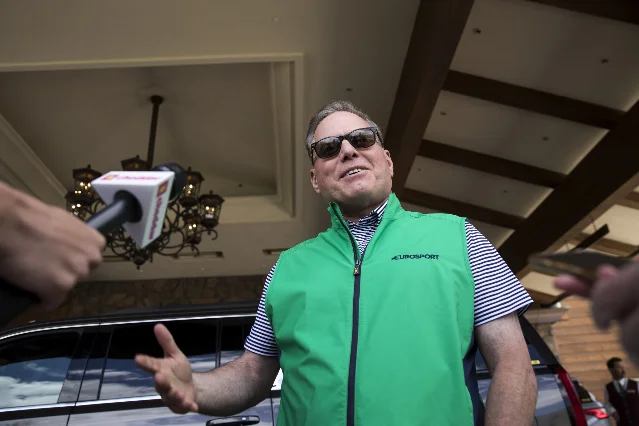
David Zaslav speaks to media following the announcement of the AT&T WarnerMedia–Discovery deal
David Zaslav at the May 2021 announcement of the WarnerMedia–Discovery combination, which effectively unwound AT&T's vertical integration strategy. 19

Frameworks you can use

The break-up fee as a revealed preference test

Every large M&A agreement includes two break-up fees: the buyer's reverse break-up fee (payable if regulatory or financing conditions are not met) and the seller's break-up fee (payable if the seller accepts a superior offer). The ratio between them is a hard signal of where each party actually sees the primary deal risk.
AT&T's $500M reverse break-up fee on an $85.4B deal — 0.59% of transaction value — is an unusually small number. Compare it to the $1.725B Time Warner would owe if it took a better offer. That ratio (1:3.45 in favor of buyer protection) meant AT&T was pricing the risk of a competing bidder roughly three times higher than the risk of regulatory failure. In hindsight — given that Apple had already walked away and no competing bid emerged — AT&T's negotiators had the regulatory risk exactly backwards. 3
Application: Before signing any large deal, map all contingency fees and their ratios. If a party is systematically underpricing one class of risk, the break-up fee structure will show it — before your lawyers do.

Raised-rival-cost theory and the arbitration commitment as a preemptive concession

The DOJ's "raising rivals' costs" theory is now a standard lens for analyzing vertical mergers: if Company A acquires a critical input supplier, it can threaten to withhold that input from Company A's downstream competitors, raising their costs. The theory does not require the withholding to actually happen — it requires only that the threat is credible enough to shift the negotiating table.
Turner's move to offer irrevocable arbitration commitments to 1,000 distributors one week after the DOJ sued was a genuine strategic insight. It didn't eliminate the theory of harm, but it introduced a costly rebuttal: Shapiro's model had to either incorporate the arbitration offer (which required, in his own words, "a completely different model") or proceed without it and accept the resulting methodological gap. The arbitration offer was what Judge Leon called "the icing already on the cake." 12
Application: In any negotiation involving regulated assets or government counterparties, a preemptive structural concession that addresses the regulator's core concern — made before the formal enforcement action, not after — is worth far more than the same concession offered under legal duress. The Comcast–NBCU deal (2011) used behavioral remedies including mandatory arbitration at the time of approval; AT&T offered them unilaterally mid-litigation. Same tool, very different timing, same result.

Comparative advantage as the pre-deal due-diligence question

Investment banker Bruce Wasserstein's counsel, as distilled by the Harvard Program on Negotiation: before paying a premium, ask whether you possess a genuine comparative advantage — specific knowledge, capability, or access that justifies the price and that no other buyer could replicate. 20
AT&T's answer to this question, in hindsight, was "no." It could distribute content. So could every other MVPD, every streaming service, and every mobile carrier. AT&T lacked the creative expertise, the talent relationships, and the operational philosophy to develop or retain premium content. The company's core business was as an MVPD (multichannel video programming distributor) — a category that includes cable, satellite, and telco-TV providers — not a content creator or curator. Mitch Zacks, president of Zacks Investment Management, put it bluntly at the time: "AT&T is paying more for Time Warner than any other entity is willing to pay. It's paying more than even Apple was willing to pay... So by definition it's overpaying." 20 Apple — which had been in preliminary discussions with Time Warner — had a credible argument for comparative advantage in hardware, software, and consumer experience. It chose not to bid.
Application: The question is not "can we afford this?" or "does the strategy sound right?" It is: "Is there something specific we can do with this asset that a competitor cannot?" If the answer requires a chain of assumptions about synergies that have never been observed at scale, the comparative advantage may be theoretical.

Winner's curse and the discipline of walking away

The winner's curse describes a consistent empirical pattern in competitive auctions: because the highest bidder is often the most optimistic about asset value, and because optimism systematically outruns intrinsic value, the winning bid tends to exceed the true worth of the asset. 20
AT&T's $107.50/share offer represented a significant premium to Time Warner's pre-announcement trading price and to Fox's prior $85/share approach. The premium was partly justified by the strategic logic Stephenson articulated — but that logic assumed AT&T could execute a transformation that no telecommunications company had successfully completed in a media environment moving at streaming speed.
Application: The winner's curse is most dangerous when the asset being bid on is unique (only one Time Warner) and the acquirer's own internal optimism about post-merger execution is the primary justification for the premium. The discipline is not to avoid winning — it is to set a reservation price before the auction opens and then hold it, even when competitive pressure makes raising the bid feel rational.

What to remember

  • Winning in court is not the same as winning the deal. AT&T's legal victory was genuine and well-earned. Its strategic defeat was equally genuine. These two outcomes can coexist because the courtroom tests a theory of competitive harm, not a theory of value creation.
  • The break-up fee structure reveals actual risk pricing. AT&T paid a $500M regulatory risk premium on an $85.4B deal — 0.59% of transaction value. That figure should have triggered a harder internal conversation about whether the regulatory scenario was truly as unlikely as the number implied.
  • Preemptive concessions in regulated deals have asymmetric value. Turner's irrevocable arbitration offer — made one week after the DOJ sued, not two years earlier — was legally effective but strategically late. The same concession offered at announcement would have reduced the probability of litigation and preserved 18 months of management bandwidth.
  • Expertise gaps in creative industries are not closeable by reorganization alone. AT&T's approach to the WarnerMedia integration assumed that competent managers could run any business. The executives it lost — Plepler, Martin, Tsujihara — had spent decades building relationships, brand identity, and creative judgment that do not transfer through an org chart.

Cover image: Time Warner headquarters, Manhattan. Image from AT&T Agrees to Buy Time Warner for $85.4 Billion (The New York Times)

参考ソース

  1. 1NPR: Judge Approves AT&T's $85 Billion Merger With Time Warner
  2. 2Fortune: AT&T's Warner Media debacle broke the two most fundamental principles of M&A strategy
  3. 3AT&T SEC Form 8-K (October 22, 2016)
  4. 4AT&T–Time Warner Merger Announcement (SEC Exhibit 99.1)
  5. 5CNBC: DOJ antitrust chief blocking AT&T–Time Warner deal didn't see a problem with it a year ago
  6. 6CNBC: DOJ demands sale of CNN or DirecTV
  7. 7NPR: Justice Department Sues To Block AT&T's Merger With Time Warner
  8. 8Fortune: AT&T and Time Warner's Antitrust Trial Starts With Clashes Over 'Startling' Employee Admissions
  9. 9DOJ Case Page: U.S. v. AT&T Inc., DirecTV Group Holdings, LLC, and Time Warner Inc.
  10. 10D.C. Circuit: United States v. AT&T, Inc., No. 18-5214 (D.C. Cir. Feb. 26, 2019)
  11. 11The New York Times DealBook: AT&T Agrees to Buy Time Warner for $85.4 Billion
  12. 12Courthouse News: Judge Approves AT&T Buyout of Time Warner, Condition-Free
  13. 13The Federalist Society: AT&T/Time Warner Decision — The Triumph of Economic Analysis (Wright & Rybnicek)
  14. 14Georgetown Law: Salop, "How Judge Leon Garbled Professor Nash" (abstract)
  15. 15ProMarket: No Fair Hearing for the DoJ in the AT&T–Time Warner Decision (Sagers)
  16. 16CNBC: John Stankey WarnerMedia CEO one year profile — departures, silos
  17. 17Vox/Recode: Why HBO's Richard Plepler is leaving AT&T
  18. 18STL Partners: Lessons from AT&T's bruising entertainment experience
  19. 19NYT: Discovery and AT&T — How a Huge Media Deal Was Done
  20. 20PON Harvard: Taking the Plunge — How a Controversial Business Partnership Agreement was Born

このコンテンツについて、さらに観点や背景を補足しましょう。

  • ログインするとコメントできます。