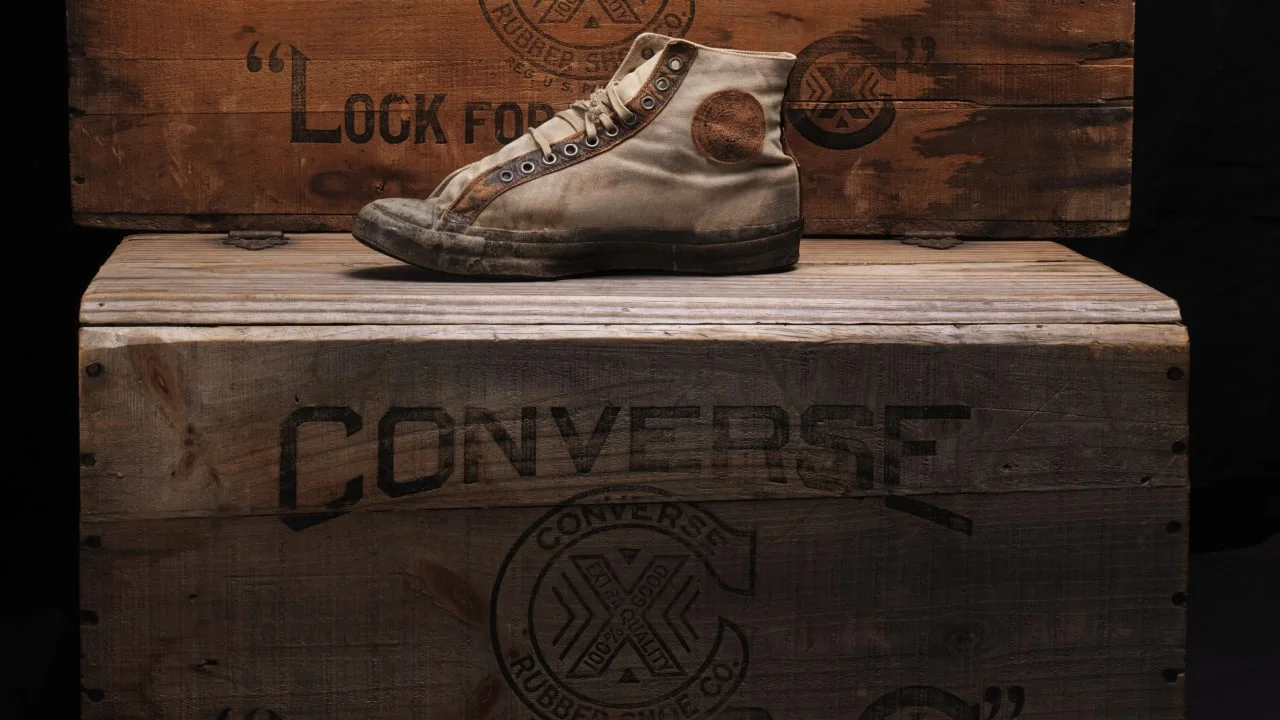
Converse: The Rubber Boot Company Whose Salesman Became the Product
In 1908, a former footwear factory manager opened a rubber boot company in Massachusetts to avoid the industry's monopolies. The seasonal cash-flow problem he solved by adding a basketball shoe in 1917 — and the salesman whose name went on it in 1932 — turned out to be the entire story. This is how a galoshes company went bankrupt, got rebuilt by a walking salesman, went bankrupt again in 2001, and was bought by Nike for $309 million in 2003.

In February 1908, a 47-year-old footwear factory manager named Marquis Mills Converse opened a small company in Malden, Massachusetts. His ambition was modest: he wanted to make rubber-soled shoes outside the grip of the industry's existing monopolies. The first products weren't sneakers. They were galoshes — waterproof winter boots. On April 30, 1909, the company produced its first ten pairs.1
The galoshes sold well in winter, then didn't sell at all in summer. To keep his skilled workers employed year-round, Converse needed a warm-weather product. In 1910, the company introduced a canvas tennis shoe. It sold fine. But the real move came when Converse spotted a faster-growing sport that needed a specialized shoe.
Basketball had been invented in Springfield, Massachusetts — just over the state line — in 1891. By 1916, it had spread to colleges, YMCAs, and factories across the country. In 1917, Converse introduced the All-Star: a high-top canvas shoe with a non-skid rubber sole, patented diamond tread, and a reinforced ankle patch. The company promoted it as the "All-American Basket-Ball Shoe."2
The shoe reached players. The company renamed the model "All Star" in 1919, made the dark brown upper darker — coaches had complained the original tan showed too many scuffs — and kept iterating on the design. Then, in 1922, an Indiana-born basketball player walked into the Converse offices complaining about sore feet.
The salesman whose name went on the shoe
Charles Hollis Taylor, known as Chuck, was not a star athlete. He had played semi-professional basketball and had a talent for coaching. What he was, more than anything, was a convincer. Converse gave him a job as a salesman and sent him on the road.3
Over the next few years, Taylor drove from gym to gym across the United States — setting up basketball clinics, coaching high school and college teams, handing out shoes. He was, in effect, a field sales rep who doubled as a product consultant. He also pushed Converse to redesign the shoe's support and flex, based on what he was hearing from the players he coached.4
In 1932, Converse added Taylor's signature to the ankle patch. The shoe became the Chuck Taylor All-Star — the first celebrity-endorsed athletic shoe in history, except that "celebrity" is a stretch. Chuck Taylor was not famous outside of basketball circles. He was a salesman. His name went on the shoe because he was the face of the product on the road, and because Converse recognized that his personal relationships with coaches and players were the actual sales mechanism.
Taylor kept working for Converse until shortly before his death in 1969. By then, the shoe that carried his name was the dominant basketball shoe in the country, worn by athletes from high school to the Olympics.
From sport to subculture
The data on the Chuck Taylor's market position in the mid-20th century is not subtle. By the early 1960s, Converse had captured 70 to 80 percent of the American basketball shoe market.5 In 1962, Wilt Chamberlain scored 100 points in a single NBA game — still the record — wearing Converse All-Stars.6 The shoe was the official footwear of the U.S. men's basketball team at the Olympics from 1936 through 1968.
Then basketball moved on, and the Chuck Taylor stayed put.
In 1957, Converse had introduced a low-top version of the shoe. It found an unexpected audience: "sidewalk surfers" — the early skateboarders of Southern California who needed a flat rubber sole with grip. The shoe's diamond-tread outsole, designed to stop NBA players from slipping on hardwood, turned out to work perfectly on concrete and pavement. The canvas upper broke in fast. Skaters adopted it without any marketing effort from Converse.2
Through the 1960s and 1970s, the Chuck Taylor drifted from basketball courts into the wardrobe of musicians, artists, and teenagers with no interest in sport. Punk bands in the late 1970s wore them partly because they were cheap — around $10 a pair — and partly because the association with street basketball was exactly the kind of unglamorous working-class reference that suited the aesthetic. Marc Jacobs used them for his 1992 Perry Ellis "Grunge" collection. They have appeared in more than 650 films.6
None of this was strategy. The product had not changed. What changed was that the basketball market had moved beneath it.
The corporate revolving door
While the Chuck Taylor was becoming a cultural object, the company that made it was passing through a series of owners who treated it largely as a cash flow problem.
In 1939, following an earlier bankruptcy, Converse was sold to the Stone Family, who ran it as an independent business for three decades.6 During World War II, the company shifted production to rubberized military footwear — boots, outerwear, protective suits — before returning to athletic shoes after the war.
In 1972, the Eltra Corporation acquired Converse. Eltra simultaneously attempted to buy PF Flyers from B.F. Goodrich, which would have given it control of the two leading canvas athletic shoe brands in the U.S. Federal courts blocked the deal as a monopoly. Converse retained only the Jack Purcell trademark from the settlement.6
Eltra was acquired by Allied Corporation in 1979. Allied had no appetite for consumer products and in 1986 sold Converse to Interco Incorporated, a furniture and footwear conglomerate. Interco spun off Converse as an independent company in 1994.7
None of these ownership changes produced a coherent competitive response to what was actually happening to the brand. By the mid-1970s, Puma, Adidas, and — critically — Nike were taking athletic shoe market share with purpose-built running and training shoes. Reebok pushed further in the 1980s. Converse lost its NBA contract. The company had built its market position on a single product, and that product was now being sold as nostalgia rather than performance.
By 2000, ESPN reported that Converse had accumulated $180 million in debt, and the announcement of the company's collapse "is merely a formality."8
On January 22, 2001, Converse filed for bankruptcy. On March 30, 2001, its last U.S. manufacturing plants closed. The Lumberton, North Carolina factory — which had produced 8 to 10 million pairs of Chuck Taylors per year — sent home its 475 employees.9
Nike and the $309 million bet on a name
In April 2001, a private equity group called Footwear Acquisitions — led by investors Marsden Cason and Bill Simon — purchased the Converse brand out of bankruptcy and installed a new management team.10
Two years later, Nike came in.
In July 2003, Nike paid $309 million to acquire Converse — a price that puzzled some observers at the time. The Wall Street Journal quoted the deal at approximately $305 million; Converse had been a bankrupt company with a single dominant product, no U.S. manufacturing, and revenues that had been declining for over a decade.11
The logic was not hard to read. Nike was paying for cultural residue. The Chuck Taylor had become — through no particular design effort by any of its corporate owners — one of the most recognized shoes on earth, worn by musicians, skaters, film characters, and people who had never played basketball and never intended to. That kind of brand equity doesn't get built by a marketing department. It accumulates over decades.
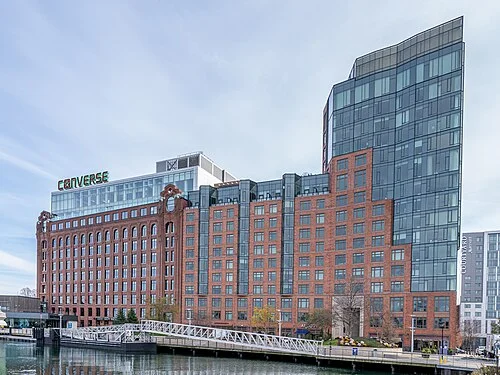
Under Nike, Converse was repositioned as an independent subsidiary with its own headquarters — eventually a purpose-built 10-story building on Boston's Lovejoy Wharf, with a music recording studio, a gym, and a flagship store. Production stayed overseas. Nike technology was folded in: the Chuck II, released in 2015, kept the classic silhouette but added a Nike-engineered insole. In 2019, Converse re-entered performance basketball with the All Star Pro BB, signing NBA players including Shai Gilgeous-Alexander and Draymond Green.
The revenue arc under Nike
For a decade after the acquisition, Converse performed consistently within Nike's portfolio. Revenue grew from a low base to $2.4 billion in Nike's fiscal year 2023 — representing less than 5% of Nike's total revenues but a genuinely significant business for what had been a bankrupt brand twenty years earlier.12
Then the numbers reversed sharply. In fiscal year 2024, Converse revenues fell to $2.1 billion, down 14 percent, as the brand lost market share to competitors in the lifestyle sneaker space.13 In fiscal year 2025, revenues declined further to $1.7 billion, down another 19 percent — the steepest two-year drop since the Nike acquisition.14
In August 2025, Converse's president and CEO Jared Carver stepped down and was replaced by Aaron Cain, a 21-year Nike veteran.6
The brand's current challenge is the inverse of its earlier one. In the 1970s and 1980s, the Chuck Taylor was considered outdated by performance standards but was being quietly adopted by subcultures. Now it has broad mainstream recognition but faces competition from a new wave of lifestyle brands that have built their own cult around similar price points. The design hasn't changed. The question is whether the accumulation of cultural residue from a century of associations — basketball, punk, art, skate — still carries the same weight when every brand is trying to manufacture the same effect.
Marquis Mills Converse opened a rubber boot factory in Malden in 1908 to solve a seasonal revenue problem. He couldn't have known that a canvas shoe made to grip a basketball court in 1917 would still be the company's primary product in 2025, or that its best salesman's signature would outlast the brand's independence, both of its bankruptcies, and four different corporate owners. The Chuck Taylor is now 108 years old. It has 136 retail locations worldwide.6 The design is essentially unchanged.
参考ソース
- 1Converse History & Timeline
- 2The True History of the Chuck Taylor All Star — Nike
- 3Chuck Taylor — The Naismith Basketball Hall of Fame
- 4Chuck Taylor Converse All Star: The Man Who Made the Shoe — Indiana Historical Society
- 5Chuck Taylor All-Stars — Wikipedia
- 6Converse (brand) — Wikipedia
- 7International Directory of Company Histories — Funding Universe
- 8Converse Nears Corporate Extinction — ESPN
- 9Converse closes Chuck Taylor plant — Billings Gazette / AP
- 10Getting Sneaker Maker Converse Back on Its Feet — Los Angeles Times
- 11Nike Purchasing Converse, A Legend on the Blacktop — New York Times
- 12Nike 2023 Form 10-K — Nike, Inc.
- 13NIKE, Inc. Reports Fiscal 2024 Full Year Results
- 14NIKE, Inc. Reports Fiscal 2025 Full Year Results
このコンテンツについて、さらに観点や背景を補足しましょう。