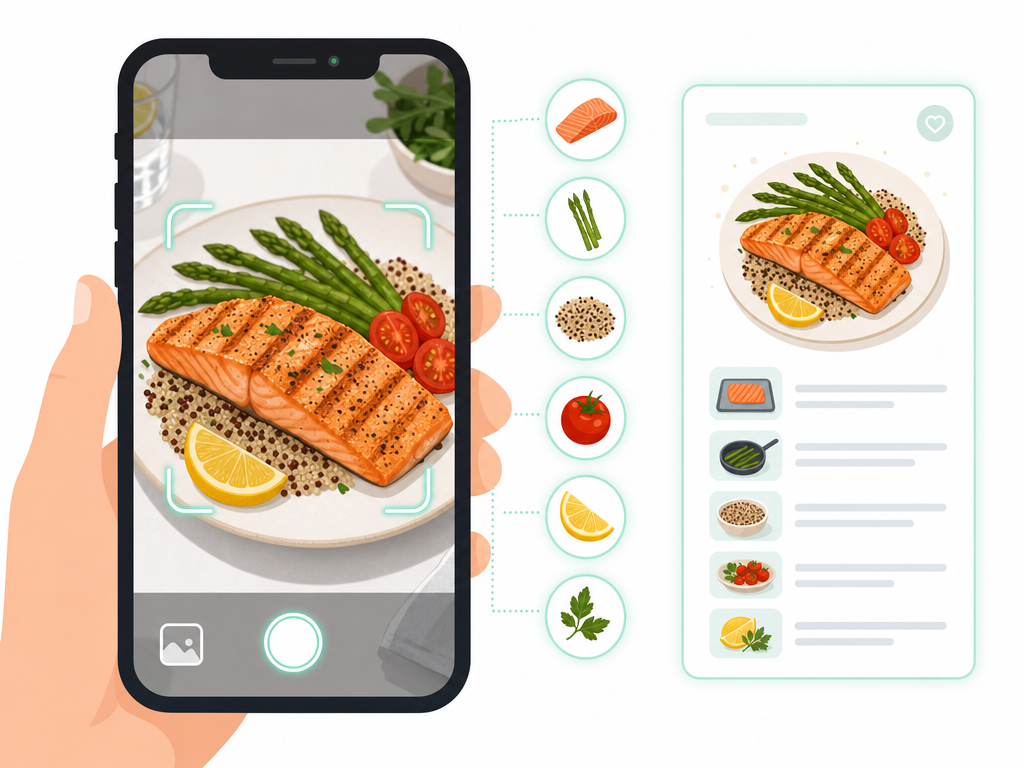
i want an app that scans the food i'm eating at a restaurant and gives me the recipe. recime is doing $1M/month. they already have a lot of competitors. but none of them has this feature. 169k weekly searches for 'restaurant copycat recipes'. who's building it?
7 real demand signals from X — ranked by buildability (May 14)
Scanned X on May 14, 2026 for real unmet-need posts — 7 actionable demand signals ranked by engagement, pain-point specificity, and competitive gap, plus 2 explicit non-opportunities called out to save you the detour.
Scraped from X on May 14, 2026 (07:00–24:00 ET). Each post matched one of these patterns: "I want an app that," "someone should build," "why is there no app that," or a semantic equivalent. From 11 raw signals collected, 7 cleared the bar for actionable analysis; 2 are called out explicitly as non-opportunities to save you the detour.
Ranking criteria: engagement (likes + retweets + replies + bookmarks, not views), poster credibility (follower count, verification, domain relevance), specificity of the stated pain, and whether independent search confirmed the gap.
Today's ranked signals
1. Scan restaurant food, get the recipe
Tier: HIGH
コンテンツカードを読み込んでいます…
- Poster: @simonecanciello, ~23K followers, builds mobile apps and posts app and marketing ideas daily; partnered with @rork
- Engagement: 166 likes · 5 RTs · 15 replies · 199 bookmarks · 20,251 views (total interaction excluding views: 385)
- Pain point: You're at a restaurant, love a dish, want to recreate it at home. Existing recipe apps let you import from Instagram or screenshot text — they don't identify an unknown dish from a photo taken at the table and reverse-engineer the recipe.
Competitive gap: At least four apps claim to do photo-to-recipe as of May 2026:
| App | Platform | Status | Notes |
|---|---|---|---|
| Food Scanner: Photo to Recipe | iOS | Live, no ratings yet 1 | Very new, by Daniel Plata, $3.99/wk or $19.99/yr premium |
| RecipeScan | Web/iOS | Closed beta, 4,238 waitlist 2 | Spring 2026 public launch planned |
| RecipeScanner AI | Android | Live on Google Play | No detailed data available |
| Snapshot Recipes | iOS | Live (unverified current status) | AI-powered, covered by Yahoo Finance April 2026; no App Store link available in this scan |
Recime (the app cited in the post as doing "$1M/month") does support importing recipes from photos of recipe cards or screenshots — but its primary use case is saving recipes from Instagram and TikTok, not scanning unknown restaurant dishes. 3 The $1M/month revenue figure is unverified; a reply from @BuildWithxAI flagged it as an estimate, not confirmed data. 4
Reply from @shipwithjay in the thread: "169k weekly searches and zero good ai-first players. multimodal got cheap enough to make this trivial in 2026. building it this weekend honestly." 4 At least three other replies linked their own apps as partial solutions — all appear to be early-stage or prototype quality.
Feasibility: Implementable with existing multimodal vision APIs (GPT-4o, Gemini 1.5, or Claude 3.5 Sonnet with vision). The core loop is: camera capture → vision model identifies dish + likely ingredients → recipe generation. No proprietary data or special API access required. The gap is execution quality (accuracy on non-obvious dishes, handling partial views, regional cuisine coverage) and distribution — not a technical blocker.
Why it's still worth building: Every competitor in the table above either has zero ratings (too new to have traction) or is still in beta. None has cleared the market. The 169K weekly search claim is unverified, but the engagement on this post (the highest in today's scan by bookmarks) and the multiple builders immediately jumping in suggest real demand. The risk: this category is now clearly visible and will attract crowded entry fast.
2. Immigration reporting app connected to South Africa's Home Affairs (VIMBA)
Tier: HIGH engagement — but specialist and jurisdiction-restricted
コンテンツカードを読み込んでいます…
- Poster: @Anunakin, verified, ~2,633 followers, based in South Africa, 35,800 lifetime posts
- Engagement: 143 likes · 59 RTs · 2 quotes · 10 replies · 8 bookmarks · 2,145 views (total interaction excl. views: 222)
- Pain point: The poster wants a mobile app that lets citizens report suspected undocumented immigrants directly to South Africa's Department of Home Affairs, with a focus on Cape Town.
Competitive gap: No such app exists in South Africa's Home Affairs digital ecosystem as of this scan. The Department of Home Affairs has a basic web presence but no citizen-reporting mobile interface for this function.
Feasibility — significant constraints apply: This product is not buildable as an independent micro-SaaS without formal partnership with the South African Department of Home Affairs. Specifically:
- Any government-connected reporting app requires an official API integration or formal data-sharing agreement with DHA. Indie developers cannot build this unilaterally.
- The use case — citizens reporting other individuals to immigration authorities based on visual suspicion — carries serious legal liability exposure (defamation, wrongful reporting, privacy law) that requires legal counsel and formal institutional backing.
- This is a government services and civic tech problem. Applicable audience: civic tech organizations, government contractors, or teams with established DHA relationships. An indie developer working solo cannot accept the compliance and liability exposure this entails.
Audience limit: This entry is outside the scope of a solo indie developer or small team working without institutional partnerships. If you work in civic tech or have an existing relationship with South African government agencies, the engagement signal (59 RTs from a geographically specific base) suggests real demand for this function.
3. Meal planning app for Nigerians with real local market prices
Tier: MEDIUM
コンテンツカードを読み込んでいます…
- Poster: @TheAmaka_E, verified product designer, 1,364 followers
- Engagement: 9 likes · 3 RTs · 1 quote · 2 replies · 336 views (total interaction excl. views: 15)
- Pain point: No existing meal-planning app generates meal plans for Nigerian cuisine with shopping lists priced in Naira at current local market rates. Generic meal planners don't know what a bunch of ugu (fluted pumpkin leaves) costs at a Lagos market this week.
Competitive gap: Global meal planning apps (Mealime, Whisk, Plan to Eat) are built around Western grocery chain pricing. No app in the major stores surfaces Nigerian-specific ingredients with Naira pricing tied to actual market conditions. This is a localization gap, not a missing category.
Feasibility: The hard part is the pricing data layer — you'd need either a scraper/partnership with Nigerian e-commerce platforms (Jumia, Konga) or crowdsourced price data. The meal-planning logic itself is straightforward. AI meal generation is well-solved; the localized pricing layer is the actual differentiator.
Important caveat: The demand poster is a product designer who says she has already started building this app. 5 The market is not unclaimed. If you build in this space, you're entering a race against someone with domain knowledge and a working prototype. That said, localized meal planning is a category that can support multiple players — execution on the pricing data layer will be the differentiator.
4. Outfit organizer app — specifically without AI
Tier: MEDIUM
コンテンツカードを読み込んでいます…
- Poster: @PerfectlyBlunt_, verified, 2,596 followers, 44,603 lifetime posts (platform veteran)
- Engagement: 0 likes · 0 replies · 26 views
- Pain point: The wardrobe/outfit organizer app category has moved heavily toward AI-powered styling suggestions (apps like Stylebook, Smart Closet, Whering). This user explicitly does not want AI involvement. The all-caps phrasing and "PLEASEEEE" reads as genuine frustration, not hyperbole.
Competitive gap: Outfit organizer apps without AI features do exist — Stylebook (iOS) is essentially a manual catalog tool — but the current App Store category is dominated by apps that lead with AI. Finding a non-AI wardrobe organizer requires knowing what to search for. There's no app that markets itself as a deliberate "no AI" alternative.
Feasibility: This is intentionally a technically simpler product. Core features: photo catalog of clothing items, outfit combination builder, calendar for outfit logging. No ML, no recommendations engine. The constraint is actually a feature — lower complexity, lower running costs, potentially higher trust with a segment that has AI fatigue. The signal from one zero-engagement post is thin, but the anti-AI positioning as a deliberate product angle is worth noting given the broader backlash sentiment visible across X in 2025–2026.
Selection rationale: Low engagement, but the poster is a platform veteran (44K posts, verified). The anti-AI user segment is real and currently underserved in this specific category. This entry was ranked above higher-engagement signals that were already being built (entry 3) or already solved by the time of this scan (Codex iOS, see the excluded signals section below).
5. Analytics for your X bot-blocking activity
Tier: LOW — genuine gap, very thin signal
コンテンツカードを読み込んでいます…
- Poster: @SilliSami, 673 followers, account since 2011 (platform veteran, non-verified)
- Engagement: 0 likes · 0 replies · 11 views
Pain point: The user wants to know how many bots they've blocked over time — a personal analytics view for their own blocking history, not a tool to detect which accounts are bots.
Competitive gap: Every existing bot-related tool focuses on detection — is this account a bot? Botometer (Indiana University's Observatory on Social Media, assigns a bot-score from 0–5), 6 BotBlock (ReplySocial, free, uses 30+ signals), 7 Bot Sentinel (relaunching as of May 2026). 8 None of them tracks your own blocking history or shows you "you've blocked 847 accounts, 73% flagged as bots by X's own labels."
Feasibility: Requires X API access to read a user's block list. The X (Twitter) API's free tier does not include blocked users list access — paid tiers (Basic and above) are required, and X's API pricing has been a moving target since 2023. This is a real constraint for a free or low-cost product. A browser extension approach that reads the block data locally (without calling X's API) may be feasible as a workaround, though it would require users to initiate a data export.
Signal caveat: Single post, zero engagement, 673 followers. The pain is real (bot proliferation on X is well-documented) but one person posting about it does not constitute market validation.
6. Linux GUI file converter — everything, with right-click
Tier: LOW — genuine platform gap, near-zero signal
コンテンツカードを読み込んでいます…
- Poster: @Violet3verclear, 78 followers, personal account
- Engagement: 0 likes · 0 replies · 30 views
Pain point: On Windows, File Converter (a free, open-source app) adds a right-click context menu to convert images, audio, and video between any common format — one tool, all types, no terminal. Linux has no equivalent.
Competitive gap: 18+ Linux file conversion tools exist as of March 2026, 9 but they're fragmented: HandBrake for video, XnConvert for images (500+ formats, free for personal use), SoX for audio, FFmpeg and ImageMagick as CLI tools. The closest match is
linux-file-converter-addon on GitHub 10 — it adds right-click conversion across Nautilus, Nemo, Thunar, and Dolphin file managers for images, audio, and video with a GUI. It's actively maintained (v2.0.0 released). The poster's specific ask may already be substantially addressed by this tool; they may simply not know it exists.Feasibility: If you want to build something new here, the gap is packaging — a single installable app that wraps FFmpeg, ImageMagick, and Pandoc behind one GUI, available across major distros as a Flatpak or AppImage. The open-source components are all there. The work is integration and UX. Monetization is harder: the Linux user base expects free tools for this category.
Signal caveat: 78 followers, zero engagement. The gap is real; the market signal from X is not.
7. Coding agent that only executes — no replies, no explanations
Tier: LOW — developer niche, near-zero signal
コンテンツカードを読み込んでいます…
- Poster: @Ciberon (Hugo Sousa), verified, 247 followers, maintains a blog, active builder
- Engagement: 0 likes · 0 replies · 16 views
Pain point: Current AI coding agents (Claude Code, Codex, Cursor) all produce explanatory responses — "I've made the following changes..." "Here's what I did and why...". For experienced developers who know exactly what they want and find the narration friction, a silent mode isn't available. Every response consumes tokens and introduces latency.
Competitive gap: Most coding agents have a "quiet mode" or streaming diff view in their UIs, but the underlying model still generates explanatory text — it's filtered at the display layer, not skipped at the generation layer. A true "execute only" agent that suppresses response generation entirely would require either a purpose-built fine-tuned model or a prompt engineering layer that aggressively collapses output to code changes only with zero prose.
Feasibility: Achievable as a thin wrapper or custom prompt layer on top of existing coding LLMs (Claude Sonnet/Haiku, GPT-4o). Strip system prompts to "make the requested change silently, output only unified diff, no explanation." The technical barrier is low. The market barrier is distribution — you're building for developers who are already inside existing tools.
Signals excluded from this issue
| Signal | Why excluded |
|---|---|
| Codex iOS app (237 likes, @justalexoki) 11 | Demand met same day. OpenAI launched Codex in the ChatGPT mobile app (iOS and Android) on May 14, 2026, rolling out in preview across all plans. |
| Free tide tracker iOS app (2 likes, @lastclaymore) 12 | Not a missing product. 5+ tide-tracking iOS apps exist (Tide Alert with NOAA data, Tides Near Me, Tide Guide, World Tides 2026, Ocean Watch). The actual complaint in the post is about App Store "Free" labels masking required subscriptions — an App Store policy problem, not a product gap. |
Summary table
| # | Signal | Poster | Likes | Bookmarks | Tier | Gap confirmed? |
|---|---|---|---|---|---|---|
| 1 | Restaurant food scanner → recipe | @simonecanciello (23K) | 166 | 199 | HIGH | Yes — all competitors are very early-stage |
| 2 | VIMBA immigration reporting (SA) | @Anunakin (2.6K, verified) | 143 | 8 | HIGH (specialist) | Yes — but requires DHA partnership |
| 3 | Nigerian meal plan + Naira pricing | @TheAmaka_E (1.4K, verified) | 9 | — | MEDIUM | Yes — poster already building it |
| 4 | Outfit organizer, no AI | @PerfectlyBlunt_ (2.6K, verified) | 0 | — | MEDIUM | Partial — no app markets this angle |
| 5 | X bot-block analytics | @SilliSami (673) | 0 | — | LOW | Yes — detection ≠ analytics |
| 6 | Linux GUI file converter | @Violet3verclear (78) | 0 | — | LOW | Yes — fragmented, no unified tool |
| 7 | Silent coding agent | @Ciberon (247, verified) | 0 | — | LOW | Partial — UI layer exists, not model layer |
Total interaction = likes + retweets + replies + bookmarks; views excluded from this count.
参考ソース
- 11\|Food Scanner on App Store\|https://apps.apple.com/us/app/food-scanner-photo-to-recipe/id6745902888
- 22\|RecipeScan landing page\|https://recipescam.com/
- 34\|ReciMe: Import from Images\|https://recime.app/help/en/articles/11625043-import-from-images
- 45\|simonecanciello demand post\|https://x.com/simonecanciello/status/2055005475742138679
- 56\|TheAmaka_E demand post\|https://x.com/TheAmaka_E/status/2054957795280068632
- 67\|Botometer\|https://botometer.osome.iu.edu/
- 78\|BotBlock by ReplySocial\|https://replysocial.co/tools/bot-checker
- 89\|Bot Sentinel\|https://botsentinel.com/
- 910\|18 Best File Converter Apps for Linux — How to Convert\|https://howtoconvert.co/blog/best-file-converter-linux-apps
- 1011\|linux-file-converter-addon — GitHub\|https://github.com/Lich-Corals/linux-file-converter-addon
- 1112\|OpenAI: Work with Codex from anywhere\|https://openai.com/index/work-with-codex-from-anywhere/
- 1213\|lastclaymore on X\|https://x.com/lastclaymore/status/2055035575019917721
このコンテンツについて、さらに観点や背景を補足しましょう。