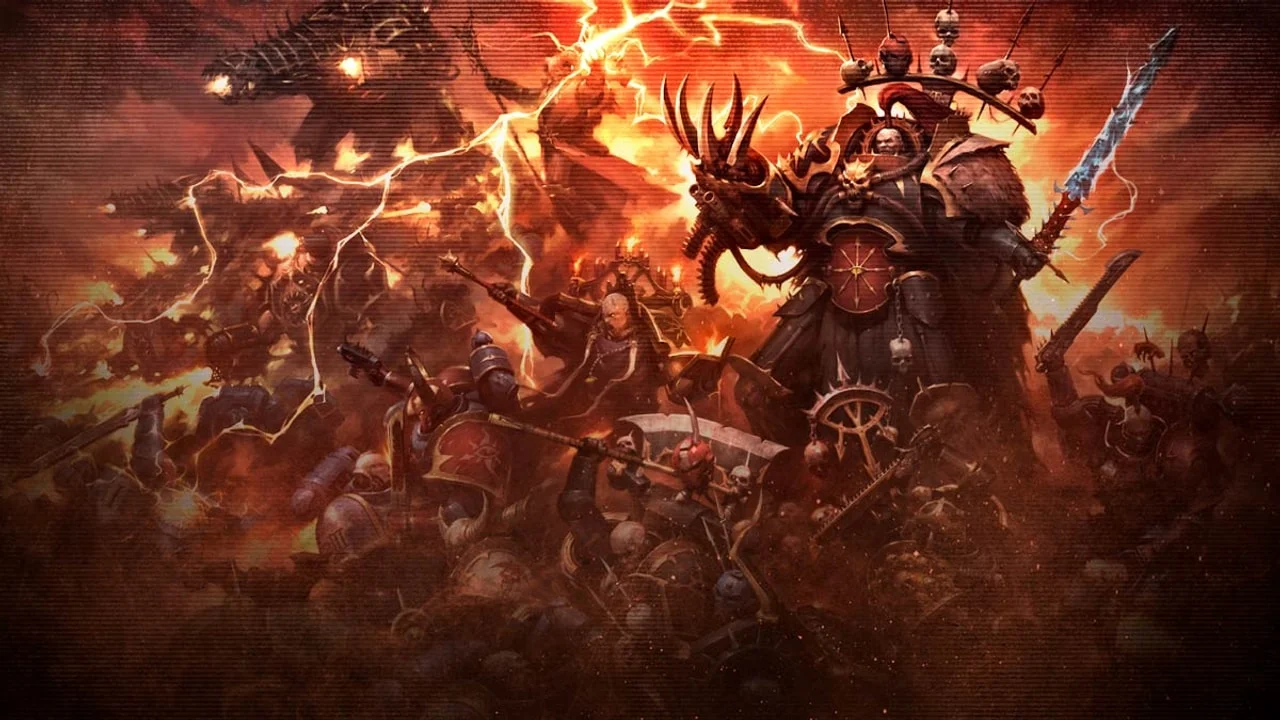
Abaddon the Despoiler, Part I: The First Captain
Part I of the Abaddon arc — from his origins as the firstborn son of a Cthonian gang warlord and his induction into the Luna Wolves, through his rise to First Captain and Mournival member, his pivotal role in the Horus Heresy's worst atrocities, to his post-Heresy exile and the Battle of Harmony that forged the Black Legion.
"I am the Arch-fiend, the Despoiler of Worlds, and by my hands shall the false Emperor fall." — Ezekyle Abaddon
He is not a fallen Primarch. He carries no divine spark, no genetic inheritance from the Emperor's direct lineage. Ezekyle Abaddon began as a gang-fighter on a dying hive world, rose to command the most feared Legion in the Great Crusade, watched the cause he served collapse under the weight of his Warmaster's corruption, and then — alone, stripped of purpose — rebuilt something darker and more deliberate from its ruins. The story of how a First Captain became the Warmaster of Chaos is not one of divine corruption. It is a story of cold, chosen ambition.
This is Part I of the Abaddon arc, covering his origins on Cthonia, his years as the Luna Wolves' foremost warrior and Mournival member, his role in the Horus Heresy's worst atrocities, and the post-Heresy void from which the Black Legion was forged.
Born on a gang world
Cthonia — the homeworld Horus shared with his Legion — was already dying when Abaddon was born there in the late 30th Millennium.1 Its mines had eaten through the planet's crust for generations, and what remained was a civilization of gang-states, where survival meant violence and the only currency was fear.
Abaddon's father, Tarkeraddon, was one of Cthonia's most powerful gang warlords.1 Among Cthonian gangs, coming of age had a specific and brutal meaning: a young heir was expected to execute his closest comrades to prove his readiness for command. Abaddon refused. He killed his father and his father's bodyguards instead, then went into exile rather than take the throne that killing had technically given him.
That refusal tells you something essential about the man he would become. Abaddon did not want kingship — he said so directly when confronted by Hastur Sejanus and another Luna Wolves emissary who found him surviving in exile.1 He was accepted into the Legion, converted into a Space Marine on Luna, and then presented to Horus himself. The Primarch gave him a coin — a gesture that, in Cthonian culture, bound warrior to warlord. From that moment, Abaddon was Horus's man.
What made him exceptional was not the coin but the scale of the devotion behind it. He came to love Horus as a father — replacing the father he had killed — and that emotional weight would shape everything: his loyalty during the Crusade, his choices on Davin's moon, and his final cold verdict on the Vengeful Spirit.
First Captain and the Mournival
The Great Crusade was the largest military endeavour in human history, and Abaddon climbed through it on the strength of a combat record described by his contemporaries as unsurpassed by any other Luna Wolf.1 He became First Captain, commander of the 1st Company — the Legion's blade-edge, its heaviest shock force, armoured in black Terminator plate that marked out the elite from across the XVI Legion.
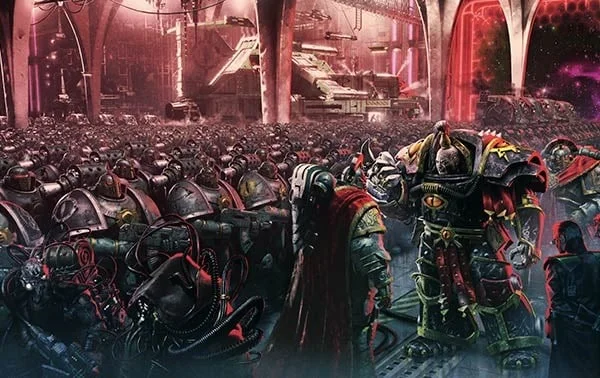
He was also one of the four original members of the Mournival: the informal advisory council that served Horus directly, with authority second only to the Primarch within the Legion.1 The Mournival was designed to give Horus four distinct perspectives — traditionally the hawkish voice, the cautious voice, the pragmatic voice, and the idealistic voice. Abaddon was the hawk, almost without question. He was quick to anger, bellicose by temperament, and frequently the loudest advocate for direct violence where others counselled patience.
That temperament showed most clearly during the Interex encounter in the Crusade's later years. The Interex were a human civilization that had found a way to coexist with Xenos species — heresy to the Crusade's dogma but arguably a functioning society. Horus elected to parley with them rather than attack immediately. Abaddon objected, sometimes violently.1 He wasn't wrong by the standards of Imperial doctrine, but the depth of his hostility pointed to something inflexible running through him — a refusal to tolerate ambiguity when he could simply eliminate it.
The Mournival was also, by all accounts, a genuine brotherhood. Abaddon shared his dry, cutting humour with Tarik Torgaddon, Horus Aximand, and Garviel Loken.1 That brotherhood would fracture, and the fracture would be Abaddon's doing.
The Ullanor proof
During the Ullanor Crusade — the campaign that ended the largest Ork empire humanity had ever encountered — Abaddon demonstrated what made him irreplaceable in a way that even his performance record could not fully capture. He joined Horus and a First Company Terminator detachment in a direct assault on the Ork Warboss Urlakk Urg's command tower. While the bulk of the Terminators held the entrance against the greenskin tide, Horus pushed through to kill the Warboss. When the fighting stopped, Horus found every single Terminator had fallen except for one: Abaddon, barely alive, buried under a mountain of Ork corpses.1
That image — last man standing, half-dead, surrounded by enemies he had killed — became something of a personal myth for the First Captain. He would replay it, in different forms, for the next ten thousand years.
The road to Davin
The Mournival's dissolution began long before Horus fell at Davin's moon. It began with a slow accumulation of resentments, many of which Abaddon felt most acutely.
He was a member of the warrior-lodge operating within the Sons of Horus — one of the informal fraternal networks that the Word Bearer Erebus had quietly seeded throughout the Legions in the years preceding the Heresy.2 Abaddon had grown genuinely furious at what he perceived as the Emperor's abandonment of his Legions — the withdrawal to Terra, the establishment of the Council of Terra, the growing sense that the Space Marines were being reduced to tools while bureaucrats inherited the galaxy they had bled for.
When Horus lay near death after the attack on Davin's moon and the warrior-lodge proposed taking him to the Serpent Lodge for healing, Abaddon went along. He had not yet committed to treason; he had committed to saving his Primarch by whatever means were available.2 That distinction, small as it seems from the outside, mattered to Abaddon. He consistently drew lines between what he would do from loyalty and what he would do from ideology — right up until the lines stopped mattering.
Into the Heresy
After Horus recovered from Davin, Abaddon's transformation accelerated. He became fiercely protective of the Primarch's reputation, seeing any Imperial scrutiny of Legion activities as an attack that needed neutralising. He sanctioned the murder of Ignace Karkasy, the remembrancer poet whose writings had grown uncomfortable, and tried to blame Legion-caused civilian casualties on Garviel Loken.1 Tarik Torgaddon refused to participate, and the Mournival — once a genuine brotherhood — was effectively dead.
When Horus finally came to the warrior-lodge and declared his intent, Abaddon was among the first to swear unquestioning loyalty.1 Not because of daemonic corruption. Not because the Chaos Gods whispered promises. Because Horus asked him, and that had always been enough.
Isstvan III: the last Mournival
The Isstvan III virus-bombing — covered in detail in the Horus arc — targeted the loyalist elements of four Traitor Legions. The Sons of Horus survivors on the surface were men Abaddon had fought alongside for decades: brothers, in the only sense that word meant anything on Cthonia.
Abaddon went down to the surface himself. He did not have to — the virus-bombing and subsequent orbital fire should have done the work. But Garviel Loken was still alive down there, still fighting, and Abaddon came personally for what he chose to frame as the final meeting of the Mournival.1 He dueled Loken. He won, though not without taking wounds.
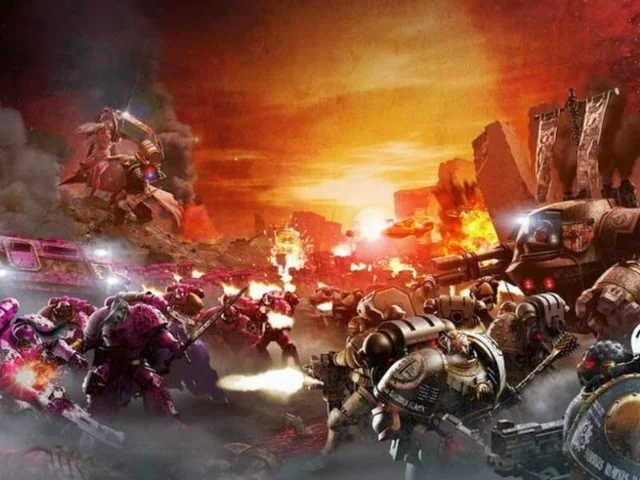
What happened on Isstvan was not just a purge. For Abaddon, it was the permanent closing of an older version of himself. The Mournival had represented something he genuinely valued: honesty, brotherhood, the idea that four warriors could give a Primarch counsel that was not simply flattery. He killed that, along with the man who had embodied it best.
Chasing Leman Russ
After the Drop Site Massacre on Isstvan V, Abaddon's Heresy career was a string of high-intensity missions rather than a single theatre. At the Battle of Trisolian, he was present when Horus was wounded by the Spear of Russ — the weapon Leman Russ had carried in a last, desperate gambit to stop the Heresy.1 The wound drove Horus into a brief state of relative clarity, and Abaddon was shaken to hear his Warmaster express regret for the blood already spilled. That moment — Horus sounding almost like Horus again — unsettled Abaddon more than any Chaos horror he had yet witnessed.
He was then ordered to hunt down the surviving Space Wolves at the Battle of Yarant — to finish what Trisolian had started.1 He failed. The Wolves escaped with aid from Corax of the Raven Guard, and Abaddon returned to the muster at Ullanor without his quarry.
The Solar War and Luna
During the Solar War — the Traitor assault on the Sol System itself — Abaddon was given one of the operation's most critical assignments: capture Luna, the gene-moon of the Space Marines and a key defensive node around Terra.1 He commanded a combined force of Sons of Horus, Word Bearers under Zardu Layak, and Thousand Sons under Ahzek Ahriman. The White Scars fleet under Jubal Khan opposed him; Abaddon boarded and killed Jubal in personal combat during the battle for the warship Lance of Heaven. He then directed a kamikaze attack on Luna's orbital defences, teleporting onto the moon's surface with his Justaerin elite to secure the gene-labs from within — and in the process convinced the Selenar Matriarch Heliosa-78 to defect rather than destroy her precious gene-tech as Rogal Dorn had ordered.1
The Siege of Terra and the fall of Horus
The Siege of Terra is treated fully in the Horus arc. Abaddon's role in it reveals much about how far his thinking had shifted from his Primarch's. By the time the Siege began, Horus spent his days semi-comatose inside Lupercal's Court, his consciousness bloated with Chaos power he could barely contain. Abaddon watched this with open resentment, concluding that his father had become a slave — precisely the fate Horus had rallied against.1
When the Siege needed practical leadership, Abaddon provided it. He led 3,000 Sons of Horus in the assault on Lion's Gate Spaceport, rescued Khârn of the World Eaters when he was stranded behind Imperial lines (Zardu Layak sacrificed himself to hold off Rogal Dorn in the process), and then proposed the infamous Saturnine Gate gambit: an underground assault exploiting a structural flaw Perturabo had identified.1 Perturabo suspected a trap. Abaddon convinced him to allow a Sons of Horus-led assault to take the risk. It was indeed a trap — Loken and Garro were waiting in the tunnels — and the operation failed badly, though Abaddon escaped.
He survived to reach Horus's body after the Emperor struck him down, arriving too late to intervene. He found Garviel Loken waiting beside the Primarch's corpse — his old Mournival brother, alive again after Isstvan.1 Loken offered terms: surrender now, and Dorn would spare the surviving Sons of Horus. Abaddon rejected it, insisting the rebellion had still been just. He was wavering — there are accounts that he genuinely considered rejecting Chaos entirely at that moment — when Erebus stepped from behind Loken and stabbed him through the back, killing him. Abaddon erupted in fury at the murder, but Erebus explained it coldly: Loken's death was necessary to birth the Daemon Samus. The calculus of necessity had replaced the calculus of loyalty.
Abaddon let Erebus live. He re-established command of the Vengeful Spirit, now cut free from the Warp by Horus's death, and ordered the retreat from Sol.
Into the Eye
The retreat into the Eye of Terror was not the beginning of a new crusade. It was a collapse.
The Traitor Legions, denied their victory, turned on each other almost immediately. The Sons of Horus were a particular target — they were the Legion that had led and lost the most — and the Emperor's Children attacked their fortress world of Maeleum, destroyed it, and stole Horus's own body.1 Fabius Bile then created clones of the Warmaster — adolescent, deformed mockeries of the Primarch — as biological experiments.
Abaddon, meanwhile, had simply walked away. Broken by his father's death and sick of a war that had devoured everything it touched, he vanished alone into the Eye of Terror.2 He was gone long enough that the Sons of Horus nearly ceased to exist without him.
What brought him back was news of the cloning. He found the Vengeful Spirit drifting on a dead Eldar world called Aas'ciaral in the Eleusinian Veil, deep in the Eye.1 Three warband leaders had been looking for him: Falkus Kibre, Iskandar Khayon, and Lheorvine Ukris. They found him already assembling forces — he had dispatched the Word Bearer Sargon to bring them to him, which meant the solitude had not been complete paralysis. He had been waiting.
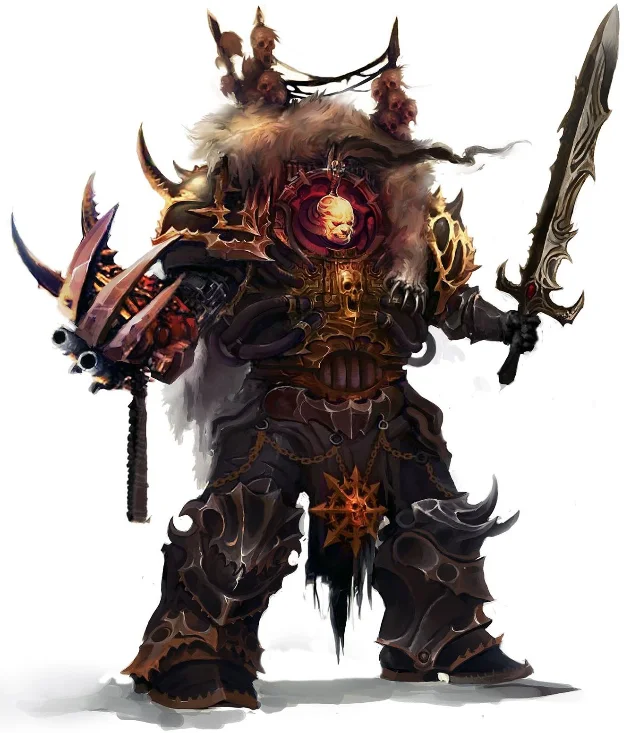
The Battle of Harmony
The Canticle City on the Daemon World of Harmony was where the crisis converged. Fabius Bile's cruiser Fleshmarket was there, carrying its cargo of horrors: deformed clones of all twenty Primarchs.1 Among them, the Horus clone.
Abaddon led the assault, and it was during this battle that he took up the Talon of Horus — the lightning claw-storm bolter hybrid that had been the Warmaster's own weapon, recovered from wherever it had rested since the Siege.1 He boarded the Fleshmarket, put down the Primarch clones, and finally faced the Horus clone itself. He shattered the Primarch's mace Worldbreaker with the Talon, then drove it through the clone's chest.
The clone's last words — recognizing Abaddon as "my son" — were the last time anyone would describe Abaddon that way and live.
"I am not your son," he said, or something close to it. "Not any longer."1
It was the moment he stopped being the inheritor of Horus's legacy and became his own.
Forging the Black Legion
With the Emperor's Children purged from Harmony, Abaddon proclaimed himself not merely the new leader of the Sons of Horus but the successor to the Warmaster's role itself — the inheritor of the Long War.2 The Legion's name changed. The Sons of Horus — a name that tied them to a failure, a slave to the gods, a man who lost — became the Black Legion.
The renaming was not nostalgia management. It was a doctrine. Abaddon had studied exactly where Horus had failed: he had allowed the Chaos Gods to pour power into him until he was consumed, driven comatose at the moment he needed to act. Abaddon resolved never to become a thrall to the Ruinous Powers. He would court their favour, fight under their gaze, accept their gifts — but remain his own general, with his own objectives, in his own body.1
He then went about consolidating power with the same methodical brutality he had applied to everything else. The Word Bearer champion Rynax the Unspoken, the Nurgle lord Purgor the Putrescent, the Slaaneshi sorcerer Hexagalimere — all made examples of, publicly and violently, to show what happened to elements within the Legion that served their god before their Warmaster.1 The Black Legion was going to be an army, not a warband. That distinction cost several senior figures their lives.
What he built and what it cost
Abaddon entered the Eye of Terror as the most capable warrior in a defeated Legion that was eating itself. He emerged from it as the leader of a force that would, over the following ten millennia, mount thirteen Black Crusades against the Imperium — each one more strategically sophisticated than the last.
The arc from gang-fighter to Warmaster of Chaos runs through a series of very deliberate choices: kill the father to avoid becoming him; swear loyalty to a substitute father with total conviction; follow that father into heresy not because the gods demanded it but because the man asked; watch the man become consumed by the power he'd sought; inherit the wreckage; and rebuild it on a principle the original architect never managed to hold — stay free.
Whether that freedom is real or an elaborate self-deception is a question the next two parts of this arc will take seriously. The Black Crusades are coming.
Next: Abaddon the Despoiler, Part II — the Black Crusades, the Gothic War, and the fall of Cadia.
このコンテンツについて、さらに観点や背景を補足しましょう。