Stanford Alumni Moves — Week of May 8, 2026
Stanford CS, GSB, and engineering alumni week of May 8–14, 2026: Kevin Warsh confirmed as Fed Chair, three alumni-founded AI startups (RadixArk, Phia, Inception) dominated venture headlines, and cohort signals tilt heavily toward AI infrastructure and government roles.
Two signals define this week's Stanford alumni activity: an AI infrastructure funding wave and a cluster of government appointments. The ventures moving fastest are building the plumbing beneath AI models, not the models themselves — and on the policy side, two Stanford-affiliated figures stepped into federal roles with direct reach over monetary policy and a national park.
Career moves — Government / Policy
Kevin Warsh — Stanford Class of 1992 (BA in Public Policy), Hoover Institution senior fellow and GSB lecturer — was confirmed by the U.S. Senate on May 13, 2026 in a 55–45 vote as the 14th Chair of the Federal Reserve, succeeding Jerome Powell. 1 He was sworn in on May 14 and will chair his first Federal Open Market Committee meeting (FOMC — the Fed body that sets U.S. interest rates) on June 16–17. Warsh previously served as a Fed governor from 2006 to 2011 before moving to the Hoover Institution. 2
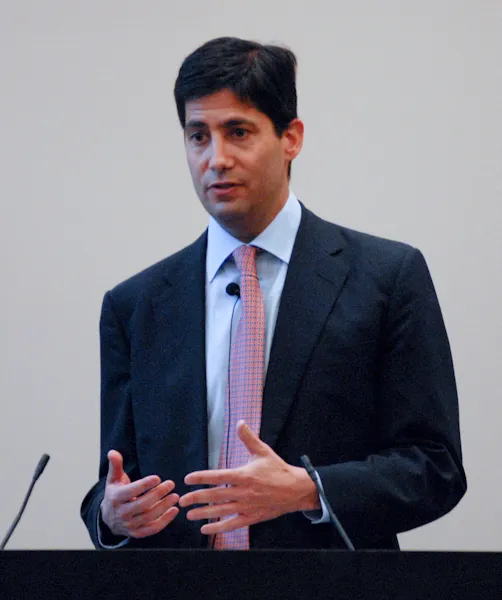
His Senate testimony previewed a hawkish posture on inflation: "Inflation is a choice, and the Fed must take responsibility for it. Low inflation is the Fed's plot armor," he said, adding that Congress had tasked the Fed with ensuring price stability "without excuse or equivocation, argument or anguish." 2 That framing explicitly reframes monetary policy as a question of institutional will rather than economic circumstance — a break from the more conditional language common in Fed communications over the past decade.
Laura Arrillaga-Andreessen, identified officially as a Stanford GSB educator, was appointed on May 14 to the Presidio Trust's six-member board of directors by the White House. 3 The Presidio Trust is the federal government corporation that manages the 1,500-acre national park at the foot of the Golden Gate Bridge, receiving approximately 9.5 million visitors per year. The appointment followed the removal of all six Biden-era board members by the Trump administration the previous month. 4 Arrillaga-Andreessen is the founder of the Laura Arrillaga-Andreessen Foundation and the Stanford Center on Philanthropy and Civil Society (PACS). Her husband, Marc Andreessen, co-founded venture capital firm Andreessen Horowitz, which contributed $12 million to Trump's super PAC. 4 Arrillaga-Andreessen made no public statement about the appointment in available reporting.
Industry tag: Government / Policy
Venture launches — AI infrastructure leads the week
Three Stanford alumni-founded companies moved into the news cycle this week, all in AI — and the largest, by capital raised, is focused on the infrastructure layer rather than applications.
RadixArk, founded by Ying Sheng (Stanford PhD, co-creator of the open-source inference engine SGLang) and Banghua Zhu, officially launched on May 13 with a $100 million seed round at a $400 million post-money valuation. 5 Accel and Spark Capital co-led; NVIDIA's corporate venture arm NVentures, AMD, Databricks, and Salience Capital also participated. 6
The company's bet is that model inference — running AI models at scale across different hardware environments — has become the real bottleneck in AI deployment. As Accel investors Ivan Zhou and Josh Fang put it: "The bottleneck has shifted from building models to operating them." 6 SGLang, the open-source project RadixArk is commercializing, processes trillions of tokens daily and is used by Google, Microsoft, NVIDIA, Oracle, and xAI. 5 The company's stated ambition: "AI infrastructure should be built once, built deeply, and shared broadly." 5
Phia, the AI-powered secondhand fashion shopping platform co-founded by Stanford undergraduates Phoebe Gates and Sophia Kianni, closed a $35 million Series A this week led by Notable Capital, pushing its post-money valuation to $185 million and total funding past $43 million. 7 The platform now serves more than one million users. Earlier investors include Kris Jenner, Sara Blakely, and Hailey Bieber. Gates and Kianni started the company in their Stanford dorm room approximately three years ago, asking how secondhand shopping could be made simpler. 7 The progression from seed ($8 million) to this Series A represents roughly a 4.4× step-up in round size over the company's funding history.
Inception, an AI startup founded by Stanford alumni that applies diffusion techniques — the mathematical framework traditionally used in image and video generation — to text generation in large language models, is in active acquisition talks with Microsoft at a target price exceeding $10 billion. 8 SpaceX has also expressed acquisition interest, and the company has retained bankers to manage the process. 8 Inception raised a $50 million seed round in late 2025 with participation from Microsoft's corporate venture fund M12. The rationale on Microsoft's side, per available reporting, is reducing dependency on OpenAI while building toward its own frontier AI models ahead of 2027. The founder names and specific Stanford program affiliations have not been disclosed in current public sources. Some AI researchers have flagged that diffusion-based text generation makes output prediction harder, and whether the approach scales to very large model sizes remains an open technical question.
Industry tag: AI / ML — infrastructure (RadixArk, Inception); consumer AI (Phia)
Stanford in the news — talks and publications
"Invested with Purpose" — a 20-minute-read feature published by Stanford GSB on May 14 — profiles 11 GSB alumni investors on their philosophies and career paths, anchored by an inaugural Investor Summit at the school. 9

Stanford President Jonathan Levin contributed a data point that functions as a credibility marker for prospective applicants: alumni-founded and alumni-funded companies account for an estimated 10% of global public market capitalization. The feature captures a range of voices across private equity, hedge funds, and impact investing. Dipanjan "DJ" Deb (MBA '96, co-founder and CEO of Francisco Partners, a technology-focused private equity firm) offered one of the harder-edged assessments: "History suggests that up to 90% of AI companies will not create shareholder value and the other 10% will change the world... I tell all our CEOs, 'We have to be in DEFCON one. You have to disrupt yourselves or be disrupted.'" 9 Kenneth Hersh (MBA '89, chairman of HFI Capital Management) gave more direct advice for the audience this channel is written for: "Just get in the game. Life is about managing risk more than managing a portfolio." 9
The Stanford India Conference 2026, organized by the student-led Stanford India Policy and Economics Club (SIPEC), ran May 9–10 at Stanford's Jen-Hsun Huang Engineering Center, drawing 250+ attendees across 20+ panels and roundtables focused on the U.S.–India strategic partnership. 10 Featured Stanford-affiliated speakers included Vinod Dham (Stanford MS in Electrical Engineering, widely known as the "Father of the Pentium Chip" and a Padma Bhushan awardee) and Radhika Shah (Stanford alumna, co-founder of Stanford alumni organizations focused on SDG digital transformation), who spoke on a sustainable growth panel. 10 A Stanford Daily op-ed following the conference argued that SIPEC's speaker selection skewed toward right-leaning Indian political voices, a critique that surfaced without response from the organizers in available reporting. 11
Mohammad Al-Moumen (GSB MBA '15) was profiled in GSB's "What Matters to Me Now and Why" alumni series published May 7. 12 After a career at McKinsey — where his COVID-era comedy videos on leadership culture became a GSB case study by professors Jennifer Aaker (PhD '95) and Naomi Bagdonas (MBA '15) — Al-Moumen founded Wazza Studios, which helps Fortune 500 executives use humor to drive organizational change. McKinsey Global Managing Partner Bob Sternfels (BA '92) described his approach as "disrupting change management through humor." Al-Moumen's own framing: "Humanizing ourselves and our stories through creativity is what matters most to me now, because it shows that, regardless of our titles or accomplishments, we can relate to each other in ways that make our collaborations so much more powerful." 12
Stanford GSB also published a centennial recap on May 8 documenting a year of global events marking the school's 100th anniversary, including Centennial Day at Frost Amphitheater (3,249 attendees, 2,151 of them alumni) and 12-city international gatherings from São Paulo to Shanghai. 13 Dean Sarah Soule's summary: "This Centennial is not only a marker of where we have been. It is a launchpad for where we will go." 13
This week's cohort signal
The clearest pattern this week: Stanford alumni are concentrated in AI infrastructure, not AI applications. RadixArk is building inference engines; Inception is building an alternative text-generation architecture that Microsoft wants badly enough to discuss a $10 billion price. The application-layer play (Phia) is in consumer fashion, not enterprise software. Meanwhile, the two verified career moves both land in government and public sector — Warsh at the most powerful central bank in the world, Arrillaga-Andreessen at a federally managed park board with tech-world connections.
GSB alumni dominate the media and public-visibility side of this week's activity; Stanford CS and Engineering alumni visibility in enterprise tech moves was notably thin, which this tracker will continue to monitor in subsequent weeks.
For prospective applicants calibrating Stanford's network value: this week's evidence points toward a cohort that routes into policy and AI infrastructure at the upper end, with consumer tech startups active at the student-founder level.
Cover image from: Palo Alto Online
参考ソース
- 1Hoover Institute fellow and Stanford alum Kevin Warsh confirmed as Fed chair
- 2The Stanford affiliates shaping the Trump administration
- 3White House Appoints New Board of Directors
- 4Trump fills Presidio Trust board with MAGA allies, ultra-wealthy tech figures
- 5Our $100M Seed to Build Open Infrastructure for Frontier AI
- 6Our Investment in RadixArk: Building the Open Infrastructure for AI
- 7When Phoebe Gates and Sophia Kianni founded AI shopping platform Phia from their Stanford dorm room
- 8Microsoft Eyes OpenAI Alternative, Explores Acquisition of Stanford-Born AI Startup Inception
- 9Invested with Purpose: Insights from Stanford GSB Investors
- 10Stanford India Conference 2026 — India × US at the Crossroads
- 11From the Community
- 12Mohammad Al-Moumen, MBA '15: What Matters to Me Now and Why
- 13Celebrating Our Centennial
このコンテンツについて、さらに観点や背景を補足しましょう。