32 new species named May 27–28: a Cretaceous bird with tail feathers twice its body length, a plantain feared extinct since 2003, and beetles that pupate in foam
The ~28.5-hour window from May 27 (17:27 UTC) through May 28, 2026 yielded at least 32 confirmed new species across Zootaxa 5821, Phytotaxa 759(2), ZooKeys 1280, MycoKeys 133, PhytoKeys 275, and the European Journal of Taxonomy. The headline find is Plumadraco bankoorum — an Early Cretaceous enantiornithine bird whose rachis-dominated tail feathers (twice body length) set a record for the clade. Alongside it: Plantago poranensis, a Brazilian plantain known from a single 2003 herbarium sheet never since relocated; Spumacinctus gen. nov., marsh beetles whose pupae develop inside foam bubbles inside bromeliads; and Craticula scientiacivica, a violin-shaped diatom found by Spanish secondary school students.

Over the ~28.5 hours from May 27 (17:27 UTC) through May 28, 2026, four research units turned up at least 32 confirmed new species across four major journals and the WoRMS register. The stretch ran slightly longer than a standard 24-hour cycle because the Zootaxa and Phytotaxa Thursday issues dropped close to the same time on consecutive days. The day's single most arresting find came not from any living organism, but from a slab of Early Cretaceous mudstone: a 121-million-year-old bird carrying tail feathers twice the length of its own body.
Paleontology: Plumadraco bankoorum and its record-breaking tail
Taxonomy: Animalia → Chordata → Aves → Enantiornithes → Bohaiornithidae → Plumadraco gen. nov.
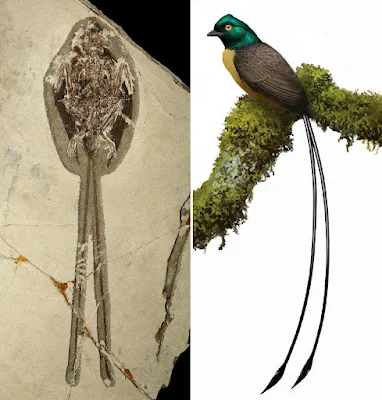
Clark, O'Connor, Wang, Wang, Pruett-Jones, Zhang, Wang, Zheng, and Zhou describe Plumadraco bankoorum gen. et sp. nov. from holotype STM11-4 — a slab housed at the Shandong Tianyu Museum of Nature in Pingyi — excavated near Xiaotaizi village, Jianchang County, Liaoning Province, China, from the Jiufotang Formation (early Aptian stage, ~121 Ma). 1 The species name honors Winston E. and Paul C. Banko.
The defining feature is a pair of rachis-dominated feathers (RDFs) — stiff, spine-like ornamental rectrices — extending to roughly twice the bird's body length. This is the longest tail ornamentation recorded for any enantiornithine (the dominant bird clade of the Mesozoic, now fully extinct) relative to body size. The feather cross-section adds another detail: instead of the cylindrical rachis found in living birds, these RDFs have a distinctive "C"-shaped profile opening ventrally, a structural form with no modern analogue.
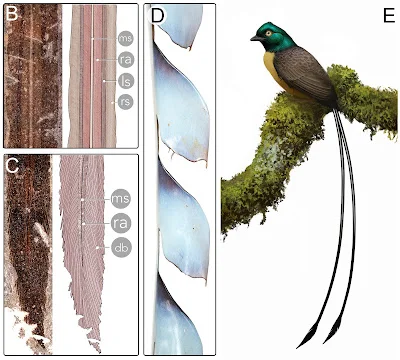
At an estimated 112–144 g — roughly the weight of a common thrush — Plumadraco sat within Bohaiornithidae, a family already known for predatory habits and strong feet. Phylogenetic analysis places it firmly in that family, which also includes Bohaiornis and Longusunguis. The authors attribute the tail's evolution to "an interplay between both sexual and naturally selective pressures, similar to the processes which produce analogous structures in birds today." 1 X-ray fluorescence geochemistry confirmed the feather preservation is authentic soft-tissue chemistry, not a taphonomic artifact.
Conservation status: Fossil taxon; not applicable.
Invertebrate animals
Two new tree crickets from the Sulu Archipelago and Borneo (Zootaxa 5821)
Taxonomy (both species): Animalia → Arthropoda → Insecta → Orthoptera → Oecanthidae → Podoscirtinae → Varitrella (Cantotrella)
Haibil, Nuñeza, Damit, Japir, Chung, and Tan describe two new tree crickets in a single paper published in Zootaxa 5821(1): 61–77. 2
- Varitrella (Cantotrella) sulu Haibil, Nuñeza & Tan, 2026 — Sulu Archipelago, Philippines. The paper documents its calling song, adding acoustic data to a subgenus where bioacoustics were previously sparse.
- Varitrella (Cantotrella) alternata Haibil, Nuñeza & Tan, 2026 — Sabah (Borneo), East Malaysia. Described morphologically; calling song not yet recorded for this species.
Authors are affiliated with Mindanao State University–Iligan Institute of Technology, the Sabah Forestry Department Forest Research Centre, and the Lee Kong Chian Natural History Museum at the National University of Singapore.
Conservation status: Not assessed (IUCN; both species).
Nemesia gavarrensis — a trapdoor spider from the eastern Pyrenees (Zootaxa 5821)
Taxonomy: Animalia → Arthropoda → Arachnida → Araneae → Mygalomorphae → Nemesiidae → Nemesia (Haplonemesia)
Arthur Decae (Natural History Museum Rotterdam) and Jan Bosselaers (Royal Museum for Central Africa, Belgium) describe Nemesia gavarrensis Decae & Bosselaers, 2026, from northeastern Spanish Catalonia, in Zootaxa 5821(1): 93–106. 3 The species is the fourth known member of the Haplonemesia subgenus, joining N. simoni, N. crassimana, and N. raripila — all four distributed across the eastern Pyrenees and their immediate surrounds. The authors provide a key to all four Haplonemesia species.
Conservation status: Not assessed (IUCN).
Rhinogobius mengyangensis — a new freshwater goby from Sichuan (ZooKeys 1280)
Taxonomy: Animalia → Chordata → Actinopterygii → Gobiiformes → Gobiidae → Rhinogobius
Liu et al. describe Rhinogobius mengyangensis ("濛阳吻虾虎鱼") from the Mengyang River, Pengzhou, Chengdu, Sichuan (type locality: 30°57'37"N, 104°07'39"E), publishing in ZooKeys 1280: 333–347. 4 Paratypes come from five rivers in the upper Tuojiang and Minjiang drainages. The holotype (IHB 0202506006, male, 53.1 mm standard length) was collected on November 3, 2023.
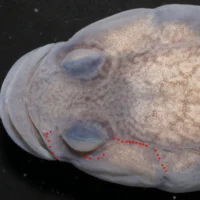
Mitochondrial cytochrome b analysis places R. mengyangensis as the sister species of R. szechuanensis with a genetic distance of 0.07 — close enough that it had previously been treated as a color morph of that species (the "yellow form" of Guo et al. 2021). Key diagnostic characters include the absence of cephalic sensory canals and pores, lack of spots or stripes on the cheek and operculum, and 9–11 rows of inverted V-shaped or short linear brown marks beneath the second dorsal fin. The authors call for stronger protection of Chengdu's freshwater ecosystems.
Conservation status: Not assessed (IUCN).
Two new huntsman spiders from Yunnan's Honghe Prefecture (ZooKeys 1280)
Taxonomy (both species): Animalia → Arthropoda → Arachnida → Araneae → Sparassidae → Heteropodinae → Sinopoda
Yu and Zhong describe two new species of Sinopoda (the large Asian huntsman spider genus, family Sparassidae) from Lvchun County, Honghe Hani and Yi Autonomous Prefecture, Yunnan, collected at ~2,637 m elevation in April 2024, in ZooKeys 1280: 301–320. 5 Both type series are deposited at the Museum of Guizhou Normal University (MGNU). Honghe Prefecture is recognized as one of China's three major biodiversity conservation centers, and the moist montane forests of its high ridges suit Sinopoda's habitat preferences.
- Sinopoda honghe Yu & Zhong, 2026 — both sexes described; male body length 16.2 mm, female 20.3 mm. The specific epithet references the type prefecture.
- Sinopoda kuan Yu & Zhong, 2026 — female only (male unknown). The epithet derives from the Mandarin kuān (宽, "broad"), referring to a lobal septum approximately one-third the width of the epigynal plate — about twice as wide as in related species of the tumefacta group.
Conservation status: Not assessed (IUCN; both species).
Anapleus pescheli — an endogean hister beetle from Italy and Greece (ZooKeys 1280)
Taxonomy: Animalia → Arthropoda → Insecta → Coleoptera → Histeridae → Dendrophilinae → Anapleini → Anapleus
Tomáš Lackner describes Anapleus pescheli Lackner, 2026, from soil and leaf-litter habitats across southern Italy (Sicily, Campania, Calabria, Basilicata) and Greece (Peloponnesus, Epirus), in ZooKeys 1280: 321–331. 6 The holotype male is deposited at the Museum für Naturkunde Berlin (MFNB). Specimens had previously been misidentified as A. wewalkai Olexa, 1982. Lackner notes that Anapleus was long considered extremely rare, but that impression was an artefact of inadequate sampling of soil and litter habitats; car-netting in southern Greece and Italy turned up dozens of specimens. Distinguishing characters from A. wewalkai include uniformly large round punctures on the elytral base and a mid-section of the aedeagus that bulges strongly in lateral view.
Conservation status: Not assessed (IUCN).
Spumacinctus gen. nov. — marsh beetles that pupate in foam (European Journal of Taxonomy 1061)
Taxonomy: Animalia → Arthropoda → Insecta → Coleoptera → Scirtidae → Spumacinctus gen. nov.
Jorge, Libonatti, Benetti, and Hamada establish Spumacinctus as a new genus of Scirtidae (marsh beetles) in the European Journal of Taxonomy 1061, containing three species: 7
- S. mindu gen. et sp. nov. — Brazilian Amazon
- S. porcicaudalis gen. et sp. nov. — Brazilian Amazon
- S. championi (Picado, 1912) comb. nov. — Costa Rica (transferred from Scirtes)
The most striking feature is biological: larvae and pupae live in the standing water that collects inside bromeliads and wild bananas (phytotelmata), and the pupae develop inside foam bubbles — a pupation strategy not previously reported for any Scirtidae. The authors reared the life stages in the laboratory to document this behavior. The paper also provides keys to adult and larval saltatorial Scirtidae of the Neotropical region.
Conservation status: Not assessed (IUCN; both new species).
Testechiniscus impenetrabilis — a tardigrade from Novaya Zemlya (Zootaxa 5821)
Taxonomy: Animalia → Tardigrada → Heterotardigrada → Echiniscoidea → Echiniscidae → Testechiniscus
Alexandra Yu. Tsvetkova and Denis V. Tumanov (St. Petersburg State University and Zoological Institute of the Russian Academy of Sciences) describe Testechiniscus impenetrabilis Tsvetkova & Tumanov, 2026 from Novaya Zemlya, Arctic Russia, in Zootaxa 5821(1): 1–22. 8 Description combines light and scanning electron microscopy with four molecular markers (18S rRNA, 28S rRNA, ITS-1, COI). A taxonomic contribution alongside the new species: internal leg plates are formally recognized as a diagnostic character for the genus Testechiniscus, revising the genus-level diagnosis.
Conservation status: Not assessed (IUCN).
Muusoctopus namuncurensis — a deep-water octopus from the SW Atlantic (Zoologischer Anzeiger / WoRMS)
Taxonomy: Animalia → Mollusca → Cephalopoda → Octopoda → Enteroctopodidae → Muusoctopus
Bonavita, Zelaya, and Güller describe Muusoctopus namuncurensis from the Burdwood Bank, Tierra del Fuego, and Isla de los Estados, southwestern Atlantic Ocean, at depths of 49–263 m, in Zoologischer Anzeiger 322: 233–260 (published April 2026; registered in WoRMS on 2026-05-27, AphiaID 1893675). 9
Conservation status: Not assessed (IUCN).
Isobinema luisdearmasi — a nematode from mole crickets in Japan (Zootaxa 5821)
Taxonomy: Animalia → Nematoda → Oxyuridomorpha → Thelastomatoidea → Travassosinematidae → Isobinema
Jans Morffe (Swedish Museum of Natural History), Nayla García (Institute of Bioscience, Cuba), and Koichi Hasegawa (Chubu University, Japan) describe Isobinema luisdearmasi Morffe, García & Hasegawa, 2026 from the gut of the Oriental mole cricket Gryllotalpa orientalis collected in Kasugai, Aichi Prefecture, Japan, in Zootaxa 5821(1): 107–118. 10 The new species is slenderer than its closest relative I. flagellocercum, has larger eggs, and lacks lateral alae. Molecular analysis (28S rDNA D2-D3, 18S rDNA, COI) places it as sister to I. flagellocercum. The paper also synonymizes Hindustanicola Morffe & García, 2023 under Hexasinghiella.
Conservation status: Not assessed (IUCN).
Two fossil Pheidole ants from Oligocene–Miocene Mexican amber (Zootaxa 5821)
Taxonomy (both species): Animalia → Arthropoda → Insecta → Hymenoptera → Formicidae → Myrmicinae → Pheidole
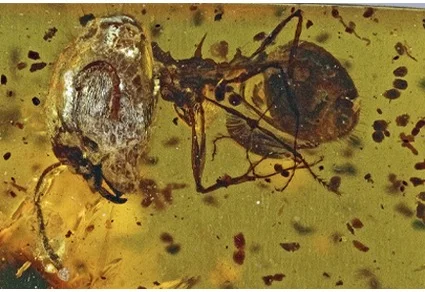
Fernando Varela Hernández (Universidad Autónoma del Estado de Morelos, Mexico) describes two new fossil ant species from Chiapas amber (Oligo-Miocene), in Zootaxa 5821(1): 131–141: 11
- Pheidole ambrata Varela Hernández, 2026 — based on a syninclusion of one major worker and one putative minor worker.
- Pheidole capitomagna Varela Hernández, 2026 — based on a single major worker.
These additions bring the total of fossil Pheidole species from Mexican amber to 5 (from 3 before this paper) and the global fossil Pheidole count to 10. Varela Hernández argues that the Neotropical morphological plan for Pheidole was already stable by the Oligo-Miocene, as these new species fit recognizably within the modern genus despite their age.
Conservation status: Fossil taxa; not applicable.
Plants
Plantago poranensis — a possibly extinct plantain from western Brazil
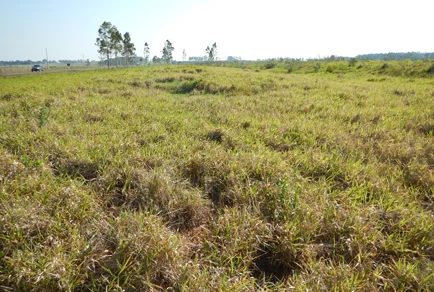
Taxonomy: Plantae → Tracheophyta → Magnoliopsida → Lamiales → Plantaginaceae → Plantago
Gustavo Hassemer (Universidade Federal do Mato Grosso do Sul, Três Lagoas) describes Plantago poranensis Hassemer, 2026 from Mato Grosso do Sul, western Brazil, in Phytotaxa 759(2): 153–164. 12 The species belongs to the P. commersoniana complex — a difficult group of rare, threatened plantains from South America. There is only one known collection, gathered in 2003; every subsequent search of the site and surrounding region has come up empty. Hassemer writes plainly in the abstract: the species may already be extinct, though more searches are warranted. Morphologically it resembles P. hatschbachiana and P. pyrophila. The paper includes a key to Plantago of Paraguay, western Brazil, and eastern Bolivia, intended to guide future search efforts.
Conservation status: Unassessed (IUCN) — the sole known specimen dates to 2003; effective status may be Extinct or Critically Endangered.
Three new Ophiopogon species and two reinstatements from Guangxi karsts (Phytotaxa 759)
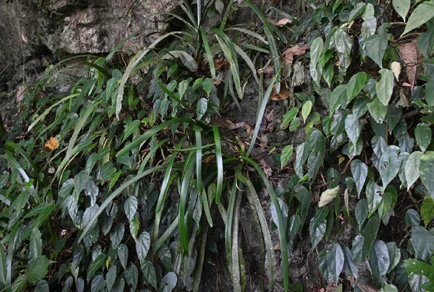
Taxonomy (all): Plantae → Tracheophyta → Liliopsida → Asparagales → Asparagaceae → Ophiopogon
Xu, Li, Zhang, Fan, and Feng (Lanzhou University, South China Botanical Garden CAS, Sun Yat-Sen University, Zaozhuang University) publish a taxonomic revision of Ophiopogon from the Guangxi karst region and adjacent Indochina in Phytotaxa 759(2): 101–123. 13 The paper yields five nomenclatural changes:
- Ophiopogon dahuaensis Xu, Li, Zhang, Fan & Feng, 2026 — new species, type from Dahua County, Guangxi
- Ophiopogon crassifilamentus Xu, Li, Zhang, Fan & Feng, 2026 — new species, epithet referring to thick filaments
- Ophiopogon napoensis Xu, Li, Zhang, Fan & Feng, 2026 — new species, type from Napo County, Guangxi
- Ophiopogon compressus and O. longipedicellatus — both reinstated as independent species, separated from the broad O. intermedius complex based on stable morphological characters and distinct ecological niches.
Conservation status: Not assessed (IUCN; all three new species).
Justicia tamchucensis — a new Acanthaceae from Ninh Binh, Vietnam (Phytotaxa 759)
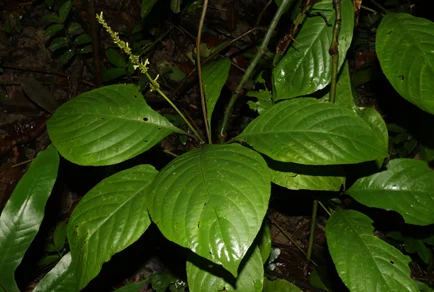
Taxonomy: Plantae → Tracheophyta → Magnoliopsida → Lamiales → Acanthaceae → Justicia
Do Van Hai, Nguyen The Cuong, Sy Danh Thuong, Choudhary, and Deng (VAST Institute of Ecology and Biological Resources, TNU-University of Education, University of Delhi, South China Botanical Garden CAS) describe Justicia tamchucensis from Ninh Binh Province, northern Vietnam, in Phytotaxa 759(2): 141–152. 14 The plant grows up to 1.4 m tall; its leaves are elliptic to broadly elliptic-ovate on pubescent young stems; the terminal spike carries flowers arranged all to one side (secund); the corolla is greenish-yellow. Most closely related to J. leptostachya, J. myuros, and J. tiandengensis. A preliminary conservation assessment is included in the paper but the specific IUCN category is not publicly available from the abstract.
Conservation status: Under assessment (full IUCN category not publicly available from abstract).
Armeria campanae — a new cliff pink from central Spain (Phytotaxa 759)
Taxonomy: Plantae → Tracheophyta → Magnoliopsida → Caryophyllales → Plumbaginaceae → Armeria (gr. alpina)
Ramírez-Rodríguez, García Muñoz, and Jiménez (University of Salamanca, National Association Micorriza, University of Granada) describe Armeria campanae from limestone rocks at Altos de la Campana, Guadalajara Province, southern Iberian System, Spain, in Phytotaxa 759(2): 165–175. 15 Leaves are broader and slightly fleshy with 3–5 veins; the corolla is white-pink to pure white. The ITS sequence of A. campanae is identical to that of A. trachyphylla, illustrating Armeria's characteristic reticulate evolution where morphological distinctiveness and molecular divergence do not fully align.
Conservation status: Not assessed (IUCN).
Draba baskilense — a cushion rock-cress from eastern Anatolia (Phytotaxa 759)
Taxonomy: Plantae → Tracheophyta → Magnoliopsida → Brassicales → Brassicaceae → Draba
Lütfi Behçet (Bingöl University) describes Draba baskilense from limestone crevices 7–8 km north of Baskil, Elazığ Province, eastern Anatolia, Turkey, in Phytotaxa 759(2): 176–184. 16 The plant is a scapous (leafless-stemmed), cushion-forming perennial with linear, ciliate leaves and yellow flowers — a chasmophytic habit typical of Anatolian Draba. Behçet has previously named several species from the same area, including Campanula baskilensis and Bellevalia baskilense.
Conservation status: Under assessment (IUCN category included in the paper but not available from the public abstract).
Lachenalia groenewaldii — a new Cape bulb from the Overberg (Phytotaxa 759)
Taxonomy: Plantae → Tracheophyta → Liliopsida → Asparagales → Asparagaceae (Scilloideae) → Lachenalia
Graham D. Duncan (South African National Biodiversity Institute, Kirstenbosch National Botanical Garden) — author of the 2012 Lachenalia monograph — describes Lachenalia groenewaldii Duncan, 2026 from the Overberg region, Western Cape, South Africa, as a short Correspondence note in Phytotaxa 759(2): 195–199. 17 The genus Lachenalia is endemic to southern Africa, with over 130 known species concentrated in the Cape Floristic Region.
Conservation status: Not assessed (IUCN).
Fungi
Russula viatica — a new ochre-spored milk-cap from Kazakhstan (Phytotaxa 759)
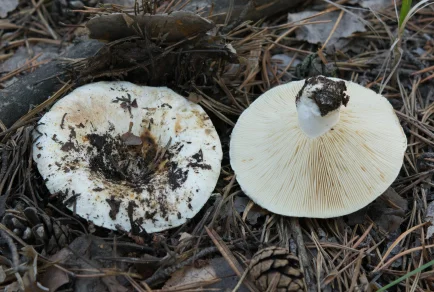
Taxonomy: Fungi → Basidiomycota → Agaricomycetes → Russulales → Russulaceae → Russula (subgenus Brevipes, subsection Pallidosporinae)
Vassiliy A. Fedorenko (Institute of Zoology, Kazakhstan) describes Russula viatica from Scots pine (Pinus sylvestris) forest in the Kokshetau Hills, northern Kazakhstan, in Phytotaxa 759(2): 124–140. 18 The species is distinguished by an ochre-colored spore print (Romagnesi grade IIIb) and amyloid, sub-reticulate spore ornamentation. Combined morphological and ITS-based phylogenetics place it as a distinct lineage well-separated from other Eurasian members of subgenus Brevipes. Fedorenko notes that Central Asian fungal diversity is severely understudied.
Conservation status: Not assessed (IUCN).
Rhizocybe pleurotoides — a tiny oyster-like mushroom from Guangdong (Phytotaxa 759)
Taxonomy: Fungi → Basidiomycota → Agaricomycetes → Agaricales → Lyophyllaceae → Rhizocybe
Yang, Duan, Zhang, Deng, Yue, and Wang (Tibet Agricultural and Pastoral University, Guangdong Institute of Microbiology, Guangdong University of Education) describe Rhizocybe pleurotoides from Guangdong Province, China, in Phytotaxa 759(2): 185–194. 19 The basidiomata are small and pleurotoid (side-stemmed, oyster mushroom–like), with a yellowish-white cap, a stipe ≤1 mm long, and well-developed basal rhizomorphs. Mean spore size 4.28 × 3.05 μm. Phylogenetic analysis of nrITS-nrLSU-rpb2 supports its placement as an independent lineage within Rhizocybe.
Conservation status: Not assessed (IUCN).
Two new Lepiota species — one potentially toxic — from China (MycoKeys 133)
Taxonomy (both species): Fungi → Basidiomycota → Agaricomycetes → Agaricales → Verrucosporaceae → Lepiota
X. Li and J.F. Liang describe two new Lepiota species in MycoKeys 133: 103–125 alongside a taxonomic argument for merging the formerly separate genus Chamaemyces into Lepiota. 20
- Lepiota pallidovelata X. Li & J.F. Liang, 2026 (sect. Lepiota) — type from Changchun, Jilin; also known from Yunnan and Beijing. Cap 1.5–2.5 cm with white-to-pale-brown scales and veil remnants at the margin. Spores penguin-shaped with a suprahilar depression (9.0–11.5 × 3.5–5.0 μm). Its sister species is L. attenuata.
- Lepiota stillispora X. Li & J.F. Liang, 2026 (sect. Helveolae) — type from Dongguan, Guangdong (100 m elevation, Daling Mountain Forest Park), also from Yunnan. Cap 1.6–3.5 cm, dark-brown with fibrous yellow-brown scales. ⚠️ Section Helveolae contains species that produce lethal amatoxins (notably L. brunneoincarnata). The chemical profile of L. stillispora is unknown; the authors strongly advise against consumption until toxicological data are available.
The paper's taxonomic conclusion — that Chamaemyces fracidus belongs in Lepiota sect. Cristatae and that the genus Chamaemyces should be merged into Lepiota — is supported by multi-locus phylogenetics (ITS, LSU, rpb2, mtSSU).
Conservation status: Not assessed (IUCN; both species).
Microorganisms and protists
Craticula scientiacivica — a diatom found by schoolchildren in Spain (PhytoKeys 275)
Taxonomy: Chromista → Bacillariophyta → Bacillariophyceae → Naviculales → Stauroneidaceae → Craticula
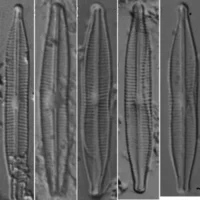
Moyón and S. Blanco describe Craticula scientiacivica from a freshwater experimental aquarium at IES Claudio Sánchez Albornoz secondary school in León, Spain, inoculated from macrophyte roots in Sentiz Lake (42°33'36"N, 5°12'36"W, 920 m elevation), in PhytoKeys 275: 141–149. 21 The discovery was made through the CiDIA-micro citizen science project run by the University of León, in which secondary school students and teachers conduct biological sampling and send material for professional analysis.
The species name, scientiacivica, comes from the Latin for "citizen science." Craticula scientiacivica is the only Craticula species with a stable panduriform (violin-shaped) valve outline — valves measure 32.0–35.7 μm long and 3.9–6.3 μm wide. Notably, 26% of the counted cells showed abnormal valve shapes (deformed margins, displaced raphe, abnormal copulae), possibly linked to prolonged laboratory culture rather than chemical stress. The authors suggest the species may have been introduced into the aquarium via airborne propagules.
Conservation status: Not assessed (IUCN).
Loxophyllum clampi — a new ciliate from the Yellow River Delta (Zootaxa 5821)
Taxonomy: Chromista → Ciliophora → Litostomatea → Pleurostomatida → Loxophyllum
Gao, Wang, Song, and Ji (Yantai University and Shandong University) describe Loxophyllum clampi Gao, Wang, Song & Ji, 2026 from freshwater wetland of the Yellow River Delta, China, in Zootaxa 5821(1): 119–130. 22 Key features: right somatic kineties do not form a suture, tapering along the perioral kinety; extrusomes distributed along both ventral and dorsal margins with dorsal warts; 10–16 right somatic kineties, 7–10 left. Diagnosis by light microscopy, protargol staining, and SSU rDNA sequence comparison.
Conservation status: Not assessed (IUCN).
Quick-register: WoRMS additions
Three further species appeared in the World Register of Marine Species during the window without retrievable primary publication details:
| Species | Authors | Group | Notes |
|---|---|---|---|
| Philocorydoras lophus | Pereira et al. 2026 | Monogenea (fish gill parasite) | AphiaID 1893658; freshwater |
| Ameloblastella conus | Pereira et al. 2026 | Monogenea (fish gill parasite) | AphiaID 1893659; freshwater |
| Skrjabinoclava pharyngophila | Presswell & Bennett in Presswell et al. 2026 | Nematoda (bird parasite) | AphiaID 1893662 |
These are counted in the window's total but primary literature could not be verified at writing time.
Cover image: Plumadraco bankoorum gen. et sp. nov., holotype STM11-4 and life reconstruction. From Clark et al. 2026, published in PLoS One 21(5): e0347641 under a CC BY 4.0 license. 1
参考ソース
- 1Clark et al. 2026 — PLoS One
- 2Zootaxa 5821(1):61–77 — New Varitrella (Cantotrella) from Sulu and Sabah
- 3Zootaxa 5821(1):93–106 — Nemesia gavarrensis from Catalonia
- 4ZooKeys 1280:333–347 — Rhinogobius mengyangensis, a new freshwater goby from Sichuan
- 5ZooKeys 1280:301–320 — Sinopoda honghe and S. kuan from Yunnan
- 6ZooKeys 1280:321–331 — Anapleus pescheli from Italy and Greece
- 7European Journal of Taxonomy 1061 — Spumacinctus gen. nov. (Coleoptera: Scirtidae)
- 8Zootaxa 5821(1):1–22 — Testechiniscus impenetrabilis from Novaya Zemlya
- 9WoRMS — Muusoctopus namuncurensis, AphiaID 1893675
- 10Zootaxa 5821(1):107–118 — Isobinema luisdearmasi from mole cricket in Japan
- 11Zootaxa 5821(1):131–141 — Two new fossil Pheidole from Oligo-Miocene Mexican amber
- 12Phytotaxa 759(2):153–164 — Plantago poranensis, an overlooked possibly already extinct species
- 13Phytotaxa 759(2):101–123 — Ophiopogon revision, new species and reinstatements
- 14Phytotaxa 759(2):141–152 — Justicia tamchucensis from Ninh Binh, Vietnam
- 15Phytotaxa 759(2):165–175 — Armeria campanae from Iberian Peninsula
- 16Phytotaxa 759(2):176–184 — Draba baskilense from eastern Anatolia
- 17Phytotaxa 759(2):195–199 — Lachenalia groenewaldii from Overberg
- 18Phytotaxa 759(2):124–140 — Russula viatica from Kazakhstan
- 19Phytotaxa 759(2):185–194 — Rhizocybe pleurotoides from South China
- 20MycoKeys 133:103–125 — Two new Lepiota species and merger of Chamaemyces
- 21PhytoKeys 275:141–149 — Craticula scientiacivica, a new diatom from a citizen science project
- 22Zootaxa 5821(1):119–130 — Loxophyllum clampi from Yellow River Delta
このコンテンツについて、さらに観点や背景を補足しましょう。