Alphabet (GOOGL) — accelerating revenue, a 63%-growth cloud, and two live DOJ cases

Alphabet (GOOGL) — accelerating revenue, a 63%-growth cloud, and two live DOJ cases

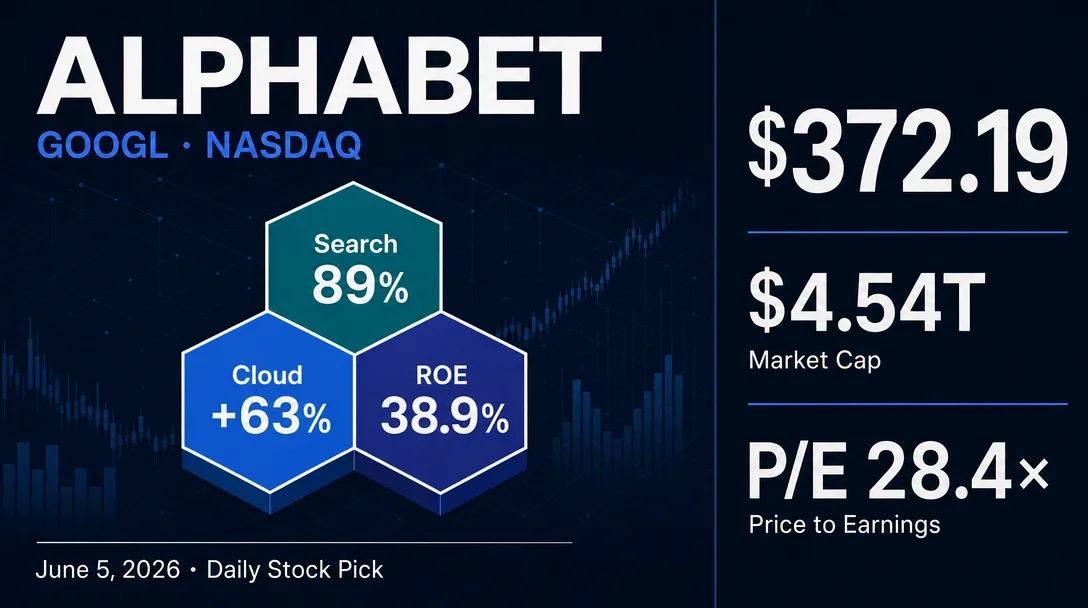
Alphabet Inc. (NASDAQ: GOOGL) passes all three hard screening criteria with ROE of 27.4% / 32.9% / 35.7% for FY2023–FY2025 (TTM 38.9%), positive FCF of $69.5B / $72.8B / $73.3B across the same three years, and a trailing P/E of 28.40×. The article covers all nine required information areas: business model (four revenue segments with Google Cloud as the fastest-growing major cloud at +63% YoY), ROE table with EDGAR methodology note, FCF bar chart, dual-axis revenue/earnings growth chart, full 8-peer valuation comparison table, balance sheet (D/E 0.20, interest coverage 111.85×, Moody's Aa2 / S&P AA+), six risk factors (DOJ search, DOJ ad tech, EU DMA, AI disruption, CapEx commitment, insider selling), near-term catalysts (Q2 earnings late July, analyst consensus $433 avg PT, Waymo expansion, June 8 ex-div), and competitive moat (search network effects, Android/Chrome lock-in, Cloud vertical stack, 13 products × 1B+ users). Closes with a structured bull/bear framework anchored on Q2 Cloud growth rate and DOJ search case timeline.

US Stock Pick: 3-Year ROE > 15%
2026/6/5 · 21:44
購読 1 件 · コンテンツ 18 件
Current price: $372.19 (June 4, 2026 close) · Market cap: ~$4.54T · Sector: Communication Services / Internet Content & Information 1
Alphabet Inc. (NASDAQ: GOOGL) is the parent company of Google, YouTube, Google Cloud, and a collection of long-horizon bets (Waymo, Wing, DeepMind) that sit under the Other Bets umbrella. All three hard screening criteria are met. Return on equity has risen every year for three consecutive fiscal years — 27.4% / 32.9% / 35.7% for FY2023–FY2025, with a TTM figure of 38.9% — each year well above the 15% threshold. Free cash flow has remained strongly positive at $69.5B / $72.8B / $73.3B across the same three years, even as capital expenditures nearly tripled. And at a trailing P/E of 28.40×, the stock is priced at a 17% premium to its own 5-year historical average (24.21×) and an 11% premium to the mega-cap tech peer median — which, for a company with accelerating revenue growth and the peer group's third-highest ROE, is either a modest premium or a full price depending on how you read the antitrust exposure and the CapEx bet. 1 2
The central tension: Alphabet is investing at a scale that compresses near-term FCF yield to 1.42% while carrying two active Department of Justice antitrust cases and a pending EU fine. Whether those risks impair the franchise — or are simply unpleasant noise for a business growing revenue at 17.5% TTM — is the question this article examines.

What Alphabet does and how it makes money

Alphabet's revenue breaks into four main streams, with the advertising business still dominant but the mix shifting. 3
Google Search & Other is the core advertising business — the roughly 89.3% global search market share that Google held as of March 2026 translates into approximately 55% of total quarterly revenue at Q1 2026 run rates. 4 Search ad revenue grew 19% year-over-year in Q1 2026, driven by AI Overviews (monthly active users above 2.5B) and AI Mode (monthly active users above 1B). 3
YouTube Ads generated $40.3B in advertising revenue for full-year 2025 and, including subscriptions (YouTube Premium has 125M subscribers), total YouTube revenue exceeds $60B per year. 5 YouTube has held the #1 US streaming watch-time position for three consecutive years. Its 27.4B monthly active users make it the third-largest internet platform globally. 5
Google Cloud generated $20B in Q1 2026 revenue (+63.4% year-over-year), the fastest quarterly growth rate among AWS (Amazon Web Services, 28% cloud market share), Azure (Microsoft's cloud platform, 21% share), and Google Cloud (14% share). 6 Annual run rate is $80B. Operating margin expanded from 17.8% to 32.9% year-over-year in Q1 2026, and Cloud's unearned revenue backlog — contracts signed but not yet recognized as revenue — reached $462B, nearly doubling quarter-over-quarter. 3
Other Bets includes Waymo (autonomous vehicles, valued at $126B in February 2026, operating in 11 US cities, 500K+ weekly rides) and Wing (drone delivery, 1M+ deliveries completed). 3 Other Bets revenue remains small relative to the core business.
Alphabet has 13 products with over 1 billion monthly active users — five of them above 3B (Search, Gmail, Android, Chrome, YouTube) — and 350M paid subscription users across Google One and YouTube. 3

ROE track record — FY2023–FY2025

ROE has risen every year for the past three fiscal years, reaching a TTM figure of 38.9%. The trend reflects both strong net income growth and disciplined equity management. 7
A methodological note: the SEC EDGAR XBRL API returned a file of approximately 3.08MB that was truncated during retrieval, preventing direct verification from the raw XBRL feed. The figures below are sourced from StockAnalysis, which aggregates from SEC 10-K filings. 7
Fiscal yearNet incomeCommon equity (end of year)ROE
FY2023 (ended Dec 31, 2023)$73.8B$283.4B27.4%
FY2024 (ended Dec 31, 2024)$100.1B$325.1B32.9%
FY2025 (ended Dec 31, 2025)$132.2B$415.3B35.7%
TTM (through Mar 31, 2026)$160.2B38.9%
FY2023–FY2025 from StockAnalysis (SEC 10-K source). 7
The three-year rise from 27.4% to 35.7% reflects a combination of revenue scaling faster than the equity base and steady net margin expansion (from 24.0% in FY2023 to 32.8% in FY2025). Return on invested capital (ROIC) stands at 28.3% TTM, and return on assets at 14.6% TTM, both consistent with the ROE signal. 1
Among the mega-cap tech peer group, GOOGL's ROE of 38.9% ranks behind only Apple (141.5%, largely inflated by aggressive buybacks shrinking the equity base), Adobe (58.8%), and Oracle (57.6%), and ahead of Microsoft (34.0%), Meta (32.9%), Salesforce (16.9%), and Amazon (24.3%). 1

Free cash flow — massive CapEx, but OCF is accelerating

Alphabet defines FCF as operating cash flow minus capital expenditures. By that measure, FCF has held firmly positive across all three trailing fiscal years, though the margin is compressing as AI infrastructure investment accelerates.
チャートを読み込んでいます…
FCF figures from StockAnalysis (SEC cash flow source). 8
PeriodOperating CFCapital expendituresFCFFCF margin
FY2023$101.8B$32.3B$69.5B22.6%
FY2024$125.3B$52.5B$72.8B20.8%
FY2025$164.7B$91.5B$73.3B18.2%
TTM$174.4B$109.9B$64.4B15.3%
Operating cash flow grew 62% from FY2023 to FY2025, from $101.8B to $164.7B. Capital expenditures rose 183% over the same period, from $32.3B to $91.5B. The result: FCF margin has fallen from 22.6% to 15.3% TTM, and FCF yield (TTM FCF / market cap) sits at just 1.42% — low by any historical standard. 8
Alphabet's full-year 2026 CapEx is guided at approximately $180–190B, roughly double FY2025's $91.5B. 3 In June 2026, Alphabet completed an $84.75B equity raise — one of the largest in US technology history — with Berkshire Hathaway investing $10B and the remainder underwritten. The proceeds are earmarked for AI infrastructure. 3
Whether OCF growth can keep pace with that CapEx trajectory, and when the AI investments convert to incremental Cloud and Search revenue, is the key variable for FCF re-acceleration. The $462B Cloud backlog provides some forward visibility. 3

Revenue and earnings growth

Revenue has accelerated for four consecutive measurement periods, which is unusual for a company already generating $300B+ in annual sales.
チャートを読み込んでいます…
Revenue and net income from StockAnalysis (SEC 10-K source). 9
PeriodRevenueYoY growthNet incomeNet margin
FY2021$257.6Bn/a
FY2022$282.8B+9.8%n/a
FY2023$307.4B+8.7%$73.8B24.0%
FY2024$350.0B+13.9%$100.1B28.6%
FY2025$402.8B+15.1%$132.2B32.8%
TTM$422.5B+17.5%$160.2B37.9%
Q1 2026 (quarter)$109.9B+21.8%$62.6B
Revenue acceleration from 8.7% in FY2023 to 21.8% in Q1 2026 is driven primarily by Search re-acceleration (AI-augmented queries growing), Google Cloud (revenue more than doubled from FY2023 to TTM), and margin expansion across all segments. Q1 2026 marked the company's 11th consecutive quarter of double-digit revenue growth. 3
Q1 2026 net income of $62.6B (+84% year-over-year) and EPS of $5.11 (+82% year-over-year) reflect both top-line acceleration and operating leverage — operating income of $40.0B in the quarter carried a 33% operating margin. 3
TTM operating margin is 32.7% and gross margin is 60.4%, both expanding year-over-year, which means Google's cost structure is not growing proportionally with revenue — scale is flowing through to the bottom line. TTM EBITDA is $161.3B (38.2% EBITDA margin). 1

Valuation — premium to history and peers, but context matters

統計カードを読み込んでいます…
Metrics as of June 4, 2026 close; sourced from StockAnalysis and Finviz. 1 2
Historical context. GOOGL's trailing P/E averaged 24.21× across the five year-end data points from 2021 through 2025: 25.61× (2021) → 19.19× (2022, tech selloff trough) → 23.89× (2023) → 23.44× (2024) → 28.93× (2025). 10 Today's 28.40× sits 17.3% above that 5-year average — elevated, but within range of where the stock traded in 2021 and at year-end 2025.
Forward P/E note. StockAnalysis places forward P/E at 29.79× while Finviz reports 25.29×, a gap of approximately 4.5 P/E points (~18%) driven by different analyst consensus datasets. 1 2 The wide dispersion reflects genuine market disagreement on FY2026 earnings, which depends heavily on how quickly Cloud CapEx converts to operating leverage.
EV/EBITDA at 27.95× — the most elevated metric. The peer median EV/EBITDA is 17.49× (Microsoft), implying a 59.8% premium for GOOGL. 1 11 The explanation is mechanical: EBITDA is depressed relative to enterprise value because CapEx is being expensed (as depreciation and amortization) at an elevated pace, but the assets being built — data centers and TPU infrastructure — are not yet fully reflected in revenue. This is a temporary premium if the Cloud backlog converts; it would be a persistent premium if it does not.
Peer comparison (all data as of June 4, 2026 close, sourced from StockAnalysis). Peers selected as the core mega-cap technology and internet-software companies that compete with Alphabet in cloud infrastructure, digital advertising, or AI platforms:
CompanyTrailing P/EForward P/EP/BEV/EBITDAPEGROE
GOOGL (Alphabet)28.40×29.79×9.42×27.95×1.85×38.9%
MSFT (Microsoft, enterprise cloud and productivity software)25.49×23.15×7.67×17.49×1.44×34.0%
META (Meta Platforms, social media and digital advertising)22.83×19.12×6.54×14.62×0.92×32.9%
AMZN (Amazon, e-commerce and AWS cloud)30.35×30.43×6.18×18.11×1.44×24.3%‡
AAPL (Apple, consumer electronics and services ecosystem)37.73×34.14×42.87×28.19×3.04×141.5%*
ORCL (Oracle, enterprise database and AI cloud infrastructure)42.41×31.32×20.26×29.25×1.36×57.6%†
ADBE (Adobe, creative and digital experience software)15.07×10.73×9.18×10.95×0.83×58.8%
CRM (Salesforce, enterprise customer relationship management)21.91×13.56×4.52×14.37×0.84×16.9%
Peer median (7 peers excl. GOOGL)25.49×23.15×7.67×17.49×1.44×32.9%
All peer data from StockAnalysis. 11 12 13 14 15 16 17
*Apple's ROE of 141.5% is inflated by aggressive share buybacks that have reduced book equity to approximately $106B on $451B in TTM revenue; it does not reflect comparable operational efficiency. †Oracle's negative FCF (–$24.7B TTM) reflects an even more aggressive CapEx cycle than Alphabet's. ‡Amazon's TTM FCF is –$2.47B (CapEx of ~$151B consumed all operating cash flow); FCF yield is not applicable.
GOOGL's trailing P/E of 28.40× sits between META (22.83×) and AMZN (30.35×), placing it in the middle of the peer group — not the cheapest, far from the most expensive. A PEG of 1.50–1.85× against 17–22% revenue growth is within the range that typically signals growth is partially justifying the multiple. Analysts who expect forward P/E of 25.29× are pricing in significant earnings acceleration.

Balance sheet health

Alphabet's balance sheet is among the strongest in US corporate history. 18
MetricQ1 2026
Total assets$703.9B
Cash + short-term investments$126.8B
Total debt (incl. lease obligations)$95.9B
Net cash$31.0B
Debt / equity0.20
Current ratio1.92
Interest coverage111.85×
Balance sheet data from StockAnalysis (Q1 2026). 18
A debt/equity ratio of 0.20 means only $0.20 of debt for every $1 of equity — among the lowest leverage ratios for any large-cap company. Interest coverage of 111.85× (operating income $138.1B / interest expense $1.2B) means Alphabet could service its current debt load from less than four days of operating income. 18
Credit ratings reflect that strength: Moody's Aa2 (stable outlook) and S&P AA+, both representing near-top-tier investment-grade status. 19 S&P projects Alphabet's adjusted leverage at 0.2× at end-2026 and 0.3× at end-2027, even assuming CapEx of approximately $185B in 2026 and $210B in 2027. 19
The one balance sheet feature worth flagging for context: PP&E (property, plant, and equipment) grew sharply to $296.5B as of Q1 2026, reflecting the data center buildout. If AI revenue does not materialize at the scale implied by that investment, some portion of those assets could face impairment. 18

Risk factors

1. DOJ search monopoly — $26B default payment at risk, share resilience uncertain
In August 2024, Judge Amit Mehta ruled that Google had illegally maintained a search monopoly. On September 2, 2025, the court ordered remedies: Alphabet is prohibited from entering exclusive search distribution contracts, must share search index data with competitors, and must offer search and search advertising as a joint service to rivals. Google was not ordered to divest Chrome or Android. 20
The financial exposure is concrete: Alphabet pays approximately $26B per year in default search placement agreements — roughly $20B to Apple and $6B to other partners — which accounts for an estimated 25% of operating income. 21 If those agreements are terminated, Google avoids the cost but also loses the traffic guarantee.
The historical evidence from comparable situations is more ambiguous than the financial exposure suggests. In markets where regulators have already introduced browser choice screens (Europe, under prior DMA rulings), Google's search share has remained close to 90%. Some analysts have argued that if the default agreements end, Alphabet retains most of the traffic while eliminating the $26B cost — freeing capital for AI and Cloud. As Dan Niles of Niles Investment Management put it, Google could be "one of the best-performing stocks" once the case resolves, because the payments are "unnecessary insurance." 21 That view is a reasonable interpretation of the evidence, but it remains a prediction, not a certainty. Both Google and the DOJ filed cross-appeals in February 2026, and the case is likely to run through at least 2027. 20
2. DOJ ad tech antitrust — divestiture of DV360 and Ad Manager sought
The DOJ brought a separate antitrust case targeting Alphabet's advertising technology stack, with the remedies phase ongoing in the Eastern District of Virginia. The DOJ is seeking forced divestiture of DV360 (Alphabet's demand-side ad platform) and Google Ad Manager (its publisher ad server). 22 Trial evidence showed that 46% of indirect open-web display ad spending flows through Google Ads, and 21% through DV360. The quantified revenue impact of a forced divestiture is not publicly available — Alphabet does not break out ad tech revenue separately — but the structural disruption to the advertising business model would be meaningful. The EU Commission also levied a €2.95B fine in September 2025 for anticompetitive behavior in the ad tech sector. 1
3. EU DMA fine — approximately €900M expected
As of May 25, 2026, Reuters reported that the European Commission plans to impose a fine in the "high triple-digit million euro" range on Alphabet under the Digital Markets Act (DMA), for self-preferencing Google's own services in search results. 23 A decision is expected before the EU summer recess. The DMA's maximum penalty is 10% of global annual revenue (theoretically over $40B), but enforcement practice suggests substantially lower actual fines. Against FY2025 revenue of $402.8B and net income of $132.2B, a €900M (~$975M) fine is financially manageable, though it signals ongoing regulatory friction in Europe. 23
4. AI search disruption — real but still small
Google's global all-device search market share fell from 90.8% in March 2025 to 89.3% in March 2026 — a 1.5 percentage point decline that is the largest year-over-year drop since 2009. 4 AI search engines (ChatGPT Search, Perplexity, Claude, and Gemini itself when used outside Google.com) collectively account for 0.9% of web referral traffic as of March 2026, a fivefold increase year-over-year from 0.18%. 4
At the same time, Google's own search query volume hit an all-time high in Q1 2026. Search revenue grew 19% year-over-year in the same quarter — acceleration, not deceleration. 3 The share loss and the revenue acceleration coexist because total search volume is growing; the AI disruption thesis has not yet translated into ad revenue erosion. Analysts project AI search could reach 3–5% referral share by end-2027 — which would be disruptive if it continues, but the pace needed to materially impair Google's ad business over a 3–5 year horizon is substantially higher than current trajectories. 4
5. CapEx commitment and FCF compression
The $190B 2026 CapEx guidance — with 2027 guided even higher — is a substantial bet on AI infrastructure. If Cloud revenue, AI product monetization, and Search AI features generate sufficient incremental revenue to justify that spend, FCF will re-accelerate significantly. If they do not, Alphabet will have committed the equivalent of more than two years' worth of prior FCF to assets that generate sub-par returns. The $462B Cloud backlog is the clearest forward signal, but backlog conversion rates and timing are not guaranteed. 3
6. Insider ownership and transaction pattern
Insider ownership is 0.20% of shares outstanding, with institutional ownership at 38.9%. 2 Recent insider transactions show a net selling pattern (–0.04%), though the magnitude is small relative to the company's market cap. Short interest is 1.42% of float (8.21M shares, 2.82 days to cover), reflecting limited bearish conviction from the short side. 2

Near-term catalysts

Q2 2026 earnings (expected late July 2026) is the next primary trigger. Based on Alphabet's historical reporting pattern (Q1 reported April 29), Q2 results are likely in the third or fourth week of July. Key variables to watch: Cloud revenue growth rate (whether 63% YoY can be sustained), Search revenue trajectory in an AI-augmented environment, and any guidance update on 2026 CapEx or operating margin. 3
Google I/O 2026 (May 20, already announced): Alphabet introduced Gemini 3.5 Flash (leading performance on multiple agentic benchmarks), Gemini Omni (native multimodal generation), Gemini Spark (24/7 personal AI agent), Universal Cart, Search Agents, and Antigravity 2.0. 24 These products are now in market; the revenue translation will show up in Q2 and Q3 results.
Dividend and buyback: Alphabet initiated its first-ever cash dividend in 2024 at $0.88 per share annually (0.24% yield). The next ex-dividend date is June 8, 2026. 2 The $70B buyback authorization from April 2022 continues; the company has retired shares consistently. The 52-week range is $162.00 to $408.61; at $372.19, the stock is 8.9% below its 52-week high and has gained +124.0% over the past year. 2
Analyst consensus: 63 analysts at StockAnalysis carry a Strong Buy consensus with an average 12-month price target of $431.10 (+15.8% upside from $372.19). 1 Finviz reports a consensus rating of 1.39 (Strong Buy) with an average target of $433.47. The highest individual target on record is $515 (Citizens, May 2026); Mizuho reiterated Outperform in May 2026 and raised its target from $420 to $460. Analyst price targets carry systematic optimism bias and should be read directionally. 1
Waymo expansion: Waymo (currently operating in 11 US cities, 500K+ weekly autonomous rides, valued at $126B) is on track to expand to 20 additional cities in 2026, with international expansion announced. 3 Waymo is not currently material to Alphabet's consolidated financials but represents embedded optionality at a scale now comparable to many public companies.

Competitive moat

Alphabet's competitive position rests on four reinforcing structures that are difficult to replicate in combination.
Search scale as a self-reinforcing engine. Google processes approximately 8.5 billion queries per day, and its 89.3% global search share is not primarily a function of the Apple default payment — it reflects 25+ years of index quality, ranking algorithm refinement, and user habituation. 4 Mobile is even more entrenched: Google holds 94.6% of global mobile search. The feedback loop — more queries generate more data, more data improves results, better results retain users — is a textbook network effect operating at internet scale. Even economist Lones Smith, cited in the DOJ antitrust case, argued that Google's default agreement with Apple is likely "unnecessary insurance" because users would select Google regardless. 21
Android and Chrome create ecosystem lock-in. Android holds approximately 68% of global mobile OS market share (StatCounter, May 2026), with roughly 3.8–3.9 billion active Android devices. 4 Chrome holds the dominant share of desktop browser usage. Together they create deep default distribution for Google Search, Gmail, Maps, and YouTube — switching costs are behavioral, not contractual, and operate at the level of daily habits across billions of users.
Google Cloud's fastest-growing major platform. Google Cloud's 63% year-over-year growth in Q1 2026 outpaced both AWS (+17% estimated) and Azure (+33% estimated) for the same period. 6 Synergy Research's John Dinsdale described the dynamic: "Take a bow, AI. Ever since ChatGPT was launched in late 2022, the cloud market has gone into overdrive." 6 Cloud's 75% AI product adoption rate among customers and the $462B backlog suggest the acceleration has multi-quarter momentum. Alphabet's vertical stack — proprietary TPU v8 chips, Gemini models trained on those chips, and the Cloud platform selling access to both — is a cost and capability advantage that cloud-only competitors cannot replicate.
13 products × 1B+ users creates a cross-selling platform. With 13 products each at over 1 billion monthly active users (five above 3 billion), Alphabet has distribution for new products that almost no competitor can match. Gemini app has grown to 900M monthly active users in roughly two years — faster than any prior Google consumer product. 3 When Alphabet launches a new AI product, it can reach a billion potential users within days through default placement across Search, Android, and Chrome.

Bull vs. bear thesis

The bull case rests on three concrete observations.
Revenue acceleration is genuine and broad-based — not a one-segment spike. Search, Cloud, and YouTube all grew at double-digit rates in Q1 2026, simultaneously, with Search actually accelerating through AI Overviews rather than being cannibalized by them. If this combination continues through 2026, Alphabet's trailing P/E of 28.40× against revenue growing at 17–22% implies a PEG well below 2×, which historically suggests reasonable pricing for a dominant growth franchise. 1
Cloud's $462B backlog and 75% AI product adoption rate give the CapEx story a concrete demand signal. The $190B 2026 CapEx is only disruptive to FCF if the revenue it enables does not materialize — and the Cloud backlog at current sizes suggests Alphabet's enterprise customers are committing to multi-year AI spending, not experimenting. If Cloud operating margins continue their trajectory (17.8% → 32.9% in four quarters), the compounding effect on consolidated margins is significant. 3
The antitrust risk, while real, may resolve in Alphabet's favor economically. A scenario where default agreements are terminated but search share holds (as European DMA data suggests is plausible) would effectively convert $26B in annual costs into retained earnings, instantly closing much of the gap between operating income and FCF. That scenario is not guaranteed but is consistent with available evidence. 21
The bear case focuses on three risks that are quantifiable and unresolved.
The trailing P/E of 28.40× is 17.3% above Alphabet's own 5-year average of 24.21×. 10 If the CapEx cycle delays earnings realization — or if ad tech divestiture removes a structurally profitable piece of the advertising stack — the multiple could compress back toward the 5-year average, implying roughly 15% downside to earnings assuming flat net income.
The DOJ ad tech case is the more structurally threatening of the two legal risks. A forced divestiture of DV360 and Google Ad Manager would directly disrupt Alphabet's ability to operate both sides of the open-web display advertising market — a position that has compounded for years. The financial impact is not publicly quantifiable from available data, but the structural disruption to the ad tech moat is irreversible in a way that the search default case is not. 22
Finally, AI search's 0.9% referral share growing 5× year-over-year is a trend worth watching, not dismissing. 4 The current numbers are small enough that they haven't moved ad revenue. If ChatGPT Search or a successor achieves materially better answers for high-intent commercial queries — the queries with the highest ad monetization — the ad revenue impact could arrive faster than aggregate share data implies.
The specific variable to track at Q2 2026 earnings (late July): Google Cloud revenue growth rate. If growth holds above 50% year-over-year, the CapEx bet is visibly translating. If it decelerates below 40%, the timeline for FCF re-acceleration extends materially, and the P/E premium becomes harder to defend. The second variable is any update on the remedies phase of the DOJ search case — if the appellate court timeline becomes clearer, the $26B default agreement risk gets a date attached to it.

All financial data sourced from StockAnalysis, Finviz, Macrotrends, Alphabet's June 2026 investor presentation, SEC EDGAR XBRL filings, and the additional sources cited throughout. Price data represents the June 4, 2026 close. This article is for informational and research purposes only and does not constitute investment advice or a recommendation to buy or sell any security. All data should be independently verified before making any investment decision.

このコンテンツについて、さらに観点や背景を補足しましょう。

  • ログインするとコメントできます。