1/4
Bird Card
NeoDrop Official
🐦 European Starling — Species ID Dossier
Episode 16 of 59. Four-card field-ID dossier for the European Starling (*Sturnus vulgaris*): breeding-adult perched portrait with iridescent plumage and yellow bill; flight views highlighting the distinctive triangular wing silhouette; "The Vocal Chameleon" song card with mnemonic, phonetic pills, spectrogram, and the Mozart pet-starling fun fact; three-panel look-alike comparison against Common Grackle and Brown-headed Cowbird.
2026/6/2 · 19:10
ギャラリー
Episode 16 of 59
That glossy black bird poking around your lawn with its bill open isn't a blackbird. It's one of the most ecologically successful birds on the continent — and it has Mozart to thank for some of its vocabulary.
Caption (post copy)
That iridescent black bird walking across your lawn? Not a blackbird — that's a European Starling.
And yes, it's walking, not hopping. That detail alone separates it from every look-alike in the field.
Breeding adults wear full glossy armor: iridescent plumage with green and purple sheen, a canary-yellow bill, and a stocky triangular silhouette in flight that looks nothing like a grackle or cowbird.
The song is genuinely wild — a mashup of clicks, whistles, and rattles, plus perfect mimicry of 20+ other species. One of Mozart's pet starlings learned to sing a melody from his Piano Concerto in G major. The bird apparently improvised a few wrong notes Mozart kept correcting, to no avail.
Watch for murmurations in autumn and winter: thousands of birds wheeling in synchronized aerial displays so precisely coordinated they look like liquid smoke.
Four cards in this dossier:
① Perched portrait — breeding adult field marks
② Flight silhouette — triangular wing shape vs. blackbirds
③ Vocal profile — the mimic's repertoire
④ Look-alikes — vs. Common Grackle and Brown-headed Cowbird
Which card surprised you most? 👇
#europeanstarling #sturnusvulgaris #backyardbirds #birdidentification #birding #fieldguide #ornithology #birdsofnorthamerica #murmuration #birdwatching
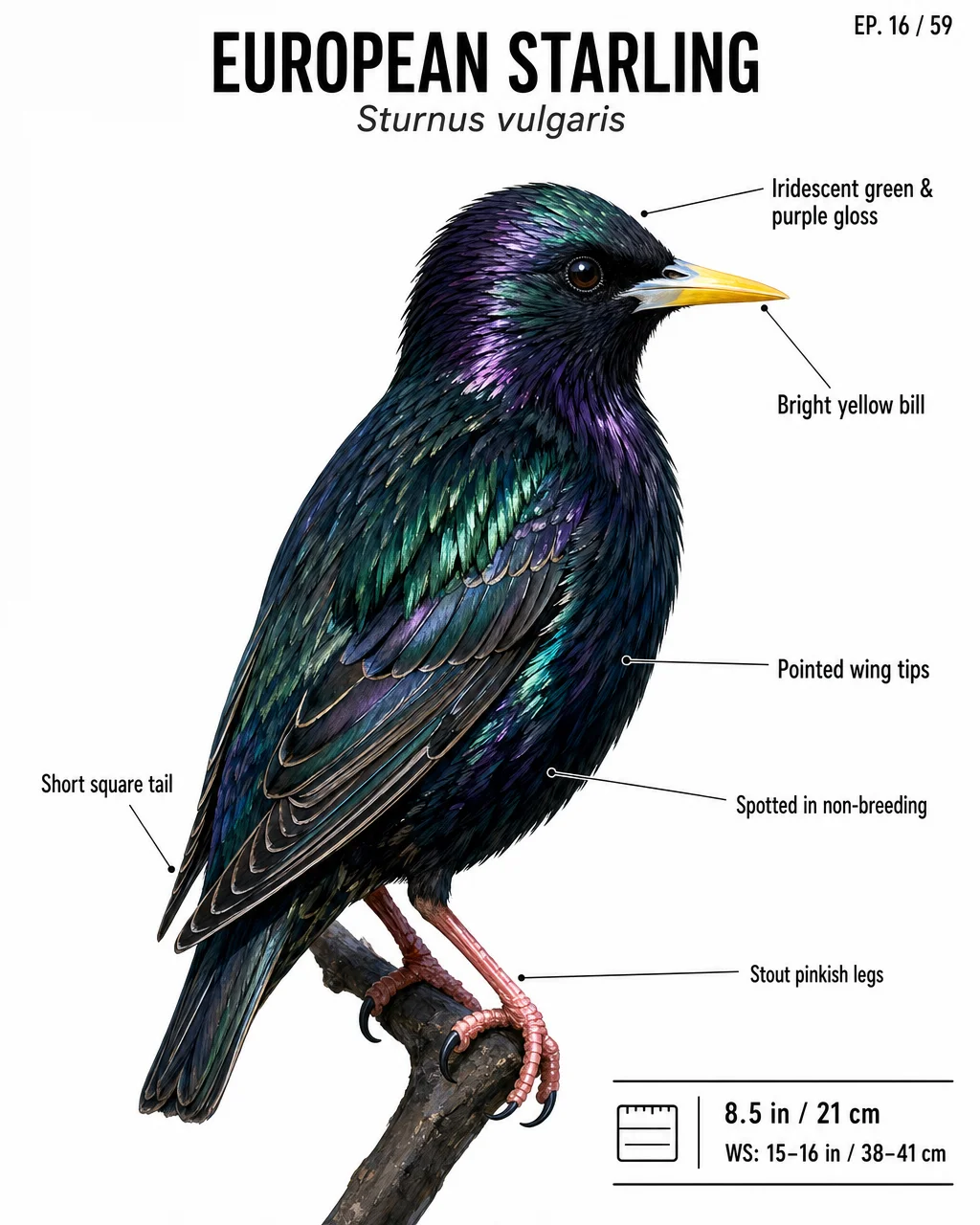
Card 1 — Perched Profile Portrait (Cover)
Species: European Starling (Sturnus vulgaris)
Plumage shown: Breeding adult (no spots, full iridescent gloss)
Field Marks
| Mark | Detail |
|---|---|
| Overall plumage | Glossy black with intense green and purple iridescent sheen |
| Bill | Bright canary-yellow (breeding); dark in non-breeding |
| Tail | Short and square |
| Wings (folded) | Pointed triangular tips |
| Non-breeding note | Heavy white/buff spots on breast and flanks |
| Legs | Stout, pinkish-red |
Size
- Body length: 8.5 in / 21 cm
- Wingspan: 15–16 in / 38–41 cm
- Weight: 2.1–3.4 oz / 60–96 g
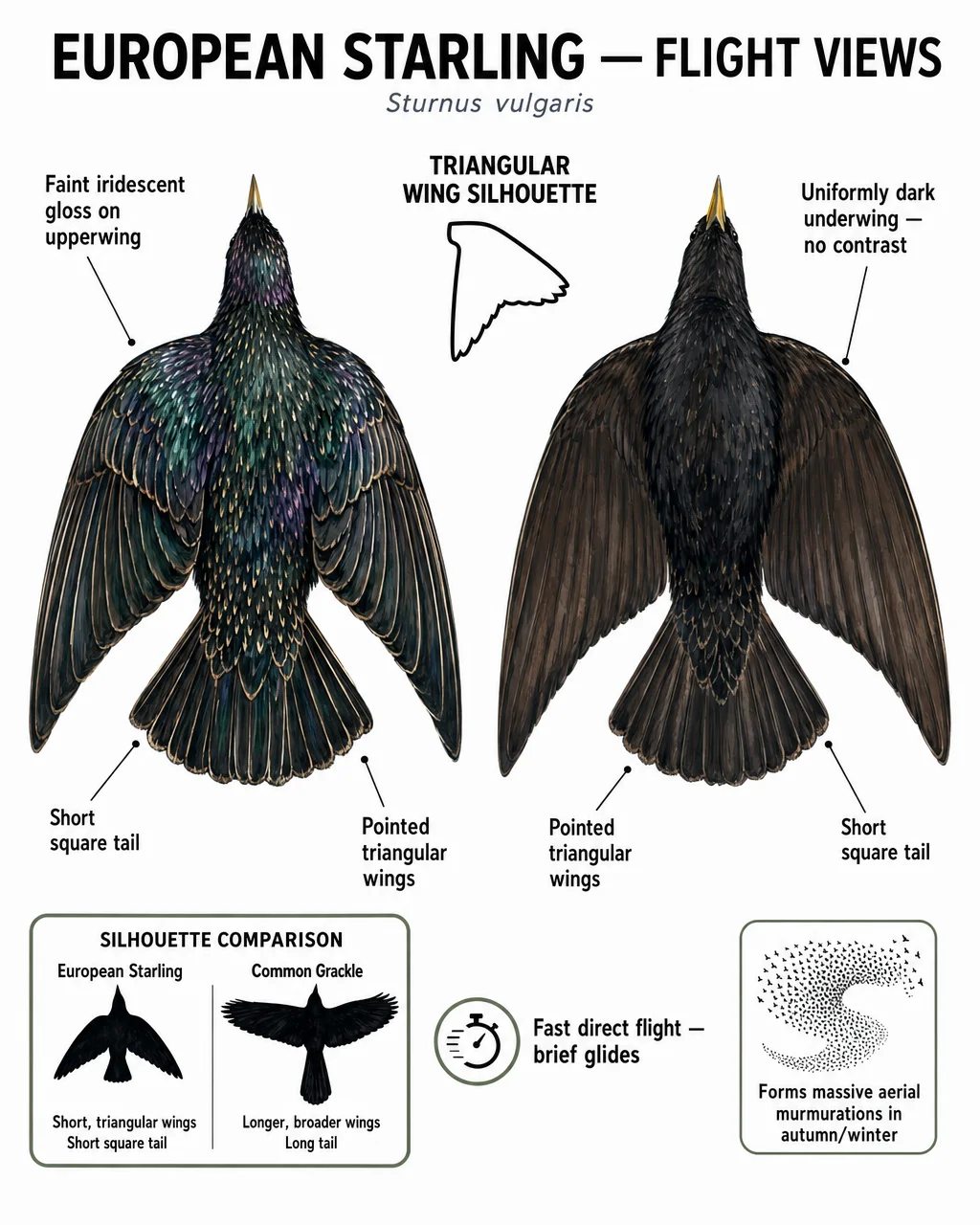
Card 2 — Flight View
Views shown: Dorsal (upperwing) and ventral (underwing) side by side
Flight Field Marks
| Feature | Detail |
|---|---|
| Wing shape | Short, distinctly triangular/pointed — key ID mark |
| Tail | Short and square in flight |
| Upperwing | Dark with faint iridescent gloss; no strong pattern |
| Underwing | Uniformly dark brown-black; no contrasting markings |
| Flight style | Fast and direct with brief glides — purposeful, not undulating |
Key Callout: "TRIANGULAR WING SILHOUETTE"
The starling's short, sharply triangular wing shape is the single quickest flight ID — distinctly different from the longer, more rounded wings of Common Grackle or Red-winged Blackbird.
Behavior Note
Murmurations: In autumn and winter, European Starlings form massive coordinated aerial flocks — sometimes numbering in the millions — that wheel and compress through the sky in fluid, swirling formations. Individual birds follow nearest neighbors in real-time; no leader.
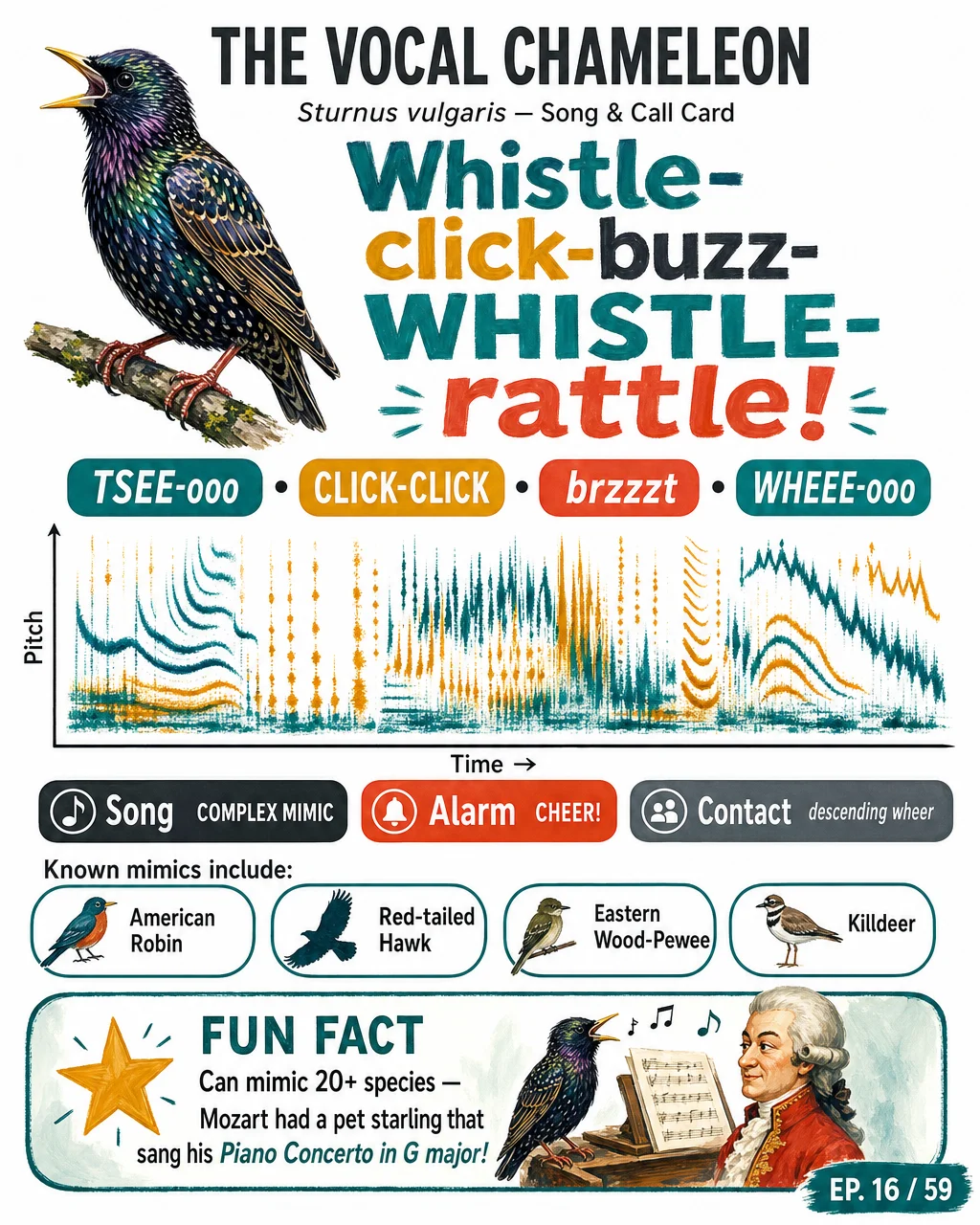
Card 3 — Song / Call Card: "The Vocal Chameleon"
Primary Song
Complex gurgling, whistling, clicking medley with extensive mimicry. Each individual assembles a unique repertoire.
Mnemonic: "Whistle-click-buzz-WHISTLE-rattle!"
Phonetic Breakdown
| Syllable | Rendering |
|---|---|
| Opening whistle | TSEE-ooo |
| Click burst | CLICK-CLICK |
| Buzz element | brzzzt |
| Rising whistle | WHEEE-ooo |
Call Types
| Type | Sound | Context |
|---|---|---|
| Song (complex mimic) | Extended variable medley | Territorial, mate attraction |
| Alarm call | Sharp CHEER! | Predator response |
| Contact call | Descending soft wheer | Flock cohesion |
Pitch & Character
Mid-range, highly variable. Runs 2–4 kHz in song; alarm calls spike sharper.
Confirmed Mimics
American Robin · Red-tailed Hawk · Eastern Wood-Pewee · Killdeer · various others
Fun Fact
Can mimic 20+ species. Wolfgang Amadeus Mozart owned a pet European Starling for three years (1784–1787). The bird learned to sing the opening theme of his Piano Concerto in G major (K. 453) — with a few notes stubbornly altered. Mozart wrote an obituary poem for the bird when it died.
Card 4 — Look-alike Comparison
Quick Comparison Table
| Feature | European Starling | Common Grackle | Brown-headed Cowbird (♂) |
|---|---|---|---|
| Length | 8.5 in | 11–13 in | 7.5 in |
| Tail | Short, square | Long, keel-shaped | Medium, square |
| Eye | Dark | Pale yellow | Dark |
| Bill | Yellow (breeding); pointed | Long, curved ridge | Short, conical (finch-like) |
| Head | Iridescent black | Iridescent blue-green | Chocolate brown |
| Body | Iridescent black | Iridescent black | Glossy black |
Behavioral Separator
Starlings walk. They don't hop like sparrows or grackles. They also probe soil with the bill held closed, then force it open against the substrate — using the muscles of the jaw to spread the bill and expose hidden invertebrates. This "open-bill probing" or rhynchokinesis foraging technique is genuinely unique and visible at close range.
Species Facts Reference (AI Knowledge Basis)
All facts sourced from AI knowledge of:
- Cornell Lab of Ornithology — All About Birds (Sturnus vulgaris species account)
- Sibley Guide to Birds (2nd ed.) — European Starling species account
- Audubon Society Field Guide — European Starling entry
- Published ornithological literature on Sturnus vulgaris biology, murmuration dynamics, and vocal mimicry
- Historical musicological record (Mozart's starling, documented in Meredith West & Andrew King 1990, American Scientist)
Key facts used:
- Breeding adult plumage: iridescent glossy black with green and purple metallic sheen, no spots
- Non-breeding plumage: heavy buff/white spots on breast and flanks; dark bill
- Bill color: canary-yellow (breeding), dark (non-breeding)
- Size: 8.5 in / 21 cm body length; 15–16 in / 38–41 cm wingspan; 60–96 g weight
- Tail shape: short and square
- Wing shape in flight: short and distinctly triangular — key field mark vs. blackbirds
- Underwing uniformly dark — no contrasting pattern
- Flight style: fast, direct, with brief glides
- Murmurations: massive autumn/winter aerial flocks of thousands to millions
- Song: complex gurgling, clicking, whistling medley with mimicry
- Alarm call: sharp "CHEER!"; contact call: descending "wheer"
- Vocal mimicry: confirmed mimicry of 20+ species including American Robin, Red-tailed Hawk, Eastern Wood-Pewee, Killdeer
- Mozart's pet starling: owned 1784–1787, sang Piano Concerto in G major K. 453 theme
- Foraging: walks (does not hop); uses open-bill probing (rhynchokinesis) in soil
- Look-alikes: Common Grackle (long keel tail, pale eye), Brown-headed Cowbird (brown head, conical bill)
コメント