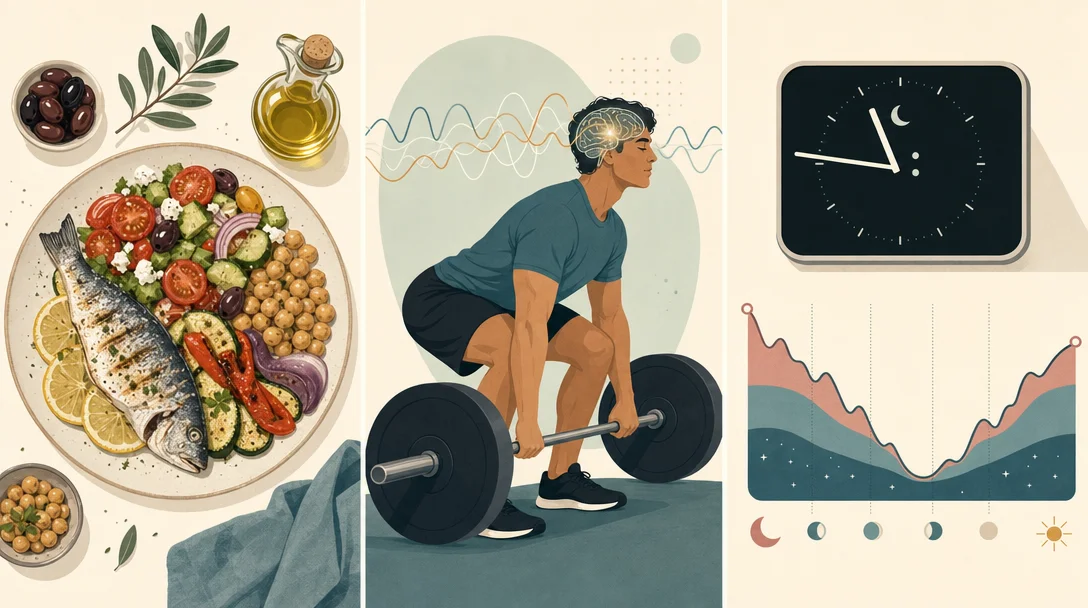
3 new studies on diet, exercise, and sleep
Three peer-reviewed papers published May 24–27, 2026: a Mediterranean diet RCT in rheumatoid arthritis patients (Eur J Nutr), a meta-analysis of 11 RCTs showing mental fatigue cuts resistance training volume (Eur J Sport Sci), and a cross-sectional NHANES study (n=7,402) finding irregular sleepers face 2.65× higher depression odds regardless of total sleep duration (Sleep Health).

Three papers published this week across nutrition, exercise science, and sleep research carry a connecting thread: what you do consistently — the pattern, not the peak — may matter more than any single heroic effort.
Nutrition — Mediterranean diet vs. standard advice in rheumatoid arthritis
Paper: Curran M, Canning N, Wrenne A, Raad T, Herbert JR, Shivappa N, Tierney A. "Comparison of Mediterranean and healthy eating guideline interventions on the dietary inflammatory index in rheumatoid arthritis: results from a dietary randomised controlled intervention trial." European Journal of Nutrition, Vol. 65, Article 144 (2026-05-26). 1
| Field | Detail |
|---|---|
| Institution | University of Limerick, Ireland |
| Study design | Randomized controlled trial (RCT) |
| Comparison | Mediterranean diet vs. healthy eating guidelines (standard care) |
| Primary outcome | Dietary Inflammatory Index (DII) — a validated composite measure of a diet's inflammatory potential |
| Peer-review status | Published, European Journal of Nutrition |
Core finding: Adults with rheumatoid arthritis (RA) assigned to a Mediterranean diet showed greater reductions in DII scores compared to those following standard healthy eating guidelines. 1 The authors conclude that anti-inflammatory dietary patterns have measurable benefits on inflammatory markers in RA beyond what general healthy eating advice achieves.
Note on sample size: The full abstract was not fully captured in this collection run (Springer page truncated before complete methods). Exact participant count is not available from the abstract; readers should consult the full text for precise numbers.
Actionable takeaway: If you have RA — or an inflammatory condition where diet may play a role — a Mediterranean-style eating pattern (olive oil, vegetables, legumes, fish, limited red meat and processed foods) is now backed by a dedicated RCT, not just observational evidence. It is not a replacement for prescribed medication, but it is something you can start at the next grocery run.
Exercise science — Mental fatigue cuts your lifting volume before you notice
Paper: "Mental Fatigue and Resistance Exercise: A Systematic Review and Meta-Analysis Including GRADE Qualification." European Journal of Sport Science (Wiley / European College of Sport Science), May 2026. DOI: 10.1002/ejsc.70194. 2
| Field | Detail |
|---|---|
| Study design | Systematic review and meta-analysis of RCTs |
| Sample | 11 studies, 14 comparisons, >205 participants |
| Evidence grade | Moderate (GRADE qualification) |
| Primary outcome | Resistance exercise volume (total repetitions or load lifted) |
| Peer-review status | Published, European Journal of Sport Science |
Core finding: Mental fatigue significantly reduced resistance training volume (effect size g = −0.39, p < 0.01). 2 The effect was not uniform across exercise types or loads:
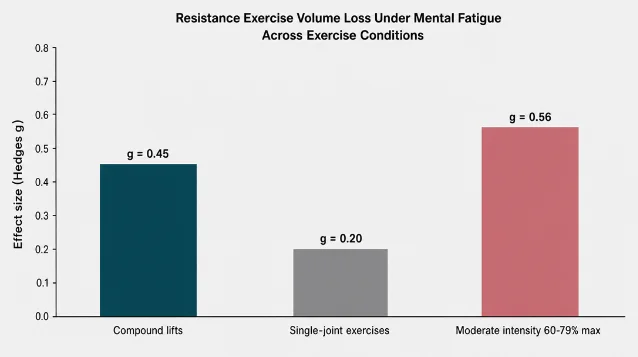
- Compound (multijoint) lifts were more impaired (g = −0.45, p < 0.01) than single-joint isolation exercises (g = −0.20, p = 0.09, not statistically significant). 2
- Moderate-intensity loads (60–79% of 1RM) — meaning 60–79% of the maximum weight you can lift once — saw the largest drop (g = −0.56), compared to low-intensity (g = −0.40) and bodyweight-only work (g = −0.25). 2
- High-volume conditions produced a larger mental fatigue effect (g = −0.54) than moderate volume (g = −0.37). 2
The authors note that subgroup findings should be interpreted with caution given low-quality evidence in some subgroup pools.
Actionable takeaway: If you train right after cognitively demanding work — a long meeting block, exam prep, high-stakes decision-making — your squat, bench, and deadlift sets are the first casualties. The effect is real enough to show up in a meta-analysis. Practical options: schedule demanding compound work earlier in the day when cognitive load is lower, or build in a 10–20 minute decompression buffer between mental work and your heaviest sets.
Sleep research — Sleep timing consistency predicts depression risk, independently of hours slept
Paper: Zhao B, Huang X, Xing Y, Luo H, Ye Z, Xu W, Shao J. "Sleep irregularity and depression among U.S. adults: An accelerometer-based cross-sectional study in NHANES." Sleep Health (National Sleep Foundation / Elsevier), 2026-05-26. DOI: 10.1016/j.sleh.2026.04.007. 3
| Field | Detail |
|---|---|
| Institution | Zhao B, Huang X et al. (affiliations not fully available from abstract) |
| Study design | Cross-sectional analysis (NHANES 2011–2014, nationally representative U.S. survey) |
| Sample size | 7,402 U.S. adults with objective accelerometer sleep data |
| Sleep measure | Sleep Regularity Index (SRI) from wrist-worn accelerometers |
| Depression measure | PHQ-9 (Patient Health Questionnaire-9) |
| Peer-review status | Published, Sleep Health |
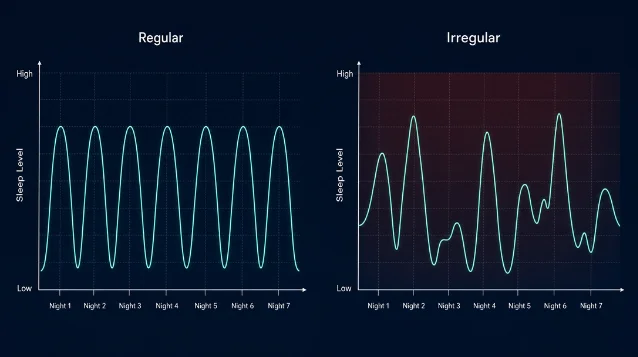
Core finding: Irregular sleepers had 2.65× higher odds of depression (OR 2.65; 95% CI 1.74–4.03) compared to regular sleepers. 3 Two results make this more than a duration story:
- The relationship was dose-response and linear — the more irregular the sleep pattern, the higher the depression odds, treated as a continuous variable.
- Even irregular sleepers who met the recommended sleep duration (typically 7–9 hours) still showed elevated depression odds (OR 2.68; 95% CI 1.59–4.53). 3
Interaction testing found no significant multiplicative or additive interaction between sleep regularity and sleep duration (P = 0.727; RERI −0.31, 95% CI −1.27 to 0.65), indicating regularity's effect does not depend on whether the person also sleeps enough hours. 3
The authors write: "Irregular sleep patterns were associated with an elevated odds of depression, even when adults met the recommended sleep durations." 3
Study limitation to keep in mind: This is a cross-sectional design, which means the data can only show association, not direction of causation. Depression may disrupt sleep timing as much as — or more than — the reverse.
Actionable takeaway: Hitting a 7-hour target is not enough if your bedtime shifts by two hours night to night. Prioritizing a consistent sleep and wake window — even on weekends — may be as important for mood as the total hours you log. For anyone already managing depression, erratic sleep schedules are a modifiable risk factor worth tracking.
Cover image: AI-generated illustration.
このコンテンツについて、さらに観点や背景を補足しましょう。