Zippo: The Lighter Company That Bet Its Survival on Never Refusing a Repair
In 1932, a Bradford, Pennsylvania businessman redesigned a flimsy Austrian lighter he couldn't sell, added an unconditional lifetime guarantee, and accidentally built one of America's most durable brands. When the country largely stopped smoking 60 years later, Zippo had to find out whether a lighter was a tobacco product or something else entirely.

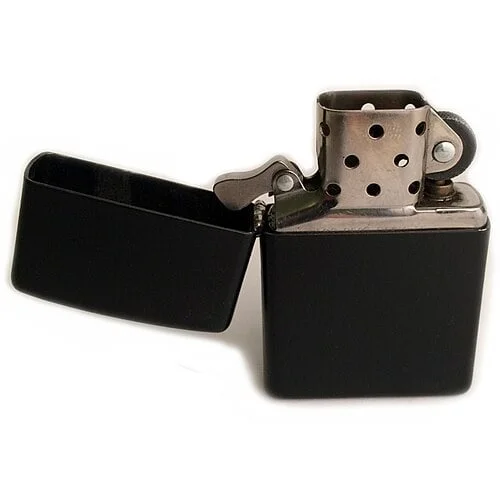
George Blaisdell did not set out to build a brand. In the summer of 1932, he was watching a friend at a Bradford, Pennsylvania country club struggle with an Austrian lighter in the wind — a clumsy two-handed device made by a company called IMCO. Blaisdell had already tried selling the IMCO lighter in America, importing it under a US distribution license. It didn't work. The design was flimsy and awkward, and customers returned it. He had already lost money on it. Rather than find a different product to distribute, he decided to redesign it from scratch. 1
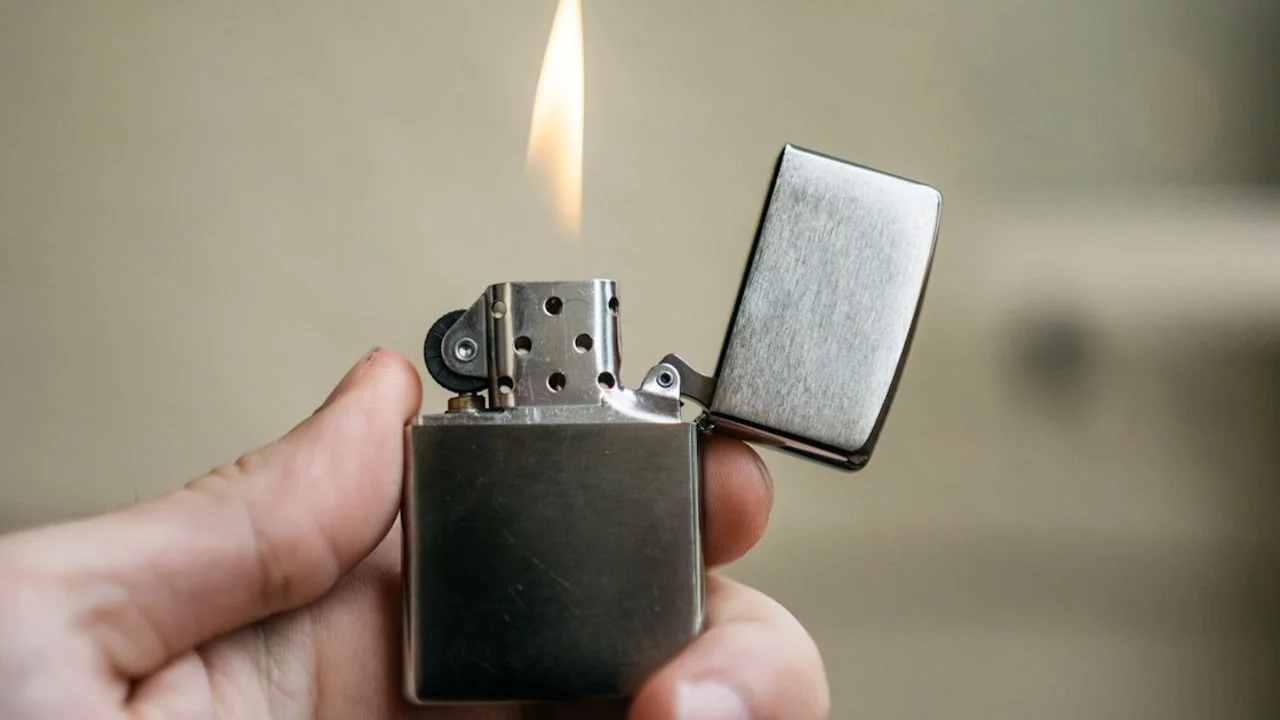
The new design was rectangular, made of durable metal, hinged at the top, and operable with one hand. Blaisdell liked the word "zipper" — it sounded modern, American, mechanical. He changed the last syllable and called it the Zippo. He founded the Zippo Manufacturing Company in 1932, moved into a rented room above the Rickerson & Pryde garage in Bradford for $10 a month, and produced his first lighter in early 1933. Retail price: $1.95, plus an unconditional lifetime guarantee. The guarantee wasn't a promotional add-on; it was printed on the product from day one. Blaisdell's motto was "it works, or we fix it free." 2
The first break
The early months were slow. The first Zippo plant had two employees and $260 worth of equipment. Blaisdell's first significant order came from the Kendall Refining Company in Bradford, which placed an order for 500 custom-branded lighters. This was the original form of Zippo's business model before anyone recognized it as such: the lighter as advertising medium. Companies could put their logo on a Zippo, and the customer would carry it — and show it to other people — every time they needed a light. By the mid-1960s, corporate advertising orders would account for 40 percent of Zippo's total volume, and the company had more than 27,000 commercial clients. 2
The lighter's windproof design gave Blaisdell an advertising angle. He instructed dealers to demonstrate the "fan test" — hold a lit Zippo in front of a blowing fan. The flame stayed lit. The test became a popular in-store gimmick and helped differentiate Zippo from its competitors on a functional rather than aesthetic basis. Blaisdell was careful to keep this language consistent. Zippo was not a fashionable lighter. It was a reliable one.
The patent came through on March 3, 1936. The mechanism — a windscreen chimney housing a wick, ignited by a flint wheel — has not fundamentally changed since. The Zippo lighter requires 108 manufacturing operations. 3
WWII: the decision that built the brand
In 1941, Blaisdell made a choice that changed the company's trajectory. After Pearl Harbor, he voluntarily ceased all consumer production and dedicated the entire factory to the US military. There was no government contract — Zippo had not been officially designated as military equipment. Individual soldiers simply wanted the lighters, and base exchange and post exchange stores stocked them in response to demand. Blaisdell supplied them anyway, at a price of roughly one dollar per unit — well below the civilian retail price. 3
The wartime Zippos were different from the civilian models. Brass had been designated a strategic war material, so the lighters were made of low-grade steel and spray-painted black with a baked crackle finish. The look was unmistakably utilitarian. It suited the context.
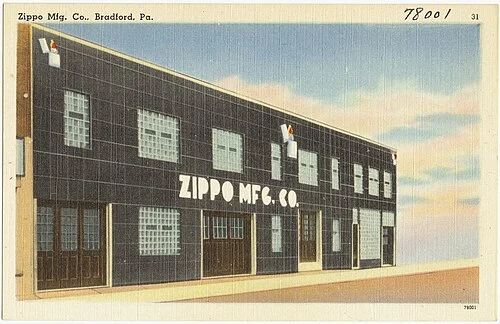
The war correspondent Ernie Pyle wrote a letter to Blaisdell calling the Zippo "probably the most important element on the front." Soldiers used them to heat food cans, to light instrument panels in the dark, to start fires in conditions where matches failed. By the end of the war, Zippo's annual production had reached three million units, all going to the military. 1
When consumer production resumed after 1945, Zippo had worldwide name recognition it had not paid to acquire. Returning soldiers were loyal customers. The brand had absorbed the context it was used in — not by advertising, but by being there.
Vietnam and the limits of association
The same dynamic that built Zippo's military reputation also produced the brand's most uncomfortable episode. In the Vietnam War, soldiers carried Zippos as their fathers had. Many had them engraved with personal mottos, dates, and expressions of dark humor. These custom lighters became a vernacular record of the war's psychological texture, and are now actively collected — a 2007 book from the University of Chicago Press documented Vietnam-era engravings as folk art. 3
But in August 1965, CBS correspondent Morley Safer filmed Marines using Zippos to set fire to thatched huts in the village of Cam Ne. The footage aired on the CBS Evening News. The soldiers who burned the village referred to themselves as "the Zippo Brigade." The phrase "Zippo squad" entered American military slang for being assigned to burn a settlement. The M132 armored flamethrower was nicknamed a "Zippo." The lighter had become a shorthand for destruction. 1
Zippo's sales remained strong throughout the Vietnam era and into the 1970s. The public did not appear to blame the company. The association was troubling, but it was also, in a perverse sense, a further confirmation of the lighter's utility. No one in the field was using something disposable.
The design that never changed — and why
The mid-1990s were Zippo's commercial peak. Annual production reached 18 million lighters. Revenue in 1996 was approximately $150 million — a record at the time. The plant in Bradford was producing 80,000 lighters per day. Export sales accounted for 65 percent of revenue, with Japan as the largest single market. 2
Throughout all of this, the core product had remained essentially unchanged since 1936. The mechanism was identical. The case dimensions were the same. Blaisdell had died in 1978; the company passed to his two daughters, Harriet Wick and Sarah Dorn, and management was handled by a succession of professional presidents. The logic was simple: the lifetime guarantee had committed Zippo to a design that could always be serviced. Every replacement part had to be compatible with every lighter ever made, potentially going back to 1933. Changing the mechanism meant changing the repair obligation — which would mean changing the guarantee, which was not something the company was willing to do.
The guarantee was by this point one of Zippo's clearest competitive advantages. "In almost 75 years," the company's website stated, "no one has ever spent a cent on the mechanical repair of a Zippo lighter regardless of the lighter's age or condition." 3 The repair center in Bradford processed returned lighters from around the world. The cost was absorbed into the business. Whether the math actually worked out in Zippo's favor is unclear — the company is private and has never disclosed repair volumes or costs — but the perception it created was worth far more than any accounting exercise could measure. A Zippo was something you kept. A disposable lighter was something you lost.
The problem Zippo could not fix
By 2011, production had fallen from 18 million units in the mid-1990s to approximately 12 million per year. American smoking rates had dropped from roughly 50 percent of adults in the 1950s to under 20 percent. The cities and states where Zippo lighters had been a standard pocket item were the same ones where smoking bans were now appearing in restaurants, bars, and public spaces. 3
In 2001, Zippo's owners appointed Greg Booth as CEO. He came from within the company — he had been running the knife-making subsidiary W.R. Case & Sons, which Zippo had acquired in 1993 — and his mandate was clear: find revenue sources that were not dependent on tobacco. 4
The diversification strategy had been underway in fragments since 1962, when Blaisdell first tried adding a steel tape measure to Zippo's product line. That effort produced folding knives, nail files, money-clip knives, golf balls, keyrings, and magnifying glasses — all small, all distributed only through corporate advertising channels, none of them material to the company's finances. Under Booth, the ambition became structural. The stated goal was to derive half of Zippo's revenue from non-tobacco-related products by 2010, while doubling total revenue to $300 million. 2
The first significant non-lighter product had been the Multipurpose Lighter (MPL) in 2002: an elongated, ergonomic butane lighter designed for candles, barbecues, and fireplaces. It went through regular retail channels — not just advertising accounts — and reached stores including Bed Bath & Beyond. First-year sales exceeded two million units, well above projections, and it attracted a noticeably younger and more female customer base than the windproof lighter. 2
Collectibles, China, and staying private
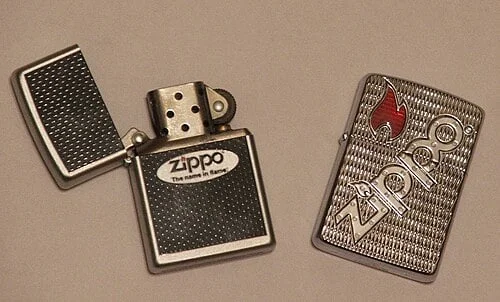
Booth's other strategic bet was more counterintuitive: lean into the collector market. Zippo estimated there were more than four million private collections in the United States alone. The company introduced annual collector editions in 1992, began holding bi-annual swap meets in Bradford, and in 2000 established Zippo Click, a paid membership club for collectors. The Zippo/Case museum at 1932 Zippo Drive in Bradford became part of the brand's identity. Rare early models traded at significant prices — a 1933 original sold at Zippo's 75th anniversary event in 2007 for $37,000. 1 3
Meanwhile, Booth shifted advertising from print to digital, began sponsoring music festivals, and expanded the design catalog substantially. Zippo offered 30,800 distinct designs in 2013, up from 8,900 a decade earlier — partly through an online customization platform that let buyers design their own lighter. The positioning was shifting: from utility tool to personalized object. From something your grandfather lit cigarettes with to something you carried as a piece of self-expression. 4
The China strategy was explicit about this repositioning. Zippo opened its first mainland China store in Hangzhou in 2003, framing the lighter as an American lifestyle brand rather than a tobacco accessory. By 2012, it had expanded to 14 branded retail stores in China, with plans for 35 more by 2015. The stores sold Zippo-branded clothing alongside the lighters. China contributed 13 percent of revenue in 2014. 4
In 2009, Zippo acquired the Ronson brand — its oldest and most direct American competitor, also a lighter company — and finalized the purchase in February 2010. 3 In 2018, it trademarked the sound of the lighter's click. The clink of the opening lid and the clunk of the closing had become, in the company's legal judgment, a recognized sound mark — one of the most distinctive sonic signatures in manufacturing. 3
Where it stands
The $300 million target was not met by 2010 — the 2008 financial crisis disrupted the timeline. But by 2013, Forbes estimated Zippo's revenue had exceeded $200 million for the first time since 2004, growing at a compounded 14 percent annually over the prior three years, even as domestic smoking rates continued to fall. 4
In June 2020, Zippo manufactured its 600 millionth lighter — 100 million units in eight years, the same pace as the prior stretch. 3 The company remains privately held, family-controlled, and headquartered on the same street in Bradford where Blaisdell set up his garage workshop in 1932. It still manufactures in the United States.
The lighter's mechanism hasn't changed since 1936. Every lighter still ships with the same guarantee it launched with in 1933. The Bradford repair center continues to service Zippos of any age, at no charge. A lighter bought in 1947 qualifies. One bought yesterday qualifies too.
Whether Blaisdell intended this as a business model or made it as a quality claim and discovered later that it was both is not something the historical record settles. What the record does show is that in a century when nearly every consumer brand attached to tobacco has had to either abandon the association or collapse, Zippo survived by insisting, against the obvious reading of the evidence, that what it had actually sold people since 1933 was not a cigarette lighter. It was the kind of thing you keep.
このコンテンツについて、さらに観点や背景を補足しましょう。