May 30 — the proving ground, the long runway, the fixed-price bet, and the business records
Four May 30 decisions across 113 years — Carl Fisher builds a racetrack as a research lab that produces the rear-view mirror; Airbus enters commercial service with 6 orders and nearly collapses during an 18-month order drought until a free trial wins the first U.S. buyer; SpaceX ends America’s 9-year dependency on Russia with a $3.1B fixed-price contract that outperforms Boeing’s $4.2B Starliner by 16 missions to zero; and a Manhattan jury convicts a former president on 34 counts for coding a hush-money payment as legal expenses.

Four events on this date across 113 years — a racetrack built as a test facility produces the first rear-view mirror while its founder spends his last years nearly broke; a government consortium's first airliner sits unsold for 18 months until an astronaut-CEO rescues it; NASA bets $3.1 billion on a private contractor to end a nine-year dependency on Russia; and a former president becomes the first in American history convicted of falsifying business records.
1911 — The racetrack as research laboratory, and the builder who lost everything
On May 30, 1911, roughly 80,000 to 85,000 paying spectators filed into Indianapolis Motor Speedway for the inaugural International 500-Mile Sweepstakes Race — today known as the Indianapolis 500. 1
Ray Harroun, driving the 32-number Marmon "Wasp" for Nordyke & Marmon Company, had a problem: race rules required each car to carry a riding mechanic to watch for overtaking traffic, but Harroun intended to drive solo to save weight. His solution was a small mirror mounted on a front bracket — the first known automobile rear-view mirror. 1 2 The stewards allowed it. Harroun later admitted the mirror vibrated so badly on the brick surface it was "largely useless" — but the concept stood. 2
Harroun ran a deliberate pace strategy: hold 75 mph to conserve tires rather than chase top speed. He made three pit stops and changed four tires total. His runner-up, Ralph Mulford, changed fourteen. Harroun finished in 6 hours, 42 minutes, 8 seconds at 74.602 mph average, winning by 1 minute and 43 seconds. 1 Total prize purse: $27,550, with $10,000 to the winner.
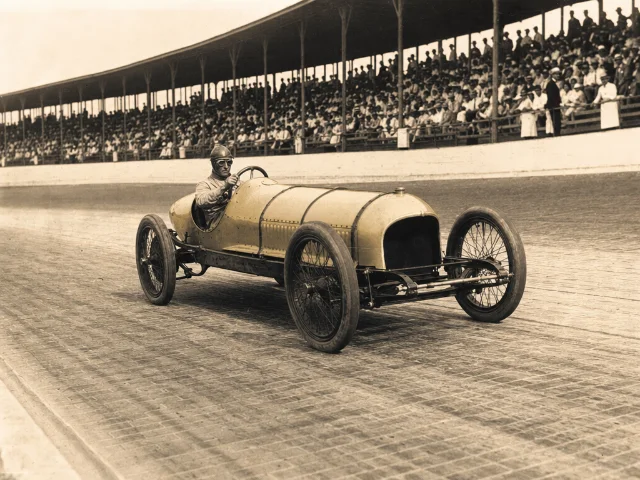
The Speedway itself had been built in 1909 by Carl Fisher — who had previously made a fortune selling Prest-O-Lite acetylene headlights to the fast-growing automobile industry, then sold the company to Union Carbide in 1913 for $9 million. 3 Fisher's stated purpose for the track was explicit: "a common testing facility for the rapidly growing local automobile industry." 4 The 3.2 million bricks that gave it the "Brickyard" nickname were laid after the track's first events in 1909 caused fatal accidents on the original gravel surface.
The Speedway fulfilled its laboratory mandate: rear-view mirrors, front-wheel-drive configurations tested in the 1920s, diesel efficiency demonstrated in 1931, disc brakes pioneered by Jaguar in the 1950s, and the SAFER barrier wall system adopted in 2002. 4 The Marmon company that produced Harroun's winning car survived until the Depression — its engineering innovations included the first commercial V-16 engine (1931) and extensive use of aluminum alloy — before being acquired by the Pritzker family and eventually sold to Berkshire Hathaway in 2007 for approximately $4.5 billion. 5
Mirror: Fisher built an institution whose value came from competitive pressure revealing what worked. The rear-view mirror that emerged from the 1911 race wasn't a product Harroun invented in a lab — it was an improvised solution to a regulatory constraint, validated under race conditions, and then quietly adopted by the entire industry. Environments designed for high-stakes testing at speed produce different innovations than controlled R&D programs. The question for operators isn't whether to build internal test environments, but whether those environments apply real competitive pressure — or just simulate it.
1974 — Airbus's first commercial flight, and the 18 months that almost killed it
On or around May 30, 1974, Air France began regular scheduled A300 service — the world's first twin-engine wide-body airliner entering commercial operation. 6 The first commercial flight had taken place on May 23 on the Paris Orly–London Heathrow route in aircraft F-BVGA, delivered to Air France just 13 days prior. 6 7
The consortium behind it — Airbus Industrie GIE, established December 18, 1970, initially a 50-50 joint venture between France's Aérospatiale and Germany's Deutsche Aerospace — had spent years fighting for its existence. 8 The 1965 British government Plowden report had documented that European aircraft manufacturers produced at 10 to 20 percent higher cost than their American counterparts simply due to fragmented national markets and insufficient production volume. 6 Aviation journalist Keith Otto summarized the odds at launch: "The omens for Airbus did not look good, taking on the big American three of Boeing, Lockheed and Douglas." 7
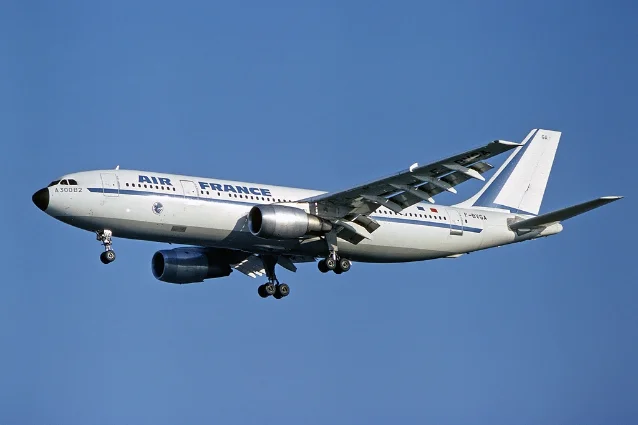
The initial order book told a worse story than the public knew. At entry into service, Airbus held just 6 confirmed orders — all from Air France, whose government had applied pressure to buy the domestic product. 6 By the end of 1974, only 20 net orders had arrived. From December 1975 to May 1977 — 18 months — not a single new order was placed. The Toulouse factory had multiple completed, unsold "white-tail" A300s parked on the tarmac; production had fallen to half an aircraft per month, and internal voices were calling for the program's cancellation. 6
The rescue came from an unusual angle. In 1977, Airbus offered Eastern Airlines — then one of the four largest U.S. carriers — four A300s for a free six-month trial lease, covering only fuel and crew training costs. Eastern's CEO was Frank Borman, the former Apollo 8 commander. After the trial, Borman reported the A300 consumed 30 percent less fuel than Eastern's existing Lockheed L-1011 TriStar. 6 9 On April 6, 1978, Eastern ordered 23 aircraft — the first American carrier to buy Airbus — and the program's survival was secured. Pan American followed shortly after. 6
The trajectory from that near-cancellation: Airbus first exceeded Boeing in annual net orders in 2003 (284 vs. 239). In 2009, Airbus established a delivery lead that has held every year since. In 2019, Airbus delivered 863 aircraft to Boeing's 380, the year Boeing's 737 MAX grounding handed Airbus a structural advantage. 10 By October 2025, the A320 family had surpassed the Boeing 737 as the highest-delivered commercial jet in history. 10 The A300 itself — 561 units built over 36 years, last delivered to FedEx in 2007 — spawned the A310, A330, A340, and the Beluga cargo transporter. 6
Mirror: Airbus entered commercial service in 1974 with a technically sound product and almost no commercial momentum. The 18-month order drought between late 1975 and mid-1977 was not a product problem — it was a market-access problem in an industry where every major U.S. carrier had deep relationships with Boeing or McDonnell Douglas. Airbus's solution was a zero-revenue product trial that converted a skeptic with actual operating data. Borman's 30-percent fuel-efficiency figure was the only argument that survived procurement politics. The lesson isn't unusual — let performance data do the selling — but the execution required absorbing near-zero revenue for half a year to get one credible reference customer. The sequence mattered: before Eastern, no U.S. carrier would commit; after Eastern, the resistance dissolved.
2020 — SpaceX's $3.1B fixed-price bet proves out, while Boeing's $4.2B doesn't
At 19:22 UTC on May 30, 2020, SpaceX's Falcon 9 lifted off from Kennedy Space Center Launch Complex 39A — the same pad used by Apollo 11 — carrying NASA astronauts Doug Hurley and Bob Behnken aboard Crew Dragon Endeavour (capsule C206). 11 It was the first crewed orbital spaceflight launched from U.S. soil since the final Space Shuttle mission (STS-135) on July 8, 2011 — a gap of 8 years, 10 months, and 22 days. It was also the first time a private company had ever launched humans to orbit.
A prior attempt on May 27 had been scrubbed at T−16:53 due to lightning risk from Tropical Storm Bertha. 11 The May 30 launch drew approximately 10 million online viewers, with 4.1 million peak on the SpaceX feed alone. Around 150,000 gathered in person near the Cape. 11
Falcon 9 / Crew Dragon Endeavour lifts off from Kennedy Space Center Launch Complex 39A, May 30, 2020. NASA photo — public domain. 11
Endeavour docked autonomously with the ISS Harmony forward port at 14:27 UTC on May 31, 19 hours after launch. 11 Hurley and Behnken joined Expedition 63, completed four spacewalks to replace ISS batteries, ran over 100 hours of science experiments, and splashed down in the Gulf of Mexico near Pensacola on August 2 — the first water landing by NASA astronauts since the Apollo-Soyuz mission in 1975. 11
The commercial context behind the mission: after the Shuttle's retirement in 2011, NASA had no domestic human spaceflight capability and was paying up to $80 million per seat on Russia's Soyuz. 11 NASA's Commercial Crew Program (CCP) structured its contracts as fixed-price — a deliberate departure from the cost-plus model that had governed NASA programs for decades, transferring financial risk to contractors. SpaceX received $3.1 billion for Crew Dragon development. Boeing received approximately $4.2 billion for its Starliner under the same program. 11
The divergence from that point:
| SpaceX Crew Dragon | Boeing Starliner | |
|---|---|---|
| First crewed test flight | May 30, 2020 (Demo-2) | June 5, 2024 (CFT) — 4 years later |
| Crew missions completed (through May 2026) | 16 | 0 operational flights |
| Key failure mode | Heat shield erosion (design fixed) | Thruster failures; crew stranded, returned via SpaceX Crew-9 |
| Contract value | $3.1 billion (fixed-price) | ~$4.2 billion (fixed-price) |
By May 2026, Crew Dragon had completed 16 crewed missions: Crew-1 through Crew-10 (NASA operational rotations), Inspiration4 (first all-civilian orbital flight, September 2021), Axiom-1 through Axiom-4 (private ISS missions, 2022–2025), Polaris Dawn (first commercial spacewalk at 1,400 km apogee, September 2024), and Fram2 (first crewed polar orbit, April 2025). 12 13 Boeing's Starliner had not begun operational rotation flights.
Mirror: NASA's Commercial Crew Program set up a natural experiment: two contractors, roughly similar contract values, identical program requirements, same fixed-price structure. The outcomes after six years differ by 16 missions to zero. What the program did not control for was organizational execution, technical debt, and the degree to which each contractor's leadership treated the contract as a ceiling or a floor. SpaceX had completed 20 prior uncrewed Dragon cargo missions before Demo-2; its crewed flight was an incremental test on top of an operational system. The fixed-price model created the incentive structure, but it didn't create SpaceX's institutional capability. For decision-makers procuring complex technical work: the contract structure determines incentive alignment; it does not substitute for evaluating the contractor's operational track record in adjacent domains.
2024 — The Trump conviction and what business records actually are
On May 30, 2024, a Manhattan jury returned a verdict on 34 counts of falsifying business records in the first degree against Donald Trump — all 34 guilty, making Trump the first former U.S. president in history to be convicted of a felony. 14 The case (People of the State of New York v. Donald J. Trump, IND-71543-23) was prosecuted by Manhattan District Attorney Alvin Bragg before Judge Juan Merchan.
The 34 counts corresponded to specific documents from February 14 to December 5, 2017: 11 invoices from Michael Cohen, 9 entries in Trump's general ledger, 9 checks signed by Trump, 3 ledger entries from the Donald J. Trump Revocable Trust, and 2 checks from the Trust. 14 Each document had categorized a reimbursement to Cohen as "legal expenses" — when the underlying payment was the $130,000 Cohen had extracted from his home equity line to pay Stormy Daniels ten days before the 2016 election. 14
Under New York Penal Law §175.10, falsifying business records escalates from a misdemeanor to a felony when the intent to defraud "includes an intent to commit another crime or to aid or conceal the commission thereof." 15 The prosecution identified potential predicate offenses including federal campaign finance violations — Cohen had pleaded guilty in August 2018 to making an illegal campaign contribution "at the direction of a candidate for federal office." 14
The market's initial read: DJT (Trump Media & Technology Group, which had gone public via SPAC merger on March 26, 2024) stock closed at $51.84 on conviction day, up 1.4% from the prior close of $51.12. 16 The recalibration followed: $49.09 the next session (−5.3%), and by June 4 the stock had reached $45.49 — an 11% decline from the pre-conviction high over four trading days. 16
Sentencing was scheduled and rescheduled six times before Judge Merchan on January 10, 2025 imposed an unconditional discharge — conviction with no fine, probation, or imprisonment, which Merchan described as "the only lawful sentence that permits entry of a judgment of conviction without encroaching upon the highest office in the land." 14 The U.S. Supreme Court declined 5–4 to block sentencing. An appeal, filed January 29, 2025, was pending as of May 2026. 14
Mirror: The 34 documents at the center of this case were not fraud in themselves — they were accurate records of payments Cohen received. The crime was in the categorization: coding a hush-money reimbursement as "legal expenses" to conceal the underlying transaction. The legal boundary §175.10 draws is between misclassification with intent to defraud (felony) and misclassification without it (misdemeanor). For any organization that runs expense approval through a classification system — which is every organization — this case is a demonstration that internal ledger entries, invoices, and check records are primary evidence in a criminal proceeding, not administrative artifacts. The intent embedded in the classification, not merely its accuracy, determines criminal exposure. Chief Financial Officer Allen Weisselberg processed the monthly payments; his signature appears on the ledger. Organizations whose internal bookkeeping is designed around categories that obscure rather than describe the underlying transaction should treat that design choice as a liability, not a routine accounting convention.
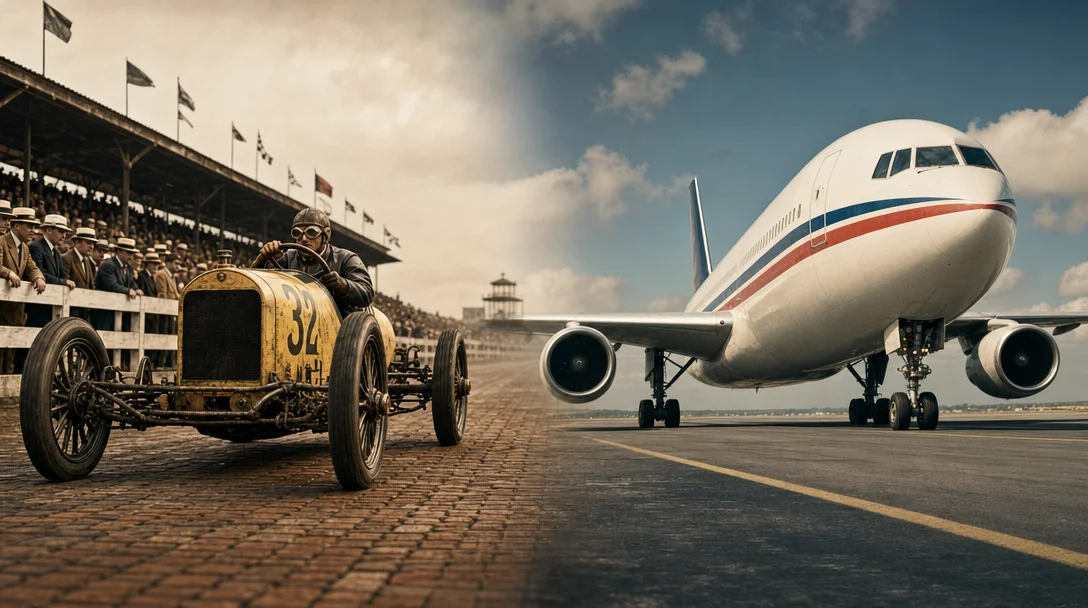
Cover image: AI-generated editorial illustration.
参考ソース
- 1Wikipedia: 1911 Indianapolis 500
- 2Wikipedia: Ray Harroun
- 3Wikipedia: Carl G. Fisher
- 4Indianapolis Motor Speedway: About the Track
- 5Wikipedia: Marmon Motor Car Company
- 6Wikipedia: Airbus A300
- 7AirwaysMag: 50th Anniversary — Airbus' First Commercial Flight
- 8Wikipedia: Airbus
- 9Wikipedia: Eastern Air Lines
- 10Wikipedia: Competition between Airbus and Boeing
- 11Wikipedia: Crew Dragon Demo-2
- 12Wikipedia: Inspiration4
- 13Wikipedia: Polaris program
- 14Wikipedia: Prosecution of Donald Trump in New York
- 15New York Penal Law §175.10
- 16Wikipedia: Trump Media & Technology Group
このコンテンツについて、さらに観点や背景を補足しましょう。