William the Hippopotamus: The 4,000-Year-Old Tomb Guardian Who Became a Museum Mascot
In May 1910, excavators opened a sealed pit in a Middle Kingdom tomb at Meir, Egypt, and found a blue faience hippo with three deliberately broken legs — placed there to neutralize Seth, the god of chaos, while preserving its power of rebirth. That figurine, purchased by dealer Dikran Kelekian and gifted to the Met in 1917, became known as William after a 1931 Punch magazine story. Today he is the museum's unofficial mascot, with a trademarked plush toy and a children's book to his name.
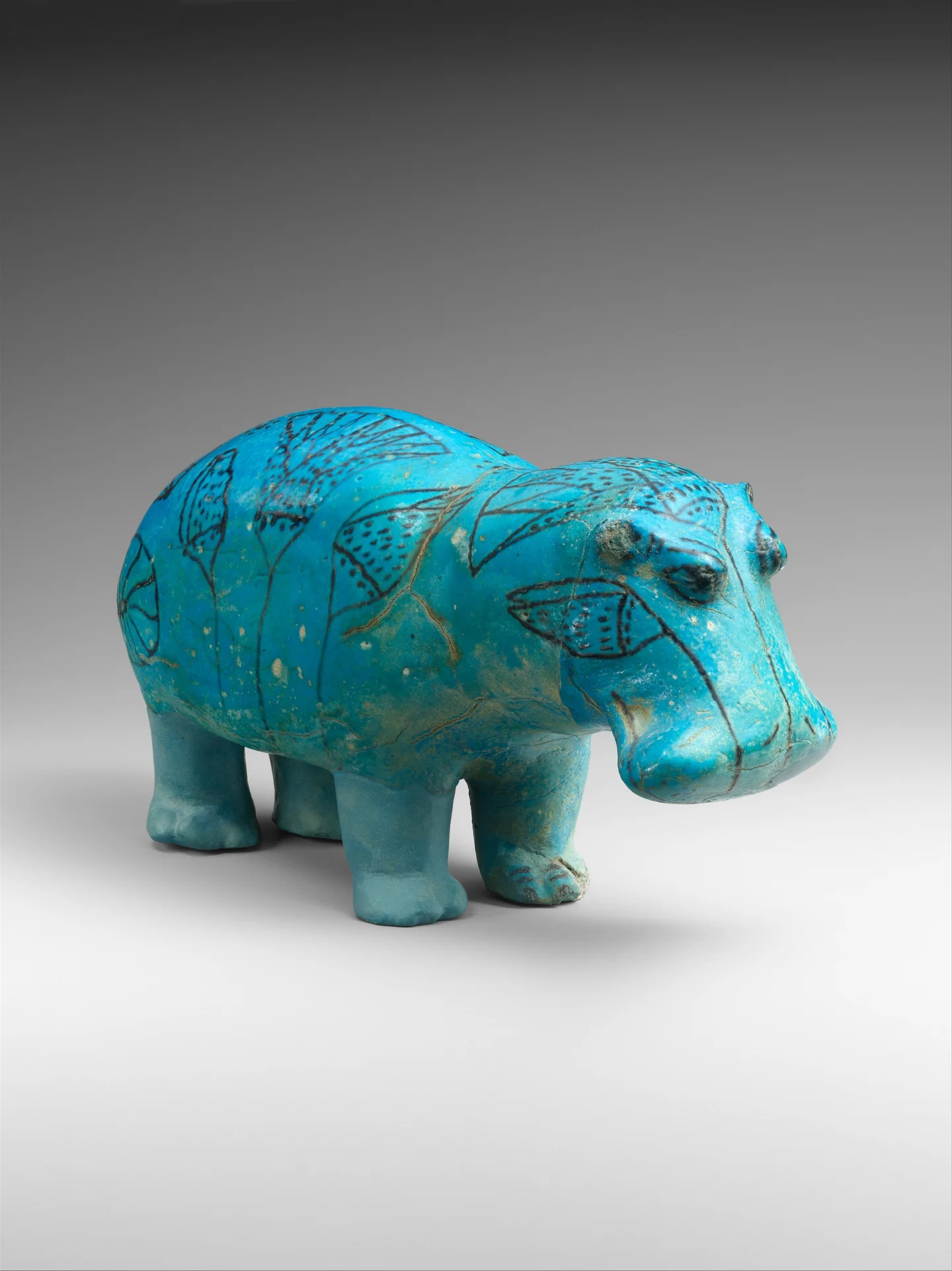
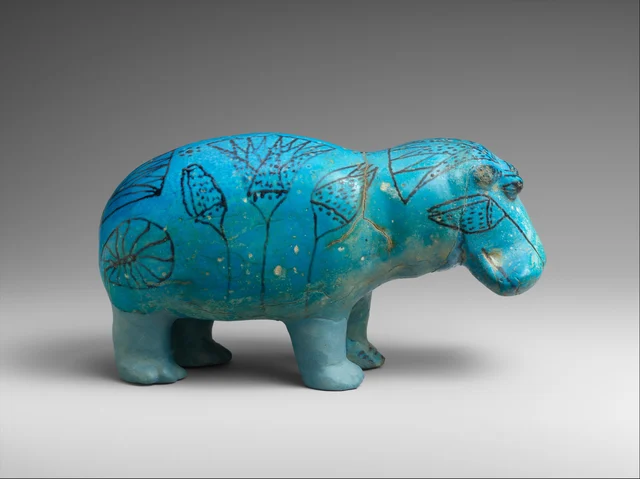
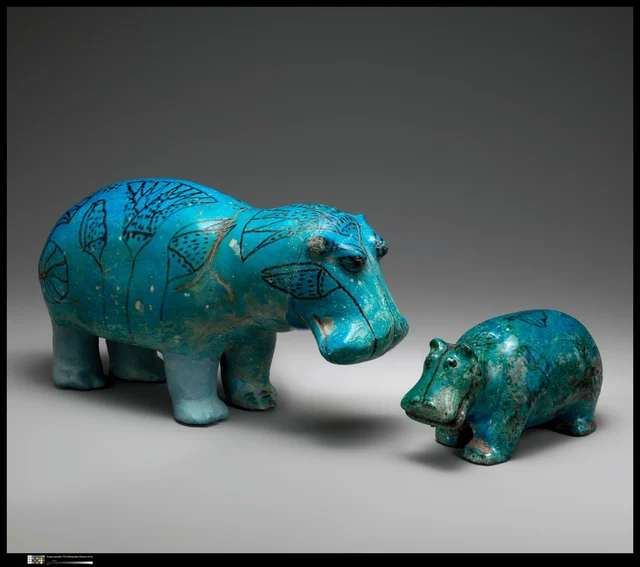
The object is smaller than you expect. Standing in Gallery 111 of The Metropolitan Museum of Art on Fifth Avenue, the blue faience hippopotamus known as William measures just 20 centimeters long and 11.2 centimeters high — about the size of a large paperback book, or a man's shoe. 1 His glaze is the color of turquoise mined from the Sinai Peninsula, or of shallow Nile water in late afternoon. Across his barrel-shaped body, someone painted open and closed lotus flowers, papyrus leaves, and buds in black manganese pigment, as though the hippo were standing in water up to his belly and had absorbed the marsh into himself. 2
Three of his four legs have been restored by the museum. The restorations are a slightly different shade than the original — deliberately left visible so that anyone looking closely can see the join. The left front leg is ancient. The other three were snapped off intentionally, more than 3,900 years ago, before the figurine was placed in a tomb.
That is not the strange part. Fifty or sixty objects like William survive in museum collections around the world, and most have their legs broken or entirely missing. 3 The ancient Egyptians broke the legs on purpose. They knew exactly what they were doing. Understanding why requires understanding what a hippopotamus meant in the Middle Kingdom — and that turns out to be the most revealing thing about William, far more revealing than the fact that he is, as Isabel Stünkel (Associate Curator in the Met's Department of Egyptian Art) has put it, the museum's "unofficial mascot." 4
The tomb at Meir
The last time William had been outside a museum before arriving at the Met in 1917 was in May 1910, when workers employed by Sayyid Pasha Khashaba (also known as Said Bey) broke into a sealed pit in Tomb B3 at Meir, a limestone cliff face in Middle Egypt about 40 kilometers south of Asyut. 1
Meir was a provincial cemetery of some importance. The tombs cut into its cliffs belonged to the nomarchs — regional governors — who administered the 14th nome of Upper Egypt during the Middle Kingdom, roughly 2055–1650 BCE. 5 Tomb B3 belonged to a nomarch named Senbi II, a provincial official who had lived during the reigns of Senusret I and Senusret II — the period Egyptologists call Dynasty 12, the political and artistic high point of the Middle Kingdom. The pit Khashaba's crew opened was designated Pit 1, listed in excavation records as belonging to Senbi's steward, also named Senbi. 1 5
William came out of that pit already minus three legs. What else came out with him is not fully documented; the record names the tomb and the pit but not the complete inventory of objects found alongside the hippo. What the provenance record does confirm is that under the arrangement governing Egyptian excavations at the time, Khashaba was entitled to a share of the finds. He took William.
By November 1910, the figurine was in Cairo in the shop of Maurice Nahman, a Lebanese-born dealer who had operated on the Sharia Kasr el Nil since around 1890 and had become one of the most influential antiquities merchants shaping Western museum collections of Egyptian art. 5 In 1911, Dikran G. Kelekian — an Armenian-American dealer and collector who maintained galleries in Paris and New York and supplied the major American collections — purchased William from Nahman. 5 In 1917, Kelekian sold him to Edward S. Harkness, a New York philanthropist and one of the Met's most generous benefactors, who gifted William to the museum. The accession number assigned was 17.9.1 — the "17" for the year of acquisition, "9" for the Egyptian Art department. 1
The whole journey from a sealed pit in Middle Egypt to a Fifth Avenue gallery took seven years.
What William is made of
The word "faience" in an Egyptian context does not mean the tin-glazed earthenware associated with Faenza in Italy. Egyptian faience — in ancient Egyptian, tjehenet, meaning something close to "the dazzling" or "the gleaming one" — is an entirely different material. 6 It is a sintered-quartz ceramic: ground quartz or sand mixed with small amounts of lime and an alkali flux (plant ash or natron), shaped, dried, and fired at temperatures archaeological experiments suggest ranged around 800–900°C, during which the surface vitrifies into a true glassy glaze. 6 The result is a material scholars have described as "the first high-technology ceramic" — an artificial substance that, at its best, convincingly imitated turquoise or lapis lazuli. 6
William's blue-green color comes from copper compounds worked into the glaze. The black painted decoration — the lotus flowers, papyrus stems, leaves, buds — was applied with manganese-based pigment. This was confirmed in October 2017 when three Met conservators — Anna Serotta, Carolyn Riccardelli, and Debbie Schorsch — brought William into the Department of Objects Conservation for a comprehensive non-invasive examination. They used a stereomicroscope, ultraviolet radiation, X-ray radiography, and X-ray fluorescence spectroscopy (XRF). 7
Under UV light, bright white fluorescence appeared around William's neck and at the top of three of his legs — modern adhesive from earlier restorations, now distinguishable from the ancient faience. Under X-ray, a thin, dense layer of fine-grained quartz appeared between the mottled core and the glazed surface: an intentional optical refinement that would have made the surface shine more brightly in gallery light. On the underside, the stereomicroscope revealed textured patches where the glaze was almost absent — firing marks, left by the kiln furniture that supported the object during firing. The XRF scan of the surviving original leg's bottom detected traces of a previously unrecorded modern restoration. 7
How a Middle Kingdom craftsman built a 20-centimeter object from faience at all remains a partial mystery. Faience paste is thixotropic — it flows under agitation but stiffens when still — which makes it extraordinarily difficult to sculpt. At 20 centimeters, William is close to the practical limit of what faience can achieve without slumping or cracking during construction and firing. The conservators found no evidence of how the body was built — hand-modeled, pressed in sections, or some combination — and they recorded the question as unresolved. "In our final estimation," Serotta, Riccardelli, and Schorsch wrote, "William is just as engaging up close, but still quite mysterious." 7
The painted garden on his back
The decoration William carries is not decorative in any casual sense. Every element was chosen for what it meant.
Lotus flowers — specifically Nymphaea caerulea, the blue Egyptian water lily — were the most powerful symbol of rebirth in the Middle Kingdom repertoire. The lotus closes at night and opens in the morning toward the sun; its daily rhythm mirrored the sun god Ra's nightly journey through the underworld and daily return. An open lotus was a statement of regeneration completed; a closed bud held it in promise. 8 9 Papyrus, the tall reed that once dominated the Nile Delta marshes, evoked the primordial swamp from which creation was held to have emerged — in some cosmologies, the first land to appear from the chaotic waters Nun at the beginning of time was a papyrus thicket. A hippopotamus covered in lotus flowers and papyrus was not just a naturalistic image of an animal in its habitat. It was a portable statement about death and what the Egyptians expected to follow it.
The blue glaze itself carried meaning. The Brooklyn Museum's curatorial explanation is direct: "The blue color was associated with the marshes where the hippos lived, and where life is said to have originated according to Egyptian mythology." 10 Lighter blue, near-turquoise, recalled both the Nile and the goddess Hathor — known in cult epithets as "the Lady of Turquoise." The darker tones of Egyptian blue imitated lapis lazuli, the deep night-sky stone associated with the primordial waters and resurrection. 10 An object fired to this particular shade of copper-blue occupied the entire symbolism simultaneously. As the Walters Art Museum's curatorial note puts it: "A hippopotamus's back rising out of the surface of the water evoked the first mound of creation from which the sun god emerged and life began. Lotus buds, too, were connected with creation and renewal." 8
The Met's original 1917 Bulletin noted simply that William was "covered with a decoration in black line of lotus flowers, buds, and leaves." 2 The Egypt Museum's commentary puts it more vividly: "Over the animal's naturalistic shape, the craftsman painted lily plants that appear as a giant tattoo." 9 That description is accurate. The flowers do not sit on William's body so much as grow from it, as though he were the marsh itself.
Why the legs were broken
The hippo in Middle Kingdom Egypt was not a charming animal. On the Nile, hippopotami capsized boats, trampled crops, and killed farmers. They were extraordinarily dangerous. In royal ideology, the pharaoh's ritual hunting of hippos — depicted in tomb reliefs — was a demonstration of divine power over chaos. The male hippopotamus in particular was identified with Seth, the god who murdered his brother Osiris and seized the throne: a force of violent disorder that had to be controlled or destroyed. 10 11
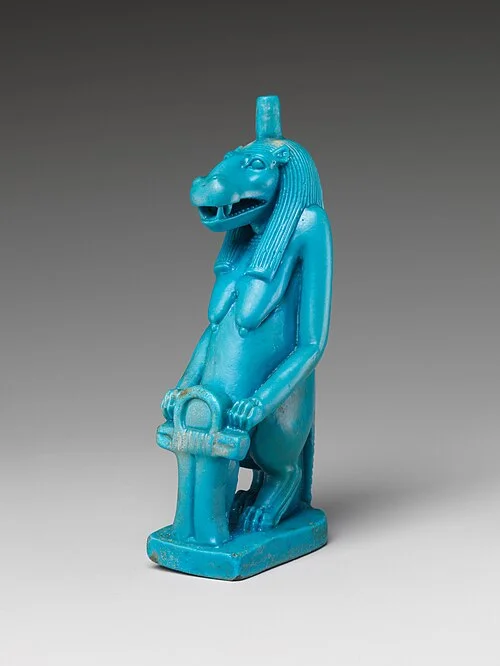
The female hippopotamus was something else. Because hippo mothers are famously aggressive in defense of their calves, female hippos were associated with maternal protection and the violence that love deploys. The goddess Taweret (ancient Egyptian: tA-wrt, "the Great One") was depicted as a standing female hippo with a swollen belly, lion's paws, and a crocodile's tail, one hand resting on the hieroglyph sa — the sign for protection. 11 Her name was a euphemism of the type Egyptians used for dangerous supernatural forces — calling the terrifying thing "great" to appease it. Taweret presided over childbirth and the protection of women and children. She was among the most widely worshipped household deities of the Middle Kingdom. Amulets of her image have been found in homes, in tombs, and on the bodies of the dead.
The hippopotamus in the tomb therefore held two possibilities at once: it could protect the deceased with the force of Taweret, and it could threaten the deceased with the chaos of Seth. The solution to this contradiction was elegant. You broke the legs.
"The standing hippopotamus represented Seth, the brother of Osiris who murdered him and then claimed his throne," the Brooklyn Museum's FAQ explains. "It was thus a symbol of chaos. Egyptians controlled negative forces in the tomb by including a hippopotamus with the legs purposely broken." 10 A hippo with no legs could not chase the deceased through the underworld. Its regenerative power remained — the blue glaze, the lotus flowers, the marsh imagery all continued to function — but it had been permanently grounded. The Met's own collection page states the fact directly: "Three of its legs have been restored because they were probably purposely broken to prevent the creature from harming the deceased." 1
This was not unique to William. Among the roughly fifty to sixty faience hippo figurines that survive from the Middle and early New Kingdom periods, most have their legs broken or entirely missing. Some were broken at the knees; some had the legs completely severed at the body; some were broken at three legs, some at all four. The specific pattern varied by tomb, perhaps by the preferences of the priests who oversaw the burial. What did not vary was the intent: the hippo was placed in the tomb for its power, and immobilized for its danger. 3 12
Senbi's steward was buried with the blue hippo and the broken legs. He had been preparing for exactly the afterlife the object promised.
Forty-nine cousins
William is the largest and best-preserved of the known faience hippopotamus figurines — and, because of his 107-year presence in Gallery 111, by far the most famous. But he is not alone. 4
The Brooklyn Museum holds at least two. The larger one (accession 35.1276, 12.1 centimeters long) has its legs entirely missing, unrestored — the white quartz body of the faience is visible beneath the surviving blue glaze, making it a more legible demonstration of the material's construction than William's restored version. 10 The smaller (36.120, 5.2 centimeters) is undecorated and deep blue, with all four legs absent and a head once broken and reglued in antiquity. 12 Both date to Dynasty 12 or 13.
The Louvre holds one that cannot be directly compared: E 7709, found near Thebes, is the only faience hippo known with its four legs bridged to the body by continuous faience straps and set on a plinth. It is unique in the entire corpus. The DailyArt Magazine account of its history records a particular footnote: "In the late 19th century, the Egyptologists of the Cairo Museum wanted to display the duplicates of the finest works in their collection in France, so they sold the hippopotamus to the Louvre." 3 The fact that Cairo's curators considered it a "duplicate" suggests there was once a much larger population of these objects than has survived.
The Walters Art Museum in Baltimore holds accession 48.401 (14 centimeters, Dynasty 12–13), its legs removed and the fully intact lotus decoration readable across its surface. The Kunsthistorisches Museum in Vienna holds a hippo with a flying duck painted on its back — the only known example with that motif. Among private collections, the George Ortiz Collection included one of the five known hippos with a turned head and the only one in the entire corpus decorated with a dragonfly. 3
What all these objects share is the same basic set of decisions: blue-green faience body, black painted marsh vegetation, deliberately damaged legs. The variations — turning heads, ducks, dragonflies, intact versus removed legs — suggest individual workshops, individual tomb owners, and individual interpretations of the same underlying formula. William, at 20 centimeters with his full decoration intact and three legs restored, sits at the top of the quality hierarchy in this corpus. The Walters Museum's catalogue description of its hippo speaks for all of them: "Blue faience hippopotamuses were popular in burials of the Middle Kingdom through the Second Intermediate Period and could assist the deceased in the process of rebirth." 8
A name from a British magazine
William entered the Met in 1917 as Accession 17.9.1. He was described in the April 1917 Bulletin as "a particularly fine example of a type found, in common with various other animal forms, among the funerary furnishings of tombs of the Middle Kingdom." 2 He had no name.
The name arrived fourteen years later, from an unexpected direction. On March 18, 1931, the British satirical magazine Punch published a short humorous piece by a writer identified as Captain H.M. Raleigh — full name Hilary Mason Raleigh, 1893–1969. 14 Raleigh's piece described how his family had come to own a framed color-print reproduction of the Met's blue hippo — the Met had been selling color collotype prints since 1927 — and how they had taken to consulting it as a household oracle. 15 When they ignored William's "advice," catastrophe followed: a ruined seaside holiday involving rain, a stolen watch, and mumps; a golf outing that ended in disaster.
Raleigh's description of the print remains one of the more charming records of what people see in this object:
"His shape is irregular and dumpy, his flanks are decorated with the outline of the lotus flowers, buds and leaves, the pottery has chipped off his near fore-foot, giving the impression, at all events in the colour-print, of a grey woollen sock bursting through a boot."
And later:
"William is inscrutable, incomprehensible, and yet with it all the friendliest thing in the world." 14
The article was reprinted in the Met's own Bulletin in June 1931. The name stuck. 2
Isabel Stünkel and Kei Yamamoto (both of the Met's Egyptian Art department) examined the Raleigh story in 2017 and noted that Punch was a humor magazine, and the same issue contained other pieces by Raleigh suggesting he was a professional story writer. The oracular narrative, they concluded, was "likely... largely a humorous fiction, possibly based on some true elements." 14 The name, however — "but to us he is simply William," Raleigh had written — was not fiction. It was precisely the kind of personal attachment that turns an artifact into a character, and the Met recognized it as such. By 1936, the museum had published a book titled William and his Friends: A Group of Notable Creatures in the Metropolitan Museum of Art. 2 The display label in Gallery 111 today reads: "Hippopotamus ('William')."
Inside the lab, 2017
One hundred years after his acquisition, William was carried into the Met's conservation lab for the first time. He had spent a century in a glass case; now Anna Serotta, Carolyn Riccardelli, and Debbie Schorsch could look at him without glass in the way. 7
"Although we've examined some wonderful ancient Egyptian faience objects, we'd only admired William through a glass case," they wrote, "so it was exciting to have him in the lab in person!" 7
The examination confirmed and complicated the picture. UV radiation revealed modern adhesive at the neck joint and at the junctions of the three restored legs — consistent with the restorations being done before the figurine entered the Met, or in the museum's early decades. The X-ray disclosed the fine-grained quartz interlayer between core and glaze: a manufacturing choice that would have sharpened the optical brilliance of the surface, analogous to the sizing applied beneath oil paint to make pigments more luminous. The XRF scan identified copper (blue glaze), manganese (black decoration), and, on the bottom of the surviving original leg, traces of lead, iron, and calcium consistent with a modern restoration that had not previously been recorded. 7
The stereomicroscope found something unexpected on William's underside: textured patches with almost no glaze, where kiln furniture had been in contact with the body during firing. This kind of firing mark tells conservators about manufacturing process — it suggests William was fired resting on supports, not suspended, and that the glazing method may have been efflorescence (allowing soluble salts to migrate to the surface during drying) or cementation (packing the shaped but unfired body in a glazing mixture), or both. No method leaves marks exactly like the ones found, which is part of why the manufacturing mystery remains open. 7
The examination found no evidence of any structural intervention more recent than the older restorations. William's three non-original legs had been in place for some time before October 2017; no legs were removed or reattached during the examination. The conservators added what they had found to the record, photographed everything, and returned him to the gallery. "We were better able to visualize the extent of modern restoration," they noted, "and we observed and documented previously unrecorded manufacturing features such as the firing marks, the fine quartz layer, and variations in glaze thickness." 7
From plush toy to global mascot
The Met began selling cast reproductions of William in 1952 — color prints had been available since 1927, but the three-dimensional copies that now sit on shelves and mantelpieces around the world started that year. 2 Today the store sells a plush version: 12 inches long, polyester fiber, blue with lotus-blossom appliqués, listed at $29.95. 16 The product description notes that the toy "references the famous 'William®,' an ancient Egyptian statuette in The Met collection." 16 He is trademarked.
In 2014, Géraldine Elschner wrote and Anja Klauss illustrated The Little Hippo: A Children's Book Inspired by Egyptian Art (Prestel), described by the Met as "a beautiful little fairy tale about how a little blue hippo (not William, but definitely a 'relative') helps an Egyptian boy." 14 The State Bags brand produced a "Hippoflage" print collaboration with the Met. DK published The Met Mystery at the Museum with William as the central character. 13
For the centenary of his arrival in 1917, the Met mounted a weekend of programming and an installation called "Conversation between Two Hippos," placing William beside a large 1936 ceramic hippopotamus by American artist Carl Walters — the modern work clearly descended from the ancient one, larger and more elaborate in its glazing but unmistakably in dialogue with it. 17 The Met's YouTube "Art, Explained" video on William reached more than 77,000 views. 13
What accounts for the attachment? Stünkel's assessment is careful: "The quality of this particular statuette and its excellent state of preservation make 'William' the best example of this type of object in our collection, and he is the faience hippo statuette that visitors react to most strongly. 'William' is and always has been very popular with museum visitors, which is why we often refer to him as an 'unofficial mascot.'" 4
Among the fifty-odd surviving faience hippos, William is the only one with a name, a trademarked plush, a children's book series, and a hundredth-birthday party. The others sit in cases in Brooklyn and Baltimore and Vienna and Paris and Providence, well preserved and well documented and almost never Googled. The difference is not scholarly significance — Louvre E 7709 with its unique plinth is arguably more remarkable as an artifact — but a century of continuous exhibition in one of the world's most visited museums, a color-print sold since 1927, a humorous story published in a British magazine in 1931, and the simple fact that someone gave him a name and decided that the name would stick.
The Met's William 100 page puts the paradox directly: "In 1917, The Metropolitan Museum of Art acquired a small ancient Egyptian faience hippopotamus. Created in a captivating blue, the little hippo quickly won people's hearts." 13
He was placed in a tomb to neutralize the god of chaos. He has a plush toy in the gift shop. The gap between those two facts is the distance between one civilization's cosmology and another's, crossed by an irregular, dumpy, inscrutable, and deeply friendly object that is 20 centimeters long and has three restored legs.
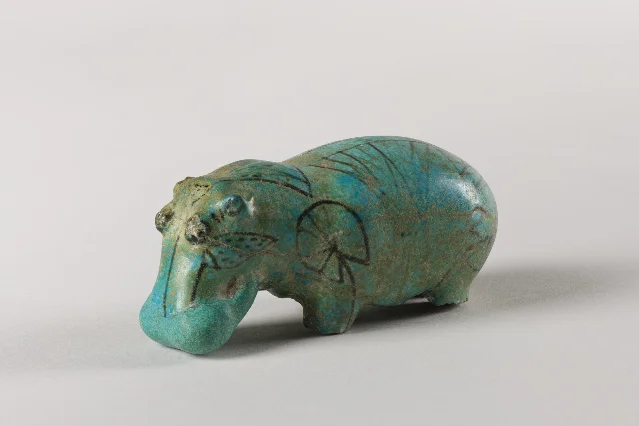
Cover image: Hippopotamus ("William"), Metropolitan Museum of Art, acc. 17.9.1, c. 1961–1878 BCE. Metropolitan Museum of Art Open Access (CC0).
参考ソース
- 1The Met Collection API: Hippopotamus "William"
- 2Wikipedia: William (hippopotamus figurine)
- 3DailyArt Magazine: Blue Faience Hippopotamuses of the World
- 4Hyperallergic: Celebrating 100 Years of William the Hippo
- 5The Met: Hippopotamus "William" (French collection page)
- 6Wikipedia: Egyptian faience
- 7The Met blog: Getting to Know "William" — Inside and Out
- 8Walters Art Museum: Hippopotamus with Aquatic Flower Decoration (48.401)
- 9Egypt Museum: Faience Statuette of a Hippo
- 10Brooklyn Museum: Hippopotamus (35.1276)
- 11Wikipedia: Taweret
- 12Brooklyn Museum: Hippo (36.120)
- 13The Met: William the Hippo — Celebrating 100 Years
- 14The Met blog: How William the Hippo Got His Name
- 15The Met press release: William the Hippo Celebrating 100th Anniversary
- 16The Met Store: William Hippo Plush
- 17A Scholarly Skater: William the Hippopotamus Makes a New Friend
このコンテンツについて、さらに観点や背景を補足しましょう。