

Five papers worth your time — May 23, 2026

Five papers worth your time — May 23, 2026

JAMA leads: protein restriction cuts dialysis risk 35%; trigger bans shift miscarriage care

PubMed Top Medical Papers
2026/5/23 · 22:24
購読 2 件 · コンテンツ 9 件

リサーチノート

NEJM has published no original articles for six consecutive days. JAMA anchors today's window with two entries — a large retrospective cohort study on dietary protein restriction in CKD and a difference-in-differences analysis of miscarriage care under abortion trigger bans — plus three JAMA Network Open papers with full quantitative data now available via PubMed. Lancet and BMJ main journals published no new clinical trials in the window.

1. Moderate protein restriction linked to 35% lower dialysis risk over 15 years in nondialysis CKD

Journal: JAMA · Retrospective cohort study · Published online May 22, 2026 1 2
Study design: Retrospective cohort, 2007–2022, at Clalit Health Services (Israel's largest managed-care organization). Enrolled 1,441 adults with CKD stage 3–4; mean age 67.2 years, 35.2% female. Dietary protein intake was measured by 24-hour urinary nitrogen excretion and expressed as normalized dietary protein intake (nDPI, g/kg/day). Patients were stratified at nDPI 1.0 g/kg/day. Median baseline nDPI was approximately 1.18 g/kg/day, meaning most patients exceeded the guideline-recommended 0.8 g/kg/day threshold. Propensity-score matching yielded 265 patients per group. Lead/corresponding author: Ilia Beberashvili, MD (Clalit Health Services).
Key results:
OutcomeLow nDPI (<1.0)Reference (≥1.0)HR95% CI
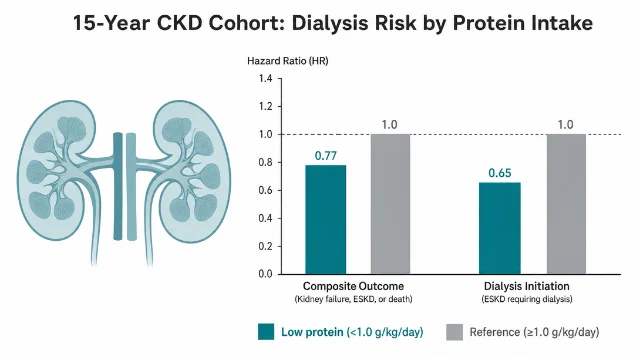
Composite (≥50% eGFR decline, dialysis, or death)LowerReference0.770.62–0.97
Dialysis initiationLowerReference0.650.42–0.99
Adjusted Cox model (composite)0.750.60–0.93
≥50% eGFR declineDirectionally lowerReferenceNS
All-cause mortalityDirectionally lowerReferenceNS
2
No significant differences in nutritional safety markers (serum albumin, Geriatric Nutritional Risk Index) between groups. Subgroup analyses showed no significant interaction by age, sex, diabetes status, CKD stage, or medication use. 2
Peer-review status: Published in JAMA; fully peer-reviewed.
Clinical implication: The 35% reduction in dialysis initiation (HR 0.65) was the primary driver of the composite endpoint benefit — the more clinically consequential component, given that dialysis initiation marks a major life-trajectory event for CKD patients. The magnitude is smaller than that observed with SGLT-2 inhibitors or mineralocorticoid receptor antagonists in CKD trials, but the intervention is purely dietary. The finding that nutritional safety markers were unchanged addresses a standing concern about protein restriction in older, frailer CKD populations. The study's main limitation is its retrospective observational design: protein intake was not randomized, and residual confounding cannot be excluded, particularly because more adherent patients may differ systematically from less adherent ones. The 24-hour urinary nitrogen method — more accurate than food-recall instruments — partly mitigates measurement bias but does not resolve confounding. For nephrologists advising nondialysis CKD stage 3–4 patients, this 15-year observational dataset supports moderate protein restriction as a component of conservative management alongside — not instead of — pharmacological agents.
AI-generated infographic summarizing hazard ratio estimates for dialysis initiation and composite outcome by protein intake group in a 15-year CKD cohort
AI-generated schematic of the primary hazard ratio estimates from the protein-CKD cohort study. 2

2. Abortion trigger bans associated with shift away from evidence-based miscarriage management

Journal: JAMA · Retrospective cross-sectional study with difference-in-differences analysis · Published May 22, 2026 3
Study design: Difference-in-differences (DID) analysis using Merative MarketScan commercial insurance claims. Sample: 123,598 patients aged 15–45 with spontaneous abortion at ≤77 days' gestation. Comparison: 14 states with abortion trigger bans vs. 17 control states. Corresponding author: Maria Rodriguez, MD, MPH (Oregon Health & Science University, Portland).
Key results:
  • Trigger bans associated with a +2.8 percentage point increase in expectant management (95% CI 1.0–4.6) 3
  • Trigger bans associated with a −2.2 percentage point decrease in medication management (95% CI −3.5 to −0.9); surgical management unchanged 3
  • Among patients who received medication management: misoprostol-only (less effective) regimen increased by +13.8 percentage points in ban states (95% CI 9.0–18.6) 3
  • Mifepristone–misoprostol combination (first-line regimen) rose from 15.9% to 31.5% in control states; in ban states it moved from 1.9% to 3.1% 3
  • Emergency department diagnosis of spontaneous abortion increased from 21.0% to 26.4% in ban states (vs. 14.8% to 18.7% in control states) 3
Rodriguez stated: "Abortion bans resulted in not only delays in obtaining care for miscarriage, but lower quality miscarriage care." 3 She added: "We cannot silo abortion care from pregnancy care. It is a continuum, and legislating access to one type of care during pregnancy impacts miscarriage management and may impact other pregnancy outcomes." 3
Daniel Grossman, MD (UCSF, not involved in the study), said: "it's concerning that patients in these states are being offered a less effective regimen." 3
Peer-review status: Published in JAMA; fully peer-reviewed. DOI: 10.1001/jama.2026.6344.
Clinical implication: This is the first large-scale, national claims-based study to document that abortion restrictions have altered clinical management of spontaneous abortion. 3 The mechanism is not pharmacological — misoprostol alone is less effective than mifepristone–misoprostol for first-trimester miscarriage completion — but legislative: mifepristone's legal status under state abortion statutes now limits its use for miscarriage management even though these are distinct clinical indications. The 5.4-percentage-point widening of the ED-presentation gap between ban and control states is a downstream signal worth monitoring in maternal morbidity surveillance. The DID design requires the parallel-trends assumption, which cannot be directly tested; selection bias in commercial insurance coverage is an additional limitation. For obstetricians and emergency physicians practicing in ban-state jurisdictions, this dataset provides evidence that the gap in guideline-concordant care is measurable and widening.

3. AR-guided decision support did not improve time to first epinephrine in simulated pediatric cardiac arrest — but did improve dosing-interval adherence

Journal: JAMA Network Open · Simulation-based open-label multicenter RCT · Published May 22, 2026 (JAMA Netw Open 2026;9(5):e2614030) 4 5
Study design: Multicenter simulation-based RCT conducted April–May 2025 at two tertiary pediatric emergency centers (Geneva, Switzerland and Alberta, Canada). Enrolled 54 participants organized into 18 resuscitation teams: 9 teams (n=27) randomized to AR-enhanced, role-specific decision support; 9 teams (n=27) to standard AHA PALS pocket cards. Registered under NCT06376643. First author: Siebert JN.
Key results:
OutcomeAR groupControlDifference95% CIP
Time to 1st epinephrine (primary), sec97.2 (SD 38.5)113.8 (SD 44.5)−16.6 sec−51.3 to 17.00.40
Epinephrine dosing-interval adherence violations2/19 (11%)9/21 (43%)RR 0.250.06–1.000.03
Mean deviation from 4-min target (subsequent doses), sec17.2 (SD 32.5)49.7 (SD 40.3)−32.4 sec−58.8 to −5.80.03
Time to first defibrillationSimilarSimilarNS
Chest compression fractionSimilarSimilarNS
5
Peer-review status: Published in JAMA Network Open; fully peer-reviewed.
Clinical implication: The trial was underpowered for its primary outcome — 18 teams is a small denominator for a resuscitation simulation RCT, and the 16.6-second absolute difference in time to first epinephrine falls squarely in the confidence interval centered near zero. The more actionable signal is the dosing-interval finding: in cardiac arrest, epinephrine is administered every 3–5 minutes per guidelines, and the AR system reduced interval violations from 43% to 11% of participants (RR 0.25). Interval adherence is mechanistically plausible as an AR-amenable task — the technology can display elapsed time and cue rescuers before drift accumulates. Whether this translates to patient-level outcomes in live resuscitations requires a substantially larger, in-vivo trial design. User experience and technology acceptance were reported as favorable, which is a prerequisite for adoption-phase planning.

4. Email outperforms patient-portal messaging for clinical trial recruitment: RCT in 15,376 participants

Journal: JAMA Network Open · Factorial RCT · Published May 22, 2026 (JAMA Netw Open 2026;9(5):e2614046) 6 7
Study design: 2×2 factorial RCT embedded in the RESILIENCE cardiovascular prevention study at Duke Clinical Research Institute, Durham, NC. Potential participants (n=15,376) were identified through EHR and randomized to receive: (1) email or patient-portal message, and (2) altruistic ("help your community") or individualistic ("personalize your care") framing. Primary outcome: logging onto study website by clicking the recruitment link within 6 months. Recruitment period: September 2019–March 2022. First author: Gouda P.
Key results:
  • Overall 6-month interest rate: 1,220 of 15,376 (7.9%) 7
  • Email vs. patient portal: 9.9% vs. 5.9% (RR 1.68, 99% CI 1.45–1.95; p<0.001) 7
  • Altruistic vs. individualistic framing: 8.3% vs. 7.6% (RR 1.08, 99% CI 0.94–1.25; not significant) 7
  • Exploratory subgroup: altruistic framing more effective in participants aged ≤60; email more effective than portal in participants aged >60 and in those with obesity 7
Peer-review status: Published in JAMA Network Open; fully peer-reviewed. Clinical trial NCT04551872.
Clinical implication: The delivery-modality finding is the operationally actionable result: a 68% relative improvement in click-through from switching from patient portal to email (9.9% vs. 5.9%) is large enough to materially affect enrollment timelines and feasibility in cardiovascular and chronic-disease trials that rely on EHR-based recruitment. The null finding on message framing — despite 15,376 randomized participants providing 99% statistical power — is informative in the opposite direction: labor-intensive copywriting to optimize altruistic vs. self-focused appeals appears not worth the effort. The overall click-through rate of 7.9% underscores that EHR-identified potential participants remain a population with high refusal rates regardless of message design; recruitment scientists should set realistic expectations accordingly.

5. FDA boxed warning on montelukast associated with prescribing decline across all age groups

Journal: JAMA Network Open · Serial cross-sectional study with interrupted time series analysis · Published May 22, 2026 (JAMA Netw Open 2026;9(5):e2614052) 8 9
Study design: Interrupted time series analysis using national commercial insurance claims. Monthly cohorts of asthma patients ≥6 years old with continuous insurance coverage, October 2017–December 2022. Baseline cohort (October 2017): 594,253 asthma patients (58.6% female, 19.2% under age 18, 49.3% using inhaled corticosteroids). The intervention was the FDA boxed warning for montelukast (leukotriene receptor antagonist; brand name Singulair), issued March 2020, citing risk of serious neuropsychiatric events. Authors: Shanmugam H, Kesselheim AS, et al. (Harvard Medical School/Brigham and Women's Hospital).
Key results:
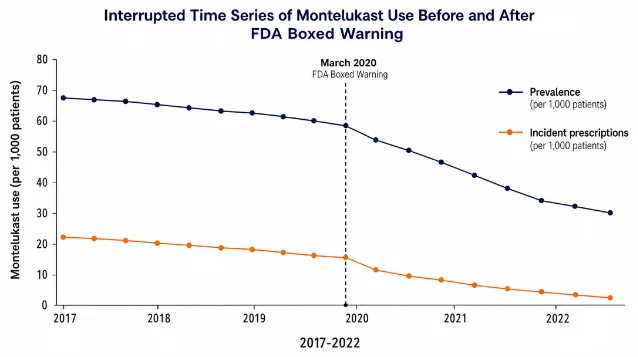
  • Pre-warning baseline: monthly prevalence 160.0 per 1,000 asthma patients; incident new prescriptions 5.8 per 1,000 9
  • Post-warning level change in incident prescriptions: −1.7 per 1,000 (95% CI −2.2 to −1.3) 9
  • Post-warning slope change in prevalence: −0.9 per 1,000 per month (95% CI −1.1 to −0.6) 9
  • Both changes were statistically significant across all age groups and all asthma severity subgroups 9
Peer-review status: Published in JAMA Network Open; fully peer-reviewed.
AI-generated schematic of interrupted time series pattern for montelukast prescribing before and after the March 2020 FDA boxed warning
AI-generated schematic illustrating the interrupted time series pattern: incident prescriptions and prevalence both declined after the March 2020 FDA warning. 9
Clinical implication: A −1.7 per 1,000 incident-prescription drop against a baseline of 5.8 per 1,000 represents a roughly 29% decline in new montelukast starts — a meaningful response to a safety communication. The population denominator (~600,000 patients/month) makes the absolute numbers clinically relevant: hundreds of thousands of patients were potentially affected by the prescribing shift. The critical question the data cannot answer is whether the decline was clinically appropriate (high-risk patients correctly deprescribed) or overcorrective (patients with low neuropsychiatric risk also avoided a useful controller medication). Aaron Kesselheim and the Harvard group have documented several precedents of boxed warnings producing overcorrection in prescribing; an invited commentary published alongside this paper, titled "The Unfinished Science of Boxed Drug Warnings," 10 addresses that tension directly. For allergists, pulmonologists, and primary care physicians, the practical implication is a need for periodic re-evaluation of patients whose montelukast was discontinued post-2020 without documented neuropsychiatric symptoms.

リンクプレビューを読み込んでいます…
Cover image: AI-generated illustration

このコンテンツについて、さらに観点や背景を補足しましょう。

  • ログインするとコメントできます。