CARBFUNC RCT: LCHF vs. standard carb at 3 months (n=193)
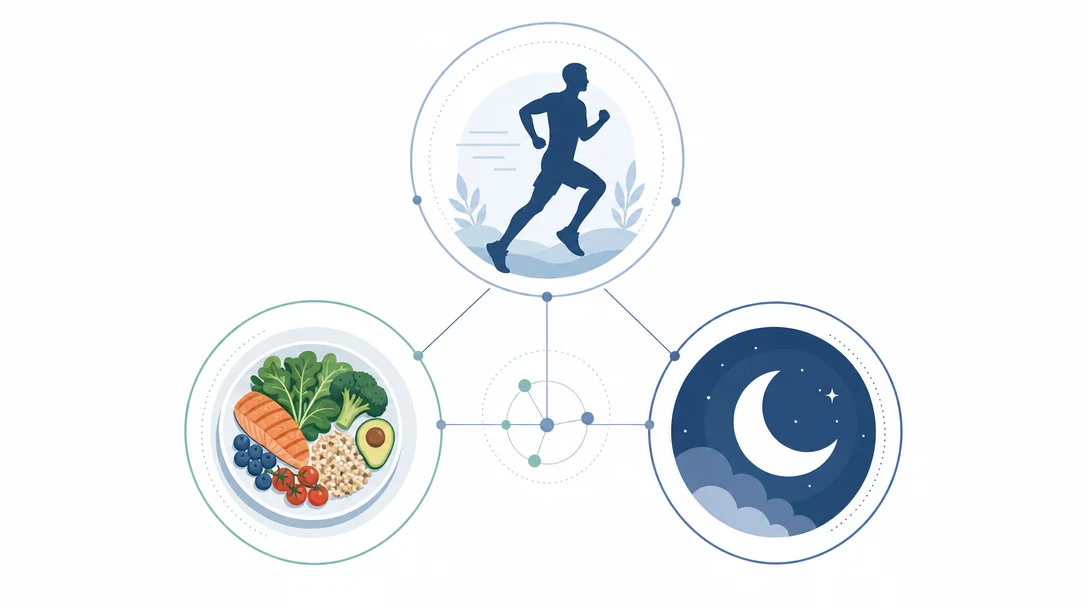
3 New Papers: Low-Carb Depletes B Vitamins, Resistance Training Clears T2D Risk Markers, and an App-Based Therapy Quiets Insomnia
Three PubMed papers indexed May 30–June 6, 2026: a 193-person 12-month RCT finds ketogenic diets significantly lower nicotinamide and B6 metabolites independent of dietary B-vitamin intake; a 33-RCT meta-analysis (n=1,396) shows resistance training cuts HbA1c 0.62%, HOMA-IR 0.90, and SBP 3.91 mmHg in adults with T2D; and an 8-RCT meta-analysis finds internet-based acceptance and commitment therapy cuts sleep quality scores (SMD −0.92) and insomnia symptoms (SMD −0.40) versus passive control.

リサーチノート
Three PubMed papers indexed May 30–June 6, 2026.
Nutrition: going very low-carb reshapes your B-vitamin metabolism — even when you eat plenty of B vitamins
The paper: Bråtveit M, Laupsa Borge J, et al. "Marked changes in one-carbon metabolism on a low-carbohydrate high-fat diet: a randomized controlled trial (CARBFUNC)." Journal of Nutrition, June 2, 2026. PMID 42235826. 1
Study design: Three-arm parallel RCT, n = 193 adults with obesity, 12 months. Arms: (1) a very low-carb, high-fat diet (LCHF: 8% of energy from carbohydrates, ~75% from fat, ~30% saturated fat); (2) a whole-food/cellular carbohydrate diet (C-HCLF: 45% carbs); (3) a refined/acellular carbohydrate diet (A-HCLF: 45% carbs, the comparator). All arms were matched for total calories and protein. Blood metabolomics drawn at 3, 6, 9, and 12 months. Peer-reviewed. No conflicts of interest declared. 1
Core finding: LCHF produced significant drops in plasma nicotinamide (−19.7% vs. +14.0% on A-HCLF at 3 months), 1-methylnicotinamide (−14.1% vs. +14.1%), and the vitamin B6 metabolites pyridoxal and 4-pyridoxic acid. Methylmalonic acid — a marker of vitamin B12 status — also fell 5.7% on LCHF while rising 8.6% on A-HCLF. Most of these between-group differences held at 6 and 9 months. The key wrinkle: the changes were largely independent of how much dietary B-vitamins participants consumed, suggesting they stem from the metabolic state of ketosis itself rather than from eating less of these vitamins.
What this means: The LCHF diet didn't cause outright B-vitamin deficiency in this trial, but it shifted the metabolic handling of B6, B3 (nicotinamide), and B12 in ways that aren't explained by diet composition alone. The authors attribute the pattern to ketoadaptive mechanisms — enhanced fatty acid oxidation alters demand on B-vitamin-dependent pathways. Observational data linking long-term very low-carb diets to neuropathy and cardiovascular risk have occasionally pointed at B-vitamin depletion; this trial provides a controlled mechanistic window into why that might happen.
Actionable takeaway: If you follow a strict ketogenic diet long-term, monitoring plasma B6 (pyridoxal phosphate), nicotinamide metabolites, and methylmalonic acid — not just dietary intake — appears warranted. Eating fortified foods or taking a B-complex supplement on its own may not fully offset the metabolic shifts that ketosis itself drives.
統計カードを読み込んでいます…
Exercise: 33 RCTs confirm that lifting weights moves the needle on every major cardiometabolic marker in type 2 diabetes
The paper: Zhang X, Sun Y, Yang K, Guo H, Zhang X. "The impact of resistance training on the atherogenic index of plasma and cardiometabolic health-related indicators in middle-aged and older adults with type 2 diabetes: A systematic review and meta-analysis." Maturitas, Vol. 209, article 108935, June 2026. PMID 41950771. 2
Study design: Systematic review and random-effects meta-analysis of 33 RCTs, total n = 1,396 middle-aged and older adults with type 2 diabetes. Databases: four (unspecified). Subgroup analyses by sex, BMI, and supervision type. Sensitivity analyses excluded high-risk-of-bias studies. No conflicts of interest declared. 2
Core finding: Resistance training produced a statistically significant reduction in the atherogenic index of plasma (AIP, a composite cardiovascular risk marker derived from triglycerides and HDL-cholesterol): effect size −0.56. The effect was stronger in overweight/obese participants. Key secondary outcomes across all 33 RCTs: HbA1c fell −0.62%, HOMA-IR dropped −0.90 units, systolic blood pressure came down −3.91 mmHg, body fat percentage declined −0.54%, and VO₂max improved with an effect size of +0.53. These effects remained consistent after excluding high-risk studies. Heterogeneity was substantial for several outcomes, partly explained by differences in supervision type and participant BMI. 2
What this means: The atherogenic index of plasma is arguably a more sensitive predictor of cardiovascular events than LDL alone — and resistance training moved it meaningfully across three dozen RCTs in a population at elevated cardiovascular risk. The simultaneous improvement in glycemic control, insulin sensitivity, blood pressure, and aerobic capacity suggests lifting isn't just an add-on for T2D management; it reaches most of the major risk domains at once. The authors caution that geographic concentration of included studies (many from Asia) and methodological heterogeneity limit generalizability. 2
Actionable takeaway: For adults with type 2 diabetes or metabolic syndrome, supervised resistance training (the subgroup with stronger effects) deserves priority alongside aerobic exercise. The data do not specify a universal dose, but the pooled trials typically used 2–3 sessions per week. If you have T2D, ask your care team about structured resistance training before adjusting medications.
統計カードを読み込んでいます…
Sleep: internet-delivered acceptance and commitment therapy cuts insomnia symptoms — without a therapist in the room
The paper: Fu J, Zhang X, Qiu Y, et al. "The effect of internet-based acceptance and commitment therapy on sleep quality and insomnia in adults: a systematic review and meta-analysis." Scientific Reports, June 6, 2026. PMID 42248986. 3
Study design: Systematic review and random-effects meta-analysis. Databases searched: PubMed, Web of Science, Cochrane Library, CINAHL, Embase (inception to December 6, 2025). Inclusion: RCTs evaluating internet-based Acceptance and Commitment Therapy (iACT) in adults with validated sleep or insomnia outcomes. Eight RCTs met inclusion criteria — five contributed to the sleep quality meta-analysis, three to the insomnia meta-analysis. Risk of bias assessed with Cochrane Risk of Bias 2 tool. No conflicts of interest declared. 3
Core finding: Compared with passive control conditions (waitlist or treatment as usual), iACT was associated with:
- Sleep quality improvement: standardized mean difference (SMD) = −0.92 (95% CI −1.45 to −0.38; p < 0.001) — a large effect
- Insomnia symptom reduction: SMD = −0.40 (95% CI −0.64 to −0.16; p < 0.001) — a small-to-moderate effect
Exploratory subgroup analyses suggested that intervention duration, participant characteristics, and delivery format may each influence outcomes, but the authors flag these as preliminary due to the small number of included trials. The certainty of evidence is rated low overall — the body of literature remains small and heterogeneous.
What this means: ACT works by changing your relationship to intrusive thoughts and hyperarousal rather than trying to suppress them directly — a different mechanism from CBT-I, which directly restructures sleep-related beliefs and behaviors. The fact that a digital, self-guided version produces large effects on sleep quality (SMD close to 1.0) is meaningful, even if the current evidence base is modest. For people who can't access a CBT-I therapist (the current first-line treatment for chronic insomnia), iACT programs represent a credible second option — and one that costs little to try. 3
Actionable takeaway: If you have chronic insomnia and can't access CBT-I in person, consider a structured iACT program (look for apps or web programs grounded in ACT, not just generic mindfulness). The caveat: only 8 RCTs with varying populations — results may not generalize to severe insomnia or clinical populations. Treat this as a promising self-help option, not a clinical prescription.
Coverage: PubMed papers indexed May 30–June 6, 2026. Papers were selected for study design quality (preference for RCTs and meta-analyses), relevance to a human adult population, and actionability for a health-conscious general reader.
このコンテンツについて、さらに観点や背景を補足しましょう。