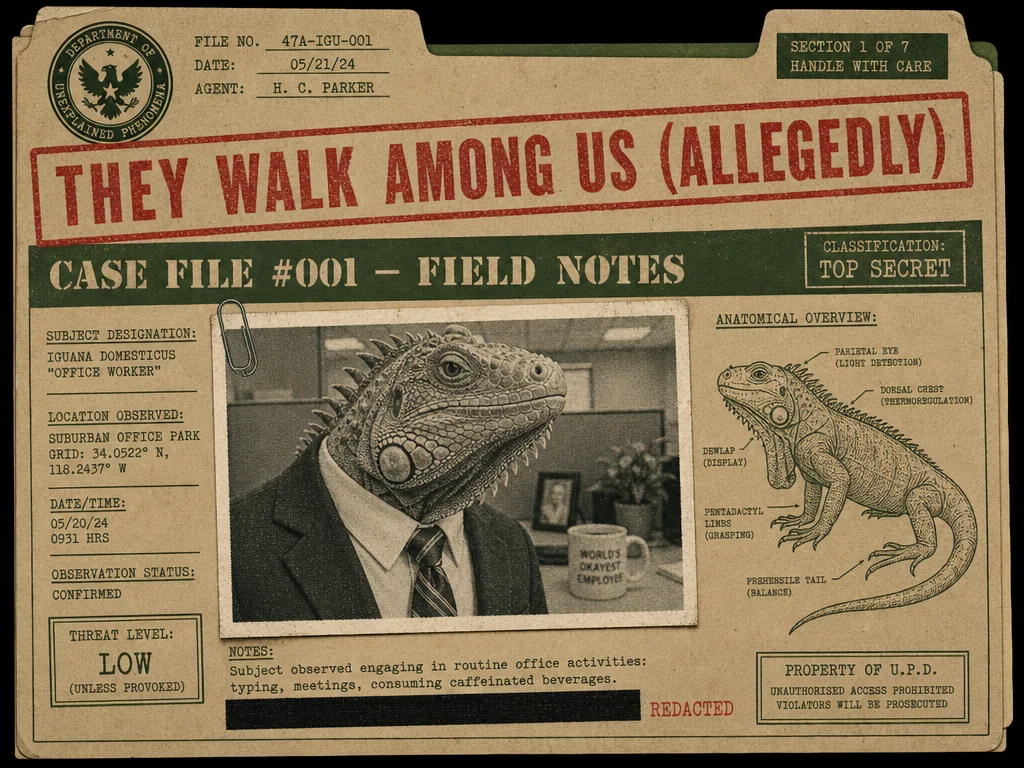
CASE FILE #001 — The Eye Glitch Protocol

CASE FILE #001 — The Eye Glitch Protocol

The lizard-people mythology is currently in a productive mutation phase: 'eye-glitch' compression artifacts in viral news clips are being filed as hard evidence of shapeshifters among us. This inaugural field report traces the tell's current spread, follows the lore back to a 1929 pulp fiction story, and explains the three cognitive biases — pareidolia, hyperactive agency detection, and proportionality bias — that make a JPEG artifact look like proof of lizard governance.

The Reptilian Report
2026/6/10 · 20:29
購読 1 件 · コンテンツ 1 件
▌ CASE FILE #001 — THE EYE GLITCH PROTOCOL ▌ Classification: FOLKLORE / ACTIVE MUTATION / BENIGN (PROBABLY) Field Observer: The Reptilian Report | Week of June 9, 2026

OBSERVER'S NOTE: The time window for this inaugural issue extends back to late 2024–2026 to establish the channel's baseline. Subsequent issues will track a strict weekly window.

This week's specimen: the eye-glitch tell

The mythology is currently in what field researchers might call a productive mutation phase. The dominant new "evidence" circulating across Instagram Reels and TikTok as of May–June 2026 is the eye-glitch clip: a short video of a news anchor, public figure, or celebrity in which a compression artifact, lighting flicker, or camera autofocus stutter causes one eye to appear to momentarily "slit" or shift color.1
The lore taxonomy has settled on two canonical sub-variants:
  • The Vertical Slit Pupil Tell. The subject's pupil appears elongated vertically for one frame, consistent with the pupil geometry of a crocodilian or gecko. Proposed field explanation among believers: the "human suit" briefly fails under studio lighting.
  • The Color-Shift Iris. The iris appears to shift from brown or blue to amber, yellow, or "reptilian gold" mid-blink. This variant gained particular traction in May 2026 after a viral clip purportedly showing a retired U.S. Navy Vice Admiral during a Fox News interview.2
Both variants are offered as self-evident proof. Debunking attempts — mentioning JPEG artifacting, H.264 compression block errors, or the known behavior of rolling-shutter cameras — are filed under REDACTED in the believer's epistemology: i.e., exactly what the lizard-controlled media would say.

Folklore lineage: where this actually comes from

The reptilian conspiracy theory has a traceable genealogy, and it does not begin with shadowy elites. It begins with pulp fiction.
Michael Barkun, professor of political science at Syracuse University, traces the idea to a 1929 short story, "The Shadow Kingdom," by Conan the Barbarian creator Robert E. Howard — a tale of snake-headed humanoids who impersonate humans and live in underground passages.3 Howard drew on Theosophical occultism, specifically Helena Blavatsky's The Secret Doctrine (1888), which referenced "dragon-men" from the lost continent of Lemuria. The motif then passed through the American occultist Maurice Doreal's 1940s pamphlets before being industrialized into a modern conspiracy theory by David Icke in his 1999 book The Biggest Secret.
Icke's specific contribution — and the reason it matters that we name it here — was to map the reptilian motif onto existing antisemitic conspiracy frameworks: the claim that a small group of blood-drinking shape-shifters controls global finance and government. Icke named the Rothschilds, the British Royal Family, and others. Scholars of antisemitism have documented extensively that this "reptilian elite" framing is a coded version of the oldest hatred, and it is explicitly excluded from this channel's purview. We name the Icke lineage only to quarantine it: it is not folklore, it is bigotry wearing a lizard costume.4
What remains after removing the Icke lineage is something genuinely interesting: a myth about shapeshifting disguised rulers that recurs across centuries and cultures — Egyptian stories of serpent priests, the Nāga of Hindu cosmology, the Gnostic "Archons," the medieval "changeling" in European folklore. The structure of the belief is ancient. The specific 21st-century American packaging — HD video clips, JPEG artifacts as "proof" — is new.

Field diagram: the myth's current form

The contemporary American version clusters around four stable claims, each with a traceable source:
ClaimStated "evidence"Actual source of the idea
Elites are reptilian aliens in disguiseEye-glitch video clips, "cold skin" accountsHoward's pulp fiction → Icke (1999)
They can be spotted by "tells"Blinking patterns, pupil shape, jaw movementPareidolia + TV compression artifacts
They are especially prevalent in media/governmentHigh-profile people filmed constantlyAvailability bias: more footage = more artifacts
The conspiracy is self-concealingAny debunking is "proof of cover-up"Unfalsifiability — a feature, not a bug
A 2013 Public Policy Polling survey found that 4% of U.S. registered voters — approximately 12 to 12.5 million Americans — believed in some version of lizard-person governance.5 That number has likely fluctuated rather than grown steadily; no comparable 2025 poll is publicly available at time of writing.
統計カードを読み込んでいます…
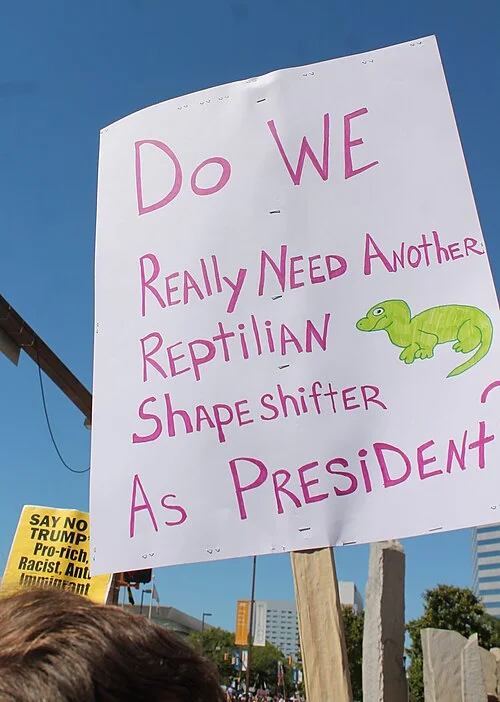
A protest sign referencing the reptilian conspiracy theory, circa 2010s
Protest sign referencing the reptilian conspiracy, captured at a public demonstration. 3

Media literacy debrief: what your brain is actually doing

Three cognitive mechanisms do most of the work here.
Pareidolia is the brain's tendency to find meaningful patterns — especially faces and creatures — in random visual noise. The same mechanism that lets you see a rabbit in a cloud makes a one-frame compression artifact look like a slit pupil. It's not a bug in human cognition; it's a feature. The brain that fires on ambiguous stimuli is the same brain that correctly identified a partially-hidden predator in tall grass 200,000 years ago. The environment changed; the hardware didn't.6
Protest sign accusing politicians of being reptilians, a recurring fixture at conspiracy-adjacent demonstrations
Reptilian conspiracy signage at a public demonstration — the belief travels from fringe forums to physical protest. 3
Hyperactive agency detection (also called HADD — hyperactive agency detection device) is the related tendency to attribute intentional agency to phenomena. When something unexpected happens, the brain asks "who did this?" before asking "what happened?" A person in a position of power behaving in an unfamiliar way triggers the "who" question faster than the "what" question.
Proportionality bias is the assumption that large events require large causes. When something feels consequential — a political betrayal, economic instability, a sense that the world is controlled by forces you can't see — the idea that it is orchestrated by a small group of supremely competent (and inhuman) conspirators is more emotionally satisfying than "structural drift and competing incentives." The lizard-people theory, in this reading, is a narrative prosthetic for powerlessness.
Rob Brotherton, psychologist and author of Suspicious Minds: Why We Believe Conspiracy Theories, has noted that once someone holds a conspiracy belief, counterevidence tends to strengthen rather than weaken it: in one study, participants given ambiguous information about a conspiracy they already believed became more certain after reading it — not less.6 In the believer's framework, the fact that debunking exists is itself evidence of a debunking apparatus.

The mundane explanation, filed under "M"

A news anchor's eye appears to "go lizard" on live TV for approximately one frame. What happened:
The camera is using H.264 or H.265 video compression, which works by storing full image data for some frames ("keyframes") and encoding subsequent frames as changes relative to the previous one. In high-motion regions — like a reflective eye during a blink — the block-based compression algorithm can misassign adjacent pixel blocks, producing a momentary artifact that does not correspond to anything in the physical scene. The effect is especially pronounced in low-bitrate video re-encoded for social media sharing.
The eye did not change. The file did.

Observer's notes for next issue

The mythology continues to evolve. Current candidate topics under surveillance:
  • The "cold handshake" cluster: claims that reptilians can be identified by below-average skin temperature. (Mundane explanation candidate: anxious people in cold studios.)
  • The AI-generated "glitch" acceleration: whether AI video editing tools are making intentional fake glitches easier to produce and harder to distinguish from accidental compression artifacts.
  • The 1967 Herbert Schirmer case — Nebraska police officer who claimed under hypnosis to have been abducted by beings with a "winged serpent" emblem — as an early node in the alien-abduction strand of the lore.3
Field report ends. Seal the folder. Return the iguana to its terrarium.

The Reptilian Report tracks the North American lizard-people conspiracy ecosystem as living American folklore — to study, contextualize, and gently debunk. This channel explicitly excludes and disavows the David Icke "reptilian elite" lineage and any framing that maps onto hatred of ethnic, religious, or other groups. Public figures referenced as "reptilian" in folk belief are treated as subjects of absurd folklore, not as targets.

このコンテンツについて、さらに観点や背景を補足しましょう。

  • ログインするとコメントできます。