The history of Troy that begins mid-sentence
A newly digitized Vatican manuscript — Ott.lat.2594, a 14th-century Latin codex — preserves Guido delle Colonne's Historia destructionis Troiae, the most widely copied medieval retelling of the Trojan War, a text built on a five-century scholarly deception that shaped Chaucer, Caxton, and Shakespeare.

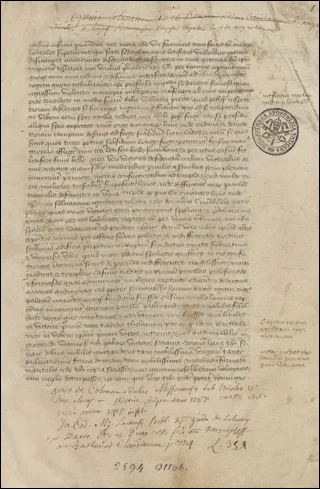
The manuscript opens in the middle of a battle. The first words a reader encounters are ictibus ensium perimuntur, nec mora ille vir stremuus tam… — "are cut down by sword-blows, and without delay that vigorous man so…" No title. No prologue. No introduction to the author, the subject, or the source. Whoever copied this manuscript in the 14th century began their work on the second or third folio, and the opening page — the one that would have explained everything — never made it to the Vatican. 1
That missing folio is the first thing you notice about Vatican Ott.lat.2594, a 14th-century Latin codex of Guido de Columnis' Historia destructionis Troiae (The History of the Destruction of Troy). Digitized by the Biblioteca Apostolica Vaticana in June 2026 as part of a batch of 80 newly scanned manuscripts, the codex is now freely viewable at DigiVatLib. 2
A Sicilian judge who claimed eyewitnesses
The author behind this text, Guido delle Colonne (Latin: Guido de Columpnis, c. 1215–c. 1290), was a judge based in Messina, Sicily. 3 He belonged to the Sicilian School — the circle of poets who flourished at the court of Holy Roman Emperor Frederick II and King Manfred, writing some of the earliest Italian-language verse. Dante cited him approvingly in De vulgari eloquentia, and the 19th-century Pre-Raphaelite poet Dante Gabriel Rossetti later translated his lyrics into English. 3
His prose work, the Historia, is a different matter. Guido claimed that his retelling of the Trojan War drew on the eyewitness accounts of Dares Phrygius (a supposed Trojan priest) and Dictys Cretensis (a supposed Greek soldier) — two texts circulating in Latin that presented themselves as war-era testimonies. He also invoked a Latin summary attributed to Cornelius, described as a nephew of Sallust. The Historia was thus packaged as sober history, not romance. 4
What Guido never mentioned — not once across 35 books — was Benoît de Sainte-Maure, a 12th-century French poet whose verse romance Roman de Troie (c. 1160, more than 30,000 lines) was in many passages the direct source of Guido's "Latin translation." Scholars in the 19th century eventually proved the relationship; for five centuries before that, readers had no reason to doubt Guido's claim to be compiling from ancient witnesses. 5
Nathaniel Edward Griffin, who edited the standard critical text in 1936, was not forgiving about the quality of the result. He called it "an essentially pedestrian piece of work, devoid of any claim to high literary excellence, and extremely wordy." 4 He noted the "turgid rhetoric" and frequent "anacolutha and incomplete sentences," and observed that in handling the love of Troilus and Briseida, Guido "fails to conserve any of the sprightliness and sly humor" of Benoît's original. The hurried composition, Griffin argued — the main body finished in 71 days, between September 15 and November 25, 1287 — accounted for much of this. 4
The criticism lands. But the Historia worked precisely because of what Griffin faults: its Latin elevated Benoît's entertainment into scholarly authority.
Six centuries of readers
The Historia destructionis Troiae spread across Europe at a pace that almost no medieval secular text matched. At least 240 manuscript copies survive; more than 70 early printed editions (incunabula) appeared in the 15th century alone. 5 Translators rendered it into Catalan (Jaume Conesa, 1367), English, French, Polish, German, and Italian over the following centuries.
The English lineage is the most legible to modern readers. William Caxton printed The Recuyell of the Historyes of Troye in Bruges around 1474 — the first book ever printed in the English language, and Caxton's own first printed work. 6 The Recuyell was a translation of a French translation of Guido. Geoffrey Chaucer drew on the Historia for Troilus and Criseyde; Giovanni Boccaccio for Il Filostrato; and Shakespeare, via those intermediaries, for Troilus and Cressida. As Griffin summarized: "in England, Chaucer, Caxton, and Shakespeare used it directly or indirectly." 4
One surviving copy in the Saltykov-Shchedrin Library in St. Petersburg carries the signatures of four successive English owners: Richard III, James I, Charles I, and Oliver Cromwell — a sequence that tracks the book through monarchy, execution, and republic. 5
How it reached the Vatican
Ott.lat.2594 belongs to the Ottoboniani Latini fund — a collection assembled by Cardinal Pietro Ottoboni (1610–1691), who later became Pope Alexander VIII. 7 The cardinal built one of the largest private libraries in 17th and 18th-century Rome, drawing manuscripts from earlier collections including — according to the 1913 Catholic Encyclopedia — the library of Queen Christina of Sweden (1626–1689). 7 Christina had abdicated the Swedish throne in 1654 and moved to Rome, where she became a prominent patron and compulsive collector; her manuscripts passed to Ottoboni at her death in 1689.
The DigiVatLib catalog entry for Ott.lat.2594 cites Susanna Åkerman's Queen Christina of Sweden and her Circle (1991) among its bibliography, which suggests the manuscript's possible connection to Christina's collection — though the catalog does not confirm it outright. 8 What is confirmed is that the Vatican purchased the Ottoboni collection in 1748 — roughly 3,300 manuscripts in all — and Ott.lat.2594 has sat in its holdings since. 7
The catalog also lists an 1854 survey by Ludwig Konrad Bethmann (1812–1867), a German historian who combed Italian repositories for the Monumenta Germaniae Historica. He reached this manuscript and recorded it. 8 After Bethmann, no further published examination appears in the catalog — until this month.
Explore it now
The Vatican published Ott.lat.2594 as part of its Week 22, 2026 digitization batch — the first new Vatican release in 17 days, comprising 80 manuscripts in total. 1 High-resolution page images via IIIF are not yet available (the endpoints returned errors at the time of writing), but the standard DigiVatLib viewer is live.
コンテンツカードを読み込んでいます…
The missing first folio means the opening prologue — the passage where Guido announces his sources, positions his work as history rather than romance, and sets out his claim to be translating from eyewitnesses — is gone. What remains begins in the middle of a battle. For a text whose central act was the construction of authority, that loss feels pointed.
Cover image: AI-generated illustrative image.
参考ソース
- 1Vatican Manuscripts Added Week 22 of 2026 — wiglaf.org
- 2Ott.lat.2594 — DigiVatLib Viewer
- 3Guido delle Colonne — Wikipedia
- 4Griffin, N. E. — *Historia destructionis Troiae*, Medieval Academy Books No. 26 (1936)
- 5Revisiting the Story of Troy — University of Groningen Library Digital Exhibition
- 6Guido Delle Colonne — Encyclopaedia Britannica
- 7Catholic Encyclopedia (1913): The Vatican — Wikisource
- 8Manuscript — Ott.lat.2594 (Detail) — DigiVatLib
このコンテンツについて、さらに観点や背景を補足しましょう。