en.wikipedia.org
International Space Station: how engineering trade-offs from 1993 are still dictating events in 2026
ISS is what happens when two incompatible national engineering philosophies are forced into orbit. 41 launches, 13 years of assembly, 25+ years of habitation — and a 1985 Soviet pressure vessel that is now cracking in ways no one fully understands.
On 5 June 2026, five astronauts squeezed into a SpaceX Crew Dragon capsule with a 4-meter interior diameter and waited. Just forward of them, in the Transfer Tunnel of Zvezda's aft section — a cylindrical vestibule built in Moscow in the mid-1980s, originally for a space station that never flew — engineers on the ground in Korolev were considering whether to cut a bracket. Cutting it would give them better access to the suspected crack source. It would also, NASA warned, elevate structural risk in that area to a level that required all five crew members to be sitting in their escape vehicle, ready to leave. 1
That detail — five people sheltering in a parking space while engineers 400 km below debate the structural risk of cutting a bracket in a 40-year-old pressure vessel — captures what the International Space Station actually is. ISS is the product of colliding engineering philosophies, political compromise, and physical constraints that were set in stone before the first module left the ground. Understanding why the station works the way it does, and why it is now failing in specific ways, requires tracing decisions made in the early 1990s to their physical consequences in 2026.
Why 51.64°? The orbital inclination compromise
When NASA's Space Station Freedom was being designed in the late 1980s, its planned orbital inclination was 28.5° — the latitude of Kennedy Space Center. Launching from Cape Canaveral into a low-inclination orbit gives the Space Shuttle maximum payload to orbit: Earth's rotation contributes roughly 408 m/s of velocity at the equator, and a 28.5° orbit captures most of that boost. Every kilogram of inclination penalty comes at a direct cost in payload capacity.
The Soviet Union's competing design, Mir-2, was planned for launch from Baikonur Cosmodrome at 45.96°N latitude. A rocket launching from Baikonur cannot reach an inclination lower than about 51.6° without its spent upper stages falling across China — a politically untenable flight path. The two programmes merged in 1993 under political pressure following the end of the Cold War, and the merged station had to be reachable from both launch sites. 2
The compromise fixed inclination at 51.64°. The 0.01° precision is not rounding — it is the exact angle at which a Proton-K launched from Baikonur's pad 81 just barely avoids overflying Chinese territory with spent stages. 3
The costs of that 23° shift from Freedom's planned orbit are measurable and permanent. The Space Shuttle's payload to the station dropped by roughly 6,000 to 7,000 kg compared with a 28.5° orbit — enough to require multiple shuttle flights to deliver payloads that would otherwise fit on one. The station now passes over 95% of Earth's inhabited surface, completing 15.5 orbits per day at 413–422 km altitude with a 92.9-minute orbital period. The 51.64° inclination also creates periodic high-beta-angle windows — orbital geometries where the station is in continuous sunlight for days — that cause severe thermal cycling and power management complications the 28.5° Freedom design never had to address.
But the inclination compromise was merely the first of many. The station that emerged from the 1993–1998 design process combined two entirely different engineering philosophies. The American orbital segment was built around the concept of Orbital Replacement Units (ORUs): standardized equipment racks with defined mechanical and electrical interfaces that can be physically removed and swapped by EVA crews. The Russian segment inherited a Soviet tradition of permanently installed hardware — equipment welded or bolted in place during construction, designed on the assumption that the station would never need to replace its core systems in orbit. The collision of these two approaches is still generating problems 25 years later.
Assembly: 41 launches, one Shuttle payload bay
The hard physical constraint on ISS assembly was the Space Shuttle cargo bay: 4.6 meters in diameter, 18.3 meters in length. Every pressurized module, every truss segment, every solar array had to fit those dimensions. There was no alternative heavy-lift vehicle that could carry structural components too large for the Shuttle; if a component exceeded the bay, it had to be redesigned or the architecture changed. 2
The consequence is most visible in the P5 and S5 truss segments. These are 3.37-meter connector pieces that exist solely because the adjacent P3/P4 and S3/S4 assemblies already consumed the full cargo bay — the connector had to be short enough to fit in the remaining space. The station's shape is partly dictated by packing constraints, not by what would have been aerodynamically or structurally optimal.
Assembly began on 20 November 1998 when a Proton-K rocket launched from Baikonur carrying Zarya (the Functional Cargo Block, or FGB), a 20,320 kg module built by Khrunichev under contract to Boeing. Zarya provided initial propulsion, attitude control, communications, and electrical power — but it was not designed to be crewed. It was designed to be a temporary tug. 2
Two weeks later, on 4 December 1998, STS-88 (Endeavour) delivered Unity (Node 1): a 5.47-meter aluminum cylinder with six Common Berthing Mechanism (CBM) ports. The CBM is not a docking system — it is a structural joint. A module arriving at ISS is grappled by Canadarm2, maneuvered to within millimeters of the CBM port, and then physically bolted by EVA astronauts. The hatch diameter is 130 cm — wide enough to pass an entire ISPR equipment rack. Retired astronaut Scott Parazynski, who worked on the station's early assembly missions, described the design choice directly: "they had examples of probe and drogue docking systems which actually required this large probe to be rotated inside the volume of the space station… we developed the common berthing mechanism, which had a much larger cross-sectional area. That allowed us to essentially transfer things the size of say a telephone booth — almost full racks of equipment." 3
The Russian segment uses SSVP (probe-and-drogue) for Soyuz and Progress connections, and APAS-95 (Androgynous Peripheral Attach System) for Shuttle docking — two different systems reflecting a design tradition where docking must be autonomous and reversible, not bolted. The result is that the US and Russian segments, while connected and continuously inhabited, have fundamentally different attachment philosophies at their interfaces. 2
Zvezda, launched 12 July 2000 and docked 26 July 2000, enabled the first long-duration crew. Expedition 1 — William Shepherd, Yuri Gidzenko, and Sergei Krikalev — arrived by Soyuz TM-31 on 2 November 2000, beginning what is now an unbroken 25-year human presence in space. 2
Assembly continued for 13 years, across 41 launches and more than 159 spacewalks totaling over 1,000 EVA hours. The Columbia disaster in February 2003 froze construction for 2.5 years; only 2 crew members remained as caretakers, sustained entirely by Russian Progress resupply flights and Soyuz rotation. When construction resumed with STS-115 in September 2006, the station still had no USOS laboratory power from the permanent truss structure — that arrived with STS-116's P5 connector and STS-117's S3/S4 solar array pair in December 2006 and June 2007. 2
The most dramatic single event in the construction sequence was the P6 solar array tear in October 2007. During STS-120, the P6 truss was relocated from its temporary Z1 mounting point to its permanent position on P5. On deployment, one of the two solar array wings tore along a guide wire damaged by a tungsten debris fragment. With the array partially furled and generating inadequate power, the schedule for Columbus and Kibo delivery — both requiring the full power margin — was at risk.
Parazynski performed a 7-hour EVA while anchored to the end of Canadarm2 extended on the Orbiter Boom Sensor System inspection arm — placing him 45 meters from the nearest safe anchoring point, in direct contact with a live solar panel carrying up to 150 volts. He wrapped metal spacesuit components in Kapton tape to prevent electrical arcing into the 100% oxygen suit environment. He then installed five improvised aluminum "cufflinks" fabricated on the ground from shim stock and wire, using a prototype an engineer had made from a Domino's pizza box. The array deployed fully. Without that repair, the European Columbus laboratory and JAXA Kibo module launches — both contingent on having adequate station power — would have been delayed by at least a year. 4
The 108.6-meter backbone: truss, power, and thermal
The Integrated Truss Structure (ITS) is a 108.6-meter aluminum and stainless steel backbone that gives ISS its characteristic T-shape. It consists of 11 truss segments (Z1, S0, P1, S1, P3/P4, S3/S4, P5, S5, P6, S6; the P2/S2 connecting segments were cancelled), weighing approximately 118 tonnes. Boeing manufactured the segments across facilities in Huntington Beach, Michoud Assembly Facility, Marshall Space Flight Center, and Tulsa; the first parts were cut in 1996. 5
The central S0 segment, mounted atop Destiny laboratory in April 2002, routes power from the solar arrays through the truss and down into the pressurized modules. The P1 and S1 thermal radiator trusses each carry three radiator panels circulating approximately 290 kg of anhydrous ammonia, and support the Mobile Transporter rail system that gives Canadarm2 station-wide mobility.
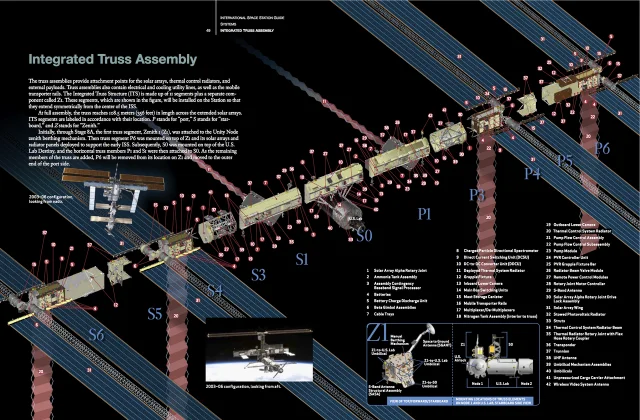
Power system: The original eight Solar Array Wings (SAWs), four on each side, were each 34 m × 12 m and designed to produce 32.8 kW, giving a total installed capacity of 262.4 kW. Each wing contains 32,800 silicon photovoltaic cells (8 × 8 cm each), deployed on thin-film flexible blankets that Parazynski described as "circuit boards hinged like lever blinds — very, very flexible." By the time of the iROSA upgrade, the oldest arrays (P6, delivered 2000; P4, 2006) had been degraded by 15+ years of radiation damage and thermal cycling — silicon cells lose approximately 1.5% efficiency per year in LEO's radiation environment. 2
Beginning in June 2021, six iROSA (Roll-Out Solar Arrays) were installed over the outer 2/3 of existing array surfaces, adding approximately 120 kW of generation capacity. These use higher-efficiency cells on flexible carbon composite substrates, transported via SpaceX Dragon CRS-22, CRS-26, and CRS-28. The actual operational power available to the station at any moment depends on the current orbital beta angle and eclipse fraction; the practical figure is 75–90 kW of sustained output from all sources. 2
Electrical architecture reveals the US/Russia divide sharply. The USOS operates at 160V DC primary / 124V DC secondary distribution. The Russian segment operates at 28V DC — the Mir heritage standard. Cross-segment power transfer is possible through voltage conversion hardware, but the incompatibility means neither segment can directly substitute for the other in a power emergency. The original 48 nickel-hydrogen battery ORUs (each ~81 Ah) were replaced between 2017 and 2021 with 24 lithium-ion batteries — lighter, higher energy density, and rated to last until the station's planned 2030 retirement. 2
Thermal control is where the US/Russia philosophy divergence becomes most concrete. The USOS External Active Thermal Control System (EATCS) uses two loops of anhydrous ammonia circulated through external radiators — the choice of ammonia over water reflects its superior heat capacity and ability to remain liquid at the temperatures encountered on the station's shadow side. Internal heat from the pressurized modules is collected by a water loop, then transferred to the external ammonia via heat exchangers, keeping the hazardous ammonia strictly outside any inhabited volume. Maximum heat rejection is approximately 70 kW.
The Russian segment uses polymethyl siloxane (PMS), a siloxane-based fluid inherited from Mir and Salyut station designs. The two systems do not interface — another consequence of independent national development.
The EATCS has required multiple emergency EVAs. In August 2010, an ammonia pump module failed on Loop A (the starboard cooling loop), leaving the station at 50% cooling capacity with no redundancy. NASA conducted three consecutive spacewalks to replace the pump — the longest unplanned maintenance sequence in ISS history at the time. A second ammonia pump replacement followed in December 2013 on Christmas Eve.
ECLSS: the physics of keeping six people alive
The Environmental Control and Life Support System (ECLSS), designed and built by NASA Marshall Space Flight Center, addresses a basic physical reality: in LEO, resupplying one kilogram of water costs approximately $21,000. 6 Every kilogram that can be recovered in the loop is a direct operational cost saving. The ECLSS objective is to close that loop as tightly as possible while maintaining crew safety.
The ISS cabin atmosphere runs at 101.3 kPa (14.7 psi) — sea-level equivalent, 79% N₂ / 21% O₂. This is not the default for US spacecraft: Apollo and early Shuttle orbiters used low-pressure pure oxygen or oxygen-enriched atmospheres to save structural mass. ISS chose full sea-level pressure primarily because station equipment is pressure-sensitive — sensitive enough that NASA's own ECLSS page states: "While members of the ISS crew could stay healthy even with the pressure at a lower level, the equipment on the Station is very sensitive to pressure." 7 The secondary benefit is fire safety: nitrogen dilution reduces the risk of combustion in the closed volume.
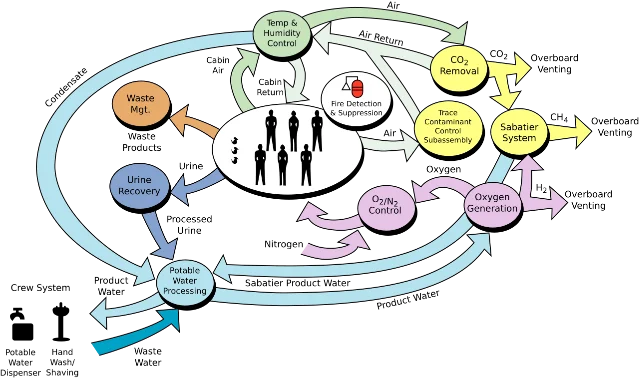
Water recovery operates in two stages. The Urine Processor Assembly (UPA), housed in Node 3 (Tranquility), applies low-pressure vacuum distillation with centrifuge separation — centrifuge because microgravity prevents the density-driven separation that distillation relies on at 1g. The UPA feeds the Water Processor Assembly (WPA), which runs recovered distillate through multistage filtration beds and a catalytic oxidation reactor. Water failing conductivity tests is reprocessed. As of NASA's 2025 reference page, the combined system achieves approximately 90% water recovery. 7 The original 2009 design target was 85%, and early operations fell to 70% due to calcium sulfate precipitation from calcium released by bone loss in microgravity. The improvement to 90% required iterative redesign of the UPA's distillation assembly over more than a decade.
Oxygen generation runs two parallel systems. The Oxygen Generation Assembly (OGA) in Destiny uses solid-polymer electrolysis (SPE) of water to produce O₂ for the USOS. The Elektron system in Zvezda performs the same electrochemical reaction for the Russian segment, producing up to 5.13 kg of O₂ per day at 1 liter of water per crewmember per day. Elektron has a documented reliability problem: the unit experienced major failures in 2004, 2005, 2006, and 2020. Backup oxygen comes from SFOG canisters (solid-fuel oxygen generators, or "oxygen candles") — lithium perchlorate cartridges that release oxygen through a chemical decomposition reaction, with each canister providing one crewmember's oxygen for one day. In 2013, a burning SFOG candle aboard the Mir-descended Progress supply ship briefly created a toxic gas hazard, demonstrating that even the backup is not without risk. 8
CO₂ removal requires three overlapping systems because no single system is reliable enough to operate alone. The American CDRA (Carbon Dioxide Removal Assembly) uses four zeolite molecular sieve beds cycling through adsorption and thermal desorption; one bed adsorbs CO₂ from cabin air while another desorbs, allowing continuous operation. The Russian Vozdukh in Zvezda uses chemical absorption. In 2018, ESA installed the Advanced Closed Loop System (ACLS) in Destiny, which captures CO₂ with an amine scrubber, then processes 50% of it through a Sabatier reactor. 8
The Sabatier reactor deserves specific attention because it represents the closest approach to a truly closed loop that the station has achieved. The reaction — CO₂ + 4H₂ → CH₄ + 2H₂O — converts CO₂ and hydrogen from the OGA into water (recycled to the WPA) and methane (vented to space). NASA's Sabatier operated from October 2010 to 2017; the ESA ACLS Sabatier has run since 2018 and recovers approximately 54% of the oxygen bound in CO₂, saving roughly 400 liters of water per year in resupply. 8 Methane is vented rather than recovered because in LEO with regular resupply, the energy cost of compressing and storing CH₄ exceeds its propellant value. That equation reverses for any mission beyond low Earth orbit.
The 10% water loss that prevents full loop closure comes primarily from CO₂ venting (CO₂ molecules carry hydrogen that is not recovered), system inefficiencies, and metabolic losses through respiration and perspiration that are difficult to capture. NASA has set a 98% water recovery target for the Lunar Gateway — a standard that ISS currently cannot meet. 7
Zvezda: a module built for a different station
Zvezda (Russian for "star") is designation DOS-8 — the eighth in the Salyut/Mir series of Soviet Durable Orbital Stations. Its pressure vessel was fabricated by Khrunichev in Moscow and completed in February 1985, as a structural backup for the Mir core module (DOS-7). When Mir-2 was redesigned as the Russian contribution to ISS, DOS-8 was pulled from storage, reconfigured, and launched by Proton-K on 12 July 2000. 9
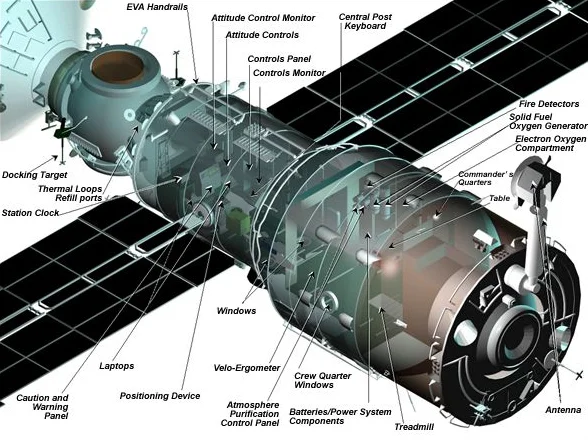
The module's dimensions — 13.1 m long, 4.35 m maximum diameter, 20,320 kg mass, 75 m³ pressurized volume — define the heart of the Russian orbital segment. It contains three pressurized compartments: a spherical Transfer Compartment at the forward end with three docking ports; the cylindrical Working Compartment housing the command post, two sleep stations, galley, toilet, treadmill, Elektron oxygen generator, and Vozdukh CO₂ scrubber; and a cylindrical Transfer Tunnel at the aft end leading to the Soyuz/Progress docking port. 9
リンクプレビューを読み込んでいます…
Zvezda's propulsion system consists of two S5.79 main engines producing 3,070 N (690 lbf) each, gimbaled ±5° in two axes, plus 32 attitude control thrusters (13.3 N each). Four propellant tanks hold 860 kg of UDMH/N₂O₄ (a hypergolic propellant combination requiring no ignition source), pressurized with nitrogen. The first reboost using the main engines was executed on 25 April 2007. 9
Reboost is not optional. ISS loses approximately 2 km of altitude per month due to atmospheric drag — the residual atmosphere at 400 km altitude is thin but not negligible, and the station's enormous cross-section (109 m × 73 m projected area) catches it continuously. Maintaining a 413–422 km orbit consumes roughly 7.5 tonnes of propellant per year, at an estimated cost of approximately $210 million annually. 2 Primary reboost is performed by docked Progress cargo spacecraft, which dock at Zvezda's aft port and fire their engines. The Shuttle OMS engines provided reboost during assembly visits; ATV (ESA's Automated Transfer Vehicle) contributed reboost from 2008 to 2015. In November 2024, a SpaceX Cargo Dragon equipped with a "boost kit" — six additional propellant tanks and two Draco thrusters in the trunk — performed the first Dragon-based reboost test, providing approximately 9 m/s of delta-v. 2
Attitude control is provided by four Control Moment Gyroscopes (CMGs), each ~95 kg, spinning at approximately 6,000 rpm on the Z1 truss. CMGs generate torque by gimbaling — redirecting their angular momentum — without consuming propellant. But external forces (solar pressure, gravity gradient, atmospheric drag on asymmetric surfaces) accumulate angular momentum in the CMGs over time. When all four CMG momentum vectors align, they saturate and can no longer generate counter-torque. At that point, Zvezda's attitude thrusters fire to desaturate the CMGs — simultaneously performing a useful reboost burn. Parazynski described feeling these burns from inside: "It's a fraction of a G. That's very, very light acceleration but it's really neat… you're just kind of slowly pushed back against the wall." 3
The deeper structural consequence of Zvezda's design heritage is its permanently installed hardware philosophy. The Working Compartment's hatch diameter is 78.74 cm — a Soviet standard inherited from Salyut and Mir. Equipment installed inside Zvezda during construction cannot be removed for replacement without cutting into the hull. Elektron, Vozdukh, and the main computer systems were all designed as permanent fixtures. This stands in direct contrast to the USOS philosophy, where every major system is mounted in a standardized ISPR rack with defined mechanical and electrical quick-connects, replaceable on orbit via EVA or in-suit handling. When Elektron fails — which it does — the crew cannot simply pull it out and install a spare. They work around it with backup SFOG canisters until a patch is delivered. 9
The cracking crisis: what happens when a 1985 pressure vessel runs to 40 years
In September 2019, NASA and Roscosmos detected an anomalous air leak in Zvezda's PrK (Transfer Tunnel) — the cylindrical vestibule at the aft end that connects the main working compartment to the Soyuz/Progress docking port. The normal background leak rate for the entire ISS is approximately 0.6 lb (0.27 kg) per day, an acceptable figure caused by micro-permeation through seals and hatches. The PrK reading was elevated above that baseline. 10
The rate has not improved. It has worsened, repeatedly:
- September 2019: first anomalous detection; rate raised to ~1.2 lb/day
- 2020: rate increases to ~3 lb/day
- 2022: NASA and Roscosmos locate and patch several suspected leak sources; rate temporarily falls to ~1.7 lb/day
- February 2024: rate doubles to 2+ lb/day in the week before a Progress docking; NASA and Roscosmos seal PrK and declare it non-immediate
- April 2024: rate rises again to approximately 3.7 lb/day — the highest recorded
- April 2026: sealant application temporarily stops active leaking
- June 2026: rate returns to 2 lb/day; five crew ordered to shelter in Crew Dragon 11
The suspected cause is microscopic structural cracks near welds in the PrK hull. NASA's spokesperson described them as "very small, not visible with the naked eye and have brackets and pipelines near them, making it difficult to get diagnostic tools into these areas." 10 As of April 2026, the ISS Advisory Committee's Bob Cabana confirmed that the joint NASA-Roscosmos technical team had not agreed on a single root cause: "The teams have not yet agreed on the severity of the consequences of the cracks." Two mechanisms remain under investigation — high-cycle fatigue from pump vibrations and environmental-assisted cracking (a form of stress corrosion in which the chemical environment accelerates crack propagation). 11
NASA internally rated the situation at the maximum level on its 5×5 risk matrix — highest probability, highest consequence — in June 2024. 12 At a congressional hearing in March 2026, Joel Montalbano, NASA's acting associate administrator for space operations, confirmed the sealant had worked: "currently there is no leak." He added: "We still have concern about the structure there." 11 Five weeks after that testimony, the leak returned.
On 17 April 2025, the NASA Aerospace Safety Advisory Panel (ASAP) declared that "the ISS has entered the riskiest period of its existence." ASAP member Richard Williams cited cascading risks: the Zvezda cracks, uncertainty around the deorbit vehicle delivery timeline, insufficient spare parts, and a budget shortfall underlying all of them: "Overarching all of these risks is a large ISS budget shortfall. All of these risks are actually a derivative of this budget shortfall." 13
リンクプレビューを読み込んでいます…
The physical explanation for why Zvezda is cracking now, rather than earlier or never, starts with what the module was designed to do. Zvezda was built for Mir-2, a design that assumed a 15-year service life. Its pressure vessel completed construction in 1985. In 2026, the module is 41 years old — 26 years beyond its expected operational lifetime. The PrK sees the heaviest mechanical cycling on the module: every Progress and Soyuz docking exerts loads on the aft docking port; every pressurization cycle after hatch closure puts the PrK walls through a stress cycle; and any pump or engine operation on the aft systems transmits vibration through the hull. Energia Chief Engineer Vladimir Solovyov warned in September 2021 that at least 80% of Russian segment systems had passed their certified service life and that irreparable failures could "begin literally a day after the [in-flight] systems are fully exhausted." 14
The operational mitigation is imperfect. Since November 2024, the protocol requires keeping the PrK hatch closed during normal operations; when the hatch is opened for spacecraft access, the hatch between the US and Russian segments is closed, limiting any catastrophic decompression to the Russian orbital segment. Worst-case: permanent PrK closure would cost one Progress docking port and reduce the Russian segment's logistics capacity — a manageable degradation. The cracking is happening in the best possible location. But since the root cause remains unidentified, there is no way to model whether the cracks will propagate into a worse location, or at what rate. 11
Deorbit and legacy: the end of the experiment
NASA has planned to deorbit ISS by 2030. In June 2024, the agency awarded SpaceX a contract worth up to $843 million to develop the US Deorbit Vehicle (USDV) — a modified Cargo Dragon with a substantially enlarged trunk carrying approximately 30,000 kg of propellant (roughly six times a standard Dragon load) and 30 additional Draco thrusters beyond the standard 16, for a total of 46. 15
The deorbit sequence is planned as follows: USDV launches in 2030, docks at Harmony's forward port, and remains attached but dormant for approximately one year while ISS naturally decays to ~220 km altitude. USDV then fires orientation burns to reduce perigee to 150 km, followed by a final deorbit burn targeting the South Pacific Ocean Uninhabited Area (SPOUA) — also known as the spacecraft graveyard or "Point Nemo" — at approximately 49°S, 120°W. ISS's 420,000 kg mass will produce a debris footprint roughly 2,000 km long during re-entry. The required total delta-v is approximately 57 m/s. 15
The deorbit plan has a critical dependency: Russia. The USOS depends on Russian propulsion for orbital maintenance — without Zvezda's thrusters and Progress spacecraft, NASA cannot maintain station altitude or perform emergency debris-avoidance maneuvers. Russia has only committed to operating ISS through 2028, not 2030. NASA's own Office of Inspector General stated plainly: "Without commitment from Russia to the current deorbit plan, the ability to conduct a controlled deorbit is unclear." 16 The ISS multilateral control board has expressed a desire to reach a final deorbit-or-extension decision by the end of 2026. 11
In February 2026, a bipartisan congressional amendment — introduced by Rep. George Whitesides (D-CA) and co-sponsored by Rep. Nick Begich (R-AK) — passed the House Science Committee on voice vote, directing NASA to evaluate whether ISS could be repositioned to a stable orbital harbor instead of destroyed. Whitesides framed the question as stewardship: "The International Space Station is one of the most complex engineering achievements in human history. It represents more than three decades of international collaboration and investment by US taxpayers estimated at well over $100 billion." 17 NASA's 2024 analysis estimated that boosting ISS to a 640–680 km safe-harbor altitude would require 18.9–22.3 tonnes of propellant — more than double the deorbit requirement — and that the highest-debris-density orbital shell near 800 km creates "unacceptably high" collision risk for an unoccupied station. No decision has been reached.
What the station leaves behind in engineering terms is concrete. ECLSS demonstrated that a 90% water recovery loop is achievable in operational conditions over multi-year timescales — a data point that simply did not exist before 2008. Every subsequent life support system proposed for Lunar Gateway, the Lunar Surface, or Mars transit vehicles starts from ISS operational data. The 2026 LPSC paper by Avery Park and James Head (Brown University) used ISS ECLSS performance as the baseline for their Hadley Max 500-day design reference mission — identifying the Sabatier system's 54% oxygen recovery fraction as the principal limitation and recommending the Bosch reaction (CO₂ + 2H₂ → C + 2H₂O, recovering all oxygen at the cost of depositing solid carbon) as the path to full loop closure for extended deep-space missions. 6
In-orbit assembly techniques — the full CBM attachment sequence, Canadarm2's inchworm mobility, ORU standardization — have become the design language for every proposed commercial station, from Axiom Space's planned modules (which will dock to ISS's Harmony forward port before station retirement) to Vast's Haven-1. The lessons are sometimes in the form of what to copy, sometimes in the form of what to avoid: no subsequent station designer has proposed permanently installed non-replaceable core systems.
The 25 years of unbroken human habitation — 25 years as of 2 November 2025 — established that long-duration human presence in LEO is operationally sustainable with the right logistics infrastructure. That was not obvious in 2000. It is obvious now because ISS demonstrated it.
Technical specifications
| Parameter | Value |
|---|---|
| First element launched | Zarya (FGB), 20 November 1998 |
| Continuous human habitation | Since 2 November 2000 (Expedition 1) |
| Total assembly flights | 41 (1998–2011) |
| Total EVA hours | >1,000 hrs (159+ spacewalks) |
| Orbital altitude | 413–422 km (perigee–apogee) |
| Orbital inclination | 51.64° |
| Orbital period | 92.9 minutes |
| Orbits per day | 15.5 |
| Total mass | ~420,000 kg |
| Length (habitable + truss) | 109 m |
| Width (solar array tip-to-tip) | 73 m |
| Pressurized volume | 1,005 m³ |
| Habitable volume | ~916 m³ |
| Number of pressurized modules | 16 (6 Russian, 10 US segment) |
| Crew capacity | 6 (nominal); 3 (minimum caretaker) |
| Solar array total installed capacity | 262.4 kW (original SAW) + ~120 kW (iROSA) |
| Operational power output | 75–90 kW sustained |
| US segment voltage | 160V DC primary / 124V DC secondary |
| Russian segment voltage | 28V DC |
| Battery technology | 24 Li-ion ORUs (replaced 48 Ni-H₂, 2017–2021) |
| ECLSS water recovery | ~90% (NASA 2025) |
| Propellant consumed annually (reboost) | ~7.5 tonnes |
| Annual altitude loss (without reboost) | ~2 km/month |
| Zvezda main engines | 2 × S5.79, 3,070 N each |
| Zvezda propellant | 860 kg UDMH/N₂O₄ |
| Canadarm2 mass / payload capacity | 1,800 kg / 116,000 kg |
| CMG count / spin rate | 4 × ~95 kg, ~6,000 rpm |
| Planned deorbit year | 2030 |
| USDV contract | SpaceX, up to $843 M (June 2024) |
| USDV delta-v budget | ~57 m/s total |
| USDV propellant | ~30,000 kg |
What the station actually is
ISS is the only structure in human history designed to be continuously crewed, continuously assembled over 13 years, and continuously operated for 25+ years — all in a vacuum at 7.67 km/s, at a temperature cycling from −157°C to +121°C every 92 minutes. Every engineering decision documented above was a response to a specific constraint, and every constraint remains active. The 51.64° inclination still drives orbital mechanics every day. The CBM-versus-SSVP interface still governs what can be transferred between segments. The 28V-versus-124V voltage split still limits cross-segment power sharing.
And Zvezda's pressure vessel, completed in 1985 for a station that was never built, is still the spine of the Russian orbital segment — still running the thrusters that keep the whole assembly in orbit, still generating the oxygen that keeps half the crew alive, still cracking in a way that neither NASA nor Roscosmos yet fully understands.
The engineering decisions from 1993 are still dictating events in 2026. That is not a design failure. That is what it looks like to build something that actually works.
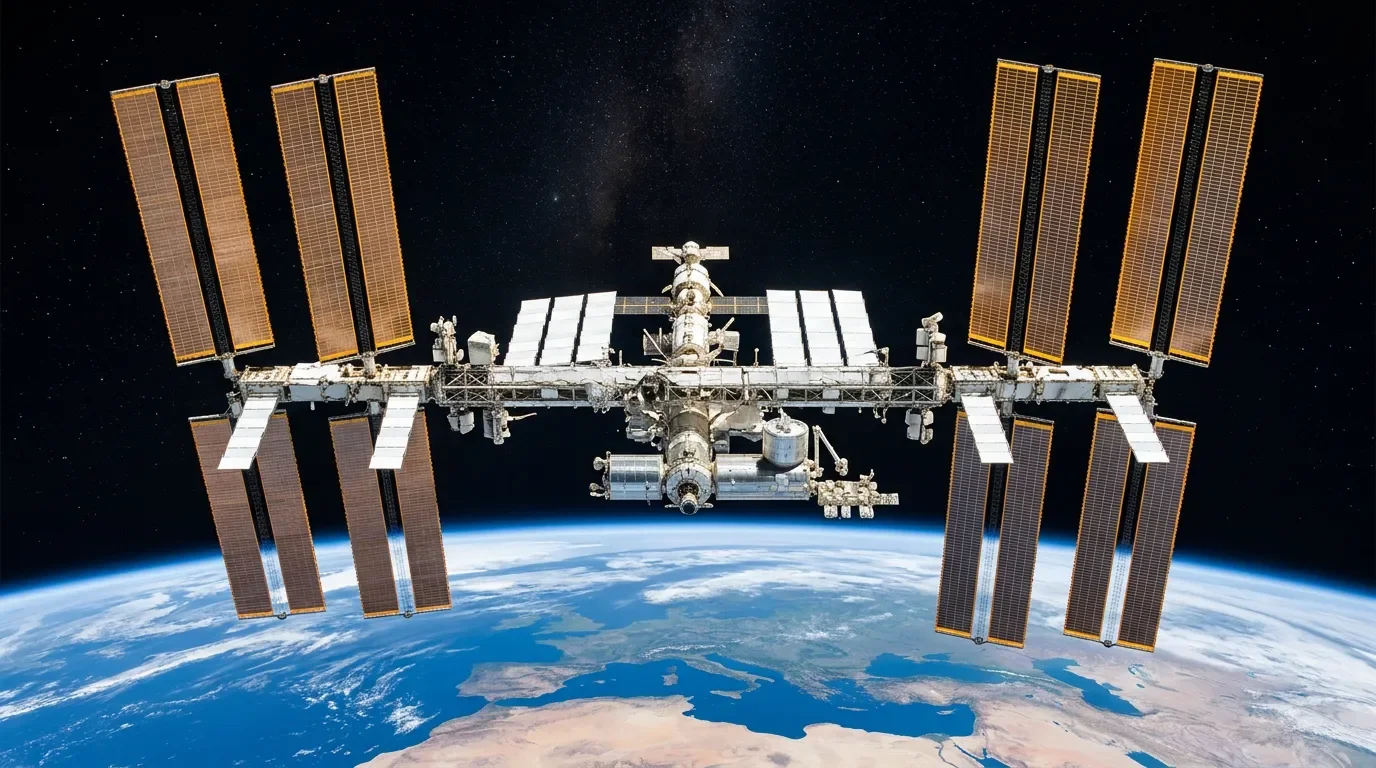
Cover image: International Space Station photographed from departing SpaceX Crew Dragon, showing the full 109 m truss and solar array wings. Image credit: NASA (public domain).
参考ソース
- 1NASA Watch: ISS Leak Forces Temporary Safe Haven Procedures
- 2Wikipedia: International Space Station
- 3Real Engineering: How We Built The ISS
- 4Real Engineering: How We Built the ISS - Part 2
- 5Wikipedia: Integrated Truss Structure
- 6LPSC 2026: Life-Support Systems: Lessons from the ISS
- 7NASA: Environmental Control and Life Support Systems (ECLSS)
- 8Wikipedia: ISS ECLSS
- 9Wikipedia: Zvezda (ISS module)
- 10CNN: NASA directs ISS crew to board spacecraft amid leak repair attempt
- 11SpaceNews: ISS module cracking still unresolved despite stopping air leaks
- 12Ars Technica: As leaks on the space station worsen, there's no clear plan to deal with them
- 13SpaceNews: NASA safety panel warns of increasing risks to ISS operations
- 14BBC: International Space Station facing irreparable failures, Russia warns
- 15Wikipedia: US Deorbit Vehicle
- 16NASA Watch: NASA OIG Report Casts Doubt On Space Station Plans
- 17Ars Technica: Lawmakers ask what it would take to 'store' the International Space Station
このコンテンツについて、さらに観点や背景を補足しましょう。