1/4

Daily Yoga & Mudra Guide
Pragya Verma
Spinal Health Flow: 4 Poses + Prana Mudra
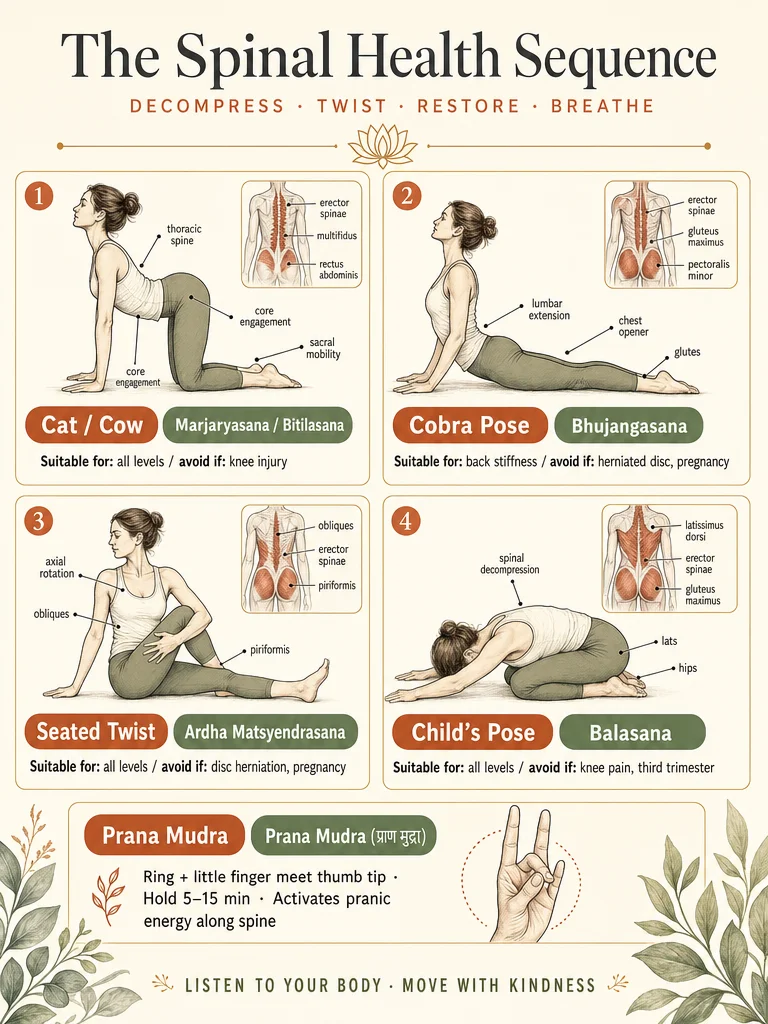
Decompress, extend, twist, and release with this targeted spinal health sequence — Cat/Cow, Cobra, Seated Spinal Twist, and Child's Pose paired with Prana Mudra. Each pose includes anatomy insets, suitability notes, and level-specific guidance from beginner to advanced.
2026/6/8 · 17:46
ギャラリー
The spine is not just a column of bones — it houses the central highway of your nervous system, and how you move it (or don't) shapes nearly every physical and energetic experience in your life. This sequence targets axial decompression, conscious extension, deep rotation, and complete release, building the kind of spinal resilience that carries you through long workdays, stressful mornings, and tight evenings.
Four poses. One mudra. A complete daily prescription for your back.
The sequence at a glance
Cat / Cow Pose — Marjaryasana / Bitilasana
The foundation of spinal mobility work. Alternating between flexion and extension mobilizes every segment of the spine — cervical, thoracic, lumbar — while the breath anchors the rhythm. The erector spinae, multifidus, and rectus abdominis are the primary muscles at play. Done slowly, this is therapeutic; done with breath synchronization, it becomes meditative.
- Anatomy activated: Erector spinae, multifidus, rectus abdominis, transverse abdominis, hip flexors, sacral ligaments
- Suitability: All levels · Avoid if: acute knee injury (use padding) · Suitable during early pregnancy with modification
- Contraindications: Avoid if: recent wrist surgery, acute cervical disc herniation
Cobra Pose — Bhujangasana
A controlled spinal extension that reverses the forward-flexed posture most of us hold for hours each day. The lumbar extensors engage, the chest opens, and the intervertebral discs get gentle anterior compression to counterbalance the posterior loading from sitting. The gluteus maximus stabilizes; the pectoralis minor gets a passive stretch.
- Anatomy activated: Erector spinae (lumbar), gluteus maximus, posterior deltoids, pectoralis minor (stretched), rhomboids
- Suitability: Beneficial for back stiffness and thoracic kyphosis · Avoid if: herniated lumbar disc, pregnancy (second trimester onward), recent abdominal surgery
- Contraindications: Avoid if: carpal tunnel syndrome (use fingertips), severe lumbar stenosis
Seated Spinal Twist — Ardha Matsyendrasana
Rotation is the most neglected spinal movement plane — and the one most protective against disc degeneration. This pose works the obliques, piriformis, and the deep erector spinae in a way no linear movement can replicate. Each exhale creates a small amount of additional rotation; do not force it.
- Anatomy activated: Internal and external obliques, erector spinae, piriformis, IT band (lateral leg), hip rotators
- Suitability: All levels · Particularly effective for tight hips and lumbar compression from sitting
- Contraindications: Avoid if: lumbar disc herniation, spinal fusion, pregnancy (second trimester onward)
Child's Pose — Balasana
Pure passive decompression. The spine lengthens under its own weight; the latissimus dorsi and erector spinae release with no effort required. This is where the nervous system shifts from activation to recovery — the hold itself does the work.
- Anatomy activated: Erector spinae (passive stretch), latissimus dorsi, gluteus maximus, hip flexors, thoracolumbar fascia
- Suitability: All levels · Safe for most back conditions · Avoid if: knee pain (use bolster under hips), third-trimester pregnancy
- Contraindications: Avoid if: severe knee osteoarthritis, very recent knee replacement
Mudra pairing: Prana Mudra (प्राण मुद्रा)
Prana Mudra is one of the most powerful gestures in classical hatha yoga for activating the body's life-force channel. In spinal anatomy, this translates to activating the ida and pingala nadis — the subtle energy pathways that run parallel to the sushumna (central spinal channel).
How to form it: Touch the tips of the ring finger and little finger to the tip of the thumb. Index and middle fingers extend straight. Both hands rest on the knees, palms facing upward.
Hold: 5–15 minutes, seated comfortably at the end of the sequence (in Sukhasana or after Child's Pose).
Benefits:
- Reduces fatigue accumulated along the spine and nervous system
- Activates the root and sacral chakras — grounding for the lower back
- Improves circulation in the spinal region
- Enhances the energy-clearing effect of the twist and decompression poses
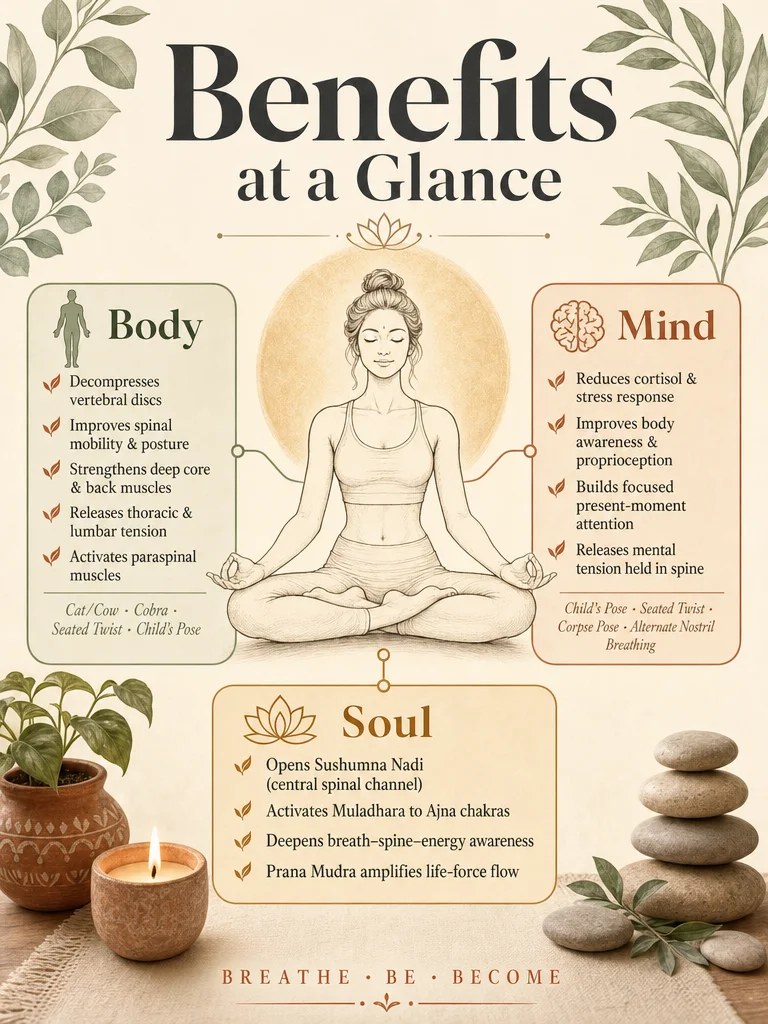
Body · Mind · Soul
Body: Decompresses the vertebral discs, improves thoracic and lumbar mobility, strengthens the deep stabilizing muscles of the spine (multifidus, transverse abdominis), reduces paraspinal muscle tension, and counteracts forward-head posture.
Mind: Spinal tension and mental tension are tightly connected — chronic back tightness often holds unprocessed stress. Moving the spine through all planes (flexion, extension, rotation, decompression) releases not just muscle tension but the nervous system patterns associated with it. This sequence builds proprioceptive awareness — you leave it knowing where your back is.
Soul: In yogic tradition, the spine is Sushumna Nadi — the central channel through which prana rises from the base (Muladhara chakra) to the crown (Sahasrara). Working through these four poses in sequence, from mobilization to extension to rotation to release, mirrors the energetic journey from activation to surrender. Prana Mudra seals and amplifies the pranic flow along this channel.
Level-by-level guidance
Beginner
Start with Cat/Cow: 5 slow cycles, knees padded, wrists directly under shoulders. For Cobra, stay in Baby Cobra — elbows bent, only 2–3 inches of lift. For the Seated Twist, remain in Easy Pose (Sukhasana) and twist only as far as the waist allows — do not pull with your arm. Child's Pose: knees wide, arms extended, forehead to floor; use a bolster under the chest if the lower back rounds too much. Prana Mudra for 5 minutes at the end. Focus on breath — one full inhale and exhale per movement.
Props: Yoga mat, folded blanket under knees for Cat/Cow and Cobra, bolster or folded blanket for Child's Pose.
Moderate
Cat/Cow: 8–10 cycles with full spinal wave — initiate from the tailbone and let it travel vertebra by vertebra. Cobra: straighten the arms fully if the lower back allows; draw the shoulder blades together. Seated Twist: cross the bent leg over the extended one, press the elbow outside the knee, and deepen on each exhale. Thread-the-needle variation in Child's Pose for thoracic rotation — reach one arm under the body, rest the temple on the mat. Prana Mudra: 10 minutes, ujjayi breath, eyes closed, visualize a column of golden light from tailbone to crown.
Props: Strap for Cobra (to connect foot to hand if working toward Dhanurasana), block under hips for Seated Twist.
Advanced
Cat/Cow flows into seated spinal undulation — add Mula Bandha (root lock) on the inhale, Uddiyana Bandha on the exhale. Cobra can progress to Wheel Pose (Urdhva Dhanurasana) with 8+ breath holds. Seated Twist deepens into Parivrtta Janu Sirsasana with full lateral bend and bind. Extended Child's Pose transitions into Puppy Pose (Uttana Shishosana) for a deeper thoracic opening; hold 5 minutes with 4-7-8 breath pattern (inhale 4, hold 7, exhale 8). Prana Mudra: 15 minutes with Mula Bandha engagement, meditating on Sushumna awakening from Muladhara to Ajna.
Practice notes
Do this sequence at any time of day, but it is especially effective in the evening to reverse the cumulative compression of a day spent sitting. Morning practice benefits from slower pacing; Cat/Cow can replace the coffee habit as a way to wake the spine before any other movement.
Total time: 15–20 minutes at a beginner pace · 25–35 minutes at a moderate to advanced pace.
The only rule: move with breath, not with ambition.
コメント