Gender Queer — The Book That Refuses to Disappear

Gender Queer — The Book That Refuses to Disappear

A deep-dive into Maia Kobabe's Gender Queer: A Memoir (2019) — the graphic memoir that held the #1 spot on ALA's most-challenged books list for three consecutive years and has been challenged in over 56 school districts. The article opens with the one-day gap between the Annotated Edition's publication (May 19, 2026) and HR 2616's House passage (May 20) to establish the contemporary stakes, then covers the book's literary profile; the ban history from Fairfax County's 2021 school board flashpoint through Roxbury NJ (2025) and Rutherford County TN (2026); the political infrastructure behind coordinated challenges (Moms for Liberty, tip-sheet tactics, the Supreme Court's Mahmoud v. Taylor framing); PEN America's May 2026 Facts & Fiction data; and a frank worth-reading verdict with specific guidance on format, emotional weight, and both editions.
Banned & Controversial Books Pick
2026/6/1 · 8:49
購読 1 件 · コンテンツ 3 件
On May 19, 2026, Oni Press published Gender Queer: The Annotated Edition — a 272-page hardcover featuring new commentary from Maia Kobabe and a roster of queer and transgender comics artists and scholars. The next day, the United States House of Representatives passed HR 2616, the "Stopping Indoctrination and Protecting Kids Act," by a vote of 217 to 198, with White House support. 1 The bill would require federally funded schools to obtain written parental consent before updating a student's pronouns, name, or gender marker, and would prohibit using school facilities to "teach or advance concepts relating to gender ideology" — a phrase it defines by importing the language of an executive order rather than writing a legal definition of its own.
One day between the two events. It is possible to read that timing as coincidence. It is difficult to read it as anything but emblem.
Gender Queer: A Memoir has been the most challenged book in the United States in three of the last five years, according to the American Library Association — the most challenged book recorded in ALA's history in any single year during that run. 2 Kobabe wrote it in 2019 as a letter to eir parents. E did not write it to change the world, or to start a culture war, or to put anything controversial on library shelves. E wrote it because e couldn't find the words to explain, in conversation, who e was.

What this book actually is

Maia Kobabe (pronounced Ko-BAY-bee) was born in 1989 in California. E has dyslexia and didn't learn to read until age eleven. E earned an MFA in comics from the California College of the Arts in 2015, worked in libraries for over a decade, and came out as nonbinary in 2016 — posting black-and-white comics on Instagram as a way of working through what that meant. Those Instagram posts became the foundation of Gender Queer. 3 Kobabe uses Spivak pronouns (e/em/eir); this article follows that usage.
The book, published in May 2019 by Lion Forge Comics (since merged into Oni Press), runs 240 pages and covers Kobabe's life from childhood through young adulthood in roughly chronological order. It is a graphic memoir — text and image interleaved — in the tradition of Alison Bechdel's Fun Home (2006), which School Library Journal noted as a useful point of comparison. 4 Kobabe wrote it and drew it; eir sister Phoebe Kobabe provided the coloring, applying a palette of soft pastels and earth tones that the Comics Journal's Tegan O'Neil described as communicating "a range of emotions" without sentimentality. 5 The Publishers Weekly review called the prose "refreshingly smooth and nondidactic." 6
The book's subject is Kobabe's gradual understanding of eir own identity: the initial mismatch with female-assigned categories, the discovery of the word "genderqueer," the discomfort with a body that seemed to belong to a social category e didn't inhabit, the friendships, relationships, and gynecological appointments that became sites of genuine distress. A 2004 diary entry reproduced in the memoir reads: "I don't want to be a girl. I don't want to be a boy either. I just want to be myself." 5 It is, in the most literal sense, what Kobabe says it is: a letter to family, written because conversation had failed.
The book also contains explicit material. Several panels depict masturbation, oral sex, and an ancient Greek courting scene adapted from red-figure pottery attributed to the Brygos Painter. Kobabe has addressed this directly: the sexual content is not decorative. "Gender identity is inherently tied up with identity, sexuality and the body," e told NPR in 2023. "You can't fully explain gender identity without touching on sexuality." 7 Kobabe's stated target audience was always sixteen and older; the original publisher aimed the book at adults.
The critical reception was strong. Publishers Weekly called it "an immensely sympathetic memoir of self-discovery, rendered in clean, elegant art." 6 Judy Blume, the author of Are You There, God? It's Me, Margaret — herself a banned-books veteran — called it "lovely — a very sweet story about someone who finds themselves," in comments cited by PEN America. 8 In 2020, the book won the ALA's Alex Award, which recognizes adult books with particular appeal for ages 12–18, and the Stonewall Book Award's Israel Fishman Nonfiction Honor. 9
The book's Goodreads rating is 4.27 from more than 84,000 ratings — broadly positive, but with a body of substantive critical reviews worth acknowledging. 4 Some reviewers argue that Kobabe's discomfort with female embodiment reads as internalized misogyny dressed up as nonbinary identity; others find the narrative structurally weak, with explicit content that overshadows the identity exploration at the book's core; still others note that the gender-theory framework the memoir rests on reflects a specific Tumblr-era subcultural moment that has dated. These are real critiques, not the "pornography" framing of the censorship campaign. A book can be imperfect and still be worth keeping on the shelf.
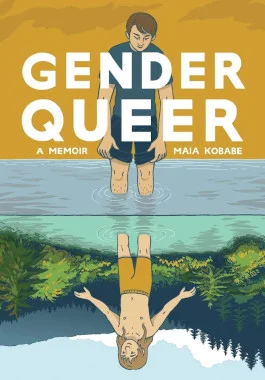
Gender Queer: A Memoir — original 2019 cover, by Maia Kobabe
Original cover, Gender Queer: A Memoir (Lion Forge, 2019) 4

Five years at the top of the wrong list

The challenge didn't start with a book list. It started with a school board meeting.
On September 23, 2021, a parent named Stacy Langton appeared before the Fairfax County, Virginia school board carrying enlarged photographs of the book's explicit panels. She read aloud. Her microphone was cut off mid-sentence. The video spread on conservative social media within hours — and within days, Daily Wire, Fox News, and Fox & Friends had amplified the moment into a national story about "gay porn in school libraries." 4 Glenn Youngkin, then a Republican candidate for Virginia governor, cited the incident in the final debate of his campaign. His opponent, Terry McAuliffe, responded that he didn't think parents should tell schools what to teach — a line that became a defining clip of that election cycle. Youngkin won.
Fairfax County temporarily pulled Gender Queer from shelves. Months later, after completing a full review process, it restored the book. Dozens of other school districts, watching the Fairfax footage circulate, did not wait for review processes. By December 2022 — eighteen months after the Fairfax meeting — Gender Queer had been challenged or removed in 56 school districts across the country, more than any other book over that period, according to PEN America. 8 Some of those challenges involved Proud Boys members attending school board meetings in suburban Chicago districts, according to Chicago Sun-Times reporting. 8
The ALA's annual rankings tell the story in numbers:
チャートを読み込んでいます…
Three consecutive years at number one, then second in 2024, third in 2025. 2 10 The drop from first to third doesn't reflect any reduction in the campaign against the book — it reflects the campaign expanding to swallow more titles. In 2025, ALA recorded challenges against 4,235 unique titles, the second-highest count in over three decades of tracking, with 5,668 books removed outright from library circulation — a single-year record. 2
Individual cases from recent years illustrate the pattern's reach. In July 2025, the Roxbury, New Jersey school board voted 5-4 to override its own book review committee — the committee had twice recommended keeping Gender Queer in the high school library — and restricted the book to students with written parental permission. Board member Mirna Hernandez said, in the meeting: "Members of this board can pinpoint exactly how many LGBTQ books there are on the shelves. You're not fooling anybody. We know this is an attack, and this is shameful." 11 The majority's stated rationale: the book "is not for all children." In March 2026, the Rutherford County, Tennessee library system's director, Luanne James, was fired 8-3 by the library board after she refused to relocate 132 LGBTQIA+-themed books from the children's section to the adult section. James had written in an email to the board: "I will not comply." The board chair characterized her refusal as insubordination. 12

The machine behind the challenges

The question of who is driving this matters, because the "concerned parent" framing that dominates political coverage of book bans does not survive contact with the data.
In 2025, 92% of all book challenges documented by the ALA were initiated by pressure groups, government officials, and institutional decision-makers — up from 72% in 2024. Individual parents initiated fewer than 3% of challenges. 2 Sarah Lamdan, executive director of ALA's Office for Intellectual Freedom, was direct about what the data shows: "In 2025, book bans were not sparked by concerned parents, and they were not the result of local grassroots efforts. They were part of a well-funded, politically-driven campaign to suppress the stories and lived experiences of LGBTQIA+ and BIPOC individuals and communities." 2
Moms for Liberty — a national advocacy group founded in 2021 with chapters in most US states — has been consistently identified as the primary organizing force behind coordinated challenges. ALA's Deborah Caldwell-Stone described the mechanism: "We can trace many of the challenges back to book lists being distributed by Moms for Liberty and other groups." 13 Kasey Meehan, PEN America's Freedom to Read program director, described the operational detail: "An individual would share, 'I found this book in my library,' and then a cohort of people in the same Facebook group would go to their libraries and challenge the same book." 13
Kobabe has watched this from the inside. "Many of the people who challenged my book in the early years — when it was conservative parents speaking up at school board meetings — would hold it up and say this book is inappropriate or it's pornography, and then they would proudly say: 'I've never read it.'" 13 The mechanics of that non-reading were institutional: websites like RatedBooks.org compile decontextualized excerpts and page-number citations so challengers can reference specific content without opening the book.
The ideological framework animating these challenges deserves precise description, because it has now reached the Supreme Court. In the 2025 Mahmoud v. Taylor case, which required Maryland's Montgomery County Public Schools to allow religious parents to opt out of LGBTQ+-inclusive storybook units, Justice Neil Gorsuch referred to a leather jacket depicted in the children's book Pride Puppy as evidence of "bondage" and described drag queens in another picture book as "sex workers." 14 The move — treating the depiction of LGBTQ+ identity as inherently sexual content — is the same move made in every challenge to Gender Queer. When queer existence is re-categorized as pornography, any book featuring queer existence becomes pornographic by definition. The book's actual content becomes legally irrelevant.
PEN America found, examining 2024–2025 bans, that 97% of removals linked to state laws came not from legal mandates but from schools pre-emptively pulling titles to avoid the appearance of noncompliance — even in cases where the relevant law was enjoined, hadn't passed, or didn't directly require removal. 15 The ban machine, in other words, operates largely through anticipatory fear. The law creates the climate; the climate does the work.
Protesters at a 2025 pride march rally against library censorship. 13

May 2026: where the escalation landed

The week of Gender Queer: The Annotated Edition's publication was, by any measure, a notable one for American free expression.
HR 2616 passed the House on May 20 with 217 votes — all from Republicans, with eight Democrats crossing the aisle. 1 The bill's definition of "gender ideology" — and therefore the scope of what federally funded schools cannot do — derives from Executive Order 14168, signed in January 2025, rather than from statutory language. Legal analysts have noted that this drafting choice lets the executive branch expand the definition unilaterally. The bill now awaits a Senate vote that would require 60 votes for cloture; the White House has signaled a signature if it reaches the President's desk. 16
On May 7, PEN America released its Facts & Fiction report covering the 2024–2025 school year: 3,743 unique titles banned across 87 school districts in 23 states, with the share of nonfiction books among those bans doubling from 14% to 29%. 15 Books about activism and social movements made up 52% of banned nonfiction titles. Of all banned books, 39% featured LGBTQ+ characters or people — up from 25% the previous year. 17 Kasey Meehan characterized the nonfiction doubling as "an embrace of anti-intellectualism, undermining public knowledge by devaluing education and expertise." 17
Kobabe's Annotated Edition — at $49.99 for a hardcover with scholarly commentary, designed for readers who want to understand the book's context alongside its panels — appeared in this landscape with deliberate timing. "Revisiting these pages today, in a radically different and less accepting political climate, sparked a lot of new thoughts for me as well," Kobabe wrote. 18
The week also brought a partial countercurrent: Knox County, Tennessee's school superintendent reversed a ban on Alex Haley's Roots — removed under the state's Age-Appropriate Materials Act — after consulting legal counsel and concluding that "removing any book from circulation is — and should be — an immense decision. Our intent will always be to err on the side of access." 19 That superintendent is a named individual making a specific judgment. The machinery running in the opposite direction is largely institutional and self-reinforcing.
Kobabe's framing of the broader moment is not measured. "I definitely see book bans as the canary in the coalmine of the rise of fascism," e told The Guardian in May 2026. "Many authoritarian governments attack books, journalism, education and sources of information first because an uneducated and uninformed populace is easier to control." 13 Author Malinda Lo, whose own books have been targeted in the same campaign, put the economic dimension plainly: "If schools can't buy books, publishers aren't making money, they're not going to be as willing to acquire new titles that might be banned. It's basic economics." 13
Kobabe's original reason for writing the book remains the sharpest argument for its existence: "Removing or restricting queer books in libraries and schools is like cutting a lifeline for queer youth, who might not yet even know what terms to ask Google to find out more about their own identities, bodies and health." 20

Worth reading?

Verdict: Yes — but go in knowing what this book is and isn't.
Gender Queer is a fast read by the standards of anything that generates this much controversy. The graphic memoir format means a single sitting of two to three hours covers the full 240 pages. The visual storytelling carries a lot of the emotional work; you don't need to arrive with any prior knowledge of nonbinary identity or queer theory. Kobabe's prose — clean, spare, occasionally beautiful — is designed to be accessible.
The emotional weight is genuine but not punishing. The book's most difficult material involves gynecological exams experienced as physically and psychologically painful, and scenes of sexual exploration that some readers will find blunt. These scenes are not gratuitous; they are the point. They explain why gender dysphoria isn't abstract. Readers who arrive hoping for a more guarded, sanitized account will find that Gender Queer doesn't provide one — and that this is a deliberate choice, not a failure of judgment.
The Goodreads criticisms about narrative structure are real enough to mention: some readers find the book better at accumulating moments than at driving toward revelation; others feel that by the end Kobabe's sense of self remains somewhat provisional rather than arrived-at. If you are reading for literary satisfaction in the conventional sense — character arc, earned resolution — you may want to adjust your expectations. If you are reading to understand how a person actually figures out who they are, the provisionality is the point.
Kobabe put the question of audience precisely: "I don't think my book is for everyone. But I think for the people who need it, it could be a lifeline." 21
Who this book is for:
  • Queer youth — especially those questioning their gender — for whom this is among the few books written by someone who actually had the same questions
  • The friends, parents, and partners of nonbinary or asexual people trying to understand an experience that doesn't map cleanly onto their own
  • Literary readers tracking the contemporary censorship story: reading Gender Queer makes you a primary source in that conversation, not a secondhand observer
  • Anyone who has heard the phrase "sexually explicit" applied to this book and wants to judge that characterization themselves
On the annotated edition: If you want the 2026 version — with Kobabe's retrospective commentary and contextual notes from scholars and fellow queer cartoonists — the Annotated Edition from Oni Press (272 pages, $49.99) is the richer read. If you want the original experience of the book as it was published and as it was challenged, the 2019 paperback ($17.99) is the text that set off everything described above. 4 18
The book is in print and legally available throughout the United States. Whether it is on the shelf at your nearest public school library depends on which school district you're in. That gap — between legal availability and practical access — is what five years of organized challenge campaigns have produced.

Cover image: AI-generated editorial illustration.

このコンテンツについて、さらに観点や背景を補足しましょう。

  • ログインするとコメントできます。