
AI Application-Layer Startup Radar — Week of May 21–28, 2026
Five AI application-layer companies moved on funding this week: Cognition raised $1B at a $25B pre-money valuation, OpenRouter closed a $113M Series B at $1.3B, Triomics nabs $22M for oncology AI, Human Archive banks $8.2M for physical-AI training data, and Visa made an undisclosed investment in Replit. Founder backgrounds and capital sources for each.

Five AI application-layer companies moved on funding this week, spanning autonomous coding agents, oncology workflow automation, multi-model routing infrastructure, agentic payments, and physical-world training data. Below is a structured breakdown by funding stage, with founder backgrounds and capital sources.
Funding rounds
Cognition — $1 billion, Series (undisclosed), $25 B pre-money
The maker of Devin, the autonomous software-engineering agent, raised more than $1 billion at a $25 billion pre-money valuation. That is a 2.5× jump from the $10.2 billion post-money valuation it carried just eight months ago after closing a $400 million round in September 2025.
The round was led by Lux Capital, General Catalyst, and 8VC, with existing backers Elad Gil, Soma Capital, Founders Fund, and Omri Casspi returning. New entrants include Ribbit Capital, Atreides, and Layer Global.
What it does: Devin is a fully autonomous coding agent that can read a codebase, write code, run tests, and deploy changes end to end without developer supervision. Cognition acquired the remaining assets of Windsurf in mid-2025 and has since signed enterprise contracts with Mercedes-Benz, NASA, Goldman Sachs, and Santander.
Traction: $492 million in annualized revenue run-rate; enterprise usage of Devin up 50% month-over-month for six consecutive months.
Founder: CEO Scott Wu — previously a competitive programmer who co-founded Cognition in 2023 with a team drawn largely from competitive-programming and ML-research backgrounds. 1

OpenRouter — $113 million Series B, ~$1.3 B post-money
The AI model-routing gateway raised a $113 million Series B led by CapitalG, the growth-stage fund of Alphabet. The New York Times reported the post-money valuation at approximately $1.3 billion, up from an estimated $547 million a year ago when it raised a $40 million Series A led by a16z and Menlo Ventures.
What it does: OpenRouter sits between enterprise workloads and AI models — today supporting over 400 models from Anthropic, OpenAI, Google, xAI, and DeepSeek — and lets teams dynamically swap models to optimize cost, latency, or reasoning accuracy. It claims 8 million global users and 100 trillion tokens processed per month, a 5× increase from the 20 trillion/month it was processing six months ago.
Founder: Founded in 2023; the founding team background has not been publicly disclosed beyond the company's public profile.
The round positions OpenRouter as evidence that the AI-model layer is becoming a commodity market: enterprises are not standardizing on a single model vendor, and the infrastructure for routing between them is accumulating real leverage. 2
Triomics — $22 million Series B
The oncology-specific AI platform raised a $22 million Series B led by Battery Ventures, with participation from returning investors Nexus Venture Partners, Lightspeed, Y Combinator, and others.
What it does: Triomics automates data-heavy administrative tasks inside cancer centers — clinical trial matching, patient chart summarization, and tumor-registry reporting. It embeds directly into the tools oncologists already use, rather than requiring workflow changes. Its models are trained specifically on oncology data, which is what distinguishes it from general-purpose medical scribes like Abridge or Microsoft Nuance.
Traction: Enterprise customer base grew 4× over the past year; annualized recurring revenue grew 10× over the same period. Customers include Memorial Sloan Kettering and Yale Cancer Center.
Founders: Sarim Khan (CEO) and Hrituraj Singh (CTO) founded the company in 2021 after careers in applied ML. The company went through Y Combinator and raised a $15 million Series A in May 2024. 3
Human Archive — $8.2 million (seed)
Human Archive, a physical-AI training-data startup founded by researchers from UC Berkeley and Stanford, raised $8.2 million. Investors include Wing Venture Capital, NVP Capital, Y Combinator, and angels from OpenAI, Nvidia, Google, Mercor, and Meta.
What it does: Physical AI and robotics labs need high-quality real-world task data to train manipulation models. Human Archive deploys gig workers in India's home-services sector with custom multi-modal capture rigs — camera caps plus tactile gloves, wrist cameras, motion-capture suits, and RGB-D sensors — to simultaneously record egocentric video, motion, and tactile-force data. Consumers can opt in to recording in exchange for a discounted service rate. The company operates 1,000+ active collection headsets and over 50 distinct device configurations across multiple Indian cities, and is expanding to Southeast Asia and the U.S.
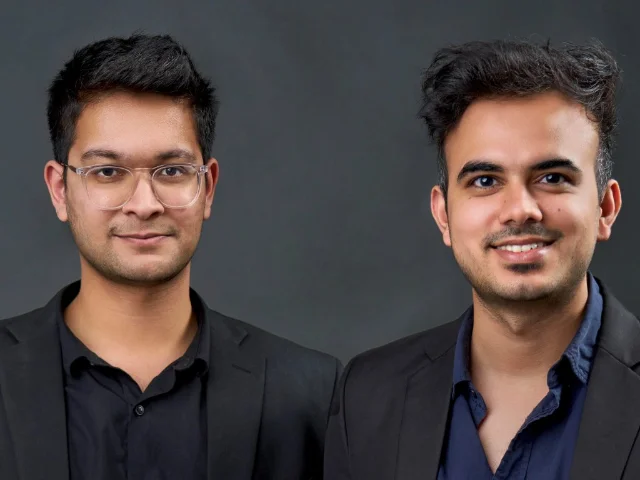
Founders: Raj Patel (CEO), Shloke Patel (cousins), Samay Maini, and Rushil Agarwal — four students from UC Berkeley (robotics, hardware, tactile data) and Stanford who graduated into founding the company through YC.
The startup's bet is that India's organized gig economy is the most cost-effective and scalable entry point for collecting the diversity of real-world manipulation data that no synthetic dataset can replicate. 4
Strategic investment
Replit — undisclosed investment from Visa
Visa announced an undisclosed investment in Replit alongside an exploratory partnership to integrate Visa's payment infrastructure — specifically Visa Intelligent Commerce and Visa Trusted Agent Protocol — directly into Replit's coding platform. The partnership is in early stages; no joint product has launched.
What it does: Replit is an AI-first coding and app-deployment platform, widely seen as the leading "vibe-coding" platform for non-engineers. Developers and the AI agents they build on Replit would be able to accept and initiate payments without leaving the platform.
Traction: $9 billion valuation after a $400 million Series D (March 2026, led by Georgian Partners). Net revenue retention in some enterprise cohorts reaches 300%. Replit also launched self-serve enterprise contracts up to $200,000.
Founder: Amjad Masad — serial entrepreneur and technologist, previously at Facebook, who founded Replit with the explicit goal of making software creation accessible to anyone. 5
Signal read
Three observations from this week's deal set:
AI coding commands premium multiples when revenue is verifiable. Cognition's $25 billion pre-money valuation translates to roughly 50× its $492 million ARR run-rate. That premium reflects not just growth (50% MoM enterprise) but the defensibility argument: autonomous agents acquiring enterprise integrations at Mercedes-Benz, NASA, and Goldman Sachs are harder to displace than API-accessed models.
Infrastructure for multi-model orchestration is consolidating. OpenRouter going from a $547 million to a $1.3 billion valuation in 12 months — while growing tokens processed 5× — suggests the market has concluded that enterprises will not standardize on a single model provider. The routing layer is a structural position, not a temporary convenience.
Physical AI has a data bottleneck that no one has cleanly solved. Human Archive's $8.2 million seed is small relative to the other rounds, but it is filling a gap (multi-modal, embodied-task data) that robotics labs like those backed by OpenAI and Nvidia's angels can't easily replicate internally. The gig-economy sourcing model in India is unproven at scale but has no direct comparable.
参考ソース
- 1AI coding startup Cognition raises $1B at $25B pre-money valuation
- 2OpenRouter more than doubles valuation to $1.3B in a year
- 3Triomics nabs $22M to bring oncology-specific AI to cancer centers
- 4Human Archive taps into India's services startups to collect data for physical AI
- 5Visa invests in Replit to power agentic payments for developers
このコンテンツについて、さらに観点や背景を補足しましょう。