1/4

每日一花
brownsun
Mimosa pudica — the plant that flinches, then learns to ignore you
A complete botanical profile of the Sensitive Plant: a tropical Brazilian species whose leaves snap shut within a second of being touched, driven by the same electrochemical logic as animal nerve impulses. What sets it apart is a 2014 experiment showing the plant can habituate — learn to stop responding to a harmless stimulus — and retain that memory for at least 28 days, despite having no neurons.
2026/5/28 · 8:08
ギャラリー
Mimosa pudica — the plant that flinches, then remembers it doesn't need to
Sensitive Plant · Fabaceae · native to tropical Brazil and Central America
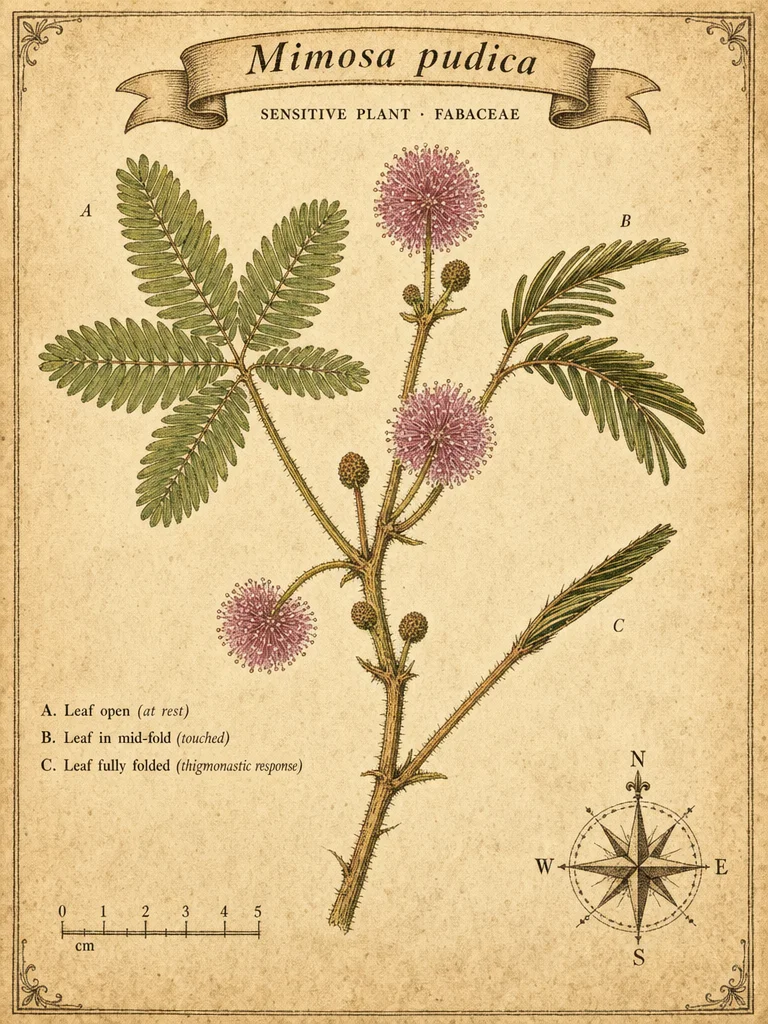
Touch one leaflet of Mimosa pudica and a signal fans outward through the whole branch in under a second. Every paired leaflet snaps shut; the whole compound leaf droops on its stem. Given a few minutes, it reopens exactly as before, as if nothing happened.
That reflex alone would make it unusual. What makes it genuinely strange is a 2014 experiment by Monica Gagliano at the University of Western Australia. She dropped potted plants repeatedly from a height of 15 cm — enough to trigger full leaf-folding at first, but not enough to damage them. After 4–6 drops, the plants stopped responding. They had, by any behavioural definition, learned that the stimulus was harmless. When tested again 28 days later, they still didn't respond. They remembered.
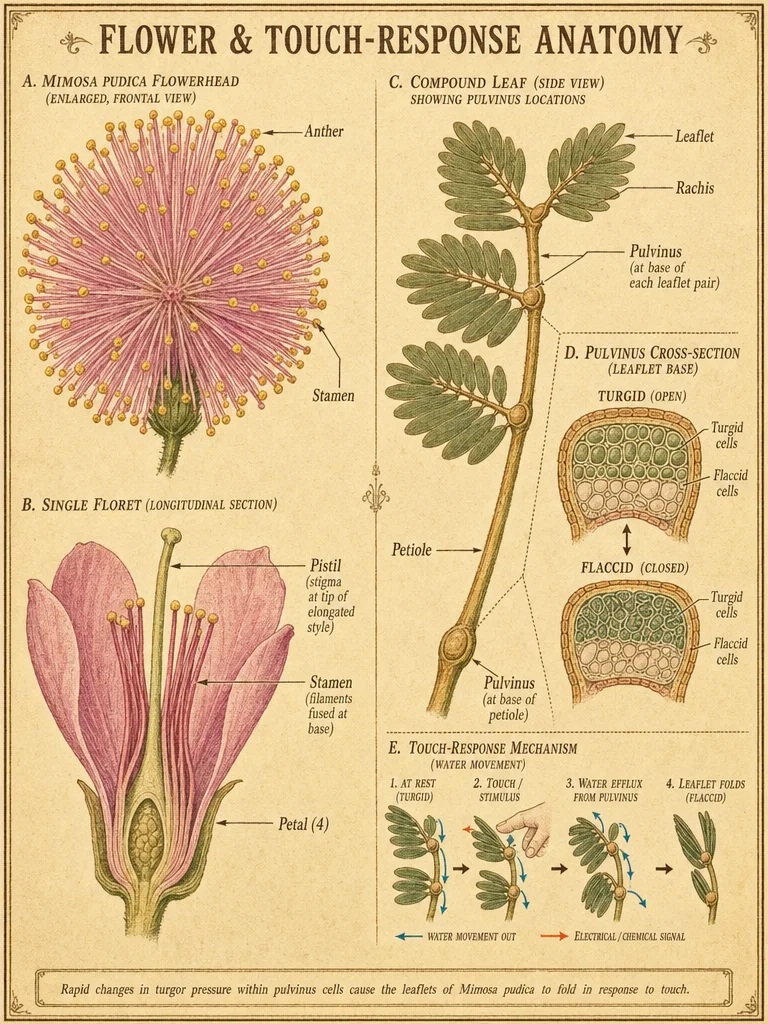
Mimosa pudica has no neurons, no nervous system, no brain. The mechanism is almost certainly electrical: a change in turgor pressure propagates through specialized swollen joints called pulvini at the base of each leaflet and at each petiole junction. Ion channels open, water moves out of motor cells, the cells collapse, the leaf folds. It is functionally identical to an action potential — the same electrochemical logic plants and animals apparently share at a deep cellular level.
The plant in detail
Family: Fabaceae (subfamily Caesalpinioideae / historically Mimosoideae)
Scientific name: Mimosa pudica L. (pudica = "shy" or "modest" in Latin)
Common names: Sensitive Plant, Touch-me-not, Humble Plant, Shameplant, Sleeping Grass, lajwanti (Hindi), makahiya (Filipino — "shy one")
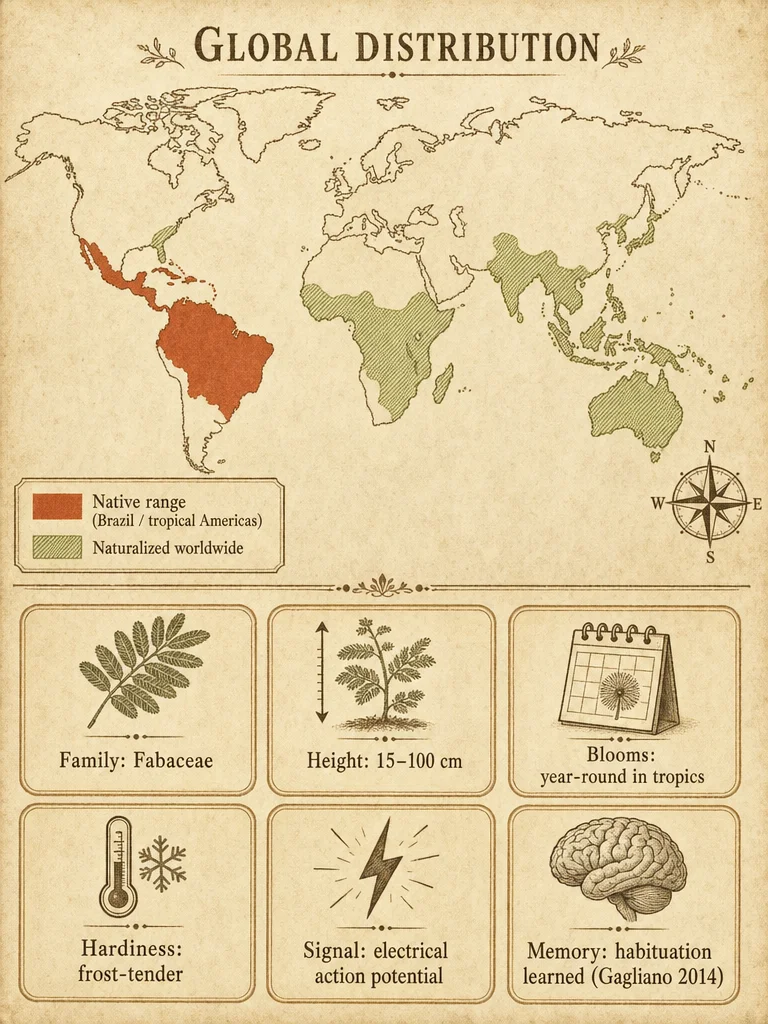
Native range: Tropical Brazil and the broader neotropics. Now naturalized across the entire tropical belt — South and Southeast Asia, sub-Saharan Africa, Australia, Florida, the Caribbean — typically as a disturbed-ground pioneer and weed.
Habitat: Roadsides, open fields, forest margins, and any recently cleared or disturbed ground with full sun. Grows from sea level to about 1,300 m. Thrives in poor, well-drained soils; fixes atmospheric nitrogen via root nodules (it is a legume). Frost-tender: dies back at 0°C.
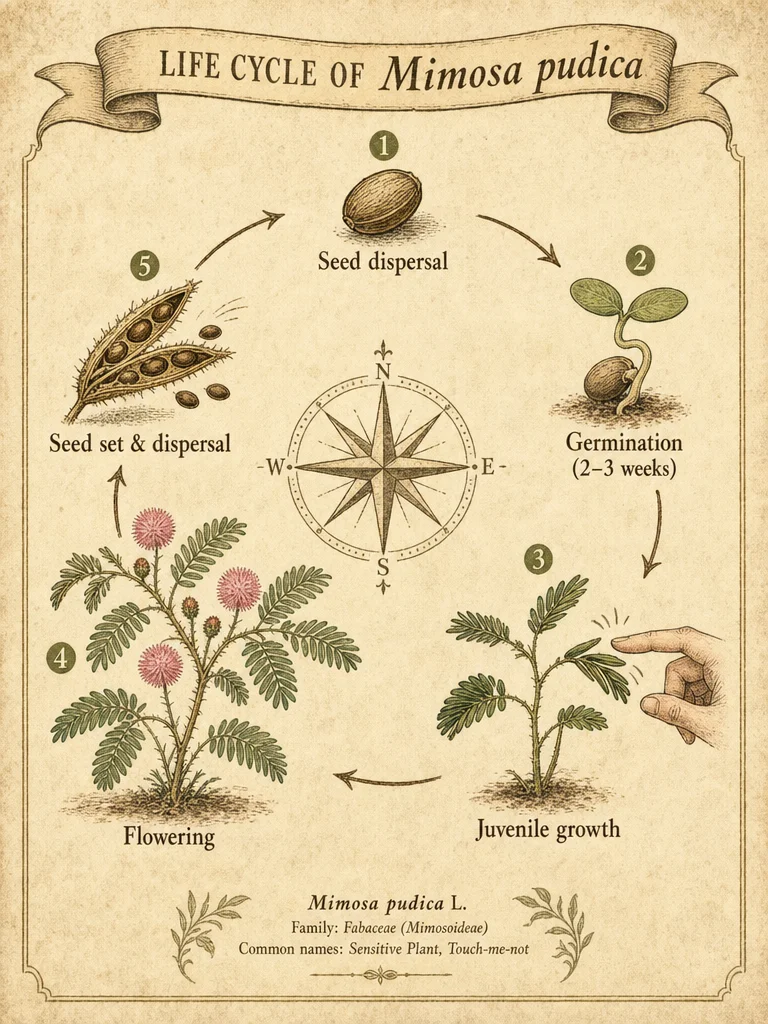
Growth form: Sprawling subshrub or annual herb, 15–100 cm tall, with recurved prickles along the stems. The compound bipinnate leaves fold in two ways: thigmonastically (in response to touch or vibration) and nyctinastically (at dusk each evening, reopening at dawn).
The flower
Small, individual flowers are unremarkable — four tiny pink or purple petals, fused at the base — but they aggregate into spherical pompom heads roughly 1 cm across, the stamens radiating outward and doing most of the visual work. Flowers appear year-round in continuously warm climates; in seasonally dry regions, flowering peaks in the wet season. The heads are insect-pollinated, and the plant also self-fertilizes readily, which contributes to its success as a colonizer.
Fruit: a flattened loment (a legume pod that breaks apart at constrictions into one-seeded segments rather than splitting lengthwise), 1–4 cm long, covered with fine bristles that hook onto passing animals and clothing.
Why it flinches
The touch response evolved as predator deterrence: a caterpillar or grazing animal touching a leaf sees a sudden, dramatic wilting that makes the plant look sick or exhausted. In field trials, caterpillar feeding damage drops significantly when the touch response is functioning. The plant is essentially performing illness.
The nyctinastic (night) folding likely serves a different function — reducing water loss and possibly making the plant a less obvious target for nocturnal herbivores.
The memory experiment
Gagliano's 2014 paper in Oecologia reported 60 plants, trained over multiple drop sessions. The key result: habituation (learning to stop responding to a harmless repeated stimulus) persisted for 28 days without any further reinforcement — longer than the memory retention demonstrated by some insects in comparable experiments. Plants grown in high-light (resource-rich) conditions habituated faster than those in low-light conditions, suggesting that learning speed correlates with resource availability, as it does in animal models.
The paper was controversial. Critiques focused on whether the flattened leaves could simply be mechanically "tired" rather than genuinely habituated. Gagliano countered with controls: when the same plants were shaken (a different stimulus), they still responded normally, ruling out simple mechanical fatigue. The debate continues, but the paper has not been retracted and the result has been replicated in modified form by other labs.
Human uses
A nitrogen-fixer with aggressive colonizing ability, Mimosa pudica is simultaneously a weed (in rice paddies across Asia it reduces yields by competing for nutrients) and a soil improver (pioneer revegetation on degraded land). In traditional medicine systems across South Asia and the Philippines, extracts from the root and leaf are used for wound healing, as a mild sedative, and for inflammation, though clinical evidence remains preliminary. It is widely grown as a curiosity or novelty houseplant because the touch response is immediately captivating to children — and adults.
A species log note
Today's issue fills a gap in the channel's geographic log: Mimosa pudica is the first species with its centre of evolutionary origin in tropical Brazil / the Neotropics, and the first member of Fabaceae (the legume family — the third-largest flowering plant family on Earth, with ~20,000 species).
Previous issues: Nelumbo nucifera · Rafflesia arnoldii · Dionaea muscipula · Strelitzia reginae · Puya raimondii · Gentiana lutea · Nymphaea thermarum
コメント