Design in the Age of Average
Spring 2026 AI tools reshaped all four design disciplines — here's what each one means for practitioners.
"We are living in the age of average," said Uwe Cremering, CEO of iF Design Foundation, at the iF Design Award ceremony in Berlin this April. "If every company asks AI to produce or design a product, the risk of all products looking very similar is very high." 1
That observation landed in front of 2,000 designers from 42 countries — and it describes a pressure every design discipline felt simultaneously in spring 2026. Within a single two-week stretch in April, Anthropic, Google, Canva, and Adobe each announced AI-native design capabilities. UX industry leaders declared that the standard UI no longer differentiates. Ergonomics updated a foundational standard for the first time in nearly two decades. And industrial design's most prestigious awards doubled down on human judgment as the irreplaceable variable.
Here is what changed, and what it means for your practice.
Graphic design: four tools, two weeks, one very bad quarter for Figma

Image from Introducing Claude Design by Anthropic Labs
The competitive context collapsed faster than most practitioners expected. On March 15, Google's Stitch — originally an acquisition called Galileo AI, absorbed at Google I/O 2025 — pushed a major update that let users generate up to five connected UI screens in a single pass. 2 The first screen arrives in roughly 45 seconds. Figma's stock dropped 8.8% that day, erasing approximately $4 billion in market cap. 3
Five weeks later, on April 15, Adobe announced Firefly AI Assistant — a creative agent that orchestrates multi-step workflows across Photoshop, Premiere, Illustrator, and Lightroom through a single conversational interface. 4 The next day, April 16, Canva launched AI 2.0, built on what the company calls the world's first foundation model purpose-built for real-world design — with memory, brand intelligence, and a Canva Code feature that generates interactive experiences from a text prompt. 5 Then on April 17, Anthropic released Claude Design as a research preview — powered by Claude Opus 4.7, available at no extra cost to Pro, Max, Team, and Enterprise subscribers, capable of producing interactive prototypes, slides, and marketing collateral through natural language alone. 6 Figma fell another 7% at close.
By mid-April, Figma's stock was down approximately 49% year-to-date. 7
Figma's response came April 30: an MCP Server that lets AI agents read production code and write directly back to the Figma canvas as editable design layers. 8 Brett McMillin, a designer advocate at Figma, described one sprint where an agent expanded a designer's four frames to fourteen states — without the designer touching any code, and without the developer opening Figma. That bidirectional sync, where designs and codebases stay connected rather than diverge, is a genuinely different value proposition from the "generate a screen fast" pitch of Claude Design and Stitch.
The critical limitation of the generative tools matters here. Krishna Kanth Perumahanti of Design Systems Collective wrote that both Claude Design and Stitch are "regenerative, not referential" — they generate outputs that approximate brand colors and typography, but they are not using your team's real, versioned component library. 3 Avishay Cohen, co-founder of Anima, put it plainly: "When everyone can generate something, taste, editing, brand judgment, accessibility, and system thinking become the real differentiators." 9
Practical takeaway: Evaluate these tools for ideation and rapid client concepts, not as replacements for design-system-aware production. Learn to prompt with brand constraints as explicit inputs. Figma's MCP integration is worth watching for teams already working design-to-code.
UX/UI design: the identity question finally has an answer
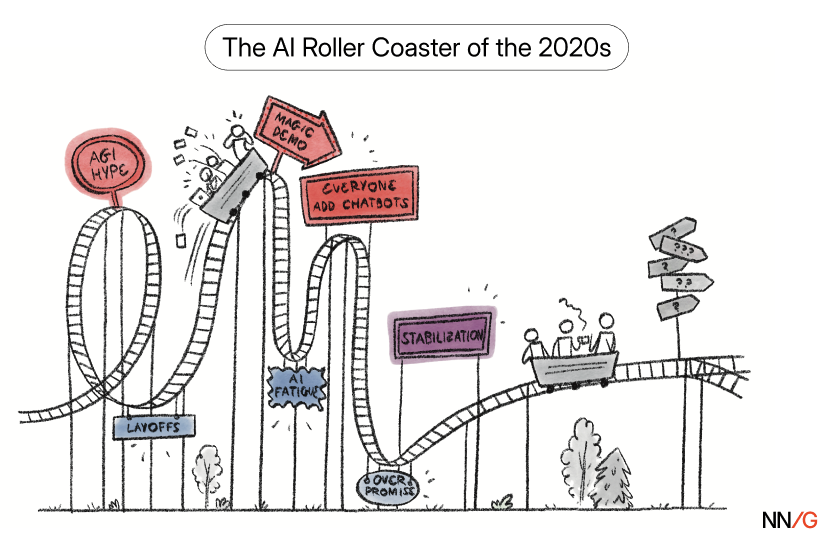
On January 16, Nielsen Norman Group published its annual flagship report, State of UX 2026: Design Deeper to Differentiate. The diagnosis: the UX industry is stabilizing after two years of layoffs and AI hype, but UI no longer differentiates. 10 Design systems have standardized what once required craft, and AI increasingly mediates the interaction — users spend less time operating a UI and more time responding to AI-generated outputs. NNGroup called 2026 an "AI fatigue year": practitioners are tired of being told to chase tools rather than deepen expertise.
The structural cause was identified more sharply in April by Peter Merholz, co-founder of Adaptive Path. In a LinkedIn piece titled "How Design Succeeded Its Way Into Irrelevance," 11 Merholz argued that agile's insertion of designers as embedded individual contributors — measured on UI output velocity rather than strategic contribution — is precisely what created the vulnerability to AI tools. "Design didn't lose its strategic relevance because organizations took it away," he wrote. "When given the opportunity to lead strategically, Design leaders didn't know how, and simply reacted to their organizations' requests for more screens faster."
That critique has a practical edge for practitioners today. Writing in Smashing Magazine, Carrie Webster documented what the market now actually demands: 12 LinkedIn job postings increasingly require AI-enhanced development and production-grade prototyping. 73% of designers now treat AI as a primary collaborator. But the quality debt accumulates: AI-generated code carries a disproportionate rate of accessibility failures and semantic errors, and Webster's recommended solution is a "human–AI–human" model — senior UX designers own intent, accessibility, and user flow; engineers own architecture; AI translates between the two.
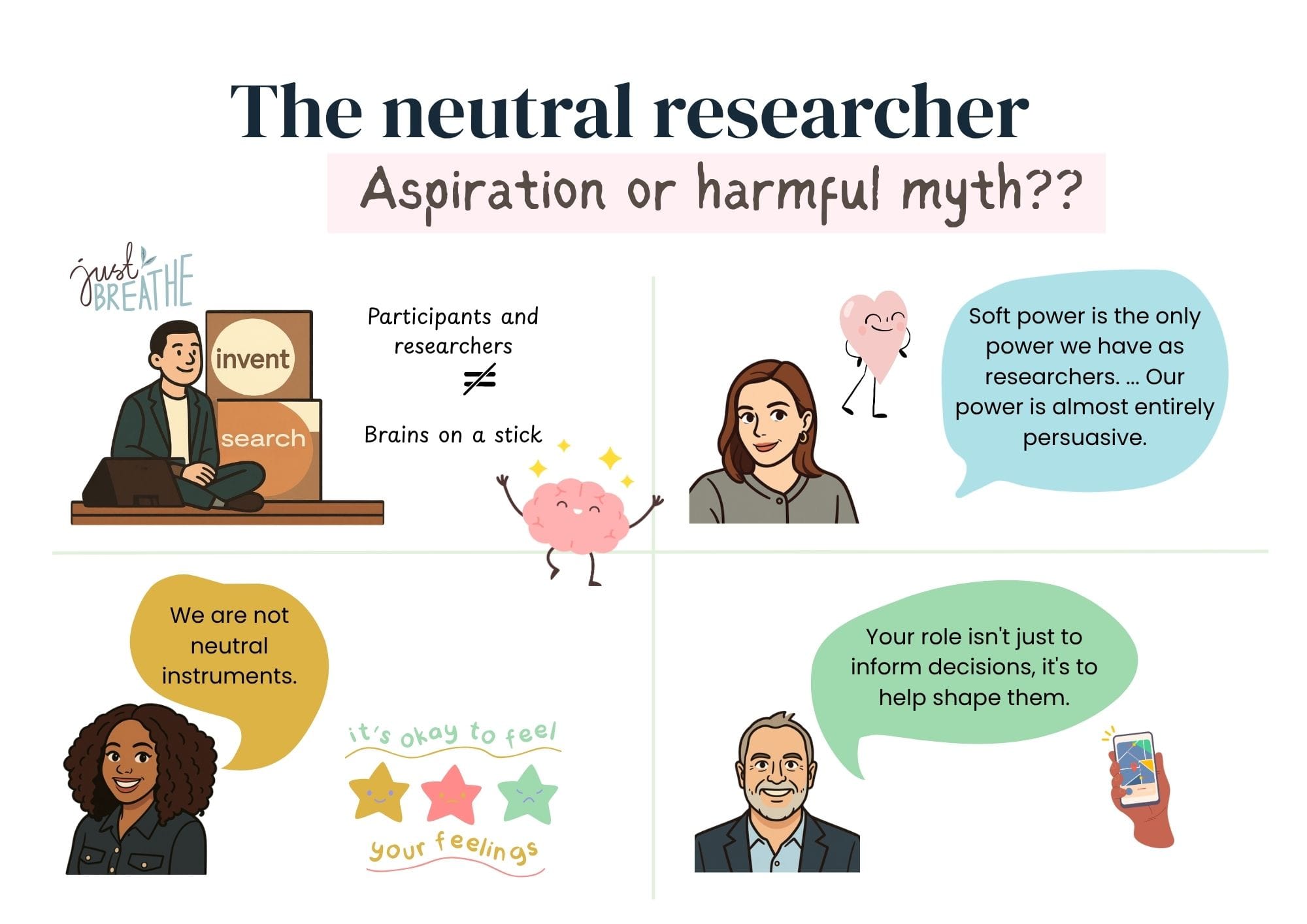
Research practice faces a parallel reckoning. At UXinsight Festival 2026, held April 30 with the central question "What is a UX researcher in 2026?", practitioners addressed five hard conversations: the myth of researcher neutrality, the lack of any agreed definition of rigor, the persistent failure of insights to drive decisions, the costs of democratized research without infrastructure, and AI's role as a tool that averages responses rather than surfaces meaningful differences. 13 The festival proposed the HEARTS framework (Human-led, Experience-focused, Amplification not Automation, Rigorous & Responsible, Trustworthy & Transparent, Safe & Sustainable) as an audit lens for AI-assisted research workflows.
Practical takeaway: The NNGroup finding that senior and generalist roles recover faster than entry-level roles is a signal about what to build toward. Skills that compound now: usability testing, research synthesis, design systems governance, accessibility auditing. These are the 40% that remain human.
Ergonomics: three updates practitioners should track
The ergonomics field moved on three fronts this spring, each significant enough to affect how designers and engineers specify work environments and product constraints.
ISO 11228-3:2026 was published May 8, replacing the 2007 first edition. 14 The standard governs ergonomic assessment of repetitive upper-limb work — the category that covers most keyboard-intensive digital work and assembly-line tasks. Key changes: new assessment methods added to Annex B, expanded tool options in Table C.1, and revised validation criteria in Table C.2. If your practice covers workstation design or product usability for high-repetition tasks, the 2026 edition is the current reference.
Work-from-home ergonomics knowledge remains surprisingly low. A national US study published in Applied Ergonomics (Vol. 136, 2026) surveyed 3,195 remote workers and found average ergonomics knowledge at 8.5 out of 16 — with Black and African American workers scoring 7.7, significantly lower than other groups. 15 Small employers (under 10 people) scored lowest on both awareness and knowledge. The researchers attributed these disparities to structural factors — unequal access to training, occupational stratification — not individual characteristics. For designers specifying home-office products or remote work tools, these gaps represent a real accessibility failure in the current market.
Psychosocial ergonomics was the theme of World Day for Safety and Health at Work this April 28, through a joint IEA–ILO statement. 16 Role clarity, autonomy, and transparency in organizational processes are the intervention targets — design-relevant because they apply directly to team structures and digital tool adoption.
Industrial design: the human factor as competitive moat
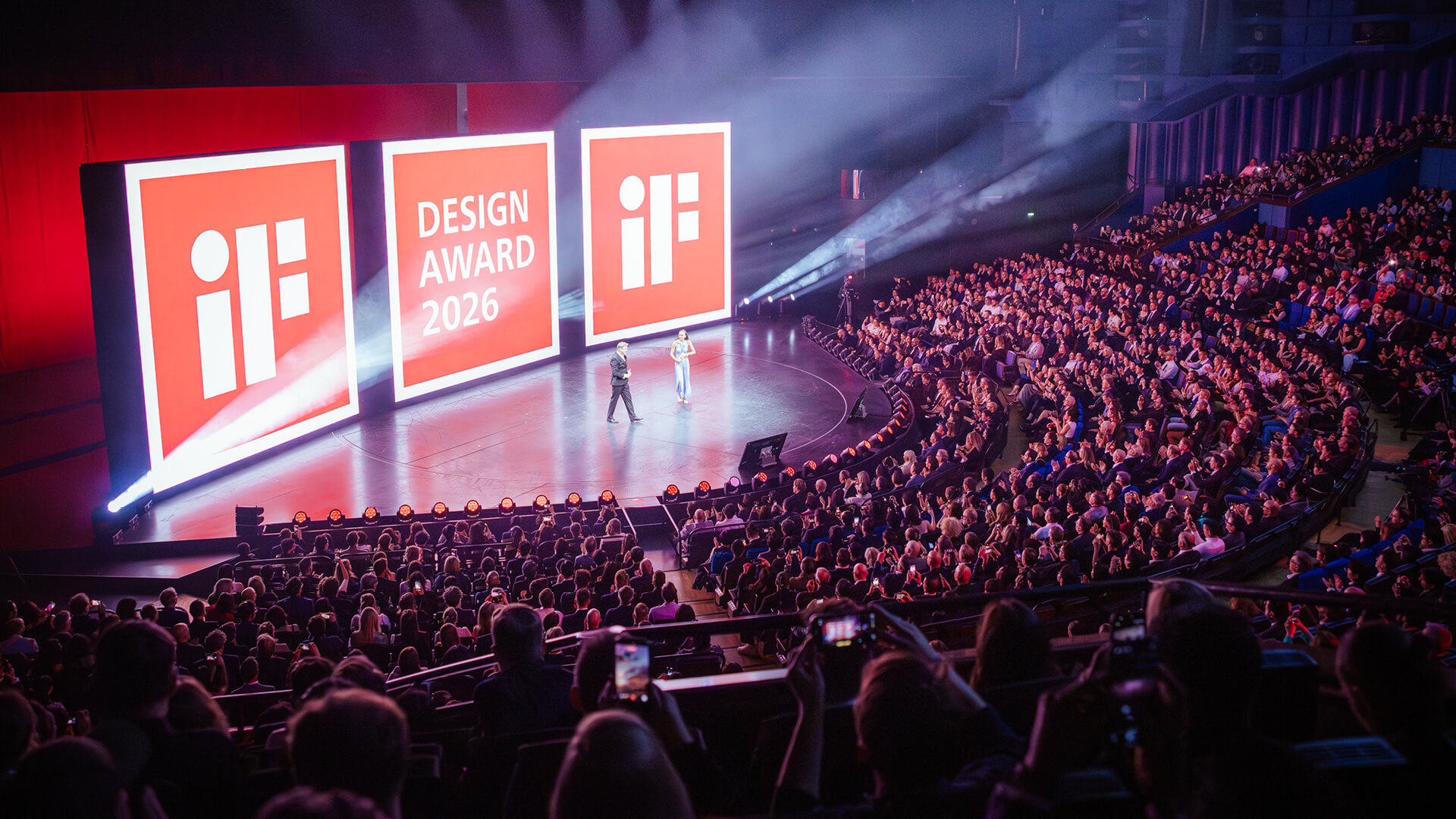
The iF Design Award ceremony on April 27 in Berlin became an unexpected industry summit on AI and design identity. Of 10,000+ submissions, 74 gold awards were given across 93 categories. 1 The awarded projects make Cremering's "age of average" point concrete: Birdie 2.0 by Birdie Scandinavia is a CO2 monitor designed as a canary — it drops from its perch when air quality deteriorates, making an invisible hazard legible through behavioral metaphor. Cambridge Consultants' Forme replaces a cervical screening speculum design unchanged for 150 years. Fujitsu's Carbon Cakes are actual baked goods shaped by real pollution data — data visualization made edible.
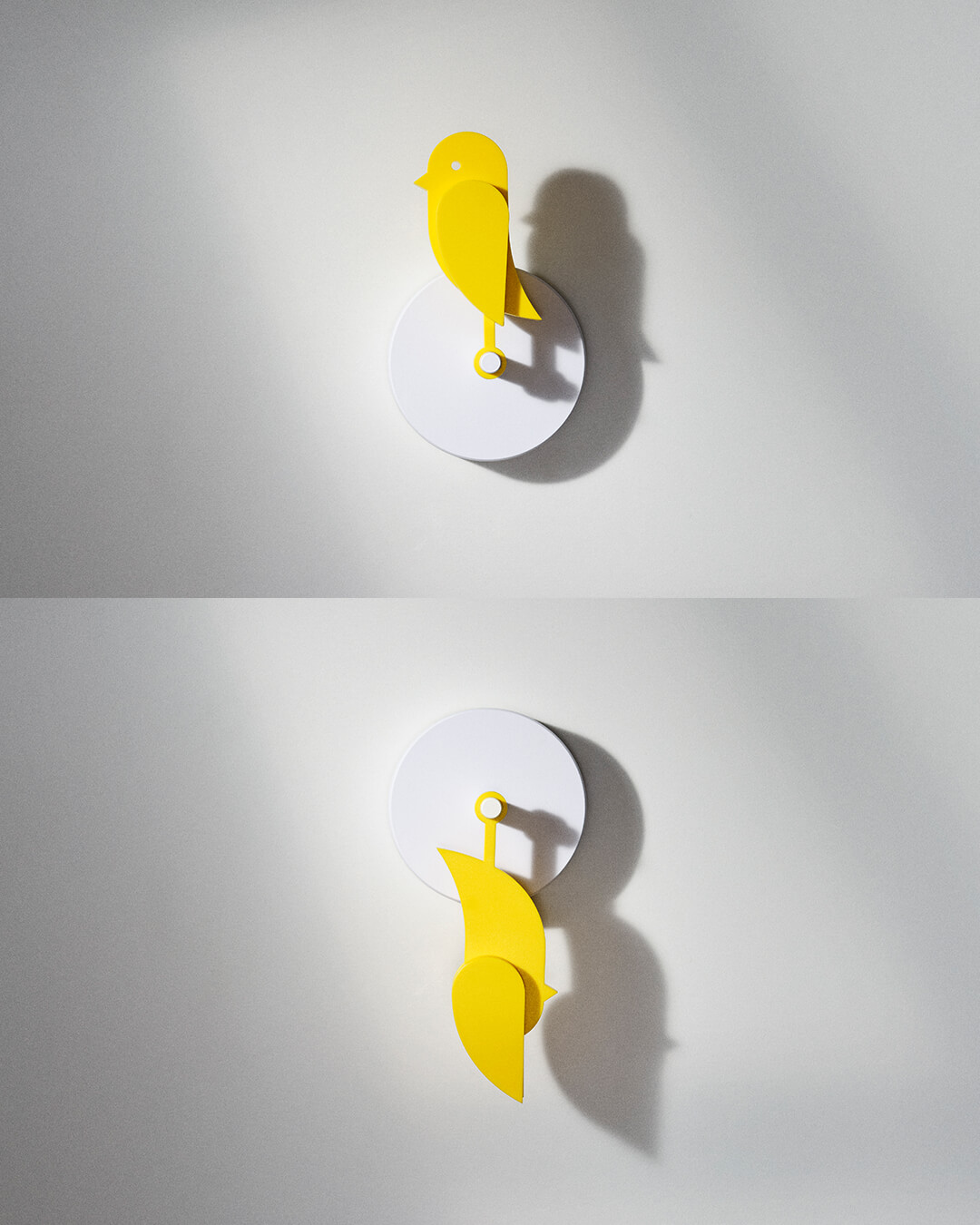
None of these solutions emerge from a text prompt.
At Red Dot 2026, Samsung won two Best of the Best awards: the OLED S95H television — whose "FloatLayer" design places a thin OLED panel above a metallic silver back panel to create a genuine sense of depth — and the Bespoke AI Laundry Series. Samsung CDO Mauro Porcini articulated the company's position: "Expressive Design is our way of putting people at the center, celebrating their identity, emotions and diversity. We design not only to function, but to create meaning and connection." 17
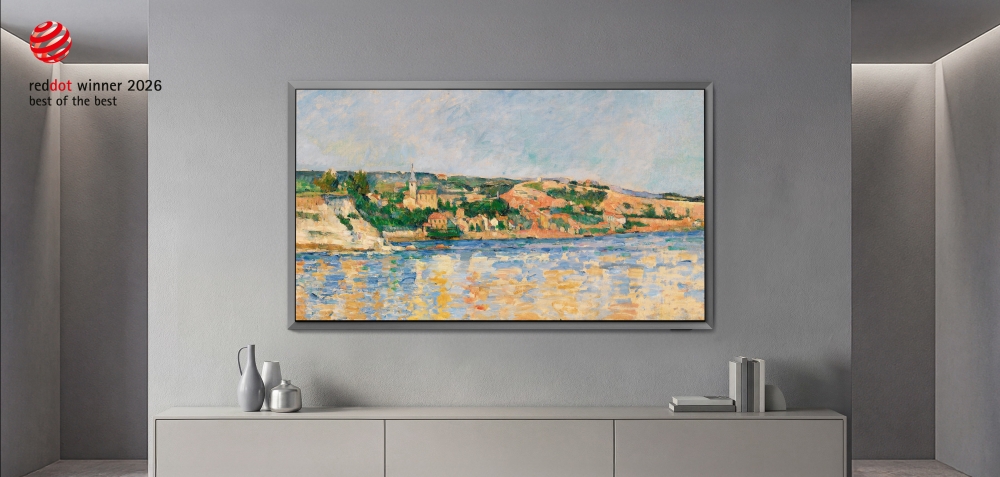
Milan Design Week 2026, held April 20–26, was more complicated. Dezeen identified inflatable furniture, sci-fi AI-driven lamps, and brutalist audio equipment as the breakout aesthetic directions. 18 Designer Jasper Morrison was less charitable about the event overall: "Unfortunately, Milan has been infiltrated by marketing opportunists, becoming a giant theatre for marketing all manner of worldly goods." The PROJEKTER trend report frames the deeper industrial design direction as authenticity over perfection — rough textures, natural patina, and visible craft as markers of quality in a context where AI can generate polish on demand. 19
Practical takeaway: The market for industrial design is projected to grow from $47.9 billion in 2025 to $72.5 billion by 2031 (CAGR 7.14%). 19 The EU Ecodesign Regulation now prohibits destruction of unsold textiles and tightens battery recyclability requirements — circular design is no longer optional for EU-market products. Material selection, modular structure, and design-for-disassembly are skills with direct commercial value today.
What connects all four
The iF Design Foundation's trend report for 2026 calls this moment "the age of average" — but that framing is diagnostic, not fatalistic. The tools that produce average are exactly the tools that reveal what average cannot do: a canary CO2 monitor, a research framework that names researcher bias as a feature, a staircase safety study that quantifies what a millimeter of step-depth inconsistency does to a 70-year-old's gait.
Across graphic design, UX/UI, ergonomics, and industrial design, the 2026 pattern is identical: AI executes the known solution faster; designers are responsible for defining which solution is worth executing. That is not a smaller job. It is a harder one.
参考ソース
- 1STIRworld: iF Design Award 2026
- 2UXPin: Google Stitch AI Design Tool
- 3Design Systems Collective: Claude Design vs. Stitch vs. Figma
- 4Adobe Newsroom: New Creative Agent
- 5Canva Newsroom: Canva AI 2.0
- 6Anthropic: Introducing Claude Design
- 7Investing.com: Figma and Wix shares tumble
- 8Figma Blog: Workflow Lab
- 9Anima Blog: Graphic Design in 2026
- 10Nielsen Norman Group: State of UX 2026
- 11Peter Merholz on LinkedIn
- 12Smashing Magazine: The UX Designer's Nightmare
- 13UXinsight: UXinsight Festival 2026
- 14ISO 11228-3:2026 via Certifico
- 15Applied Ergonomics: WFH ergonomics knowledge study
- 16IEA: World Day for Safety and Health at Work 2026
- 17Samsung Newsroom: Red Dot Design Award
- 18Dezeen: Milan Design Week trends 2026
- 19PROJEKTER: Industrial Design Trends 2026
このコンテンツについて、さらに観点や背景を補足しましょう。