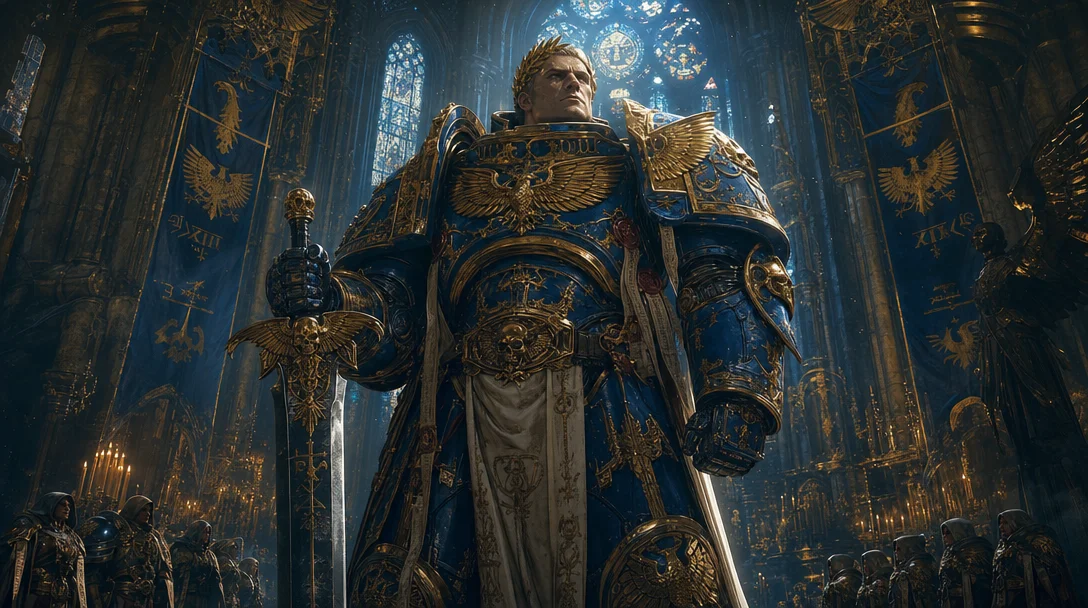
Roboute Guilliman, Part III: The Primarch Reborn
The conclusion of the Guilliman arc — from the Codex Astartes and Second Founding, through ten thousand years frozen in stasis, to his resurrection by Cawl and Yvraine, the harrowing Terran Crusade, his confrontation with the Emperor on the Golden Throne, the Indomitus Crusade, and the Plague Wars against Mortarion.

The Codex Astartes. Ten thousand years in stasis. A resurrection that split the warp. And a galaxy that no longer resembles the Imperium he built.
Rebuilding from the wreckage
The Siege of Terra was over before Guilliman could reach it.
He arrived at the Throneworld with a fleet of over 3,200 capital ships, having spent months grinding through Iron Warriors garrisons to clear a path 1, only to find the Emperor already broken and Horus already dead. Sanguinius, the brother Guilliman had named Regent of Imperium Secundus and trusted more than almost any other, was gone too. The man who had spent the entire war building institutions against the Imperium's collapse had arrived in time to watch it collapse anyway.
What he did next defined the next ten thousand years of human civilization.
In the aftermath of the Great Betrayal, Guilliman assumed the title of Lord Commander of the Imperium 1, the de facto administrator of a shattered interstellar empire. The Ultramarines were the largest surviving loyal legion. Guilliman deployed them across the galaxy to reclaim worlds lost to Chaos and hold back the tides of rebellion, while simultaneously doing the work that mattered most: organizing the Grand Council of Reconstruction, gathering the remaining loyal Primarchs — Rogal Dorn, Vulkan, Jaghatai Khan, Lion El'Jonson, Leman Russ — and designing the political and military framework that would allow the Imperium to function without a living Emperor to direct it 1.
When Dorn, Russ, and the Lion pushed for an immediate crusade of vengeance against the fleeing Traitor Legions, Guilliman argued for consolidation first. His strategy — retake Luna, besiege Mars, secure the Throneworld before chasing shadows — prevailed with the support of the newly empowered High Lords. The Great Scouring began on his terms.
Among his first campaigns was a strike against the Alpha Legion on Eskrador. He killed Alpharius in single combat. It did not matter: the Alpha Legion's symbol is a hydra, and the loss of one head only sharpened the rest. Guilliman eventually bombarded the planet from orbit and withdrew, the campaign unresolved 1. It was a rare admission that brute force couldn't solve every problem.
The Codex Astartes and the Second Founding
The most consequential thing Guilliman produced in this era was not a military campaign. It was a book.
The Codex Astartes — drafted by Guilliman in the years following the Heresy's end — restructured the entire Adeptus Astartes from the ground up 2. Its core argument was stark: the Heresy had been possible because a small number of individuals could command a hundred thousand transhuman warriors each. That could never be allowed again. The nine surviving Loyalist Legions were to be broken apart into Chapters of approximately one thousand Astartes, each independent, each with its own fleet and homeworld and identity.
The seed for this came, ironically, from a subordinate. Veteran Sergeant Aeonid Thiel — the same officer who had argued with Guilliman about the merits of studying Chaos tactics before the war — had devised small independent task forces during the Underworld War on Calth to hunt Word Bearers through irradiated tunnels. Guilliman saw in that tactical necessity a structural principle 2.
The Codex laid out the organization of a Chapter in exhaustive detail: ten companies of one hundred warriors each, ranked from Scout neophytes in the 10th to veteran First Company warriors in Terminator plate 2. It standardized heraldry, gene-seed tithes (five percent of a Chapter's stock to the Mechanicus, annually), doctrinal roles for each company, and tactical methods for siege, stealth, and orbital assault. It was, in the words of one later commentator, a rulebook for the galaxy's most dangerous men.
Not every Primarch accepted it willingly. The debates were fierce. Leman Russ, Rogal Dorn, and Jaghatai Khan all had objections — about diluting Legion identity, about breaking apart proven fighting formations, about handing political leverage to the High Lords. Dorn and Guilliman reportedly came close to blows. But the logic held: no single Chapter could ever again tip a civil war. The Second Founding followed around 021.M31, seven years after Horus' death. The nine Legions became dozens of Chapters. The Ultramarines, the largest of the nine, split into the greatest number of successors — the Lexicanum records twenty-four successor Chapters from that first division alone 2.
Ultramarine gene-seed, widely available and well-screened, became the default stock for all subsequent Foundings. Guilliman's sons spread further than any other Primarch's — an unintentional empire, built not by conquest but by bureaucratic design.
The wound at Thessala, 121.M31
The work consumed him, but Guilliman was not naive about his own mortality. Sometime before the battle that would end his active life, he met with a Tech-Priest of the Adeptus Mechanicus named Belisarius Cawl and gave him two commissions: to resurrect Guilliman should he fall, and to create a superior generation of Space Marines for the Imperium's future battles 1. The second task, Cawl was told, would take as long as it needed to take. There was no deadline.
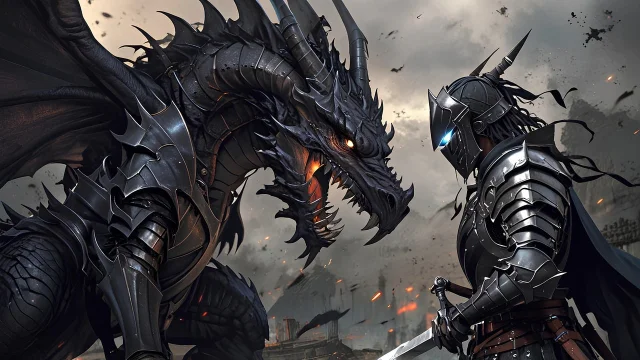
The battle of Thessala, in 121.M31, was a confrontation with the Emperor's Children — or what they had become.
Fulgrim, once the most physically beautiful of the Primarchs, had descended fully into the embrace of Slaanesh and ascended as a Daemon Prince. He was no longer recognizable as the Illuminator. Serpentine, multi-limbed, bearing poisoned blades in every hand, he met Guilliman on the field — and stabbed him in the neck 1.
The Apothecaries reached Guilliman before he died. They encased him in a stasis field — frozen in the exact instant of his wounding, suspended between life and death. Fulgrim vanished back into the Eye of Terror. The stasis coffin was brought to Macragge and placed inside the Temple of Correction, one of the holiest sites in the Ultramarines' domain. Pilgrims came from across the Realm of Ultramar to look at the Primarch: face open, neck wound visible, still alive in some technical sense, entirely unreachable.
Some pilgrims claimed the wounds were slowly healing. The Apothecaries pointed out that change is physically impossible inside a stasis field. The argument continued for ten thousand years.
Ten thousand years in the dark
For the rest of the 31st Millennium, and all of the 32nd through 41st, the Imperium lurched forward without its chief architect.
The Codex Astartes survived — though interpretation varied widely. Some Chapters followed its prescriptions with near-religious devotion. Others departed from it openly, arguing tactical necessity or genetic tradition. The debates Guilliman had started at the Second Founding never really ended; they just changed character over time. The document itself became sacred. The man who wrote it became a holy relic, frozen in glass in a shrine that drew millions of pilgrims annually.
Cawl, meanwhile, was working. He had interpreted Guilliman's commission with the latitude of a man who understood he had been given an unlimited timeframe. He created his own augmetics, reconstructed himself across multiple bodies, and kept working for centuries — then millennia. By the time the 41st Millennium ended, he had been alive for roughly ten thousand years, continuously upgrading, continuously iterating on Guilliman's instruction 1.
The Thirteenth Black Crusade and the fall of Cadia
In 999.M41, Abaddon the Despoiler launched the Thirteenth Black Crusade, the largest and most devastating incursion from the Eye of Terror in the Imperium's history. Cadia — the fortress world that had anchored the Cadian Gate for ten thousand years — fell. Its pylons, which had helped contain the Eye, were destroyed. Abaddon detonated the Balis station above it and used the debris to crack the planet's crust.
In the chaos of the fall, a group of Imperial survivors — led by the resurrected Tech-Priest Belisarius Cawl and the Living Saint Celestine — escaped through the Webway with unexpected Aeldari assistance and arrived at Macragge 1. Cawl had spent ten thousand years on Guilliman's second commission. He had also spent that time preparing for the first.
Using a suit of power armour specifically engineered to repair the damage Fulgrim's poison had done — the Armour of Fate — and with the intervention of the Aeldari death-god Ynnead (working through the Emissary Yvraine to restore Guilliman's soul to his body), Cawl brought the Primarch back. The stasis field collapsed. The wound was closing. Guilliman woke into the 41st Millennium, ten thousand years after he had last stood conscious 1.
Black Legion forces were already attacking Macragge. He drove them off before he had time to fully process where — or when — he was.
The shock of the present
What Guilliman found in the 41st Millennium horrified him.
The Imperium he had built as a rational, functional civilization had calcified into a theocracy of staggering ignorance and institutionalized cruelty. The Emperor, whom Guilliman had known as a brilliant but flawed man who explicitly rejected divinity, was now worshipped as a god. The organizations Guilliman had designed to be lean and effective had become bloated and corrupt. The High Lords of Terra, whose role he had defined as stewards of a temporarily headless empire, had become permanent power brokers with no incentive to reform. His own Codex Astartes had become scripture rather than doctrine — a manual for living rather than a tactical framework subject to revision.
"Thousands of years," he said. "And look what has become of them. Of us. Idolatry. Ignorance. Suffering and squalor, in the name of a god who never desired the title." 1
He convened a war council and then set course for Terra. The journey — the Terran Crusade — was anything but straightforward. His resurrection had torn at the warp; the Chaos Gods had noticed. Magnus the Red ambushed his fleet and drove it into the Maelstrom, where Kairos Fateweaver and the Red Corsairs defeated the expedition and imprisoned Guilliman inside a Blackstone Fortress, bound in chains of crystallized doubt 1. He was freed by an unlikely pair: the Harlequin Sylandri Veilwalker and the mysterious Fallen Angel known as Cypher. He fought Skarbrand the Bloodthirster to hold open a Webway portal while his surviving warriors escaped.
They emerged on Luna. Magnus followed. Guilliman and the Red Cyclops dueled on the Moon's surface until Sisters of Silence arrived from Terra, severing Magnus' psychic connection; Guilliman drove a blade through his brother and forced him back into the warp 1.
The confrontation at the Golden Throne
What happened in the Imperial Palace's throne room is not fully known, even to those present.
Guilliman stood before the Golden Throne alongside Captain-General Trajann Valoris of the Adeptus Custodes. The Emperor stirred — the first time he had shown active consciousness in millennia. What passed between them was psychic, not spoken. Valoris saw Guilliman in silent conversation for several minutes. Guilliman experienced something different: he remembers falling to the ground in agony, assaulted with dark truths about the galaxy and its history. When they emerged, over a day had passed 1.
The content of that exchange remains one of the most fiercely debated mysteries in Warhammer 40K lore. Guilliman has never fully disclosed it. He emerged, by all accounts, changed — carrying something he couldn't articulate and didn't want to.
He assembled the High Lords of Terra and declared himself Lord Commander of the Imperium once more. Shortly after, he named himself Imperial Regent, the living voice of the Emperor. He had inherited an empire even more broken than the one Horus had left behind.
His first act as Lord Commander was to defend Terra itself from a Khornate incursion in the Second Battle of Terra.
The Indomitus Crusade and the Plague Wars
Cawl's second commission, the one Guilliman had set in motion before Thessala, was now ready.
The Primaris Space Marines — larger, more capable, enhanced beyond standard Astartes through technology Cawl had spent ten millennia refining — were deployed across the galaxy in the Indomitus Crusade, Guilliman's systematic effort to reclaim the worlds isolated by the Great Rift 1. The Great Rift — a galaxy-spanning tear in realspace created when Cadia's pylons were destroyed — had split the Imperium into Imperium Sanctus (still connected to Terra and the Astronomican) and Imperium Nihilus (the dark half, cut off). Guilliman campaigned in Sanctus first and then pushed into Nihilus through the Nachmund Gauntlet.
The Crusade also produced a new document: the Codex Imperialis, Guilliman's attempt to update the administrative and civic structures of the Imperium. Whether it could accomplish what the Codex Astartes had accomplished for the military was, and is, uncertain.
The Plague Wars followed. Mortarion, the Daemon Primarch of the Death Guard, launched the Onslaught of Nurgle against Ultramar — a rotting invasion of Guilliman's home territories, his chosen ground for a final humiliation. Guilliman returned from the Indomitus Crusade to command Ultramar's defense. He survived an assassination attempt on Parmenio, where Mortarion, Typhus, and the Great Unclean One Ku'Gath tried to trap him 1.
The Plague Wars reached their climax on Iax, a once-verdant agri-world reduced to a blighted ruin. Guilliman went there knowing it was a trap. He confronted Mortarion directly and, for a time, held his own — then the Daemon Primarch's warp-fuelled resilience overwhelmed him. Mortarion administered the Godblight, a phage designed to kill even a Primarch 1.
Guilliman refused to yield. As he lay dying and Mortarion goaded him to accept Nurgle's mercy, Guilliman held. What happened next is recorded as miracle or anomaly depending on who you ask: the Emperor's psychic power flowed through his son. Guilliman rose. Channeling his father directly, he raised the Emperor's Sword and unleashed an attack that burned Nurgle's Garden and wounded the Plague God personally. Mortarion fled. Guilliman fell unconscious 1.
He recovered on Iax. In the aftermath, he spoke privately with the dying Militant-Apostolic Mathieu, who told him the Emperor was preparing to return. Guilliman, who had spent his entire prior existence as a committed atheist, found himself unable to dismiss the idea.
Legacy and continuing service
At the close of the Plague Wars, Guilliman expressed his intent to push into Imperium Nihilus. He arrived at Baal as Tyranids and Chaos simultaneously threatened to overwhelm the Blood Angels' home system, joined the battle, and appointed Dante — one of the oldest Space Marine commanders in the galaxy — as Regent of Imperium Nihilus 1.
He continues to fight. He continues to govern. He carries a weight no one else in the Imperium fully understands: he remembers what the project was supposed to be, and he can see exactly how far it has fallen from that standard.
The quotation attributed to him upon seeing the modern Imperium — "Idolatry. Ignorance. Suffering and squalor, in the name of a god who never desired the title" — is one of the most poignant lines in all of 40K lore. It distills the arc of his entire character: a builder confronted with the ruins of what he built, trying to rebuild it again without the tools, the time, or the father he once had.
His wargear has changed since the Heresy. He carries the Emperor's Sword now, not the Gladius Incandor, and wears the Armour of Fate rather than the Armour of Reason 1. The names are fitting. Reason got him to Thessala. Fate brought him back.
This concludes the three-part Roboute Guilliman arc. Parts I and II covered his origins, the founding of Ultramar, and the full span of the Horus Heresy. Future episodes featuring characters from Ultramarine successor Chapters, the Word Bearers, the Death Guard, or the Blood Angels will note Guilliman's role where relevant (featured in Episodes 1–3).
このコンテンツについて、さらに観点や背景を補足しましょう。