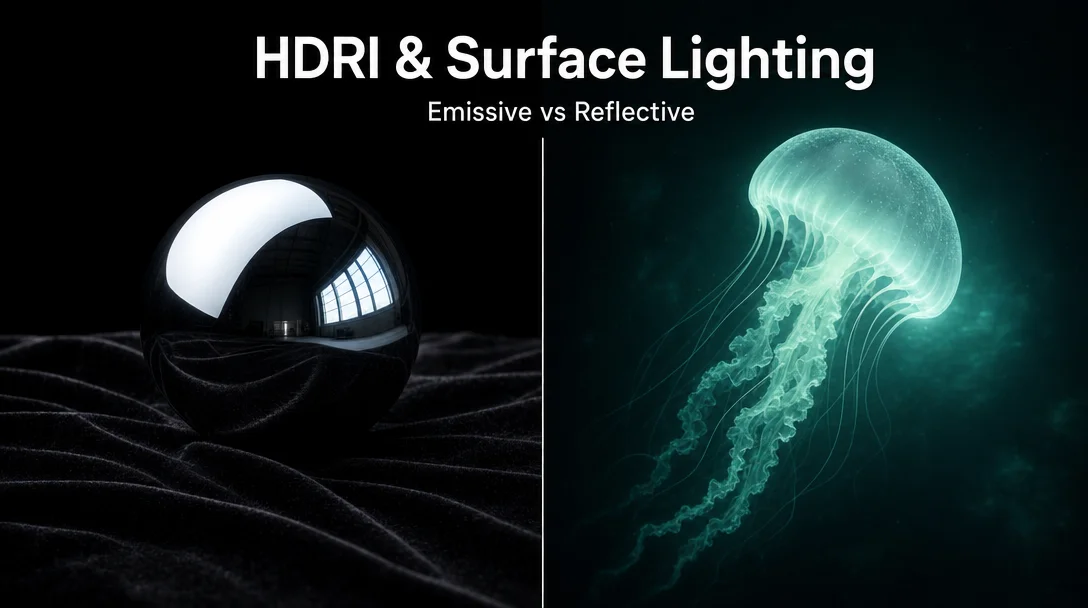
HDRI and surface lighting vocabulary for AI image-gen prompts
Replaces "studio HDRI" and "outdoor HDRI" — 3D renderer concepts that AI image-gen models can't actually use — with the physical environment and surface-behavior vocabulary that works across tools. Covers studio key-light blocks, Rembrandt lighting, overcast-dome approximations, emissive vs. reflective surface prompting, a cross-tool syntax table (MJ V7 / V8.1 / Flux dev/schnell / SDXL / SD3), and 8 copy-paste prompt snippets.

"Studio HDRI" and "outdoor HDRI" are 3D renderer concepts. They refer to a 360° environment map that wraps a scene and provides both illumination and reflections. Feed either phrase into Midjourney, Flux, or SDXL and the model doesn't actually load a panoramic environment — it statistically samples whatever training images were tagged with that description, which produces flat, indistinct overhead lighting. Soft, averaged, purposeless illumination that communicates nothing.
The vocabulary that actually works is different from what 3D artists reach for. There are two layers to get right: the environment descriptor (what surrounds and illuminates the subject) and the surface behavior descriptor (how the material interacts with that light). Get both right per tool and you can reliably produce controlled studio setups, convincing chrome, and glowing emissive materials.
Why generic lighting labels fail
Nightjar's testing of AI product photography found a consistent pattern: one light source described in specific physical terms outperformed three vaguely named lights in every tested model. 1 The reason is attention mechanics. A prompt naming three lights splits the model's attention three ways and produces a blended, median result.
Artlist documented the same failure mode: when lighting isn't described clearly, models default to soft even lighting that feels safe but dull. 2 QuestStudio's framing: "Great prompts are not longer. They are more specific where it matters: camera, light direction, and contrast." 3
"HDRI lighting" fails for the same reason "cinematic lighting" does: it names a category, not a physical configuration. The substitution is a physical description of the environment that would produce that light in a real-world or studio context.
Studio HDRI vocabulary: controlled environment substitutes
A real studio HDRI is usually a single-source or two-source setup photographed at high dynamic range. The prompt equivalent is a modifier block naming the source, its position, its quality (hard vs. soft edge), and the contrast ratio.
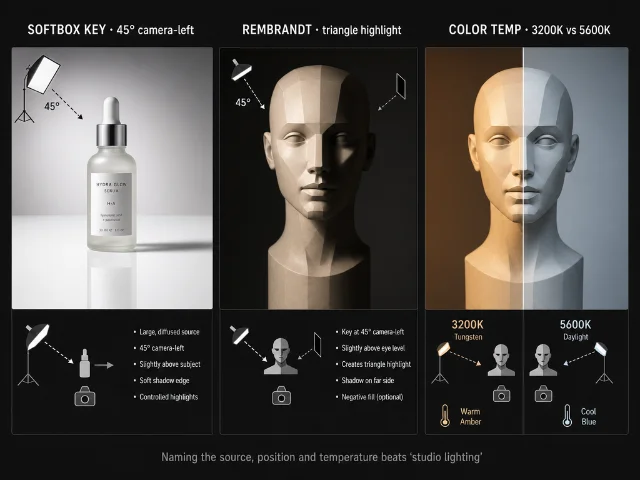
For a classic studio key-light setup — equivalent to a large overhead softbox HDRI with fill bounce:
large softbox key light at 45° camera-left, soft wrap,
clean shadow edges, subtle fill, no specular flare
This block from QuestStudio 3 works in MJ V7, SDXL, and Flux. For Flux, add scene framing before it:
product shot of [subject], lit by a large softbox positioned 45 degrees camera-left, soft wrap, clean shadow edges. Flux's T5-XXL encoder (a large language-model-style text encoder that understands prose context) responds better to behavioral sentences than to isolated parameter labels. 4For Rembrandt lighting (dramatic portraits, equivalent to a single-source HDRI with deep falloff):
Rembrandt lighting, single key light high and to the side,
dramatic contrast, triangle cheek highlight, deep shadow opposite side
PromptsEra confirms this produces the expected triangle highlight on the shadow-side cheek in Midjourney. 5 If "Rembrandt" trends toward oil-painting style in MJ V7, add
--no painting. In V8.1, where --no is removed, rephrase as Rembrandt-style portrait lighting, photography.Color temperature is part of the studio HDRI vocabulary and often skipped. Use Kelvin values or named descriptors:
- Warm tungsten fill:
3200K tungsten background light, warm amber tone - Daylight key:
5600K daylight key, neutral skin tones, corporate lighting - Mixed for depth:
warm practical key light on subject, cool 5600K background— Storytella identifies this mixed-temperature approach as the standard cinematic technique for visual separation without post-production 6
Outdoor HDRI vocabulary: diffuse sky and overcast dome equivalents
A real outdoor HDRI overcast setup wraps the subject in a uniform gray-sky dome: soft, directionless, even light with no hard shadows. This is the most underserved area in AI prompt vocabulary. There is no single keyword equivalent to dropping an overcast HDRI in a 3D scene.
The combinatorial substitute:
soft diffused daylight, overcast sky, no harsh shadows,
even wrap lighting, moody gray atmosphere
For north-facing window light (a stable, soft-directional equivalent):
north-facing window light, soft directional light,
diffuse fill, cool 6500K natural daylight, gentle catchlights
For the volumetric outdoor haze that gives HDRI scenes their depth:
volumetric atmospheric haze, soft god rays through fog,
environment reflected on subject, diffuse wrap
These combinations work in MJ V7 and Flux. In Flux, pairing
god rays with diffuse wrap keeps it atmospheric rather than generating a hard beam cutting across your subject.Emissive vs. reflective surface prompting
These two surface types both involve light, but they require opposite prompting strategies.
Emissive surfaces produce light. The common mistake is naming the glowing object as an object. The correct approach is describing what the light does in the scene.
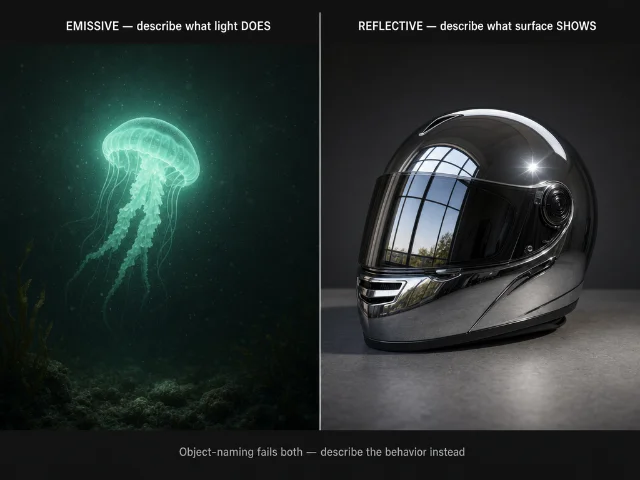
Bioluminescent glow — instead of
glowing bioluminescent creature, use:bioluminescent glow illuminating the fog, light emanating from within,
soft aqua luminescence diffusing through dark waterBlake Crosley's MJ V7 testing confirms that behavioral light descriptions like this are interpreted as atmospheric effects rather than generating discrete objects. 7 For tighter control in ComfyUI workflows, physical emission phrasing works:
emission behaves physically, illuminating nearby surfaces without magical glow, halos, or particle effects beyond light emission.For self-illuminated surfaces like neon, screens, or practicals: use
self-illuminated or practical light source casting warm ambient glow on surroundings rather than naming the fixture.Reflective surfaces show other things. Chrome, polished metal, wet pavement — the prompt describes what they're reflecting, not just that they're shiny.
- Flux (behavioral sentence):
the chrome helmet reflects the overcast sky, soft diffuse highlights across the visor - MJ V7 / SDXL (material keyword + context):
highly reflective chrome surface, strong specular highlights, environment reflected in surface
Juggernaut Z (SDXL-based checkpoint): the official prompt guide lists these as its material vocabulary layer:
reflective glass, polished metal, glossy surface, matte concrete. 8 Adding wet pavement reflecting blue and amber light produces film-noir puddle reflections in SDXL-based models.For SDXL weight syntax:
(chrome:1.3) pushes reflectivity; (emissive:1.2) pushes self-glow. Stacking both at high values produces saturated artifacts.Cross-tool syntax reference
| Tool | Lighting syntax style | Emissive phrasing | Reflective phrasing | Exclusion method |
|---|---|---|---|---|
| MJ V7 | Keyword labels or short phrases; multi-prompt :: supported | bioluminescent glow illuminating the fog | chrome surface, strong specular, environment reflected | --no flat lighting |
| MJ V8.1 | Positive-phrasing only; --raw for literal control | soft aqua luminescence diffusing through dark water | highly polished chrome, specular highlight camera-right | ::-1 negative weight + --raw |
| Flux dev/schnell | Natural-language behavioral prose; T5-XXL encoder | light emanating from within, diffusing through surrounding fog | the chrome surface reflects the overcast sky | No native negative_prompt (Flux 1); rephrase positively |
| SDXL | Keyword labels + weight syntax (keyword:1.3) | (emissive:1.2), self-illuminated surface, glow casting on surroundings | (chrome:1.3), polished metal, specular highlights | negative_prompt field; CFG 5–8 |
| SD3 / SD3.5 | Plain English sentences; CFG 3.5–4.5 | Unreliable — style adherence too poor for deliberate surface control | Unreliable — use SDXL or Flux for precise material work | Leave negative_prompt empty: adding one introduces noise, not element removal 9 |
SD3's behavior here is documented in Replicate's official guide: negative prompts in SD3 do not remove unwanted elements — they vary the output the way changing a seed does. 9 For lighting work that requires predictable surface behavior, use SDXL or Flux dev.
コンテンツカードを読み込んでいます…
Copy-paste reference card
Studio key light (MJ V7 / SDXL):
large softbox key light at 45° camera-left, soft wrap,
clean shadow edges, subtle fill, 5600K daylight
Studio key light (Flux dev/schnell):
[subject], lit by a large softbox positioned 45 degrees
camera-left, soft wrap, clean shadow edges, no specular flare
Rembrandt portrait (MJ V7):
Rembrandt lighting, single key light high and to the side,
triangle cheek highlight, deep shadow opposite side --no painting
Outdoor diffuse dome (MJ V7 / Flux):
soft diffused daylight, overcast sky, no harsh shadows,
even wrap lighting, cool 6500K north-facing daylight
Emissive atmosphere (MJ V7 / Flux):
bioluminescent glow illuminating the fog, light emanating
from within, soft aqua luminescence, no discrete light source
Chrome reflective (Flux dev):
the chrome surface reflects the overcast sky,
diffuse highlights, strong specular camera-right
Chrome reflective (SDXL):
(chrome:1.3), highly reflective polished metal,
strong specular highlights, environment reflected in surface
Wet pavement (SDXL / MJ V7):
wet pavement reflecting blue and amber light,
puddle reflections, film noir atmosphere
Cover image: AI-generated illustration
参考ソース
- 16 Prompt Patterns That Consistently Produce Realistic AI Product Photos — Nightjar
- 2How to prompt lighting in AI images — Artlist
- 3Camera + Lighting Prompt Cheatsheet — QuestStudio
- 4Creating images with Flux: Your prompt guide — Nebius
- 5Midjourney Prompts for Cinematic Realism — PromptsEra
- 6AI Lighting & Mood: How to Direct Cinematic Looks — Storytella
- 7Midjourney Prompt Engineering Guide — Blake Crosley
- 8Juggernaut Z Prompt Guide — RunDiffusion
- 9How to get the best results from Stable Diffusion 3 — Replicate
このコンテンツについて、さらに観点や背景を補足しましょう。