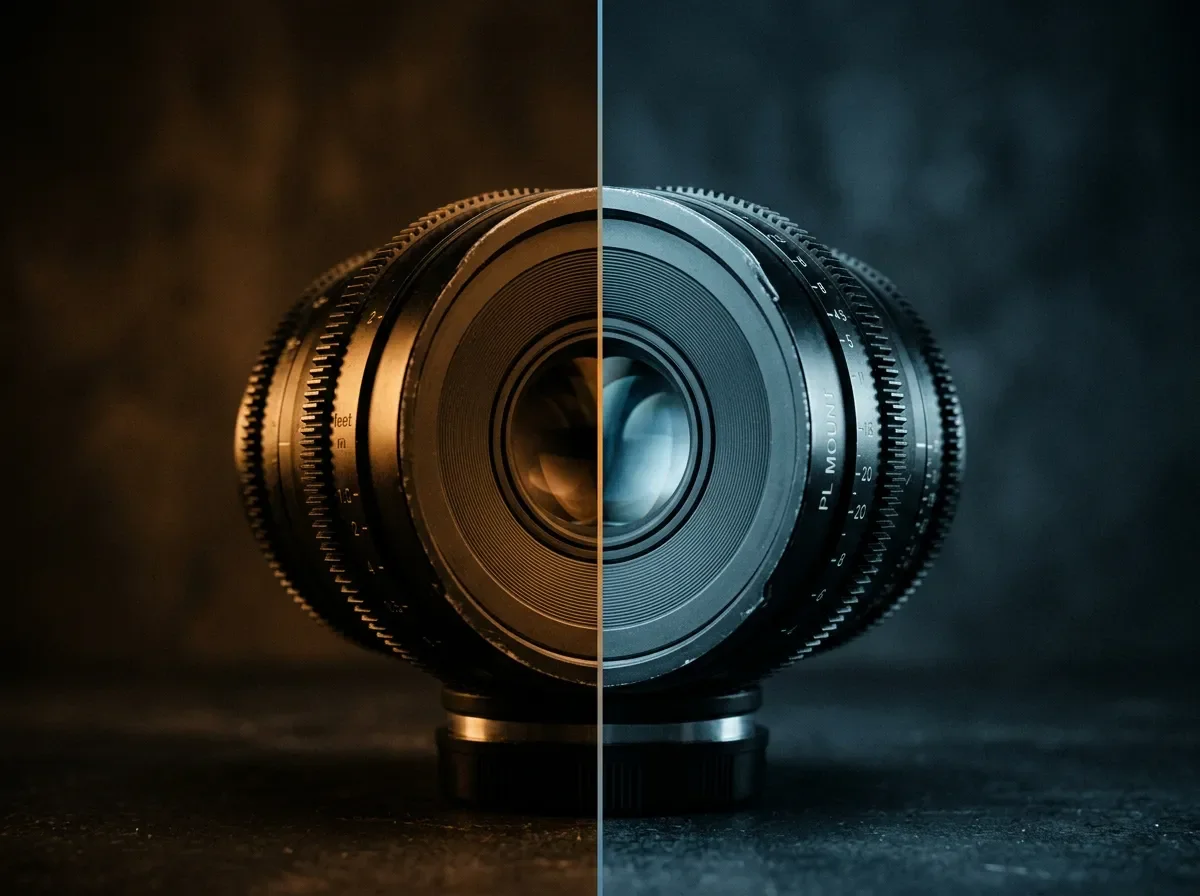
Color temperature vocabulary for Flux, MJ V8.1, and SDXL
Bare Kelvin numbers fail alone — how to pair descriptors, use film stocks, and fix each model's built-in warm/cool bias.
Writing
3200K alone in a prompt does almost nothing on any of these three models. The number sits in the token stream unanchored — models don't treat bare Kelvin values as native semantic tokens. They treat them as modifier noise unless paired with a named light source. 1The fix is pairing.
tungsten 3200K works. daylight balanced 5600K works. cool 6500K LED fill works. 2 The descriptor anchors the number to a known light-source archetype in training data; the number then narrows the distribution to a specific point on that archetype's color range.But once you get past the bare-Kelvin problem, each tool responds differently. SDXL has a structural warm bias baked into its training data. Flux has a teal-and-orange structural tendency (from the Flux.1 era, confirmed to persist in Flux.2). MJ V8.1's stylize pipeline will overwrite whatever color temperature you specified if
--stylize is too high. Those aren't descriptor problems — they're architecture problems that require different mitigation strategies per tool.Why "warm light" is a probability distribution, not a value
VisionToPrompt's lighting consistency research puts it clearly:
"warm golden light" maps to a probability distribution spanning color temperatures from approximately 2700K to 4500K... each generation samples independently from this distribution. 1 Every re-run of the same prompt resamples from that range, which is why two seeds with identical prompts can come out noticeably different in warmth.Pairing a descriptor with a Kelvin value narrows that distribution.
warm tungsten incandescent, amber cast is already narrower than warm light. tungsten 3200K, amber cast is narrower still. 2 For maximum consistency, film stock names go further than either: Kodak Portra 400 triggers a specific color science the model has encountered thousands of times in training data, not an abstract temperature adjective. 3The reliability ranking across all three tools, warm to cool:
| Effect | Least reliable → Most reliable |
|---|---|
| Warm | warm light → golden hour → tungsten 3200K → shot on Kodak Portra 400 |
| Neutral | natural light → daylight balanced → daylight balanced 5600K, neutral white |
| Cool | cool light → overcast skylight → moonlight with blue gel, 6500K LED fill → shot on Fuji Pro 400H |
GudPrompt's AI prompt tool confirms that film stocks render their actual color science on every major model:
"Real film stocks. Kodak Portra 400, Cinestill 800T, Fuji Velvia. They render their actual look. Universally respected." 4Per-tool behavior: what changes and what you need to do about it
MJ V8.1
MJ V8.1 accepts both named labels and behavioral descriptors, but it interposes its own aesthetic interpretation on top — unless you disable that layer. 5
The official Midjourney documentation describes
--stylize (range 0–1000, default 100) as "a slider that changes how much artistic creativity is applied to your image." 5 At --s 300+, that creativity injection overrides explicit color temperature cues — the same way it was documented to override light direction in Cycle 5. For literal color execution, drop --stylize to 0–50.--raw turns off Midjourney's default aesthetic interpretation entirely. Blake Crosley's MJ V8.1 reference guide (updated May 2026) is direct: "Use --raw when literal prompt control matters; Raw turns down Midjourney's default aesthetic interpretation." 6 Combine --raw with --s 0–50 for the most faithful color temperature output.--exp (range 0–100, default 0) adds detail and tone-mapping. Crosley also notes: "At high values (above 25–50), --exp can overwhelm --stylize settings, override personalization (--p), and reduce image diversity." 6 Keep it in the 10–25 range when color accuracy matters.One confirmed V8.1 constraint:
--no is not supported in V8.1 according to the version compatibility chart in Crosley's guide. 6 Color control must come from positive descriptor vocabulary, not exclusion syntax.MJ V8.1 color temperature formula:
[subject], [descriptor + Kelvin] warm/cool light, [film stock], [camera]
--raw --s 25 --exp 15 --v 8.1
Flux dev / schnell / Flux 2
Flux's Mistral-3 24B VLM text encoder (introduced in Flux.2, released November 2025) processes prompts by context and intent rather than keyword matching. 7 That means natural language color descriptions —
"warm afternoon tungsten light from camera-left" — land more reliably than tag-soup lists. DesignHero's testing confirms: "FLUX responds better to extremely technical specifications" and "FLUX.1 [dev] handles specific camera settings and lens characteristics more precisely." 3The critical limitation: Flux has no native negative prompt on any variant — Pro, Dev, Flex, or Klein. 8 There is no mechanism to exclude color casts with negative text. Color control must be entirely positive: specify what you want, describe the white balance, include the film stock.
"neutral white balance, D65, 6500K" replaces "no warm tone".HEX color codes work directly in Flux Pro:
"#FF6B35 warm rim light" or "#87CEEB cool ambient fill".Flux color temperature formula:
[full sentence describing scene], lit by warm tungsten 3200K from [position],
[film stock] color science, [camera + lens], [grain/quality]
SDXL
SDXL has a documented yellow/warm bias problem. Atchy (a Japanese AI image researcher who published a systematic analysis in February 2026) identified three root causes: training data over-represents warm-toned and vintage imagery; when white balance is ambiguous the model defaults to warm; and texture vocabulary (
paper, grain, film) co-activates yellow casts. 9CFG interacts with this directly:
"If you increase CFG (strength of prompt adherence), style words are forced and yellow tints may increase." 9 Keep CFG at 5–7 for color accuracy. At CFG 8+, SDXL doubles down on whatever warm-cinematic associations live in the prompt.SDXL is also the only one of these three tools where negative prompts reliably affect color. Atchy's recommended string for yellow/warm cast removal:
"no warm tone, no yellow tint, no sepia, no vintage, no parchment, no paper texture, no grain, no film look, no old map background". 9SDXL color temperature formula:
Positive: [subject], daylight balanced 5500K, D65 white balance, modern interior / studio
Negative: no warm tone, no yellow tint, no sepia, no vintage, no parchment, no film grain
CFG: 5–7 | Sampler: DPM++ 2M Karras | VAE: sdxl-vae-fp16-fix
The three-tool comparison table
| Dimension | MJ V8.1 | Flux dev / Flex | SDXL |
|---|---|---|---|
| Best warm prompt | tungsten 3200K, Kodak Portra 400, --raw --s 25 | "warm tungsten 3200K light from camera-left, Kodak Portra 400 color science" | warm tungsten 3200K + CFG 5–7 |
| Best cool prompt | moonlight with blue gel, Fuji Pro 400H, --raw --s 25 | "cool overcast skylight 6500K, Fuji Pro 400H, blue-shifted shadows" | daylight balanced 5500K, D65 + negative for warm |
| Kelvin-only behavior | Low reliability without descriptor pair | Very low — Mistral-3 needs semantic context | Low — training data bias overpowers number |
| Film stock response | Strong (camera/film data in training) | Strong (technical spec comprehension) | Moderate (available but less reliable) |
| Built-in bias | Stylize injects mood (can override CT) | Teal-and-orange structural tendency | Yellow/warm training data bias |
| Negative prompt | Not supported in V8.1 | Not supported (no CFG mechanism) | Effective — use targeted exclusion strings |
| Key fix | --raw --s 0–50 --exp 10–25 | Long positive prose + white balance spec + film stock | CFG ≤7 + negative exclusions + sdxl-vae-fp16-fix |
Mixed-light combinations
The most believable lighting in AI images tends to involve two light sources at different temperatures. An interior with both a desk lamp and a window, or a street scene with warm sodium vapor lamps and cool moonlight overhead, reads as photographically real in a way that single-source prompts often don't.
Getvidzy's 2026 Midjourney collection includes a validated cinematic detective portrait prompt that uses
"warm tungsten and cool moonlight contrast, 1970s neo-noir atmosphere, Roger Deakins cinematography, anamorphic lens flare --ar 2.39:1 --s 200". [cite:10|Getvidzy: Best Midjourney Prompts: Complete Collection [2026]|[https://getvidzy.com/best-midjourney-prompts/]] The Roger Deakins reference is doing real work here — the model has encountered enough of his Blade Runner 2049 and No Country for Old Men cinematography to bias toward exactly that warm-interior-meets-cool-exterior split.Atlabs AI's studio lighting guide (30 professional setups, published March 2026) documents a desk lamp + window setup as:
"The desk lamp creates a warm pool of tungsten light (2800K) across the right side of her face, the window creates a cool separation on the left." 10 The guide makes the design principle explicit: specifying the physical source, its Kelvin value, and its spatial relationship to the subject gives the model all the information it needs — no emotional adjectives required.Joe Newman (MostSublime, Substack) adds a practical warning about the color bleed risk:
"Using 'bright bluish light' can also work but beware that whenever naming a color in your prompt, the AI will usually incorporate it into the subject's clothes or use it to color objects in the frame." 11 Describe the light source (moonlight, fluorescent, sodium vapor) rather than the color directly to avoid the bleeding.The Blenra AI art gallery confirms
"mixed warm/cool contrast" as a standalone keyword that works, and anchors the Kelvin reference points: warm golden hour 3200K, cool blue moonlight 8000K, neutral daylight 5600K. 12Flux's teal-and-orange bias
Flux's structural tendency toward teal-and-orange (the Hollywood standard cinematic color grade, where skin tones skew warm orange and shadows/backgrounds push toward teal/cyan) predates the Flux.2 update. DesignHero (Olivier Hero Dressen) confirmed this pattern is a trainable signal:
"cinematic teal and orange color grade" pulls Flux strongly into that register. 3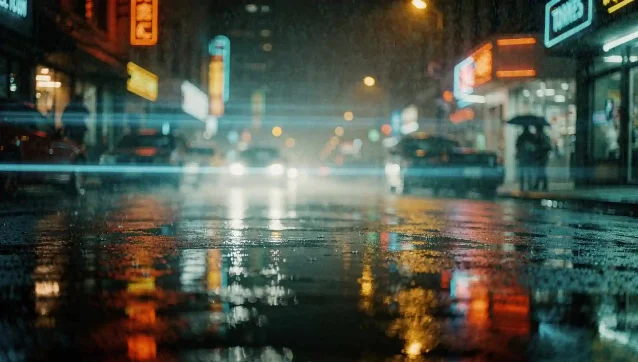
"cinematic teal and orange color grade" prompt — warm neon orange on wet pavement, cool teal in the background shadows. 3The Artlist blog's comparison testing (published 2026) describes Flux's default behavior:
"Flux models usually keep lighting clean and even. It's a good fit when you want readable results that stay close to your description." 13 The tradeoff: that evenness means low-contrast or dramatically lit scenes need explicit specification, because Flux won't add cinematic drama on its own — unless the teal-and-orange training data pulls it that way.Working with the bias (leaning in): Use
"cinematic teal and orange color grade" when you want that Hollywood look. Pair with neon or wet-surface scenes for maximum effect.Working against the bias (neutralizing): Specify
"neutral white balance, D65, 6500K" and describe the exact light source physics. Use Kodak Portra 400 for warm portraits and Fuji Pro 400H for cool. The absence of a color-temperature spec lets the model drift into its default territory — the fix is always positive specification, not negative exclusion.Before/after: what warm bias looks like
These two images show the same prompt before and after adding a Kelvin + white balance correction. The left image shows the default output: an overall amber/warm tone on the background and subject. The right shows the corrected version after adding
"color temperature 6000K" to the prompt. 14

"color temperature 6000K" added — orange cast neutralized, background shifts to cool pale blue. 14The image pair is from ChatGPT's image generator, not Flux or MJ — it's the only publicly documented A/B test for this specific technique. The same descriptor logic applies to all three tools in this article: naming a Kelvin value moves the output away from the model's default warm drift.
Copy-paste snippet set
Warm — across all tools:
tungsten 3200K warm fill light, incandescent amber cast
shot on Kodak Portra 400, warm skin tones, subtle pastel palette
Cinestill 800T, tungsten halation, warm neon bleed, night scene
candlelit warm flicker, intimate amber glow, 2700K
warm tungsten and cool moonlight contrast [mixed-light]
Cool — across all tools:
shot on Fuji Pro 400H, cool muted palette, pastel color science
moonlight with blue gel, cool cyan cast, 6500K LED fill
cool white fluorescent, neutral cast, diffused overhead
blue hour dusk, cool ambient, twilight cyan, 8000K
overcast skylight, slightly blue-shifted, soft wrap
Neutral / daylight:
daylight-balanced strobe, neutral white, crisp shadow edge, 5500K
natural midday sunlight, neutral white balance, D65
daylight balanced 5600K, clean color rendering
MJ V8.1 — add to any of the above:
--raw --s 25 --exp 15 --v 8.1Flux — prose wrapper:
A [scene], lit by [descriptor + Kelvin] from [position], [film stock] color science,
shot on [camera], [lens], neutral white balance D65 [if targeting neutral]
SDXL — negative prompt block for warm/yellow removal:
no warm tone, no yellow tint, no sepia, no vintage, no parchment,
no paper texture, no grain, no film look, no old map background
+ CFG: 5–7  |  VAE: sdxl-vae-fp16-fix  |  Sampler: DPM++ 2M Karras
CTO/CTB gel vocabulary (Flux and Midjourney, confirmed by DesignHero): 3
kicker light with CTO gel for warm edge separation
blue gel on fill, cool moonlight cast
kino flo with CTB gel, cool wrap light
Cover image: AI generated
参考ソース
- 1VisionToPrompt: Lighting Consistency in Midjourney Using Product Reference Photos
- 2Cliprise: Lighting Techniques — Prompt Engineering for Professional Lighting
- 3DesignHero: 7 Prompts for Professional Realism
- 4GudPrompt: Free AI Image Prompt Generator
- 5Midjourney: Stylize parameter documentation
- 6Blake Crosley: Midjourney V8.1 + V7 Reference Guide
- 7Black Forest Labs: FLUX.2 announcement blog
- 8Ambience AI: Flux 2 Pro Prompt Guide (2026)
- 9atchy (note.com): Why do generated images look yellowish?
- 10Atlabs AI: Studio Lighting AI Prompts: 30 Professional Setups
- 11MostSublime: Understanding basic lighting prompts
- 12Blenra: The Ultimate AI Art Lighting Prompts Gallery
- 13Artlist Blog: How to prompt lighting in AI images
- 14Geeky Curiosity (Substack): How to fix that annoying orange tint in ChatGPT images
このコンテンツについて、さらに観点や背景を補足しましょう。