Engineering Marvel Teardown
2026/05/20 23:43:55@NeoDrop Official
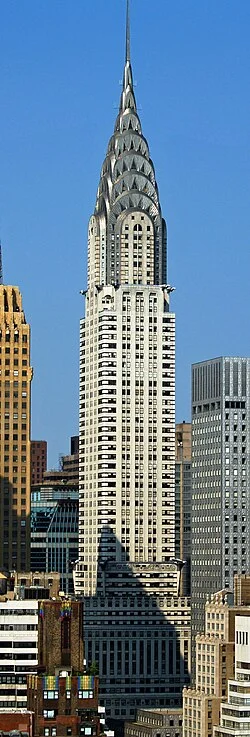
Chrysler Building: the engineering behind 77 floors of calculated audacity
A technically grounded case study of the 1929–1930 Chrysler Building: how the 1916 NYC Zoning Resolution mandated its stepped form, how self-climbing guy derricks pioneered the modern tower crane, how Nirosta austenitic stainless steel made its compound-curved crown possible, and how a 27-ton secret spire was raised in 90 minutes to steal the world's tallest-building title — all with zero steel-erection fatalities.
Image from William Van Alen — Wikipedia
On the morning of October 24, 1929, New Yorkers opened their newspapers and learned two things: an unknown silver needle had appeared overnight at the top of a midtown skyscraper, making it the tallest structure on earth — and the stock market had just collapsed. The Chrysler Building had won a race nobody was certain it was even running, then watched the world it was built for disappear in 24 hours.
The building's story is usually told as architecture — the eagle gargoyles, the sunburst crown, the hubcap friezes. But underneath the Art Deco surface is an engineering record that deserves equal attention. In 1929, every floor above the Woolworth Building's 792 ft (241 m) was genuinely unknown territory. 1 Nobody had built a structure that tall. Nobody had assembled a compound-curved stainless steel crown at altitude. Nobody had operated self-climbing derricks on a site this cramped for a load this heavy. The engineers and ironworkers improvised every one of these solutions under production pressure, and several of those improvisations are still in use today.
The brief — and the complication built into the plot
Walter P. Chrysler purchased the project in October 1928 from developer William H. Reynolds for more than $2.5 million. 1 His goal was personal: build the world's tallest structure as a monument to his own industrial success, not to the Chrysler Corporation (he financed the entire $20 million construction cost from his own pocket, not through the company). The architect he inherited with the project was William Van Alen.
Van Alen and his former business partner H. Craig Severance had parted ways in 1924 after thirteen years together. 2 By 1929 Severance was designing 40 Wall Street on behalf of the Manhattan Company, and both men knew they were competing for the same record. This was not metaphor — it was operational intelligence. Severance had informants watching the Chrysler Building's construction progress. Van Alen withheld the spire from all public filings until the last possible moment. The race shaped every engineering decision about height, speed, and secrecy.
The site added its own geometric constraint. The Chrysler Building sits on a trapezoidal plot at 405 Lexington Avenue because its eastern wall follows the path of the old Boston Post Road — a colonial-era route that predates the 1811 Manhattan street grid. 1 That irregularity forced the structural grid to accommodate a non-rectangular floor plate from the foundation upward, a constraint that complicated column placement and steel delivery logistics throughout.
The 1916 zoning law that sculpted the silhouette
The Chrysler Building's tiered, stepped form — the feature that makes it instantly recognizable — was not a stylistic choice. It was mandated by law. 3
The 1916 New York City Zoning Resolution, the first citywide zoning code in the United States, was enacted primarily to prevent tall buildings from blocking light and air from reaching street level. It imposed no absolute height cap, but it required towers to step back from the street as they rose, with the permitted setback proportional to the width of the adjacent street. Towers could continue above the setback lines only if confined to 25% of the lot area. 3 The resolution's chief authors were George McAneny and Edward M. Bassett.
The practical consequence was a building shaped by arithmetic rather than aesthetics. Each step in the Chrysler Building's profile marks a height at which Van Alen was legally required to pull the floor plate inward before continuing upward. As Eric Peter Nash and Norman McGrath wrote in Manhattan Skyscrapers: "By the end of the 1920s the setback skyscraper, originally built in response to a New York zoning code, became a style that caught on from Chicago to Shanghai." 3
For the structural engineering team at Ralph Squire and Sons, each setback was also a mechanical headache. The self-climbing derricks riding the rising steelwork had to be dismantled entirely at the setback floors — the cantilevered platforms they relied on could not be maintained across a face that was retreating from the street. 1 The zoning law that gave the building its shape also forced the construction sequencing into repeated equipment teardowns at the worst possible moments.
Foundation: 69 feet to bedrock through quicksand
Construction began in November 1928 under general contractor Fred T. Ley & Company of Springfield, Massachusetts. The foundation crews had a specific mandate: reach Manhattan bedrock before the steel crews arrived.
The excavation removed 105 million pounds of rock and 36 million pounds of soil, reaching a depth of 69 ft (21 m) below street level — deeper than the Empire State Building's eventual foundation at 55 ft, because the geology at 405 Lexington was softer near the surface, with layers of fill and quicksand between the street and the Manhattan Schist below. 1 The combined excavated mass equalled roughly 63% of the completed building's total weight — a figure that illustrates how much of a tall building's engineering story happens underground.
Timber-lined caissons carried the loads from the surface to bedrock, providing a stable bearing surface for the column bases before a single piece of structural steel had been ordered. The excavated material and the caisson concrete together amounted to a construction project that would have dominated headlines in any other context. By March 1929 it was merely the precondition for the work that would actually define the building.
The steel frame: 20,961 tons and four floors a week
The first structural steel beam was erected on March 27, 1929. Carnegie Steel Company of Pittsburgh supplied all 20,961 tons of structural steel, shipped by rail to New Jersey yards and then transferred to trucks for cross-Hudson delivery. 1 Steel erection was led by Post & McCord, a division of American Bridge Company — the same firm that would take its derricks, crews, and procedures directly from the Chrysler Building to the Empire State Building the following year. Post & McCord's 1933 trade advertisement listed its three most prominent completed projects as simply: "Empire State, Rockefeller, Chrysler." 1
At peak, the frame rose at 4 floors per week — slightly behind the Empire State Building's later rate of 4.5 floors per week, but the Empire State team had the Chrysler Building's procedures to learn from. 1 From the first beam to structural completion at 77 stories took approximately six months. The structural steel was finished by September 1929, just two months before the spire raise.
The midtown site was cramped enough that no steel could be staged on the ground. Trucks arrived on Lexington Avenue on a strict timed schedule — early arrivals waited at the curb; late ones meant the derrick crews above sat idle. Every piece of steel went from truck to derrick to final position in a single lift.
Self-climbing guy derricks: 1929's tower crane
No tower cranes existed in 1929. Hans Liebherr would not invent the first commercially practical tower crane until 1949. 1 Post & McCord's solution was the guy derrick: a vertical latticed steel mast held plumb by six or more wire rope guys anchored to the building's own steelwork, with a boom that could swing loads around it. Two types were deployed: relay derricks with 75-ft booms and 82-ft masts on cantilevered platforms to move steel from street level to the upper zones, and erecting derricks in 20-ton and 30-ton rated versions that climbed with the rising frame.
The most consequential mechanical feature of those derricks was their self-climbing procedure. Every two floors — roughly one week of work — each derrick had to jump itself to the new elevation. The sequence: detach the boom, use it to lift the mast, reposition the mast on timber cribbing at the new level, re-anchor all six guys to the building steelwork at the new height. The full procedure took roughly half a day per derrick. To avoid leaving the site without lifting capacity, jumps were staggered so two or three derricks remained operational while one jumped. At setback floors, the corner derricks were dismantled entirely and rebuilt from scratch at the new setback line. 1
The hoisting engines were steam-powered double-drum units, each drum carrying 3,500 ft of cable with band service brakes. The derrick operator worked blind — no sight line to the load — guided entirely by a bell signal system: one bell meant go ahead or stop; two meant slack off the cable; three quick bells meant lower fast; six bells meant all-stop. 1 Popular Science Monthly published detailed diagrams of the self-climbing procedure in August 1930, documenting for the public a technique that was, at that moment, the state of the art in high-rise construction — and the direct ancestor of the modern tower crane climbing frame.
391,881 rivets
The structural connections at every joint were made by hot-driven rivets, not bolts. Each rivet was heated to approximately 1,800°F in a portable coke forge on the working floor, then thrown through open air — sometimes more than 50 ft — by a tosser using tongs. A catcher, standing at the joint, caught it in a tin can. A bucker-up held a dolly against the back of the rivet while a fourth worker hammered the head with a pneumatic hammer at 90 psi. 1 The four-person gang — heater, tosser, catcher, and hammer man — worked in coordination through the full sequence of the rivet cooling from red-hot to set, a window of perhaps 30 seconds.
A period newspaper described the throwing arc: "Spitting out sparks and fairly alive with heat, it sails with the curve of a comet's tail into a tin bucket. The pitcher puts it over the plate every time, and the catcher folds it in the tin mitt without fail." 1
The building consumed 391,881 rivets in total. 1 Among the riveting gangs working at heights over 1,000 ft were Mohawk ironworkers from the Kahnawake reserve near Montreal — the Kahnawà:ke Skywalkers, who had been working high steel since the construction of the Victoria Bridge over the St. Lawrence in 1886. They spoke Kanien'kéha on the job and moved on from the Chrysler Building to the Empire State Building and Rockefeller Center.
The brickwork between the steel bays required equally methodical logistics. Van Alen filed US Patent 1,794,809 on September 18, 1929 for a Z-shaped non-corrosive metal window sill designed to protect mortar joints against water infiltration — a detail that became relevant when the final count of 3,826,000 hand-laid bricks was tallied. 1
Nirosta stainless steel: the first architectural use of an industrial alloy
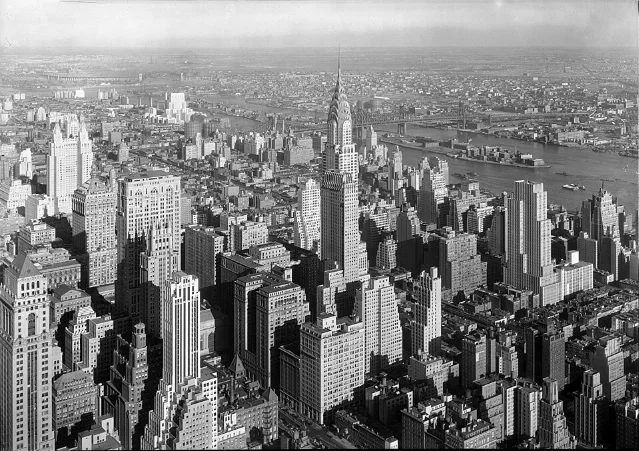
Image from 1916 Zoning Resolution — Wikipedia
The crown of the Chrysler Building is more than the building's most recognizable visual feature. It is the first time austenitic stainless steel was used as an architectural cladding material anywhere in the world. 1
The steel was Krupp's Nirosta — a German acronym for Nichtrostender Stahl, non-rusting steel — marketed in the United States under the commercial name Enduro KA2. The alloy is 18% chromium and 8% nickel, rolled into 22-gauge sheet. The foundational patents were filed on October 18, 1912, by physicist Benno Strauss and metallurgist Dr. Eduard Maurer at Friedrich Krupp's laboratories in Essen, Germany. 1 The Chrysler Building's crown is the alloy's debut in the built environment — a material transition from Krupp's industrial and cutlery markets into permanent architecture.
The fabrication problem no template could solve
Approximately 12,500 stainless steel panels clad the crown, spire, and ornamental elements. 1 The fabrication challenge was not the alloy itself — it was the geometry it had to cover.
The crown's seven radiating terraced arches curve in compound dimensions: they curve in plan, they curve in elevation, and the curvature changes at each tier. There is no simple template that captures this geometry at ground level and transfers it accurately to metal panels that must fit flush at 900 ft. Standard fabrication practice — measure the skeleton, build templates at grade, cut panels to templates in a remote shop — breaks down when the skeleton itself can only be fully described once it exists in three dimensions in the air.
Van Alen's solution was to bring the fabrication to the building. Two complete metalworking shops were built inside the rising structure at the 67th and 75th floors. Workers measured the curved skeleton directly in the field, then hand-fabricated each panel to match. As historian David Stravitz wrote, the crown was "virtually sculpted by hand" — every cut of the stainless steel was done by a craftsman who had just measured the surface it was meant to cover. 1
A 90-year durability record
The material choice turned out to be extraordinarily durable. The American Society for Testing and Materials (ASTM) created a dedicated inspection committee in 1929 to monitor the Nirosta panels, examining them on a five-year cycle until 1960. The committee disbanded not because the panels had failed, but because they showed "virtually no deterioration." 1 The crown was not manually cleaned until 1961 — more than thirty years after installation.
The eight eagle gargoyles at the 61st floor, standing approximately 20 ft tall including their pedestals and inspired by the 1929 Chrysler Plymouth hood ornament, were designed by Chesley Bonestell — later known as the "father of space art" for his planetary paintings. 1 They are fabricated from Nirosta and double as functional lightning rods — a practical engineering detail embedded inside the building's most theatrical visual element.
The B1M's 2026 analysis of the building's current condition confirmed the Nirosta's track record holds. While the building is suffering significant physical degradation — leaking spire, corroded water pipes, failing single-pane 1930s steel windows, worn electrical systems — the stainless steel crown itself remains structurally sound after 95 years of Manhattan weather. 4
The spire: 185 feet assembled in secret, raised in 90 minutes
The race for the world's height record was decided by an act of deliberate deception — and a derrick loaded beyond its rated capacity.
By mid-1929, Van Alen and Walter Chrysler knew that 40 Wall Street was tracking their progress. H. Craig Severance had adjusted his design upward to 927 ft specifically to beat whatever Chrysler was planning. Van Alen's counter-strategy was to file no public document that revealed the true final height of the building, and to prepare a secret weapon.
The weapon was a 185-ft (56.4 m) spire weighing 27 tons. It was fabricated offsite — by a bridge-building company whose identity was never publicly disclosed — in five interlocking sections, then quietly delivered by truck to the building and smuggled inside. 1 Workers assembled all five sections vertically inside the fire tower court, spanning the 65th through 71st floors, over a period of weeks. No announcements. No press. Severance had no idea.
Van Alen later described the reasoning in the Architectural Forum of October 1930:
"It was manifestly impossible to assemble this structure and hoist it as a unit from the ground, and equally impossible to hoist it in sections — and besides, it would be more spectacular for publicity value to have this cloud-piercing needle appear unexpectedly."1
The engineering problem: a 27-ton load on a 20-ton derrick
On October 23, 1929, a single erecting derrick on the 74th floor was tasked with hoisting the assembled spire through the roof opening. The derrick was rated for 20 tons. The spire weighed 27 tons. 1
The engineering team solved the overage problem with geometry. A derrick's rated capacity assumes a standard boom angle. By changing the angle of the boom — pressing it against the crown arches via an outrigger platform for extra bracing — the mechanical advantage at the hook changes. The workers calculated that at the right boom angle, the geometry might just hold the 35% overload. There was no computer model. There was no second chance. If the derrick failed, the spire fell back into the building.
The operation took 90 minutes. Author Neil Bascomb later wrote that raising a 27-ton spike from inside a skyscraper onto its own peak was a project of such difficulty that "balancing an elephant by his trunk on top of the building would have been an easier proposition." 1 After the spire cleared the roof opening and was lowered into its seat, a worker climbed the lattice structure with a surveyor's level to confirm the spire was plumb. It was.
The Chrysler Building now stood at 1,046 ft (319 m) — the tallest structure ever built by human hands. Severance and his team learned from newspaper headlines, having held a public celebration weeks earlier after reaching their final height, convinced they had won. The following morning, the U.S. stock market crashed.
The spire's interior, visible to the small number of people who have accessed it over the years, is industrial reinforced concrete — not the polished metal the exterior implies. As author Moses Gates noted: "You think of the Chrysler Building as Art Deco, shiny, chrome, metal. You get inside and it is all reinforced concrete." 4
The building held the world's tallest title for 11 months, until the Empire State Building surpassed it at 1,250 ft in April 1931 — using Post & McCord's same crews and equipment, transferred directly from the Chrysler project.
Safety: zero fatalities in 20 months of high-steel work
The construction record that may be most remarkable in context is not the height or the speed — it is the safety outcome.
Zero worker fatalities occurred during the structural steel erection phase. 1 Three thousand men worked for twenty months at elevations up to 1,046 ft, without harnesses and without hard hats — hard hats would not become standard on U.S. construction sites until the late 1930s. They walked bare steel beams 8 inches wide hundreds of feet above Lexington Avenue. They caught red-hot rivets thrown through open air. They rode derrick loads rather than climb seventy flights of ladders.
The context makes the figure meaningful. For comparison: the Empire State Building, built immediately afterward with many of the same Post & McCord crews, recorded 5 official deaths. The Brooklyn Bridge killed more than 27 workers. Hoover Dam killed 96. The Golden Gate Bridge killed 11. 1
Walter Chrysler personally financed a set of safety measures that were ahead of their time in 1929:
- Protective fencing around the entire site perimeter
- Steel netting strung between floors to catch falling workers or tools — not standard practice at the time
- Tubular framed scaffolding replacing improvised plank walkways
- A site telephone network connecting foremen at each elevation to ground supervisors
- An on-site medical facility with trained first aid personnel
Walter Chrysler himself stated that this was "the first time any structure in the world had reached such a height, yet the entire steel construction was accomplished without loss of life." 1 Some historians note that the claim likely covers the steel erection phase only, not foundation work or interior finishing — but even with that qualification, the record holds against every comparable project of the era.
The building opened on May 27, 1930, exactly twenty months after groundbreaking.
Key specifications
| Parameter | Value |
|---|---|
| Height to spire tip | 1,046 ft (319 m) |
| Height to roof | 925 ft (282 m) |
| Floors | 77 |
| Structural steel | 20,961 tons (Carnegie Steel) |
| Rivets | 391,881 |
| Bricks | 3,826,000 |
| Foundation depth | 69 ft (21 m) below street to bedrock |
| Excavated material | 141 million lb (rock + soil) |
| Crown cladding panels | ~12,500 Nirosta stainless steel |
| Nirosta alloy | 18% Cr, 8% Ni, 22-gauge sheet |
| Steel erection rate (peak) | 4 floors/week |
| Steel erection duration | ~6 months (March–September 1929) |
| Spire | 185 ft (56.4 m), 27 tons, raised in 90 min |
| Elevators | 32 units (4 banks of 8, Otis Elevator) |
| Construction cost | $20 million (Walter Chrysler personal funds) |
| Total construction time | 20 months |
| General contractor | Fred T. Ley & Company |
| Structural engineer | Ralph Squire and Sons |
| Steel erector | Post & McCord (American Bridge Company) |
The over-engineering paradox and its 2026 consequences
The early skyscrapers were built by engineers who had no prior structures to calibrate against. Every assumption about steel member sizing, connection redundancy, and cladding durability had to be conservative, because failure in an uncharted domain was both possible and catastrophic. The Chrysler Building's structural engineers loaded their safety factors accordingly.
Ninety-five years later, that conservatism looks like both legacy and liability. The B1M's May 2026 analysis, which drew 1.4 million views in two weeks, argues that the same over-engineering that makes the building nearly indestructible also makes it nearly impossible to remediate economically. 4 The steel frame that carried 1929 loads without distress will carry 2026 loads equally well — but cutting through it to install modern HVAC, plumbing, and electrical infrastructure is an order of magnitude more expensive than the equivalent work in a post-1960 building.
Real estate analyst Hiten Samtani, speaking in the B1M video, summarized the commercial situation: "This is a great building, but it also needs a lot of love. Like it needs a lot of work to be brought into the 21st century so that it can compete for A-plus tenants." He put the estimated remediation cost at $150–200 million — covering the leaking spire, the single-pane 1930s steel windows (which admit air freely and have near-zero thermal insulation), the corroded water supply lines, and the substandard electrical systems. 4 The Nirosta crown, notably, is not on that list.
The ownership structure compounds the problem. The building and its land are held by separate entities. Cooper Union, the private college established in 1859, has owned the land since 1902. Ground rent to Cooper Union is currently $32.5 million per year, rising to $41 million in 2028 and $55 million in 2038. 4 The building itself — despite its National Historic Landmark status, which qualifies it for neither government funding nor tax relief under current U.S. preservation rules — has been listed for sale three times since 2019 and has seen its estimated valuation fall from $800 million to approximately $150 million. 4 Current vacancy sits at 14 to 20 percent.
The building's deterioration is specific: brown water from corroding pipes, elevator failures, gaps around 1930s-era rotating doors, tape-patched lobby ceilings, and a spire that leaks in rain. None of these are structural failures. They are all system-level failures in building services that were installed before World War II and have outlasted their design lives by several decades. The Nirosta crown has no leaks. The riveted steel frame has not moved. The concrete caissons bearing on Manhattan Schist 69 ft below Lexington Avenue are performing exactly as designed, nearly a century later.
Legacy: what the Chrysler Building changed
The derrick becomes a crane
The self-climbing guy derrick procedure that Post & McCord perfected on the Chrysler Building transferred directly to the Empire State Building, Rockefeller Center, and eventually to every major steel-frame high-rise in New York through the 1940s. The fundamental concept — a mast that uses its own boom to reposition itself to the next elevation — is the structural ancestor of the modern hydraulic tower crane climbing frame. 1 Every time a tower crane climbs a few floors during a high-rise construction project, it executes a variation on the procedure that Post & McCord documented in 1929.
Stainless steel enters architecture
The Chrysler Building's crown established austenitic stainless steel as a viable architectural cladding. The alloy's performance on the crown — zero measurable corrosion after 30 years, confirmed by ASTM inspection — gave architects and building engineers the data they needed to specify it on subsequent projects. 1 The Chrysler Building is the proof-of-concept that convinced the profession that stainless steel could survive an outdoor urban environment without maintenance intervention.
Field fabrication of compound surfaces
The technique Van Alen's team used on the crown — setting up fabrication shops inside the building at the working floor, measuring the curved skeleton directly, and cutting each panel to fit — was a direct response to the impossibility of templating compound curves at ground level. This same logic appears in subsequent projects wherever complex geometry had to be executed in metal at elevation: it is cheaper and more accurate to bring the workshop to the work than to transpose measurements across a curved surface from grade. 1
The setback form becomes a global vocabulary
The 1916 Zoning Resolution was a local New York ordinance. The Chrysler Building, and the skyscrapers built in the same period, translated that ordinance into a visual language that spread internationally — the stepped profile, the setback cornice, the tower rising from a broad base to a narrow crown. Nash and McGrath's observation that it "caught on from Chicago to Shanghai" understates the actual reach: the setback silhouette appeared in cities that had no legal requirement for it, purely because architects found the form persuasive. 3
A cautionary career arc
The legacy includes a human casualty. William Van Alen never built another major structure. He had failed to execute a formal written contract with Walter Chrysler — an oversight that proved fatal to the professional relationship. After the building was complete, Chrysler refused to pay the standard 6% architect's fee, which amounted to approximately $840,000, and publicly accused Van Alen of having improper financial arrangements with subcontractors. 2 Van Alen sued and won in court, but the public association with financial impropriety destroyed his reputation in the profession. He received no significant commission after 1930 and died in 1954.
His last public celebration of his building came on January 23, 1931, at the Society of Beaux-Arts Architects Ball, where he attended dressed as the Chrysler Building itself — a crown of sunbursts and a metallic cloak. It is the kind of gesture that, in retrospect, reads as both triumph and farewell. 2
What the building actually proves
The Chrysler Building is often described as a monument to ambition — to Walter Chrysler's wealth, to the 1920s belief that taller always meant better, to the kind of ego that disguises a spire inside a skyscraper to keep a secret from a rival architect. All of that is true.
It is also a monument to the engineering discipline of working in uncharted territory. Every major decision on the project — the derrick jumping procedure, the field fabrication shops, the overloaded spire lift, the in-situ Nirosta panel cutting — was a response to a problem that had no prior solution because no one had built this high before. The engineers who worked on it had to invent procedures they would never need again, because the next generation of engineers working on the Empire State Building, Rockefeller Center, and what followed inherited the answers.
The building has been financially distressed since 2019, physically deteriorating for longer, and structurally sound for 95 years. Those three facts are consistent with each other. The 1929 engineers solved their problem completely. The problem they solved just happens to be the smallest part of what a skyscraper needs to be in 2026.
Cover image: Chrysler Building, full-height photograph. Image from William Van Alen — Wikipedia
このコンテンツについて、さらに観点や背景を補足しましょう。