AI Product Updates Daily — June 11, 2026

AI Product Updates Daily — June 11, 2026

Anthropic publishes data showing Claude writes over 80% of its own codebase and lays out a path toward recursive self-improvement. Google cuts AI Plus to $4.99 with 400GB storage, completing a full subscription restructure. Apple's WWDC 2026 delivers a rebuilt Siri on Gemini, iOS 27, and Tim Cook's final keynote. TensorWave closes a $350M AMD-backed Series B, and the UK launches a £500M Sovereign AI venture fund.

AI Product Updates Daily
2026/6/11 · 8:19
購読 4 件 · コンテンツ 22 件

Today's snapshot

Three separate forces shaped June 11: Anthropic published hard data showing Claude already writes more than 80% of its own codebase and is pushing toward recursive self-improvement; Apple's WWDC 2026 developer session delivered a rebuilt Siri and iOS 27 with Gemini at the core; and Google cut its AI Plus subscription from $7.99 to $4.99 while doubling storage, completing a full pricing restructure that also swept through AI Ultra and AI Pro. On the infrastructure side, AMD-backed TensorWave closed a $350M Series B, and the UK government launched a £500M Sovereign AI venture fund.

Anthropic: when AI builds itself

Anthropic published a detailed research report today from the Anthropic Institute laying out what it calls progress toward recursive self-improvement — the point where an AI system designs and trains its own successor. 1
The data are specific:
  • As of May 2026, more than 80% of the code merged into Anthropic's codebase was authored by Claude — up from low single digits before Claude Code launched in February 2025.
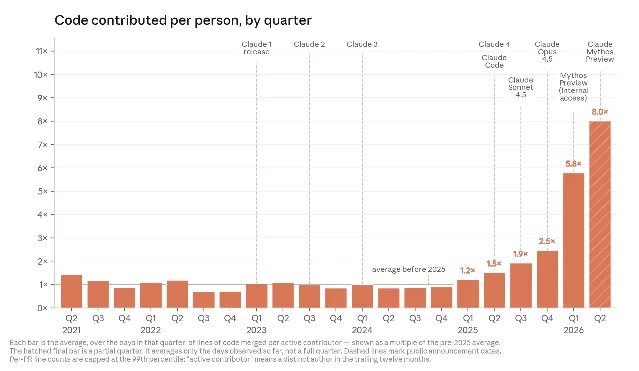
  • Engineers on average shipped 8× as much code per day in Q2 2026 as they did in 2024.
  • On the hardest open-ended tasks in Claude Code sessions, Claude's success rate hit 76% in May 2026, up 50 percentage points in six months.
  • In a focused ML-optimization experiment, Claude Mythos Preview reached a 52× speedup over baseline code by April 2026 — where a skilled human researcher would reach 4× in four to eight hours.
The report also covers Claude's improving research judgment: when researchers were shown decision forks from real Anthropic sessions and asked what to do next, Claude Mythos Preview chose the better path 64% of the time versus the human's choice (up from 51% in November 2025 with Opus 4.5).
Bar chart showing Claude Code per-engineer daily code output rising steeply from Q1 2025 through Q2 2026, with annotated inflection points at Claude Code launch and autonomous long-horizon mode
Code per engineer per quarter at Anthropic, Q2 2021–Q2 2026 1
Anthropic frames three possible futures: the trend stalls (unlikely given measured trajectories); AI labs keep compounding efficiency while humans set direction; or full recursive self-improvement where the pace of AI development is set entirely by compute availability. The report does not predict which path is certain but treats the third as sufficiently plausible to demand preparation now. It also notes that Claude Mythos Preview can already work for at least 16 hours continuously on open-ended tasks — beyond what METR's existing benchmarks can measure.
Why it matters for practitioners: Anthropic's 800+ API error fixes — where Claude compressed what an engineer estimated as four years of work into a single session — point to a near-term shift in how AI tooling gets maintained. Teams building on Anthropic APIs should track Claude Opus 4.8 and Fable 5 model behavior more closely, since the underlying codebase is changing faster than before.

Claude Fable 5 vs. Opus 4.8: the two-tier model landscape

統計カードを読み込んでいます…
Since Claude Fable 5 launched on June 9, Anthropic's model lineup is now a four-rung ladder: Haiku → Sonnet → Opus → Mythos. Fable 5 is the first publicly accessible Mythos-class model. 2
BenchmarkFable 5Opus 4.8
SWE-Bench Pro (agentic coding)80.3%69.2%
FrontierCode Diamond (hard coding)29.3%13.4%
Blueprint Bench 2 (spatial reasoning)38.6%14.5%
OSWorld-Verified (computer use)85.0%83.4%
Pricing is exactly double: $10 input / $50 output per million tokens for Fable 5 versus $5/$25 for Opus 4.8. The benchmark gaps are widest on the hardest, longest tasks — FrontierCode Diamond is more than double — which means routing strategy matters. Fable 5 includes a built-in safety layer that automatically falls back to Opus 4.8 when a request touches cybersecurity, biology, or chemistry; callers routing those domains to Opus 4.8 directly avoid paying the Fable 5 rate for an Opus 4.8 response.
One new constraint: Fable 5 enforces mandatory 30-day data retention, which Opus 4.8 does not. Teams with strict data-residency requirements need to account for this before migrating high-sensitivity workloads.

Apple WWDC 2026: Siri AI, iOS 27, and Tim Cook's final keynote

Apple's WWDC 2026 opened June 8 and delivered software updates across all platforms — the AI story ran through all of them. 3 4
Siri AI is the headline. Apple VP of Siri engineering Mike Rockwell described it as rebuilt from scratch, combining Siri with Apple Intelligence and Google Gemini under the hood — the partnership Apple announced earlier this year. The new Siri ships as a standalone app, gains on-screen awareness and personal context, handles multi-step tasks, and integrates Visual Intelligence through the camera. A waitlist is in place; developer beta is live now (roughly 20GB update on iPhone).
Key feature updates shipping in iOS 27, iPadOS 27, and macOS 27:
  • Spatial Reframing — on-device spatial models + facial recognition re-angle your photos after the shot
  • Safari tab grouping — AI organizes open tabs by topic in real time
  • Shortcuts by description — type what you want a Shortcut to do; Siri builds it
  • Proofreading in apps — automatic grammar checking in Slack, Mail, and hundreds more apps
  • Camera ask — press the shutter to ask Siri AI about what the camera sees
  • iOS 27 responsiveness — photos load up to 70% faster; AirDrop transfers 80% faster
  • Liquid Glass slider — users can adjust the transparency level of Apple's design layer
MacOS 27 drops Intel support, requiring Apple M1 or newer. This was Tim Cook's final WWDC; he said the company's CEO role passes to John Ternus in September.
Craig Federighi characterized Apple's current stance on agentic AI as an "exciting experiment" — the architecture is in place, but long-horizon autonomous tasks remain early stage. The distinction from competitors is Apple's reliance on deterministic app intents rather than open-ended agentic prompting.

Google: AI Plus drops to $4.99, storage doubles

チャートを読み込んでいます…
Google cut its AI Plus subscription from $7.99 to $4.99 per month (annual plan: $79.99 → $49.99) and doubled included storage from 200GB to 400GB. 5 Vikas Kansal, Google's Product Lead for Gemini AI subscriptions, announced the changes on June 10; new subscribers see the new price immediately, while existing subscribers get it on their next billing cycle.
What stays in AI Plus: Gemini 3.1 Pro, Deep Research, NotebookLM, Daily Brief, Gemini Omni video generation, 2× usage limits versus the free tier, and a 128K-token context window.
PlanPrevious priceNew priceStorage
AI Plus$7.99/mo$4.99/mo400GB (↑ from 200GB)
AI Ultra$250/mo$200/mo (at Google I/O)unchanged
AI Prounchangedunchanged5TB (upgraded at I/O)
Regional pricing for AI Plus: CAD 7 / GBP 4.50 / EUR 5 / INR 400.
The cut completes a restructuring of Google's entire AI subscription stack that started at Google I/O in May. At that point AI Ultra dropped from $250 to $200 and a new $100 developer tier was added. The AI Plus cut is the final piece. Google is also migrating the consumer Gemini CLI to the Antigravity CLI by June 18, 2026 — free accounts, AI Pro, and AI Ultra subscribers all lose Gemini CLI access on that date. 6

GitLab + Google: Gemini 3.5 in the DevSecOps pipeline

GitLab and Google deepened their AI partnership, with Gemini 3.5 models — including Gemini 3.5 — now available inside GitLab Duo Agent Mode. 7 The integration allows GitLab to offer a fully managed DevSecOps platform with the latest Gemini models handling code review, pipeline analysis, and security scanning in agent mode. This complements the general availability of Gemini 3.5 Flash at Google I/O, and extends AI-assisted coding pipelines beyond stand-alone editors.

Funding: TensorWave's $350M AMD-backed Series B

TensorWave, a Las Vegas-based cloud platform built entirely on AMD hardware, raised $350 million in a Series B co-led by Magnetar Capital and AMD Ventures at a $1.55 billion valuation. 8 Previous participants Maverick Silicon, Nexus Venture Partners, and Western Frontier also participated. Total funding reaches approximately $493 million.
The capital targets expansion of data centers running AMD Instinct MI355X accelerators — positioning TensorWave as the primary hyperscaler-alternative for workloads that specifically need AMD's memory-bandwidth advantages (large mixture-of-experts inference, RLHF training). The round is the largest Series B in Nevada history.
AMD's direct equity participation is notable: it gives AMD a financial stake in a cloud customer building out at scale on Instinct hardware, structurally mirroring NVIDIA's approach of cultivating dependent cloud providers.

Policy: UK launches £500M Sovereign AI fund

The UK Department for Science, Innovation & Technology published its Digital and Technologies Sector Plan year-one update, confirming the launch of Sovereign AI, a £500 million sovereign venture fund specifically for scaling AI companies in the UK. 9 The first equity investment went to Callosum, an AI infrastructure company.
The broader plan covers six frontier technologies: AI, quantum, semiconductors, advanced connectivity, cybersecurity, and engineering biology. Alongside the Sovereign AI fund, the government committed £4 billion through UKRI to these technologies through 2029/30, pledged to train 10 million workers on AI skills by 2030, and confirmed quantum procurement targets (large-scale quantum computers by the early 2030s). The government also says it aims to become the fastest AI adopter in the G7.
UK tech sector companies should check the AI Hardware Plan and Cyber Growth Action Plan published alongside this update for procurement and tax reform details.

In brief

  • Q1 2026 startup funding: AI startups took 57% of all venture capital in Q1 2026 per Fundraise Insider's first quarterly report. AI startups are now reaching Series A and B faster than non-AI counterparts. 10
  • MiMo V2.5 Pro: Xiaomi's MiMo V2.5-Pro hit 1,000 tokens per second — a throughput milestone that puts sub-$100 inference within reach for many API-level use cases.
  • Claude Fable 5 access window: Fable 5 is included in current usage plans through June 22, after which it transitions to standalone API pricing.

このコンテンツについて、さらに観点や背景を補足しましょう。

  • ログインするとコメントできます。