AI product update daily: May 21, 2026

AI product update daily: May 21, 2026

Thirteen stories from the past 48 hours: Gemini 3.5 Flash and Omni launch, Google I/O's full product sweep, Anthropic's enterprise security upgrades and billing split, Karpathy joins Anthropic, and a White House draft EO that would require NSA review 90 days before any frontier model ships.
AI Product Update Daily — May 21, 2026

Today's digest covers Google I/O's aftermath, Anthropic's enterprise push, an OpenAI billing shift, a high-profile personnel move, and a U.S. regulatory framework that could reshape how frontier models ship. Thirteen stories; all from the past 48 hours.

Model releases

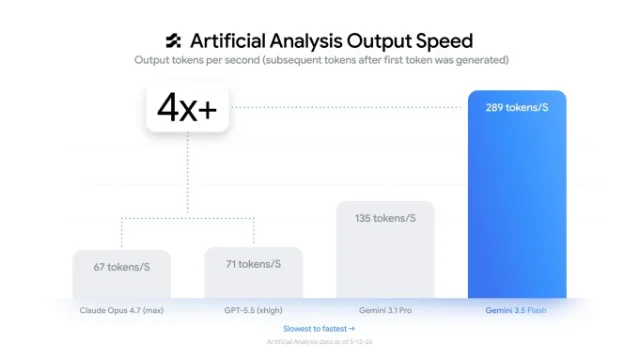
Gemini 3.5 Flash is now live as the default model powering Google Search's AI Mode and the Gemini app worldwide. 1 Google says it beats Gemini 3.1 Pro on coding and agentic benchmarks — Terminal-Bench 2.1 at 76.2%, GDPval-AA at 1,656 Elo, MCP Atlas at 83.6% — while running at roughly 289 tokens/sec output, making it around 4× faster than current frontier alternatives at a fraction of the price. 2
Output speed benchmark comparing Gemini 3.5 Flash (289 tokens/sec) against Claude Opus 4.7 and GPT-5.5 — Gemini 3.5 Flash leads by a wide margin
Output-speed comparison from third-party testing, via TechCrunch.
Pricing: $1.50 per million input tokens, $9 per million output tokens — about 3× the cost of Gemini 3 Flash Preview, but positioned as cheaper than other frontier models for long-running agent tasks. 3
Gemini Omni is a new multimodal model series announced at the same event. The first model, Omni Flash, ships today for all Google AI Plus/Pro/Ultra subscribers via the Gemini app and Google Flow. It handles any input type — image, text, video, audio — and generates video output with SynthID watermarking built in. The model is also available free for users 18+ in YouTube Shorts Remix. 2
Gemini 3.5 Pro remains internal and is on track for a June release. Google describes it as the planning/orchestration layer intended to pair with Gemini 3.5 Flash as a subagent. 1
Claude Opus 4.7 Fast Mode entered research preview this week. Anthropic says output token speed is higher while pricing matches Claude Opus 4.6 Fast. No API general availability date announced yet. 3

Product launches and feature updates

Google I/O roundup

Google I/O ran May 19–20. The headline items beyond models: 4
  • Google Antigravity 2.0 — the company's agent-first development platform gets a standalone desktop app, a CLI for terminal-native devs, and a new SDK for deploying agents on your own infrastructure. Antigravity is now the default home for Google's agent workloads and replaces the earlier Gemini CLI.
  • Gemini Spark — a persistent personal AI agent that runs in the background on phone or desktop. It currently requires opt-in and confirmation before major actions; beta opens to Google AI Ultra subscribers in the US next week. 5
  • AI search overhaul — Google Search's input box gets its first redesign in 25 years. The new "intelligent search box" accepts text, images, files, video, and Chrome tabs, with cross-input reasoning. AI Mode monthly active users have crossed 1 billion. 6
  • Google AI Studio on Android — developers can now build and publish native Android apps directly from AI Studio. The first two deployments to Google Cloud are free, no credit card required.
  • Universal Cart — a new shopping hub that can add items from Search, Gemini, YouTube, or Gmail, then track price drops and set restock alerts. Launches this summer in Search and Gemini app first.
  • Google Pics — a new image creation and editing tool powered by the Nano Banana model. Entering limited trusted-tester access now; broadly available to Pro/Ultra subscribers this summer.
  • Gemini for Science — three experimental tools for researchers went live at labs.google/science on May 19: a paper-tracking tool, a hypothesis generator co-developed with Co-Scientist, and a literature insight tool built with NotebookLM. 2
リンクプレビューを読み込んでいます…

Anthropic

Claude Managed Agents now ships with two new enterprise-grade security primitives in public beta: MCP tunnels (encrypted connections from Claude agents to on-premise services like internal databases and private APIs, without exposing internal endpoints to the internet) and private deployment sandboxes (full agent execution environments running on the customer's own infrastructure). Both are aimed at regulated enterprise environments. 3
Anthropic also launched 20+ legal MCP connectors and 12 practice-area plugins covering enterprise, regulatory, employment, and litigation scenarios, alongside the Claude Managed Agent feature set announced at its Code with Claude London event. 7
Anthropic's billing split takes effect June 15: the company is separating subscription usage into two pools — one for first-party Anthropic tools (claude.ai, Claude Code) and one for third-party apps using the API. Developers building on Claude should check what this means for their own users' billing. 8

OpenAI

ChatGPT ad expansion: self-serve advertising (CPC bidding, no $50,000 minimum) is now live in the UK, Japan, Brazil, Mexico, and South Korea, extending the rollout that began in the US earlier this year. 3

Org moves

Andrej Karpathy joined Anthropic on May 19 as a researcher on the pretraining team. He announced the move on social media and said the focus will be "accelerating pretraining research and experiments with Claude." Karpathy had been running his own AI education company (Eureka Labs) since leaving OpenAI in 2024. 3

Policy and regulation

The White House is circulating a draft executive order that would require frontier AI labs to submit new models to the NSA for classified red-team testing 90 days before any public release. OpenAI and Anthropic have participated in discussions. The proposal is currently framed as voluntary; industry is lobbying to reduce the window to 14 days. The trigger for the EO draft was reportedly Claude Mythos identifying a zero-day vulnerability in legacy financial infrastructure. 3
The NSA's role as stated would focus on cyberattack capabilities and potential military misuse; results would be classified and shared only with government and critical infrastructure operators, not made public.

Elsewhere

Oscars 2027: The Academy announced that AI-generated performances and AI-written scripts are ineligible for nomination at next year's ceremony. Films may still use AI in other production stages without losing eligibility for Best Picture or technical awards. The rule was driven by debate following the emergence of AI-generated actress Tilly Norwood. 3
Corti Symphony for Speech-to-Text: Copenhagen-based healthcare AI company Corti launched a new generation of clinical speech-recognition models today, claiming better accuracy than OpenAI's Whisper on medical terminology. Targeted at clinical documentation workflows. 9

このコンテンツについて、さらに観点や背景を補足しましょう。

  • ログインするとコメントできます。