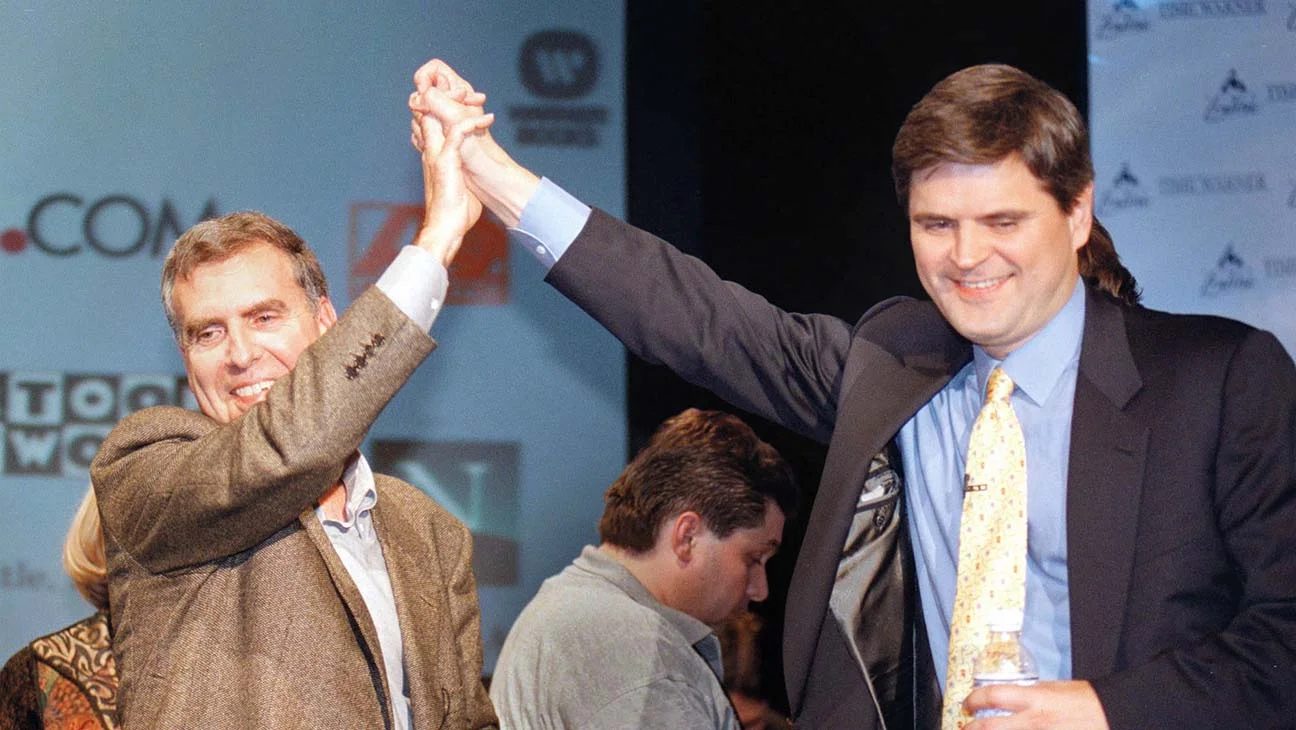
The $165 billion trap: how AOL bought the world's largest media company with casino chips
A business school–style case study of the AOL-Time Warner merger — how Steve Case converted bubble-inflated stock into hard media assets using a $165 billion stock swap, how a single CEO-title concession bypassed Time Warner's board, and how regulatory conditions from three agencies failed to address the human and cultural drivers of a $98.7 billion collapse. Includes four named frameworks for mid-level managers: the funny-currency test, the CEO-chair trap, the synergy promise–integration reality gap, and the due-diligence floor rule.

On January 10, 2000, Steve Case and Gerald Levin stood before cameras in New York and raised their clasped hands above their heads. Behind them, banners bore both companies' logos. In front of them stood reporters, analysts, and Ted Turner — the media tycoon who had already decided to cast his vote in favor. The deal they were announcing was worth $182 billion, making it the largest merger in U.S. corporate history to that point. 1
Within three years, every person in that room who built the deal would be gone. The company they created would report $98.7 billion in losses in a single calendar year — still the largest annual loss in U.S. history. 2 The merger had not failed because of bad luck or an unforeseeable market turn. It had failed at the negotiating table, before a single contract was signed.
This case study dissects how it happened and what mid-level managers can extract from the wreckage.
The asymmetry nobody quantified
By late 1999, AOL and Time Warner operated in what looked like parallel economic universes.
Time Warner was a real business. Its $26.8 billion in annual revenue came from HBO, CNN, Warner Bros. films, Time and People magazines, Warner Music, and the largest cable system in the United States. It employed roughly 70,000 people and had posted a profit of $1.3 billion. 1 AOL was something different. It had $4.8 billion in revenue, 12,000 employees, and earned $762 million — less than the postage budget of a mid-size publisher. 1 It was also, at its 1999 peak, worth $222 billion on paper, trading at roughly 200 times earnings. 3
AOL's management was not deluded about this gap. Steve Case and his advisors privately used the phrase "nuclear winter" to describe what they believed was coming for internet stocks. Eduardo Mestre, the Salomon Smith Barney banker who had helped WorldCom acquire MCI using its own overvalued stock, called AOL's shares "funny currency." 4 The strategic logic, from AOL's side, was simple: convert bubble equity into hard assets before the bubble popped.
| Metric | AOL (1999) | Time Warner (1999) |
|---|---|---|
| Annual revenue | $4.8B | $26.8B |
| Employees | ~12,000 | ~70,000 |
| Net income | $762M | $1.3B |
| Market capitalization | ~$222B (peak) | ~$90B |
| P/E ratio (approx.) | ~200× | ~70× |
Time Warner's position was the mirror image of AOL's anxiety. Jerry Levin watched AOL's market cap surpass Berkshire Hathaway, Disney, and the combined value of McDonald's, Philip Morris, and Pepsi. 3 His own board had produced no credible digital strategy. He felt, by his own admission, like he was falling behind. Roger Martin, then a Rotman School professor, called the announcement "idiotic for Time Warner and doomed to failure" from the moment it was made. 5
The two anxieties were perfectly complementary. AOL needed to spend its funny currency before the market repriced it. Time Warner needed a digital identity before it became irrelevant. Case understood this alignment far better than Levin did.
The negotiation: five weeks from cold call to handshake
The deal did not emerge from a formal process. No investment banker ran a competitive auction. No board committee convened to assess strategic alternatives. It was set in motion by a phone call.
In October 1999, Case rang Levin directly. His opening line, as reconstructed by journalist Nina Munk, was direct: "Jerry? I've been thinking: we should put our two companies together. What do you think? Any interest?" 4 Case mentioned, on that same call, that Levin should be CEO of the combined company. Case would take the chairmanship.
Levin said no.
A few weeks later, they met privately over dinner at the Rihga Royal hotel in midtown Manhattan. By Nina Munk's account, the conversation turned personal — Levin spoke about his son's murder and his subsequent desire to "devote his life to others." 4 A shared language of purpose and values began to form. Case and his team recognized they had found the opening they needed.
In mid-November, Levin told Case "The deal's off. I'm sorry." He could not accept AOL's proposed 65/35 stock split. 4 Between November and late December, AOL's stock rose another 50 percent, adding roughly $60 billion to its market cap while Time Warner's price moved sideways. By late December, Levin agreed to resume talks in Boston. The final structure gave AOL shareholders 55 percent of the combined entity; Time Warner shareholders received 45 percent — despite Time Warner having five times the revenue and more than twice the profit. 1
Negotiations moved at a pace that, in retrospect, should have been a warning in itself. The entire due-diligence process lasted roughly three days. 3 Division heads at Time Warner learned about the deal in the final hours before the public announcement. Salomon Smith Barney and Morgan Stanley each collected $60 million in advisory fees. 3 Their compensation structure gave them no financial interest in slowing down.
Alec Klein, whose book Stealing Time drew on his Washington Post reporting that later triggered DOJ and SEC investigations, wrote that Case's team had spent months mapping Levin's psychology: "Armed with months and months of meticulous research, Case and his advisors knew how to build the perfect trap." 3 Levin later confirmed what that trap was. "If he'd said anything else, there's no fucking way I would have gone ahead," Levin told Munk — referring to Case's offer of the CEO title. 4
AOL Vice-Chairman Kenneth Novack was explicit about the calculation: "We believed that the only basis on which Time Warner would be prepared to do a merger with us was if Jerry was the CEO and it was perceived as a merger of equals." 4 Time Warner's board accepted this framing without stress-testing the economics underneath it.
The regulatory review: three agencies, three problems they couldn't solve
U.S. regulators took nearly a year to decide whether to let the deal proceed. The FTC, which had jurisdiction over the antitrust review (rather than the DOJ), voted 5-0 in December 2000 to approve the merger with conditions. 6 The merger formally closed on January 11, 2001. 7
The FTC's core concern was access. Time Warner owned the second-largest cable infrastructure in the country. AOL was the dominant internet service provider with roughly 30 million dial-up subscribers. Combined, the two could theoretically block rival ISPs from reaching consumers over Time Warner's wires. The consent order required that Earthlink be available to Time Warner cable subscribers before AOL's own broadband service launched, followed by two additional ISPs within 90 days. It included most-favored-nation pricing provisions and non-discrimination rules for content delivery. The order expired after five years. 6
FTC Commissioner Mozelle Thompson voted to approve but attached a notable warning: the behavioral conditions were "an unusually regulatory solution for a merger order" and he doubted they would prevent the combined entity from "discriminating against unaffiliated conduit and content providers." 8 Thompson's preferred tool — structural divestiture — was off the table.
The EU Commission, which approved the deal on October 11, 2000, had a different but related anxiety: the online music market. 9 Time Warner and Bertelsmann together held 30–40 percent of music publishing rights in the European Economic Area. The Commission required Bertelsmann to exit AOL Europe entirely and prohibited AOL from reformatting Time Warner or Bertelsmann music content into proprietary formats playable only on AOL's Winamp software. 9
The FCC, which handled the license transfer, added an instant-messaging interoperability condition: any future "advanced" IM service with video capabilities would need to work with rival platforms. The existing AIM and ICQ text-messaging services were explicitly excluded. 10 FCC Commissioner Michael Powell, dissenting on this point, noted that the Commission was mandating interoperability "for a product that does not as yet exist." He was correct about the absurdity, though the underlying concern — that AOL controlled messaging infrastructure that could become a platform bottleneck — proved prescient a decade later in different form.
All three regulatory bodies acted as if the deal's strategic logic were sound and the risks were structural. None of them could address the problem that would actually destroy the company: the people inside it.
The implosion: six forces that turned a deal into a disaster
The merger closed in January 2001, fourteen months after Nasdaq peaked. By then, AOL's stock had already shed roughly half of the value it had carried on announcement day. The combined company, named AOL Time Warner, started its life with a market cap well below the $350 billion originally projected. What followed was a systematic destruction of value across six dimensions.
Cultural warfare. AOL's employees — fast, digital, informal — occupied the same org chart as Time Warner's — established, rights-protective, hierarchical. The two sides, as one internal assessment summarized, "seemed to hate each other." 11 Concrete examples were not metaphorical: when management mandated that all employees switch to AOL email, Time Warner staff refused en masse. When AOL's business units sought Fortune magazine content from within the same parent company, they were told to pay for it — and the deal collapsed. 11
Synergy illusion. The merger had been sold to shareholders on a promise of 30 percent annual growth and transformative cross-platform integration. Analyst Bill Whyman's post-mortem was direct: "They promised the moon, but almost none of the vision has been delivered to consumers or investors." 11 Business-unit heads refused to share revenue streams, ad sales teams continued to operate separately, and cross-promotion required separate negotiation and additional discounts.
Governance paralysis. The board was split evenly — eight AOL directors, eight Time Warner directors — producing a standoff rather than a governing body. Case and Levin, nominally chairman and CEO of the same company, barely communicated. Levin announced his retirement in December 2001, less than a year after close. 12 Bob Pittman, the AOL-side COO who had been the most forceful advocate for realizing the synergies, resigned in July 2002. 13 Case was pushed out of the chairmanship in January 2003. 12 The architects of the merger had all exited within three years of close.
Technological disruption. AOL's core business — dial-up internet access — was being killed by broadband. Time Warner's own Road Runner cable service was among the products accelerating that death. The FTC's open-access conditions had required AOL Time Warner to let competing ISPs onto its cable network; this meant the company was contractually required to facilitate the shift away from the AOL product it had just paid $165 billion to protect. 6
Accounting fraud. SEC investigators later established that, between mid-2000 and 2002, AOL had inflated its online advertising revenue through "round-trip transactions" — lending money to counterparties who used it to buy advertising they would not otherwise have purchased. 14 AOL also inflated subscriber counts using bulk subscription sales it knew would largely go unactivated. In March 2005, Time Warner (the successor entity) agreed to pay a $300 million civil penalty. 14 SEC Enforcement Director Stephen Cutler noted that "some of the misconduct occurred while the ink on a prior Commission cease-and-desist order was barely dry." 14
The write-downs. In Q1 2002, the company recorded a $54 billion goodwill impairment — then the largest single write-down in U.S. history, triggered in part by new FASB rules requiring annual impairment tests. 15 In Q4, a further $45.5 billion followed. 2 Full-year 2002 net loss: $98.7 billion. David Bahnsen's assessment captures the accounting logic precisely: "The fire was in 2000. The press release about the fire was in 2002." 3
The shareholder class-action settlement reached $2.65 billion in 2006, with Time Warner paying $2.4 billion and auditor Ernst & Young contributing $1 billion. 16 More than 100 institutional investors opted out to pursue larger individual claims. In December 2009, Time Warner completed the spin-off of AOL as an independent company. AOL's market value on its first day of trading: roughly $2.5 billion — about 1.4 percent of the deal's announced value nine years earlier. 13
Frameworks for managers
The wreckage left behind four testable frameworks that translate directly into deal-room practice.
Framework 1: The funny-currency test
Mechanism. In stock-financed acquisitions, the acquirer's shares are the transaction currency. When the acquirer's stock is priced on expectations that management knows are unsustainable — and that the target's board has not independently validated — the deal is not a merger; it is a wealth transfer. The target's shareholders absorb the eventual repricing. Target boards that accept overvalued equity without subjecting it to an independent valuation haircut are giving away their company at a discount.
Illustration. AOL's $222 billion market cap rested on a dial-up subscriber base that broadband would eliminate within three to five years — a timeline AOL's own executives were modeling internally. Time Warner accepted a 45 percent stake in a combined entity whose value was largely AOL's stock price, without commissioning an independent scenario analysis of what that stake would be worth if AOL's subscriber trajectory continued at trend rather than accelerating. By 2002, the 45-percent stake had become 45 percent of something worth a fraction of its 2001 value.
Manager takeaway. Before accepting equity-financed terms, run the acquirer's stock through three stress scenarios: (a) current price maintained for 24 months; (b) a 30 percent correction; (c) a 60 percent correction. Price the deal in each. If the deal only makes strategic sense in scenario (a), it is not a merger — it is a bet on the acquirer's stock maintaining its premium. That bet belongs to the acquirer's shareholders to take, not to the target's board to accept on their behalf.
Framework 2: The CEO-chair trap
Mechanism. When a negotiating counterpart makes a unilateral concession on title or status before discussing economics, treat it as an anchoring move, not a goodwill gesture. Single-concession anchoring works by creating a felt reciprocity pressure — the counterpart who received the concession finds it psychologically harder to hold firm on terms that follow. In M&A, this is particularly dangerous when the concession targets the decision-maker's personal incentives rather than organizational interests.
Illustration. Case identified Levin's core vulnerability — the desire for the CEO title — and offered it before negotiating price, structure, or governance. Kenneth Novack was explicit that this offer was the prerequisite for any deal. 4 Levin's board never formally evaluated whether the economic terms (45 percent for the larger, more profitable company) were fair independent of the personal incentive. The SLU Law review article by Matthew Bodie frames this as a case of shareholder primacy failing in practice — managers making decisions nominally in shareholders' interests that actually serve managerial ego. 3
Manager takeaway. When a counterpart leads with a non-economic concession — title, role, naming rights, announcement optics — explicitly separate that concession from the subsequent economic negotiation. Document the separation. A decision that looks rational after someone has offered you the CEO title often looks less rational when you re-run the economics with a neutral job title in place. Boards should require that any deal approved when the decision-maker has a personal stake in the outcome be independently validated by directors who carry no corresponding personal benefit.
Framework 3: The synergy promise–integration reality gap
Mechanism. M&A synergies require two organizations to change their behavior simultaneously, voluntarily, and in ways that reduce each unit's short-term autonomy. When synergy projections are large and the execution assumptions go unvalidated before signing, the gap between promise and delivery becomes both an operating failure and a trust failure. Once investors stop believing management's forward guidance, the market imposes a discount beyond what the missed numbers alone would justify.
Illustration. AOL Time Warner projected 30 percent annual growth and promised unified advertising, shared infrastructure, and cross-platform distribution. The operating model assumed that Time Warner's cable operators, film studios, music labels, and magazines would actively channel customers toward AOL products, and that AOL's ISP subscribers would become buyers of Time Warner content. Neither side had agreed to this. Time Warner's division heads had not been included in the negotiation and had no incentive to dilute their own P&L performance to support AOL's subscriber metrics. Whyman's "promised the moon" observation was confirmed at the revenue line: 11 growth came in at 13 percent rather than 30.
Manager takeaway. Before finalizing any merger in which synergies exceed 15 percent of the combined deal value, require the synergy model to be stress-tested by the heads of the operating units responsible for delivering them — before the deal is signed. If those unit heads are not willing to be held accountable for the synergy targets in their own performance reviews, the synergy number is a projection on paper, not a commitment. Revise the model accordingly, or revise the price.
Framework 4: The due-diligence floor rule
Mechanism. Due diligence is not primarily a financial exercise; it is a conflict-discovery process. The three categories of risk it reliably surfaces — cultural incompatibility, governance conflict, and undisclosed liabilities — all require time to surface, because they depend on conversations with people below the executive level. Compressing due diligence to satisfy announcement-day urgency removes the only systematic check on deal assumptions before they become deal terms.
Illustration. AOL Time Warner's entire due-diligence process ran approximately three days — compared to an industry baseline of two to four weeks for transactions of this size. 3 No cultural compatibility assessment was conducted. No integration working group was convened before signing. The accounting irregularities that the SEC later identified — round-trip advertising transactions, inflated subscriber counts, improper treatment of the AOL Europe acquisition — were visible in AOL's financials at the time but were not surfaced. 14 Three days of due diligence on a $165 billion acquisition is not due diligence; it is a press-release delay.
Manager takeaway. Set a minimum due-diligence window based on deal size, not on announcement-day pressure. For transactions exceeding $1 billion, the minimum should be four weeks; for deals above $10 billion, eight weeks. Populate the diligence team with division-level operators from both sides — not only financial and legal advisors, whose fee structures reward closing rather than caution. Require a written cultural-fit assessment signed off by HR leadership from both organizations before any board vote.
The verdict
Gerald Levin, speaking to CNBC in 2010, described the merger as "a stunning piece of history" and invited business schools to keep studying it. 12 His invitation has been taken up by HBS (Case 802-098, "Valuing the AOL Time Warner Merger," 2002) 17 and by a generation of M&A practitioners who use the deal as a teaching case in what not to do.
The case's enduring lesson is not "don't merge during bubbles," though that is correct. It is that the negotiation itself contained the failure. Case knew his currency was inflated and used it before it deflated. Levin accepted personal status in exchange for shareholder economics. Two advisory banks collected $120 million in fees with no stake in the outcome. A board approved a $165 billion deal after three days of review. Regulators imposed behavioral conditions that dissolved when the business they were regulating disintegrated. Not a single structural safeguard caught any of it.
The stock peaked at $71 per share when the merger closed in January 2001. By July 2002 it had fallen to $8.70. 2 Ted Turner lost roughly $8 billion — about 80 percent of his wealth. 13 The employees whose retirement accounts held AOL Time Warner stock fared proportionally. In 2018, AT&T acquired what remained of Time Warner for $85.4 billion — a real price for a real company, without the funny currency. 13
Paul Bond at The Hollywood Reporter wrote the most economical post-mortem: "The smartest people on the planet didn't recognize a stock bubble when they saw it." 13 That is probably too generous. Several of them — Case, Mestre, and AOL's bankers — recognized the bubble perfectly well. They just needed someone on the other side of the table who didn't.
Cover image: Steve Case (AOL, right) and Gerald Levin (Time Warner, left) at the merger announcement press conference, January 10, 2000. Photo: Chris Hondros/Newsmakers.
参考ソース
- 1WSWS: AOL buyout of Time Warner
- 2PBS NewsHour: AOL Time Warner Posts Record $99 Billion Annual Loss
- 3The Bahnsen Group: What to Learn from the Worst Business Deal in History
- 4Vanity Fair: The Taking of Time Warner
- 5HBR: How I Knew AOL Time Warner Was Doomed
- 6FTC: FTC Approves AOL/Time Warner Merger with Conditions
- 7FTC: America Online, Inc. and Time Warner Inc. Case Page
- 8FTC: Concurring Statement of Commissioner Mozelle W. Thompson
- 9European Commission: Case COMP/M.1845 — AOL/Time Warner Decision
- 10FCC: America Online-Time Warner Merger Page
- 11PBS NewsHour: Bad Marriage? AOL Time Warner
- 12TIME: Jerry Levin Obituary
- 13The Hollywood Reporter: Hollywood Flashback
- 14SEC: Press Release 2005-38
- 15Los Angeles Times: AOL to Take a $54-Billion Write-Down
- 16Stanford Securities Class Action Clearinghouse: AOL Time Warner
- 17HBS Faculty & Research: Case 802-098
このコンテンツについて、さらに観点や背景を補足しましょう。