
Hantavirus Global Situational Briefing — June 1, 2026
Nebraska's National Quarantine Unit begins dispersal today: two New York passengers return home under continuous health-worker monitoring, while a third stays through June 22. Europe received 1,400 tablets of favipiravir from Japan via EU-Japan cooperation — the first experimental antiviral to reach French, Dutch, and Spanish clinicians. The cluster holds at 13 cases and 3 deaths; France's ECMO patient enters approximately Day 23; MV Hondius is cleared for its June 13 Svalbard restart.

The Nebraska dispersal begins today, closing one chapter of the US quarantine response while another takes shape in state surveillance networks. Europe, meanwhile, moved on two distinct tracks: favipiravir tablets — the only credible experimental antiviral — reached French, Dutch, and Spanish clinicians this week, while the EU launched emergency procurement to build a larger stockpile. The cluster count holds at 13 cases and 3 deaths. Transmission indicators remain stable.
Cluster status at a glance
| Metric | Status as of June 1 |
|---|---|
| Total cases | 13 (11 confirmed, 2 probable) |
| Deaths | 3 |
| Days since last new case | 6 (last confirmed: May 26, Case 13) |
| Countries with cases | 7 |
| Contacts traced globally | 306 across 16 countries |
| WHO transmission assessment | Rt ≈ 0.7 (declining) |
Nebraska dispersal: the mechanism and what comes next
Eighteen US passengers have been housed at the University of Nebraska Medical Center's National Quarantine Unit (NQU) since May 11. Beginning today, June 1, some of them will leave. 3
Two passengers from New York State — one from Orange County, one from Westchester County — will travel home by non-commercial flight. A third New York passenger, based in New York City, chose to remain in Nebraska for the full 42-day period. 4
The monitoring conditions attached to the two returnees are tighter than initial White House proposals suggested. Officials initially pushed for 24/7 law enforcement presence outside passengers' homes; states pushed back on both cost and legal authorization. The revised condition requires continuous health-worker monitoring — daily check-ins by local health officials, residency restrictions, and no contact with others. A formal quarantine order remains in place for at least two passengers; the 42-day incubation window runs from May 11 disembarkation and closes June 22. 5 3
New York Health Commissioner Dr. James McDonald confirmed on May 29: "At this point, it is important to emphasize that there is no immediate risk to the public." 4
Angela Perryman, a US passenger who brought a separate legal challenge to her quarantine conditions, reached her own 42-day endpoint on May 31. Her legal challenge's resolution has not been publicly confirmed.
Three states — Arizona, Georgia, and California — are actively monitoring the returning passengers who were not sent to the NQU. Arizona is monitoring one resident; Georgia two; California's Department of Public Health is coordinating with county-level partners. No illness has been reported in any of the three. 6
Favipiravir reaches European patients
コンテンツカードを読み込んでいます…
The European Commission announced May 28 that emergency shipments of favipiravir — the antiviral the European Medicines Agency identified as the most plausible candidate for compassionate use or clinical trial — had been dispatched to France, Spain, and the Netherlands. 7
The 1,400 tablets came from Fujifilm Pharmaceuticals in Japan, donated and facilitated through the EU-Japan health emergency partnership. EC Commissioner Hadja Lahbib said: "Thanks to close cooperation between the EU, Member States and our Japanese partners, we were able to rapidly secure access to potentially life-saving Hantavirus treatments for European patients." 7
No medicines or vaccines are currently approved for hantavirus treatment or prevention. Individual EU member states will decide how to deploy the tablets — whether as compassionate use for existing patients or as part of clinical trials. In parallel, the Commission launched emergency procurement procedures to secure additional doses if further cases are confirmed. 8
The US already authorized favipiravir access domestically: HHS Secretary Kennedy signed a targeted PREP Act declaration on May 22 covering favipiravir for Andes hantavirus treatment through July 18, 2026 (docket 2026-10539). 2
Patient status: France, Spain, Switzerland, Canada
France: The 65-year-old woman remains on ECMO (extracorporeal membrane oxygenation) at Hôpital Bichat-Claude Bernard in Paris. She has been on ECMO since approximately May 10 — roughly Day 23 as of June 1. The last confirmed status report, from May 28, described "no further deterioration." 9 All 26 of her contacts remain under mandatory hospital isolation; all have tested PCR-negative, with testing occurring three times weekly.
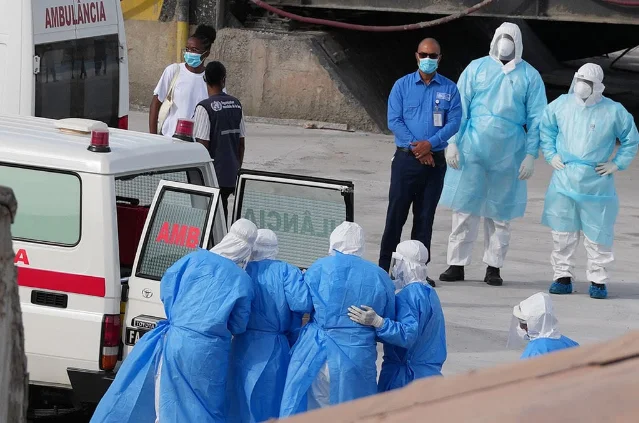
ECMO is a form of advanced life support in which blood is routed externally through a membrane oxygenator — an artificial lung — before being returned to the body. Doctors describe it as a last resort for severe respiratory or cardiac failure. In hantavirus cases with pulmonary syndrome, it buys time for the lungs to recover. Patients are typically sedated throughout. 10
Spain: Two confirmed cases. Case 1 (70-year-old) is in recovery in the UATAN isolation unit. Case 2, confirmed May 25 at Gómez Ulla Military Hospital in Madrid, is asymptomatic. The Spanish protocol requires 28 days of hospital isolation, followed by 14 days at home for patients who test negative and remain asymptomatic; home-phase eligibility for asymptomatic contacts opens around June 7. 2
Switzerland and Canada: Both patients remain hospitalized. No clinical deterioration reported. The Swiss patient's sequence — collected from Case 7 aboard the MV Hondius — showed approximately 98.7% genomic identity with a June 2018 ANDV strain from Neuquén Province, Argentina, confirming natural evolution in the rodent reservoir rather than any recent modification. 2
MV Hondius: cleared and bound for Svalbard
GGD Rotterdam issued its clearance on May 30 after infection control experts completed a final inspection and confirmed that decontamination was effective. The statement read: "From a public health perspective, there are no longer any obstacles to putting the Hondius back to sea." 11

Oceanwide Expeditions expects the ship to resume commercial passenger operations on June 13, bound for Svalbard in the Norwegian Arctic. The decontamination process involved multiple rounds of PPE-equipped cleaning crews, strict rodent inspection procedures (relevant because hantaviruses spread primarily via rodent excreta), and final clearance from Rotterdam public health authorities. 11 Twenty-five crew and two RIVM medical staff who rode the ship from the Canary Islands to Rotterdam remain in the Rotterdam quarantine facility; per RIVM policy, the agency publishes updates only when a positive test is detected — continued silence indicates no new positives.
Scientific and policy record
Oxford/ISARIC clinical study: The multinational prospective clinical study of hantavirus patients enrolled from this outbreak reached Day 11 on June 1. No interim results have been released.
NIH CREID network cancellation: Wired reported this week that the Trump administration canceled the NIH Centers for Research in Emerging Infectious Diseases (CREID) network in June 2025, terminating approximately $82 million in grants, including at least one award supporting one of the few US labs studying Andes hantavirus — the precise strain behind this outbreak. The stop-work order characterized the research as "unsafe for Americans and not a good use of taxpayer funding." 3 12
WHO Rt estimate: WHO's May 28 disease outbreak notice put the effective reproduction number at approximately 0.7, meaning the cluster's transmission rate has been declining. With 600+ contacts traced across 32 countries and no secondary cases outside the ship exposure network, the Rt estimate is consistent with contained transmission. 1
Argentina source investigation: Argentine scientists are conducting rodent surveillance near Ushuaia to characterize the reservoir conditions that likely gave rise to the index case. Results are expected by mid-June.
What to watch
- June 1 onward: Dispersal of Nebraska NQU passengers to home monitoring. State-level surveillance networks in New York, Arizona, Georgia, and California become the operational layer.
- June 7: Earliest date for asymptomatic Spanish contacts to enter home-monitoring phase.
- June 13: Scheduled MV Hondius restart to Svalbard.
- Mid-June: Argentine rodent surveillance results from Ushuaia-area fieldwork.
- June 22: End of 42-day monitoring window for Nebraska passengers who disembarked May 11. This is the date after which, absent any new symptoms or cases, the US response to the MV Hondius exposure chain will formally close.
- Ongoing: ECMO patient in France (Day 23+); Oxford/ISARIC Day 11+; WHO DON 604 follow-up.
参考ソース
- 1WHO Disease Outbreak News 604, May 28, 2026
- 2HantaTracker, MV Hondius outbreak summary, accessed June 1
- 3CIDRAP, "Experimental hantavirus drug ships to Europe as US passengers offered home quarantine," May 29, 2026
- 4New York State Department of Health, Commissioner McDonald statement, May 29, 2026
- 5Ground News / multiple sources aggregated, "Dutch Health Officials Clear Hantavirus Ship to Sail Again," May 31, 2026
- 6AOL / Mirror, "Officials in 3 states monitoring hantavirus cruise ship passengers," June 1, 2026
- 7European Commission, Luxembourg Representation, May 28, 2026
- 8Reuters, "EU secures emergency deliveries of potential treatment against Hantavirus," May 28, 2026
- 9Wego Travel Blog, hantavirus update, accessed June 1
- 10NewsNation, "Inside the machine keeping the French hantavirus patient alive"
- 11The Mirror / Daily Mirror, "Four key checks before infamous hantavirus cruise ship MV Hondius was allowed to finally return to sea," May 31, 2026
- 12Wired, "US Researchers Studying Ebola and Hantavirus Had Their Funding Cut," cited in CIDRAP
このコンテンツについて、さらに観点や背景を補足しましょう。