Before the bricks, before the speed: The Brickyard's first race was a balloon contest
On June 5, 1909, Indianapolis Motor Speedway's inaugural event was a gas balloon race — 9 coal-gas spheres, 40,000 spectators, and a winner who landed 382 miles away in Alabama.

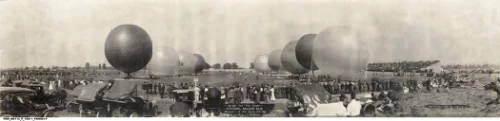
On June 5, 1909, roughly 40,000 people gathered at the Indianapolis Motor Speedway to watch the facility's very first competitive event. They watched nine enormous spherical balloons lift silently off a muddy, half-graded construction site and drift south over the Indiana horizon.
The winner wouldn't be known for another 26 hours — and he'd be in Alabama when it happened.
This was not a car race. This was not even close to a car race. The oval that would one day become the most famous racing surface in the world was still being shoveled into shape by 500 laborers and 300 mules. Cars would not turn a competitive lap here for another 10 weeks. And when they finally did, it would kill five people in three days. But on this particular Saturday afternoon in June, the Indianapolis Motor Speedway held its inaugural event: the U.S. National Championship gas balloon race, sanctioned by the Aero Club of America. 1
A quick fact that Wikipedia still gets wrong
Before going any further: those balloons were not filled with helium. Wikipedia's early-history section describes the event as a "helium gas-filled balloon competition," and OnThisDay.com calls it a "hot air balloon race." Both are wrong. 3
The balloons were inflated with manufactured coal gas — also called illuminating gas or town gas — piped directly from the Indianapolis city gas plant. Carl Fisher, the Speedway's co-founder and the man who organized the entire event, had a dedicated pipeline built from the city mains to the infield specifically for this race. Helium was essentially unavailable in commercial quantities in 1909; the U.S. wouldn't begin large-scale helium extraction until the 1920s. Coal gas was the standard lifting agent for competitive ballooning at the time, and it's what sent all nine balloons south over Indiana that afternoon. 3
The setup: an unfinished racetrack, a revenue problem, and 40,000 free-riders
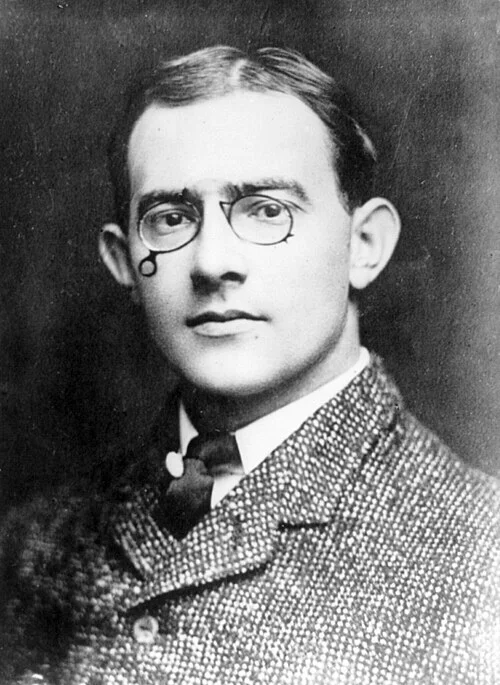
Carl Fisher (pictured below) had incorporated the Indianapolis Motor Speedway Company with three partners on March 20, 1909, capitalizing the venture at $250,000. 1 They'd purchased a 328-acre farm five miles outside Indianapolis for $72,000, broken ground on March 15, and immediately fell behind schedule. Persistent spring rain delayed the oval's construction, forcing cancellation of a planned May opening. The founders needed to start recovering their investment. Now.
Enter the balloon race. Fisher was the 21st licensed balloon pilot in the United States and had founded the Aero Club of Indiana. Staging a national championship gas balloon contest — on an infield that didn't yet have a finished road surface — was both a publicity stunt and a genuine revenue attempt. 2
It half-worked. Gates opened at 12:30 p.m., with the Big Four railroad running trains to the course every 20 minutes. The grandstands, built to hold 6,000, admitted roughly 3,500 paying spectators. The other 36,500 or so parked along Crawfordsville Road outside the grounds and watched for free. Ernest Moross, the event director and one of the top auto-race promoters of the era, had reportedly been nervous about ticket sales. His concern was warranted. 5
Nine balloons, two divisions, and a competition format that took 26 hours to finish
Nine balloons competed in two categories. The free-for-all division featured six craft with 80,000-cubic-foot gas capacity; the handicap division held three smaller 40,000-cubic-foot balloons. The competition format was simple: whoever landed the farthest distance from the launch point won. Balloons launched in staggered intervals between 3:45 and 5:00 PM to prevent mid-air collisions. 3
U.S. Weather Bureau official Major H.B. Hersey predicted the winds would carry the fleet eastward. They went south instead — every single one of them. "The wind is the motor for this kind of a balloon," Hersey later philosophized, "and as in the case of an automobile, the driver should know all about this motor power." 3
The winning balloon, University City out of St. Louis, was piloted by John Berry with Paul J. McCullough as his aide. They stayed aloft for 26 hours and 35 minutes, landing approximately 6 miles south of Fort Payne, Alabama — a straight-line distance of about 382 miles from Indianapolis. 3 Berry's strategy was essentially "go until the wind says stop." "If we had landed two hours sooner than we did we would have been fifty miles farther south," he told the press. "We were being driven rapidly north." 3
The longest flight of the day belonged to St. Louis III, piloted by Albert B. Lambert (later the namesake of St. Louis' Lambert Airport), which stayed up for an extraordinary 35 hours and 12 minutes before setting down 2.5 miles north of Corinth, Mississippi — 350 miles away. Lambert lost on distance despite his marathon duration. 3
Carl Fisher's wild ride: gunshots, 14,000 feet, and a disputed disqualification
Fisher himself entered the free-for-all, piloting his balloon Indiana with his mentor George Bumbaugh as aide. His flight became the most eventful of the nine.
Crossing Brown County, Indiana, local farmers opened fire on the enormous fabric sphere descending toward their land. The shooting continued all the way into Tennessee. Fisher later told reporters: "Yes, we are safe and sound, thanks to the poor marksmanship of a number of farmers." 3
At one point a thermal updraft shot the Indiana to 14,000 feet so fast the coal gas began to vent and condense into white smoke. "I expected the gas to explode any minute," Fisher recounted. "Our teeth were chattering and we almost froze to death." He and Bumbaugh piled on every available coat and made it through. 3
They flew 230 miles over 18 hours and 30 minutes, landing near Tennessee City, Tennessee — a result that would have placed third. Then winning pilot John Berry filed a protest. Fisher had twice accepted water jugs from the ground (at Shackle Island and Ashland City, Tennessee), which Berry argued constituted illegal landings. Fisher insisted neither the basket nor any crew member had touched the ground. The officials sided with Berry. Indiana was disqualified. 3
What happened next: death, bricks, and the race that changed American motorsport
Fisher's balloon stunt had proven the facility could draw an enormous crowd. Whether it covered the bills is a different question. But by August, the oval was ready for its originally intended purpose — and it immediately went sideways.
The first auto races at IMS, held August 19–21, 1909, turned catastrophic. The track's gravel-and-tar surface disintegrated under race speed. Driver William Bourque and his mechanic Harry Halcomb died on day one when their Knox suffered a rear-axle failure and flipped into a fence post. On August 21, Charlie Merz's right front tire blew out at 175 miles into the 300-mile finale, sending his car into a crowd and killing spectator mechanic Claude Kellum and two others. Five people died across three days. The American Automobile Association boycotted the facility. 1
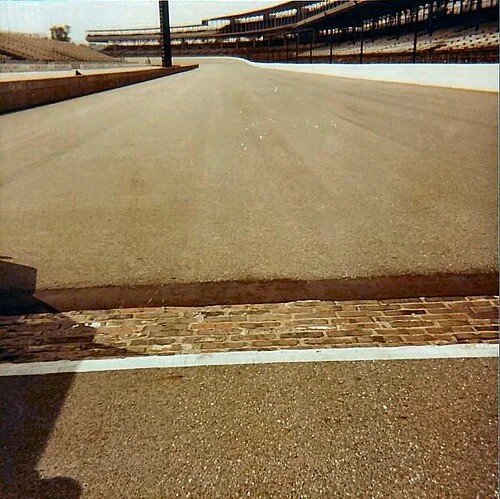
Fisher's response was to rebuild the entire surface from scratch. Between September and December 1909, five Indiana manufacturers supplied 3.2 million bricks — each weighing 10 pounds — and workers laid every single one by hand over a 2-inch bed of sand, leveled and mortared. A 33-inch concrete retaining wall went up around all four turns. The final brick, a gold-plated brass ceremonial piece, was laid by Indiana Governor Thomas R. Marshall. Before the work was even done, locals were calling it "The Brickyard." The total bill came to approximately $155,000. 1
By May 30, 1911 — Decoration Day — the first Indianapolis 500 was ready. 80,000 paying spectators arrived at $1 a head. Forty cars started. Ray Harroun won in the No. 32 Marmon "Wasp," completing 500 miles in 6 hours, 42 minutes, and 8 seconds at an average of 74.602 mph. He was the only driver without a riding mechanic — to save weight, he installed a device he'd invented: the rear-view mirror, making the Indy 500 the first automobile race in which one was used. 7
From 26-hour balloon drift to 237 mph in two years
The current qualifying lap record at IMS stands at 237.498 mph, set by Arie Luyendyk in 1996. 1 University City's winning average over its 382-mile coal-gas drift was roughly 14.4 mph, if you factor in 26 hours of float time.
That's the distance between the first event at Indianapolis Motor Speedway and what it became: a facility so synonymous with maximum velocity that even its nickname — "The Brickyard" — refers to emergency remediation after a death toll. None of that arc was inevitable. It started with a gas pipeline special-ordered to a dirt field, nine fabric spheres, and 40,000 people standing along a road watching something drift south into the sky.
In 2009, for the Speedway's centennial, approximately 50 balloons raced at IMS in a commemorative event — a direct echo of June 5, 1909. 8 And if you visit the Speedway today, somewhere along one of its outer walls, a balloon is painted on the side of a building — a small, quiet acknowledgment that before the bricks, before Ray Harroun's mirror, before 237 mph, the very first thing that competed here went wherever the wind decided. 9
Cover image: AI-generated illustration
参考ソース
- 1Wikipedia: Indianapolis Motor Speedway
- 2Indiana Historical Society: Balloons Over Indianapolis
- 3IndyMotorSpeedway.com: 1909 National Balloon Race
- 4Wikipedia: Carl G. Fisher
- 5Mark Dill / Medium: The Unlikely & Pivotal Racing Event of 1909
- 6Indianapolis Motor Speedway: Traditions
- 7Wikipedia: Indianapolis 500
- 8AP via HeraldNet: Balloons to race at Indy again
- 9First Super Speedway: Why a balloon is painted on the side of a restroom at IMS
このコンテンツについて、さらに観点や背景を補足しましょう。