Copper hits all-time record; Hammack fires first rate-hike warning under Warsh; grains slide for third session
Tuesday's June 2 session: COMEX Copper HGN6 hit an all-time record $6.6765/lb (+1.89%) on a Section 232 tariff amendment and the CopperTech Metals NYSE IPO filing; Cleveland Fed President Hammack issued the first explicit rate-hike signal under Chair Warsh, flipping futures pricing toward tightening; WTI settled at $93.76/bbl (+1.74%) as the Iran ceasefire stalemate deepened with no US-Iran communication for days; gold recovered to ~$4,535.50 (+0.6%); CBOT grains fell a third straight session as debut crop ratings (corn 67% G/E, soybeans 66%) missed estimates without triggering a reversal.

Tuesday's session delivered three distinct storylines that pulled in different directions. Copper broke its all-time record on a tariff amendment and an IPO filing. Cleveland Fed President Beth Hammack issued the first explicit rate-hike signal from a voting member under new Chair Warsh, flipping futures pricing toward tightening. And grains fell for a third straight day as the market treated USDA's debut crop ratings as good enough — even if they came in below expectations. WTI CLN6 settled at $93.76/bbl (+1.74%), its highest close since May 26, as the Iran-US ceasefire stalemate persisted with no meaningful diplomatic contact for days. Gold recovered ~$4,535.50 (+0.6%) from Monday's ISM-driven selloff as the dollar softened. The S&P 500 notched its ninth consecutive all-time high.
The session's core signal: with the June 16-17 FOMC now days away, rate futures pricing has shifted. A hike — not a cut — is what futures markets now expect as the next move.
Settlement snapshot — June 2 vs. June 1
| Contract | Settlement | Change | % Change | June 1 close | Data status |
|---|---|---|---|---|---|
| NYMEX WTI Jul (CLN6) | $93.76/bbl | +$1.60 | +1.74% | $92.16 | Confirmed |
| Brent (BRN00/ICE) | $96.00/bbl | +$1.02 | +1.07% | ~$94.98 | ⚠ Single source (BRN00 continuous) |
| COMEX Gold Jun (GCM6) | ~$4,535.50/oz | +$60.30 | +~0.6% | $4,475.20 | ⚠ Likely (GCM6 = expiry month, low liquidity; Aug GCQ6 active at $4,519.50) |
| COMEX Copper Jul (HGN6) | $6.6765/lb | +$0.1240 | +1.89% | $6.5525 | Confirmed (HG00 cross-check: $6.6760) |
| CBOT Corn (C00) | 440.50¢/bu | −3.50¢ | −0.79% | 444.00¢ | Confirmed |
| CBOT Soybeans (S00) | 1,165.25¢/bu | −15.50¢ | −1.31% | 1,180.75¢ | Confirmed |
Data notes: (1) GCM6 is the June expiry contract, carrying only 1,527 contracts of open interest vs. 261K+ in August GCQ6; settlement price is a Dow Jones/MarketWatch estimate (~$4,535.50 per Morningstar Data Talk roundup) — treat as directionally confirmed but subject to CME end-of-day revision. Use GCQ6 $4,519.50 for active-market analysis. (2) Brent uses the BRN00 ICE continuous contract as the sole available source; BZCN26 and BZ00 returned no data. (3) Copper HGN6 confirmed against HG00 continuous ($6.6760 vs. $6.6765, within rounding).
Crude oil: Iran stalemate holds, WTI extends to one-week high
WTI CLN6 settled at $93.76/bbl on Tuesday, up $1.60 (+1.74%) — a one-week high and the second straight gain after Monday's 4.94% surge. 1 Brent settled at $96.00/bbl (+1.07%). 2 Both contracts marked their highest closes since May 26.
The directional driver remained the Iran impasse, now entering a new phase. According to Iranian semi-official media outlets Fars and Mehr, Tehran has not communicated with Washington for several days — the last substantive exchange was a message from Iran about Lebanon. 8 Iran is reviewing the US ceasefire proposal but has not responded. Trump, posting on Truth Social, rejected that characterization: "The conversations between us have been going on continuously, including four days ago, three days ago, two days ago, one day ago, and today." 8 On Monday he had projected a deal "over the next week."
Secretary of State Rubio testified to the Senate on Tuesday, offering the clearest public accounting of where talks stood. He said Iran had agreed to negotiate aspects of its nuclear program it had previously refused to discuss — but added that agreement to negotiate does not guarantee an agreement, and that the US had not offered sanctions relief in exchange for Hormuz reopening. 8 The framing suggests the two sides are talking past a core asymmetry: Iran wants near-term economic relief, Washington wants verifiable nuclear concessions first.
Ritterbusch and Associates put the market's working assumption plainly: "There are still various moving parts to this drama, but at the end of the day a significant reopening of the Strait of Hormuz doesn't appear much closer than was the case a couple of months ago." 9
Inventories: API draw double the estimate, IEA flags summer red zone
The American Petroleum Institute reported crude stocks fell 6.75 million barrels in the week ending May 29 — roughly double the analysts' consensus of −3.6 million barrels. 10 The Strategic Petroleum Reserve drew another 8.0 million barrels to 357.1 million barrels, its lowest level since January 2024. 10 Gasoline stocks surprised to the upside with a 3.45 million barrel build, but remain 6% below their five-year seasonal average. EIA's official weekly report is due Wednesday June 3.
The IEA's head of oil industry and markets warned Tuesday that global commercial and strategic stocks are on track to enter a "red zone" by July-August. From March through May, global inventories drew by more than 250 million barrels — at a pace the agency described as record-setting. 11 The IEA estimates 2026 global oil supply will be roughly 3.9 million barrels per day below 2025 levels, with an average daily deficit of 1.78 million barrels. Gulf producers have cumulatively lost more than 1 billion barrels of net exports since the Strait closed. 11
HSBC issued a separate note Tuesday arguing the oil market is in a "super-squeeze" rather than a structural super-cycle — meaning the current price pressure comes from physical supply disruption, not a demand-driven upcycle. 12 The bank's analysts wrote that if inventories reach a critical functional floor, price increases could become non-linear — sharp moves rather than gradual adjustments. They declined to specify a price target. 12
Hormuz: MSC vessel hit, dark transits proliferate
The humanitarian and logistics dimensions of the stalemate continued to accumulate. MSC confirmed its vessel Sariska V was struck by two projectiles at Iraq's Umm Qasr port — the IRGC claimed responsibility, saying the attack retaliated for a US strike on an Iranian vessel in the Gulf of Oman. 8 The IRGC separately claimed 24 vessels transited the strait in the past 24 hours with its permission.
A Bloomberg/gCaptain investigation published Tuesday documented that Qatar and ADNOC have shifted to "dark transits" — running LNG carriers with AIS transponders switched off — to move cargoes through Hormuz. 13 At least four Qatari vessels and four ADNOC vessels used this method in May. Qatar is reportedly requiring ships to shut transponders near Ras Laffan and cross in pairs. About 20,000 seafarers remain aboard vessels trapped in the Persian Gulf. 13 Michelle Wiese Bockmann of Windward described the pattern: "This is a battle for the freedom of navigation. You look at all those chokepoints, and all of a sudden the foundation of seaborne international global trade just goes out the window. We are seeing the increase in dark transits and the escalation of risk." 13
コンテンツカードを読み込んでいます…
Copper: all-time record $6.6765 on tariff amendment and CopperTech IPO
COMEX Copper HGN6 settled at $6.6765/lb Tuesday, up $0.1240 (+1.89%) — the contract's second straight record close. 4 Volume hit 43,410 contracts, 176% of the 65-session average of 24,650 — a meaningful volume spike on an already-stretched price. The intraday high of $6.6980 approached the 52-week record of $6.7160. Year-to-date, COMEX copper has gained +18.11% and is up +53.55% from its 52-week low of $4.3305 set last July. 14
Two catalysts converged on Tuesday. First, President Trump signed a proclamation on June 1 — published Tuesday — amending Section 232 national security tariffs on steel, aluminum, and copper derivative imports, effective June 8 through December 31, 2027. 15 The amendment lowers tariffs on some agricultural machinery and HVAC equipment to 15% from 25%, creates a new 10% tier for capital equipment with at least 85% US-melted or US-smelted steel and aluminum content, and adds steel racks and aluminum lithographic plates to the 25% duty list. The proclamation frames the changes as measures "to spur near-term investments that will rebuild the Nation's industrial base." 15 For copper specifically, the amendment reinforces the critical-minerals policy framework that added copper to the US critical-minerals list last year.
Second, Reuters reported that CopperTech Metals — a Vedanta Resources-backed producer that operates Zambia's Konkola Copper Mines — filed for a NYSE IPO under the ticker "CUX." 16 Net sales for the year ending March 31, 2026, came in at $1.33 billion, up from approximately $398 million the prior year. The filing cited structural copper demand from AI infrastructure, data centers, the global energy transition, and rising defense spending. 16
The combination arrived against a supply backdrop that remains structurally tight. Morgan Stanley's 600,000-tonne 2026 refined copper deficit forecast continues to underpin the bull case. LME warehouse stocks stood at 386,050 tonnes as of June 1 (June 2 data was unavailable due to access restrictions). TC/RC charges at Japanese and Korean smelters remain negative — meaning smelters are paying miners for concentrate rather than the reverse — a level of raw-material scarcity last seen in 2015.
コンテンツカードを読み込んでいます…
Gold: recovers toward $4,500 as DXY softens, Iran stalemate supports
COMEX Gold (active front month, with GCM6 the expiry-month contract) recovered to approximately $4,535.50/oz on Tuesday, up roughly +0.6% from Monday's $4,475.20 settlement — erasing about a third of Monday's 1.87% ISM-driven selloff. 3 The most-active August contract GCQ6 settled at $4,519.50. 3 COMEX silver snapped its two-session losing streak, settling at $75.311/oz (+$0.304, +0.41%), though it remains 34.56% below January's record high of $115.08. 17
Gold's partial recovery Tuesday came from two sources. The US Dollar Index (DXY) closed at 99.22 (+0.02%), essentially flat after Monday's push to 99.37 that had squeezed the safe-haven bid. 18 The 10-year Treasury yield settled at 4.455%, down 2 basis points, with the 2-year at 4.050%. 19 The Iran stalemate provides an ongoing safe-haven underpinning — even if Monday demonstrated that ISM shocks and dollar moves can overwhelm it intraday.
The more consequential macro signal for gold arrived via the Fed. Cleveland Fed President Hammack's speech (detailed in the macro section below) directly addressed the Hormuz variable: "What I've heard from business contacts, particularly in the energy sector, is that even if the Strait of Hormuz was opened tomorrow, it's going to be months before we actually rebuild that flow of oil." 20 That framing — a protracted supply drag on inflation even after any deal — argues for rates staying elevated longer than markets had priced before the Iran war began.
Bank of America projects gold reaching $6,000/oz by year-end. Stewart Thomson at Kitco placed a technical floor closer to current levels: "A price of $4,400 and under offers significant value to supreme money enthusiasts." 21 Jason Hamlin of Nicoya Research noted that gold's RSI reset from ~90 in January to 45 by June, a momentum reset of the kind that historically precedes another major move higher. 21
India's decision to double gold and silver import tariffs from 6% to 15% (announced in late May) adds a modest demand headwind from one of the world's largest physical buyers, as the rupee has fallen roughly 6% since the Iran conflict began. 22
Macro: Hammack's rate-hike signal, JOLTS beat flagged as anomalous
Hammack's speech: the first explicit hike signal under Warsh
Cleveland Fed President Beth Hammack — a voting FOMC member — delivered a speech Tuesday to the City Club of Cleveland that marked a break from the recent Fed communications pattern. She stated the Fed "may need to raise interest rates soon" if inflation pressures continue building, and put the assessment plainly: "The picture for inflation is not encouraging. Inflation is too high and is moving higher." 20
This is the first explicit rate-hike signal from a voting FOMC member since Kevin Warsh was sworn in as Fed Chair on May 22. Hammack had dissented at the April 28-29 FOMC meeting against language implying the next move would be a cut. 20 The FOMC's current rate sits at 3.50%-3.75%, after six cuts from September 2024 through December 2025. Warsh's first meeting as chair is June 16-17.
Rate futures markets, having already moved toward pricing a hike rather than a cut as the next FOMC action, treated Hammack's remarks as confirmation. 20
Hammack explicitly factored in the Hormuz variable: "Based on the data, I'm more concerned about the growing risks of persistently elevated inflation than the risks to full employment, and also that monetary policy may not be sufficiently restrictive to bring inflation down to 2%." 20 She added: "If we wait for definitive evidence that high inflation has become embedded in the economy, it may require larger policy adjustments, at greater cost." 20
The Trump-Warsh dynamic adds its own complexity. At Warsh's swearing-in, Trump told him: "I want Kevin to be totally independent. Just do your own thing and do a great job." 23 Hours later, Trump told a community college audience: "We're going to get interest rates down quickly. Everybody's gonna be happy." 23 Trump has publicly stated he wants rates at 1% or below. Hammack's speech may or may not reflect Warsh's own view — the June 16-17 meeting will be the first data point.
JOLTS April: headline beat, but 91% of the gain came from one sector
The Bureau of Labor Statistics released April JOLTS data Tuesday morning. Job openings surged 731,000 to 7.618 million, the highest reading since May 2024 and the largest monthly increase since April 2021. 24 Economists polled by Reuters had forecast 6.88 million — the actual reading beat by approximately 730,000. 25
The headline figure is almost certainly overstated. 91% of the entire increase (668,000 openings) came from professional and business services alone. 24 Samuel Tombs of Pantheon Macroeconomics noted: "Sharp drops in openings in this sector in previous months have been revised away as more data have been collected. It is just as likely that April's big increase in openings also proves illusory." 25
The rest of the report told a different story. Hiring fell 419,000 to 5.116 million — a broad-based decline across nearly all sectors. Resignations dropped 183,000 to 2.977 million, the lowest since August 2020 (the COVID trough). 24 The quits rate fell to 1.9% from 2.0%. Layoffs dropped to 1.692 million, the layoffs rate to 1.1%. The underlying picture is a labor market where workers are holding their positions rather than job-hopping — a "slow-hire, slow-fire" configuration — likely reflecting uncertainty about the economic impact of persistently high energy prices.
Matthew Martin of Oxford Economics identified the vector: "Without a concrete end to the war in Iran in sight, higher oil prices will reduce aggregate demand by crimping real incomes. Coupled with increased uncertainty, businesses are likely to pull back further on hiring intentions." 25
コンテンツカードを読み込んでいます…
Grains: third session lower, fund selling and crop ratings keep bears in control
CBOT grains fell for a third consecutive day Tuesday. July corn (CN26) settled at 440.50¢/bu (−3.50¢, −0.79%), and July soybeans (SN26) at 1,165.25¢/bu (−15.50¢, −1.31%) — the steepest single-session soybean drop since the current slide began. 6 7 July Chicago SRW wheat closed at 603.00¢ (−5 to −6¢), its seventh loss in eight sessions. July Kansas City HRW wheat settled at 634.75¢ (−12 to −25¢), now down more than $1.10 from the May 13 high of $7.50. 26
StoneX estimated managed funds sold approximately 65,000 corn futures contracts (equivalent to 325 million bushels) in the past week. 27 December corn — the new-crop contract traders watch for production signals — hit a fresh intraday low of $4.6850, its cheapest since March 5, before settling at $4.6650 (−6¢). December corn has now fallen more than 36 cents (−7.2%) from its May 13 peak of $5.0650. 26
StoneX analyst Arlan Suderman framed the shift in market attention: "Headlines from the war are losing their impact on the grain and oilseeds amid the ongoing stalemate. It's June now, and crop condition scores for this year's corn and soybean crops will increasingly be a factor." 27
USDA crop progress: debut ratings come in below expectations
USDA released its first corn and soybean quality ratings of the 2026 season on Monday afternoon — and both missed analyst estimates, yet the market's bearish reaction confirmed the broader trend rather than reversing it. 28
| Crop | G/E rating | Analyst estimate | Year-ago G/E |
|---|---|---|---|
| Corn | 67% | 70% | 69% |
| Soybeans | 66% | 67-68% | 67% |
| Winter wheat | 26% | — | ~26% (at all-time low) |
Corn planting reached 93% (vs. a 5-year average of 92%), and soybeans reached 87% (vs. 80% average) — planting is essentially complete. 28 The Pro Farmer Crop Condition Index (0-500 scale) came in at 371.33 for corn and 368.10 for soybeans — slightly below year-ago readings of 374.60 and 369.74, respectively. 28
Winter wheat held at 26% good-to-excellent — matching the all-time low — with 44% rated poor or very poor. Kansas remained the worst state at 15% G/E and 55% poor/very poor. Harvest reached 5% nationally, slightly ahead of the 3% five-year average for this week. 28
Bruce Blythe of Farm Futures explained why the below-expected ratings didn't trigger a rally: traders are focused on nearly complete planting and a favorable near-term weather outlook rather than the initial quality read. "Corn and soybeans 'easily fall into seasonal patterns,'" he noted. 27 Bryce Knorr's satellite vegetation health index analysis, however, flagged drier-than-average conditions spreading through western production areas. In a scenario where that stress persists, Knorr's model puts corn trend yield at 179.4 bushels per acre (versus the 184 bpa trend projection), which would translate to corn prices between $4.65 and $4.85 for most sales. 29
About 25% of corn acreage is currently in some degree of drought. Western production areas — Nebraska, the Dakotas, western Kansas — are set to receive 0.5 to 2 inches of rain this week, while the eastern Corn Belt stays mostly dry. 29
Fertilizer costs putting floor pressure on farm economics
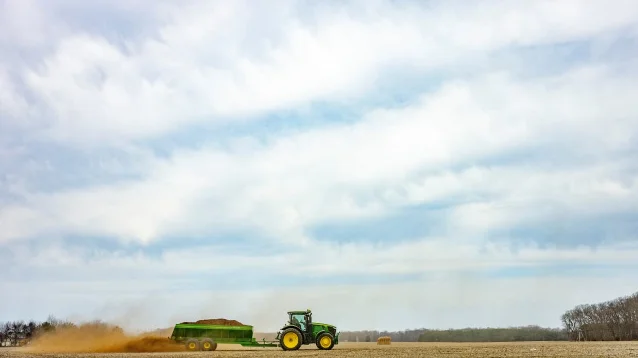
One dimension of the grain selloff that doesn't show in futures prices: the margin squeeze from fertilizer costs. A farmer profiled Tuesday by MarketWatch's Myra Saefong put it directly: "If I guess wrong, I lose the farm." 6 The Iran conflict has raised nitrogen fertilizer costs, with Michael Langemeier of Purdue's Center for Commercial Agriculture estimating that farmers who didn't lock in fertilizer before the war started are looking at a corn break-even price at least 5% higher than pre-conflict levels. 30 The Purdue/CME May Ag Economy Barometer released Tuesday showed the farm capital investment index falling to its lowest level since September 2024, with more than half of surveyed farmers citing high input costs as the primary constraint on profitability. 30
The Trump administration's tariff amendment signed Monday — reducing import duties on agricultural machinery and construction equipment from 25% to 15%, effective June 8 — offered some relief on the equipment side. Deere gained +5.7%, CNH +10%, AGCO +6.6%, and Caterpillar +4.7% on the news. 31 AEM Senior VP Kip Eideberg: "At a time when our nation's farmers are under increasing pressure, this action represents an important step towards lowering input costs, strengthening supply chains, and supporting American farmers and manufacturers." 31
China purchase drought extends past 112 days
No USDA flash sale announcements were made on Tuesday. China's zero-purchase streak for US soybeans extended past 112 consecutive days. 32 Former USDA Chief Economist Joe Glauber, speaking with Brownfield Ag News on June 1, quantified the gap: China's US agricultural imports through March 2026 totaled $5.1 billion, against $8.3 billion in the same period of 2024. 33 China has committed to buying 12 million tonnes of US soybeans this marketing year, but Glauber flagged the structural obstacle: "Yes, China is committed to buying 12 million tons of soybeans... but at least the 10 percent surcharge on the 3 percent tariff for soybeans still applies. So they are paying more for U.S. soybeans as a result." 33 He added: "For five months of the year in particular, we are the cheapest soybeans in the world, as long as we don't have to struggle with supplemental tariffs." 33
Australia's winter wheat crop forecast down 26%
Australia's agriculture ministry released its first 2026/27 winter wheat crop estimate Tuesday: production is projected at 27.0 million tonnes — down 26% year-on-year, with planted area falling 12% to 10.9 million hectares (the smallest since 2019/20). 32 The drivers were a combination of abnormal dryness, low global wheat prices, and the Hormuz conflict's impact on fertilizer and fuel costs. Australia is among the world's largest wheat exporters, primarily supplying Southeast Asia, the Middle East, and China.
Macro dashboard — June 2
| Indicator | Reading | Change | Prior |
|---|---|---|---|
| JOLTS job openings (Apr) | 7.618M | +731K | 6.887M (Mar, revised) |
| DXY | 99.22 | +0.02% | 99.37 (Jun 1 close) |
| 10Y Treasury yield | 4.455% | −2 bps | 4.475% |
| 2Y Treasury yield | 4.050% | −0.1 bps | 4.051% |
| S&P 500 | 7,609.90 | +0.13% | ATH (9th straight) |
| Dow Jones | 51,307.79 | +0.45% | — |
| Nasdaq | 27,093.90 | +0.03% | — |
| Philadelphia SOX (semiconductors) | — | +5.9% | — |
| Fed funds rate (current) | 3.50%-3.75% | — | unchanged |
| Next FOMC | June 16-17 (Warsh's first) | — | — |
The S&P 500 closed up 9.94 points (+0.13%) at 7,609.90 for its ninth consecutive record. 34 The gains were driven entirely by AI-related hardware: Hewlett Packard Enterprise surged 19.5% after pulling its long-term financial targets forward by two years citing AI server demand, and Marvell Technology gained 32.5% after Jensen Huang at Computex Taipei called it the "next trillion-dollar company." 34 Alphabet slipped 3.9% on news of a planned $80 billion equity offering to fund AI infrastructure. Bitcoin fell 5.7%, dragging Coinbase (−4.7%) and Strategy Inc (−9.2%).
The Philadelphia Semiconductor Index's 5.9% gain reflects the same AI-infrastructure demand story driving copper higher — data centers require copper for wiring and busbars at scale, which is one reason copper's new record occurred the same session that chips surged. The cross-asset read: the market believes AI hardware demand is not slowing, and the metals complex is beginning to price that alongside the supply disruption from Hormuz.
Week-ahead watch
The Iran situation remains the variable without a calendar anchor. API's crude draw of 6.75 million barrels landed roughly double analyst estimates, and the EIA confirmation Wednesday will determine whether the implied inventory trajectory shifts the market's assessment of how quickly the IEA's "red zone" arrives. OPEC+ meets June 7.
| Date | Release | Commodity relevance |
|---|---|---|
| Wed Jun 3 | EIA weekly petroleum status | Crude draw pace; gasoline buffer |
| Wed Jun 3 | ADP employment; ISM Services PMI | Inflation persistence; Fed path |
| Wed Jun 3 | EIA weekly ethanol production | Corn crush demand check |
| Thu Jun 4 | Weekly jobless claims | Labor market; Fed |
| Thu Jun 4 | USDA weekly export sales | Corn, soybeans |
| Sat Jun 7 | OPEC+ Ordinary Ministerial Meeting | Crude output policy |
| ~Jun 5 | Saudi Aramco July OSP | Crude benchmarks; Asia pricing |
| Jun 8 | Section 232 tariff amendment effective | Copper derivative imports |
| Jun 16-17 | Warsh's first FOMC meeting | Rates; gold; DXY; all commodities |
Data flags: (1) GCM6 (June gold) is an expiring contract with 1,527 contracts of open interest; the settlement figure of ~$4,535.50 is a Dow Jones/MarketWatch estimate, and GCQ6 ($4,519.50) is the market's active benchmark. (2) Brent settlement of $96.00 is sourced from the BRN00 ICE continuous contract only — no cross-validation available as BZCN26 and BZ00 returned no data. (3) Corn and soybean settlements use MarketWatch continuous contracts (C00, S00) pending CME official confirmation. (4) EIA official inventory data for the week ending May 29 will be released Wednesday June 3; Tuesday's API figure (−6.75M bbl) is an industry-source estimate.
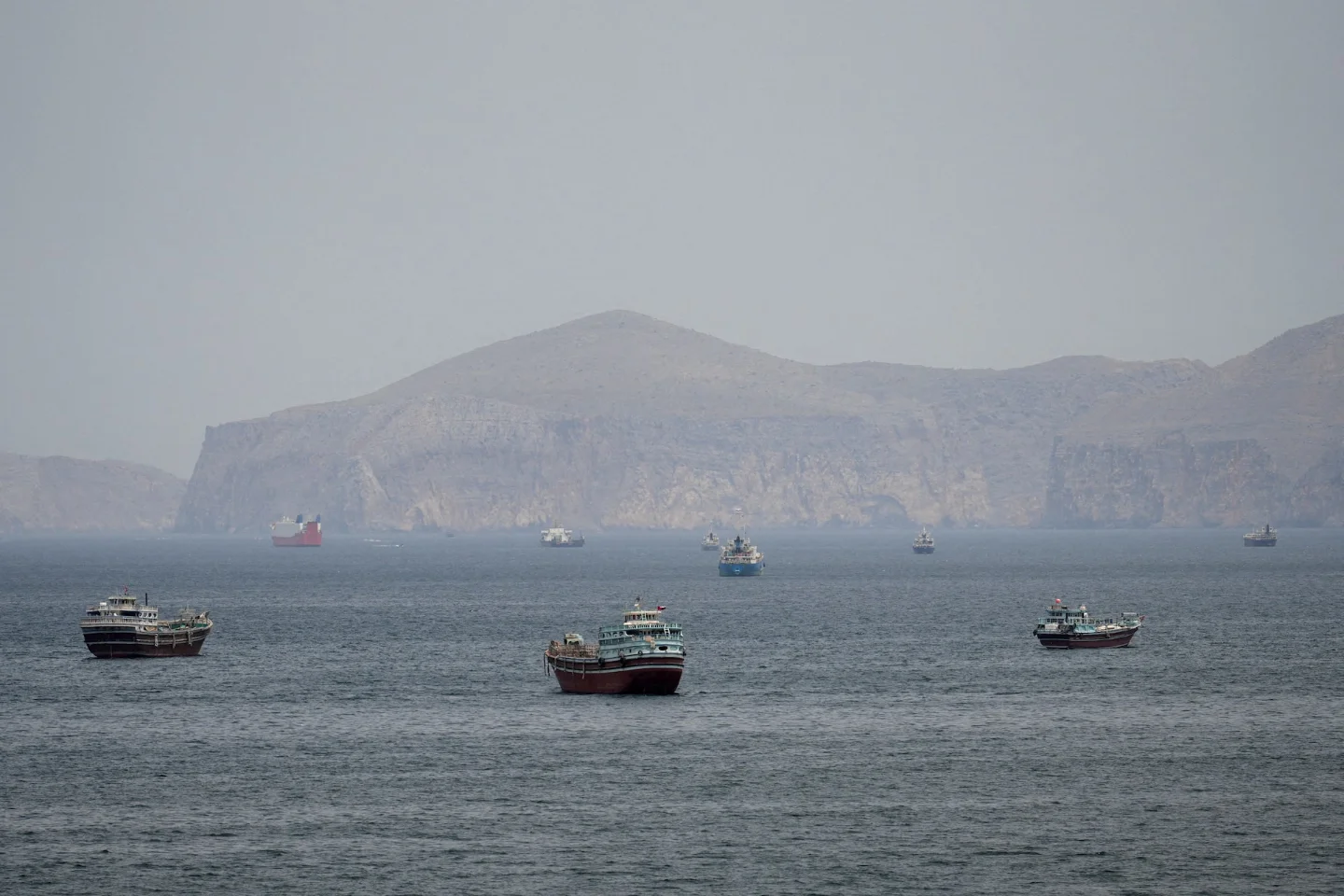
Cover image: Strait of Hormuz vessel transit — Reuters
参考ソース
- 1CLN26 — MarketWatch
- 2BRN00 — MarketWatch
- 3GCM26 — MarketWatch
- 4HGN26 — MarketWatch
- 5HG00 — MarketWatch
- 6C00 Corn — MarketWatch
- 7S00 Soybeans — MarketWatch
- 8Reuters: Iran studying deal to halt war
- 9Reuters: Oil prices rise to one-week high
- 10OilPrice.com: US Crude Oil Inventories Continue Downward Plunge
- 11OilPrice.com: IEA Global Oil Stocks on Track for Historical Lows
- 12OilPrice.com: HSBC Flags a Super-Squeeze
- 13gCaptain: The Iran War Is Pushing the Global Gas Trade Into the Shadows
- 14Morningstar/Dow Jones: Comex Copper Settles 1.92% Higher at $6.6495
- 15Kitco/Reuters: Trump signs proclamation amending tariffs on steel, aluminum and copper imports
- 16Reuters: CopperTech Metals reports revenue surge in US IPO filing
- 17Morningstar/Dow Jones: Comex Silver Settles 0.41% Higher
- 18MarketWatch: DXY overview
- 19WSJ: Treasury Yields Steady as Hormuz Impasse Goes On
- 20Reuters: Fed's Hammack says rates may need to rise
- 21Kitco: Golden tools for golden money
- 22AOL/24-7 Wall St: India doubled tariffs on gold and silver
- 23Yahoo Finance/Motley Fool: Trump threw Warsh under the bus
- 24BLS: Job Openings and Labor Turnover Survey, April 2026
- 25Reuters: US job openings rise by the most since 2021
- 26Farm Progress: What's going to stop the slide? — Afternoon Market Recap
- 27Farm Progress: Morning Market Review
- 28Farm Progress: Crop progress — Corn, soybean quality ratings go live
- 29Farm Progress: Forecast — Scattered opportunities for weather rallies
- 30Brownfield Ag News: Ag Economy Barometer
- 31Bloomberg via Farm Progress: US cuts tariffs on farm and construction equipment
- 32Pro Farmer: First Thing Today — Grains weaker overnight
- 33Brownfield Ag News: Former USDA economist questions China's soybean commitments
- 34Reuters: Wall St ends modestly higher as AI zeal overcomes Middle East jitters
このコンテンツについて、さらに観点や背景を補足しましょう。