Chokepoint status — 11 May 2026, 04:00 UTC
Supply Chain Risk Brief — Hormuz Crisis, 6–11 May 2026
Five-day operational briefing for supply chain and logistics professionals covering 6–11 May 2026. US-Iran peace talks collapsed after Trump rejected Iran's counter-proposal; Iran's Persian Gulf Strait Authority toll and vessel-declaration requirement went live; UAE sustained four attack waves; Jebel Ali import dwell hit 297% above baseline. Closes with five concrete Decision Flags including insurance audit, OFAC rescreening, and GRI booking guidance.
COVERAGE WINDOW: Wednesday 7 May 08:15 UTC → Sunday 11 May 03:56 UTC (approx. 5 days) This extended brief covers a period in which the pace of diplomatic and military events materially outran the normal daily cycle. Section leads carry the most operationally significant developments; background context follows.
1. Active conflict & ceasefire status
Peace talks collapse; fighting escalates
The week opened with cautious optimism and closed with a rejected counter-proposal and resumed missile exchanges. Iran submitted its response to the US peace framework via Pakistani mediators on or around 10 May. President Trump declared the offer "TOTALLY UNACCEPTABLE" on Truth Social.1 Iran demanded five conditions as a package: full lifting of US sanctions, termination of the US naval blockade, war reparations, recognition of Iranian sovereignty over the Strait, and an end to Iranian oil export restrictions. Tehran also proposed a shorter nuclear enrichment moratorium and partial dilution of its highly enriched uranium (HEU) stockpile — stopping well short of the facility dismantlement the US was seeking.2 Iranian President Pezeshkian said Iran would "never bow down to the enemy."3
The US 14-point memorandum of understanding — essentially a framework to end the conflict first and then open separate tracks for the Strait and the nuclear file — remains the American baseline. The gap between the two positions is structural, not incremental.
Mid-week saw the heaviest US-Iran fighting since the April 8 ceasefire. On 7 May, Iran launched missiles, drones, and small boats against three US Navy destroyers (USS Truxtun DDG-103, USS Rafael Peralta DDG-115, and USS Mason DDG-87) as they transited toward the Gulf of Oman.4 No US assets were hit. CENTCOM retaliated against Iranian missile and drone launch sites, command and control nodes, and ISR infrastructure. Iran accused the US of striking civilian vessels and residential areas on Qeshm Island.5 Separately, CENTCOM disabled three Iranian tankers during the week: MT Hasna (20mm rounds into its rudder, 6 May), and MT Sea Star III and MT Sevda (smokestacks hit, 9 May).6
By 10 May, Iran's Supreme Leader had issued "new directives" to military chief Ali Abdollahi for "continuation of operations to confront the enemy," per Iranian state television. Iranian military spokesperson Brig. Gen. Akrami Nia said forces were at "full readiness" to protect the HEU stockpile.3
Drone strikes spread to Qatar and Kuwait
On 10 May, the geographic footprint of attacks widened.2 UAE intercepted 2 UAVs from Iran (the fourth distinct attack wave during the window — see Section 3 for UAE port detail). A drone ignited a fire on a cargo vessel in Qatari waters; Kuwait detected and engaged hostile drones entering its airspace. Iran's Deputy FM Kazem Gharibabadi warned any French or British vessels entering the area in coordination with US operations would face "a decisive and immediate response."3 Iran also seized the Barbados-flagged oil tanker Ocean Koi in the Gulf of Oman on 8 May, alleging it was disrupting Iranian oil exports.2
Project Freedom paused after 36 hours
President Trump suspended the "Project Freedom" naval escort operation on 6 May — roughly 36 hours after launch — citing progress in negotiations.7 Only two US-flagged vessels transited under escort (Maersk Alliance Fairfax and one unnamed vessel). Saudi Arabia had refused the US permission to use its bases and airspace. Pre-war traffic through the Strait averaged 120 crossings per day; the entire week to 3 May saw 40 transits total.6 Shipping analyst Lars Jensen assessed that even if a peace agreement is signed, carriers will adopt a "let's wait a while and see if it holds" posture, meaning normalization of traffic will lag well behind any political agreement.
China, the 40-nation coalition, and the Trump-Xi summit
China explicitly did not endorse Iran's Persian Gulf Strait Authority (PGSA) during FM Wang Yi's meeting with Iranian FM Araghchi in Beijing on 6 May — and called for a "comprehensive ceasefire" and "prompt resumption of shipping traffic through the Strait."8 Beijing simultaneously invoked its "blocking rule" against US sanctions on Chinese refiners for the first time, directing domestic companies not to comply — a hedged position that maintains economic ties with Tehran while signaling it won't back the Strait authority claim.9 Trump needs Beijing to restrain Tehran ahead of the 14–15 May summit, giving Xi considerable leverage on trade and Taiwan concessions.
The UK and France announced a 40-plus nation defense ministers' meeting for 12 May, co-chaired by UK Defence Secretary John Healey and French counterpart Catherine Vautrin, to plan multinational escort operations.2 The coalition will not begin escort operations until hostilities are fully over. France's Charles de Gaulle strike group is already positioned in the Red Sea in anticipation. Iran has warned this coalition against participation.
Gaza and Lebanon
The Israel-Lebanon ceasefire continued to unravel: Israeli strikes killed at least 36 people in Lebanon on 10 May, with a follow-on Washington talks session scheduled for 14 May.10 In Gaza, 221 days into the ceasefire, at least 850 more Palestinians have been killed. Neither front has generated direct shipping lane disruptions in this window, but further Lebanon escalation would increase risk to eastern Mediterranean routing.
Red Sea / Houthi: quiet
UKMTO Update 042 (7 May) recorded no change in the Southern Red Sea, Bab-el-Mandeb, or Gulf of Aden.6 Zero Houthi attacks on commercial shipping during the window. The Houthi threat to close Bab-el-Mandeb — first issued 2 April and periodically restated by an adviser to Khamenei — remains a latent conditional threat rather than an active operational posture. Somali Al-Shabaab (assessed by the Jerusalem Post as Houthi-backed) is a secondary monitored threat to the strait but has not acted.11
2. Sanctions tracker
OFAC May 8: weapons and UAV procurement networks
On 8 May, OFAC designated 3 individuals and 7 entities across China, Hong Kong, Belarus, Dubai, and Iran for enabling Iran's military to acquire Shahed-136 UAV components and MANPADS.12 Key designees:
- Hitex Insulation Ningbo Company Limited (China) — supplied millions of dollars' worth of carbon fiber, honeycomb fabric, and aerospace-grade materials for Shahed-136 servomotors; principal Li Genping personally designated.
- Yushita Shanghai International Trade Co Ltd (China) — facilitated MANPADS procurement for Iran's Center for Progress and Development of Iran (CDPI).
- Armory Alliance LLC (Belarus) + staff — intermediaries to obscure the Iranian end-user.
- Elite Energy FZCO (Dubai) — transferred funds to AE International Trade Co Limited (Hong Kong) and Mustad Limited (Hong Kong) for the procurement chain.
This is the sixth OFAC nonproliferation action since UN sanctions were reimposed in September 2025. Treasury Secretary Bessent framed the action as part of the "Economic Fury" campaign.12
Compliance implication: Any transshipment through UAE free zones that touches the above networks now carries elevated exposure. Dubai-based intermediary chains for aerospace materials into Iran warrant immediate rescreening.
OFAC May 7: Iraqi oil smuggling for Iran-backed militias
OFAC designated Iraq's Deputy Minister of Oil, Ali Maarij Al-Bahadly, for authorizing oil diversion from the Qayarah field to benefit Iran-linked smuggler Salim Ahmed Said and Asa'ib Ahl Al-Haq (AAH).13 Co-designated: AAH economic official Mustafa Hashim Lazim Al-Behadili and four Iraqi oil-sector companies he controls, plus two senior leaders of Kata'ib Sayyid Al-Shuhada (KSS) — one of whom coordinated weapons purchases directly with Hizballah. Energy traders with Iraqi counterpart exposure should screen these names.
Iran's PGSA: OFAC has flagged toll payments as sanctions exposure
Iran's Persian Gulf Strait Authority (PGSA) is now operationally active, requiring vessels to submit a 40-plus question "Vessel Information Declaration" before transit and pay a toll of up to $2 million per crossing.14 OFAC has formally warned that toll payments to Iran or the IRGC are not authorized for US persons, and no general license has been issued. For non-US persons, the exposure arises through IRGC designation status and secondary sanction risk.
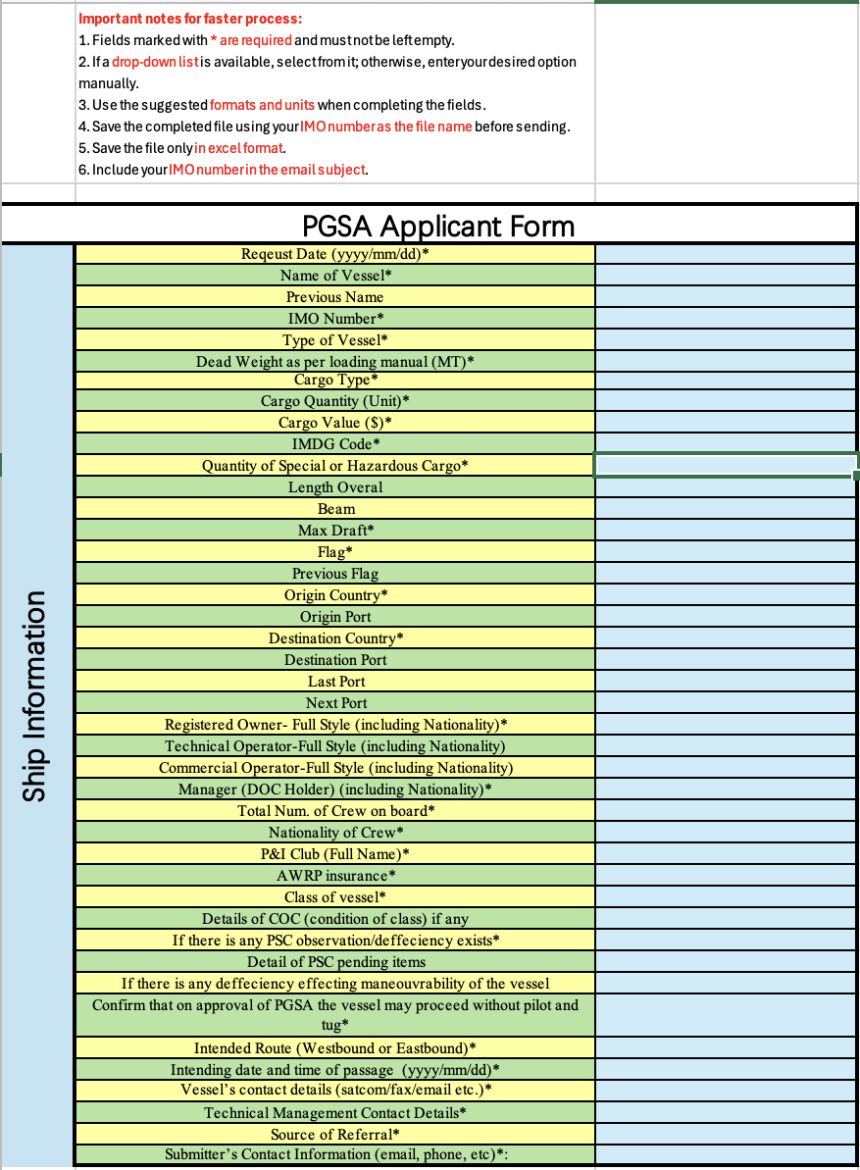
The form demands vessel name, IMO number, all previous names, country of origin and destination, nationalities of registered owners, operators and crew, and full cargo details. The PGSA email warns that "any incorrect or incomplete information provided will be the sole responsibility of the applicant, and any resulting consequences will be borne accordingly."14 The compliance fork is structural: submit and you hand your corporate structure to a sanctioned entity; refuse and your vessel does not transit.
Tolls are to be paid in Chinese yuan via CIPS/Kunlun Bank or in cryptocurrency (Bitcoin/USDT) — payment rails that themselves carry secondary sanctions exposure for US-connected counterparties.
Eritrea: US moving to lift sanctions
The Trump administration is proceeding to cancel Biden's 2021 executive order sanctioning Eritrea's ruling party and military, per an internal government document reported by Reuters.15 Eritrea's 1,150-km Red Sea coastline opposite Saudi Arabia makes it strategically relevant as the Hormuz closure redirects interest to alternate energy and trade corridors. The State Department called the move part of "strengthening the US relationship with the government and people of Eritrea." Action for sanctions compliance teams: Update Eritrea screening protocols in anticipation of a formal executive order revocation; monitor Federal Register for the effective date.
EU and UK: no new autonomous designations in window
No new autonomous EU or UK designations targeting Iran, Yemen, or Houthi-affiliated actors were identified during the 6–10 May window.16 UN Security Council members began talks on a resolution threatening Iran with sanctions over threats to commercial shipping, but no text has been tabled.
3. Corridor & chokepoint conditions
統計カードを読み込んでいます…
Strait of Hormuz
Effectively closed to commercial traffic since 28 February 2026. The cumulative picture at the close of the window:6
- PGSA active — 40+ question Vessel Information Declaration + $2M toll per vessel (see Section 2)
- Mines confirmed — NAVCENT warning (4 May): transit near the Traffic Separation Scheme "should be considered extremely hazardous due to the presence of mines that have not been fully surveyed and mitigated."17 Vessels are directed to a south-of-TSS enhanced security area in Omani territorial waters. Two US Avenger-class minesweepers are en route from Japan; Germany is preparing its own mine countermeasures vessel for potential deployment.
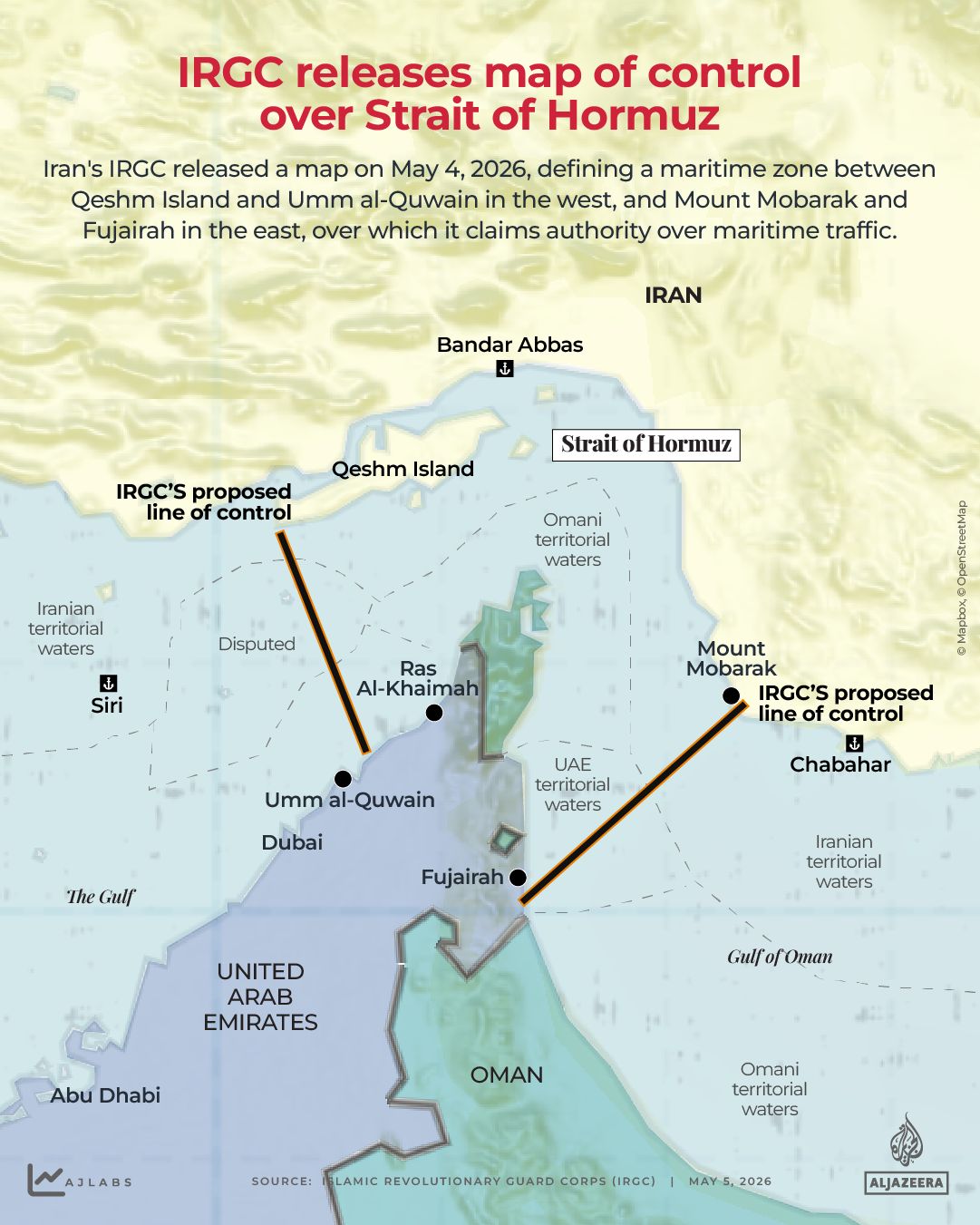
- IRGC maritime control zone — extended to cover the Gulf of Oman as of 5 May; IRGC fast-attack craft formation of 39 vessels detected at 07:30 UTC on 6 May.18
- US blockade — active since 13 April; 61 vessels turned back, 4 disabled.6 Only exceptional transits occurred during the window: 1 Qatari LNG carrier (Al Kharaitiyat, 10 May), 1 Panama-flagged bulk carrier (10 May), plus occasional India/Pakistan-flagged vessels with negotiated passage.
- AIS suppression — SAR imagery on 5 May found 146 of 167 detected Strait vessels running dark; GPS jamming affected approximately 470 vessels off Fujairah within 24 hours.18
- Mariner humanitarian crisis — approximately 20,000 seafarers stranded on nearly 1,000 vessels; 10 IMO-confirmed fatalities; crew rotation impossible for most. WSJ reported (10 May, paywalled) a Chinese-owned tanker crew entering "final days of food."19
UAE ports — Fujairah and Jebel Ali
Fujairah has been struck four times since 4 May: attack waves on 4, 5, 8, and 10 May. The VTTI oil terminal fire (4–5 May) collapsed UAE crude exports from a 30-day average of ~3.5–4 million bpd to roughly 500,000 bpd on 5 May; recovery to ~1.35 million bpd was confirmed by 6 May — still less than half the 10-year seasonal average of 3.25 million bpd.20 Berth 6 at Fujairah remains offline; breakbulk/bulk/general/ro-ro berthing wait is approximately 3 weeks. Khor Fakkan (all 6 berths operational) shows a 4-week wait for the same cargo types; container volumes have surged roughly 25-fold since Hormuz closed, with truck movements rising from 100 to 7,000 per day.21
Iran published a maritime map on 4 May explicitly claiming waters near Fujairah and Khor Fakkan within its IRGC maritime control zone.22
Jebel Ali (Dubai) sustained limited debris damage from intercepted projectiles on 4–5 May; terminal operations are continuing normally.23 As of 8 May, GPS spoofing warnings remain active in offshore Fujairah anchorage. STS (ship-to-ship transfer) operations have resumed in Dubai anchorage with tug assistance, on a case-by-case basis.
UAE cumulative interception tally since 28 February: 551 ballistic missiles, 29 cruise missiles, 2,265 UAVs; 13 killed, 230 injured across multiple nationalities.24 Schools reopened 11 May — a signal that UAE domestic life is normalizing despite ongoing missile threats.
Israel has deployed Iron Dome systems on Emirati soil; the UAE-Israel security partnership has deepened materially during the conflict.25
Other Gulf port status:26
| Port | Status |
|---|---|
| Jebel Ali | Normal operations |
| Khalifa Port | Normal operations |
| Khor Fakkan | Fully open; 4-week breakbulk wait |
| Fujairah | Open; Berth 6 offline; 3-week breakbulk wait; GPS jamming advisory |
| Bahrain | Limited; APM Terminals 06:00–18:00 only; BAPCO suspended |
| Kuwait | Fully operational; import permits from Iraqi ports temporarily suspended |
| Qatar | Full maritime navigation resumed 2 May |
| Iraq (Basra) | Basra Oil Terminal and SPM Somo export operations suspended |
| Dubai Airport | 90% capacity |
Suez Canal and Bab-el-Mandeb
Suez Canal commercial shipping remains suspended; military and naval transits continue (France's Charles de Gaulle strike group crossed eastbound 6–7 May).27 Cape of Good Hope routings reached a record 24 million deadweight tonnes in late April. Maersk CEO Vincent Clerc stated the Suez reopening is closer than it was and "could come quickly" if a peace agreement is reached — but Maersk and Hapag-Lloyd have not committed to a return date.28 Zencargo analysis: a Suez return by the market would release roughly 6% of global fleet capacity, likely triggering 2–3 weeks of European port congestion.
Bab-el-Mandeb: zero incidents in the window; UKMTO "no change." The conditional Houthi threat to close the strait remains a background risk, not an active operational posture.
4. Supply chain risk highlights
Port dwell: Jebel Ali at a nine-week extreme
Jebel Ali import container dwell reached 64.6 days for the week ending 27 April — up 297% from the 16.3-day baseline on 2 March, and still increasing across nine consecutive weeks.27 Export dwell: 59.1 days — vessels cannot depart via the Strait, creating simultaneous inbound backlog and outbound queue. Nhava Sheva (Mumbai) import dwell: 19-plus days, up 155% since 2 March. Project44's analysis notes the backlog will not resolve on the day Hormuz reopens: new inbound flows will compete directly with the existing queue, and clearance will take weeks.
統計カードを読み込んでいます…
Freight rates: sideways with upward pressure from May 15 GRIs
Drewry WCI for the week to 8 May: Shanghai-Rotterdam $2,170/40ft (+2% week-on-week); Shanghai-Genoa $3,075/40ft (+1%); Shanghai-LA $3,062/40ft (+5%); Shanghai-NY $3,721/40ft (+7%).29 Carriers are implementing new FAK rates from 15 May: $3,500–$4,500/40ft to North Europe, $4,500–$4,600 to Mediterranean. Effective capacity on Asia-North Europe is down 3% month-on-month; Asia-Mediterranean down 10% month-on-month. Drewry projects a 6% global cancellation rate over the next five weeks, with 42% of blank sailings on Asia-Europe/Med lanes. Linerlytica assesses carriers face "an uphill task" securing the next three rounds of rate hikes to North Europe.
Maersk is absorbing roughly $500 million per month in additional fuel costs and redistributing bunker supply from North America and Europe to maintain vessel operations.30 Spot rates are approximately 40% above late-February levels across the board.
Bunker prices cooling from peak but supply remains tight
Fujairah VLSFO settled at $878/tonne on 8 May — down 6.8% from $942.50 on 5 May and meaningfully below the ~$1,000+ peak seen earlier in the conflict.31 Singapore VLSFO: ~$816/tonne; Rotterdam: ~$787/tonne. Supply in Singapore remains "extremely tight"; Fujairah "tight across all grades" per ENGINE (5 May report). Intra-Asia carriers are still imposing $100 emergency fuel surcharges plus $50 low-sulphur surcharges despite the price cooling — arguing they need protection against renewed price spikes while Hormuz stays closed.32
Carrier workarounds: feeder landbridges and a new express service
Carriers have stopped treating Hormuz closure as temporary:
- Hapag-Lloyd (from 4 May) re-opened upper Gulf bookings via third-party feeder services anchored at Sharjah — five-day bonded truck transfer to Khor Fakkan, then sea to Kuwait, Saudi Arabia, Qatar, Iraq, and UAE. Feeder rotations are not on a fixed schedule.33
- MSC launched its Europe-Red Sea-Middle East Express service with first sailing from Antwerp on 10 May, rotating through Gdansk, Klaipeda, Bremerhaven, Antwerp, Valencia, Barcelona, Gioia Tauro, Abu Kir, King Abdullah Port, Jeddah, and Aqaba. Landbridge connections to the upper and lower Gulf run via Saudi trucking corridors.34
JOC analysis noted these services are "an acknowledgement by the liners that Hormuz will remain a no-go zone for the foreseeable future."
Air freight: first rate softening; volatility persists
DHL confirmed on 8 May that air freight capacity is increasing and surcharges are beginning to ease from their peak, while stressing rates remain "significantly elevated versus pre-crisis."35 DHL has restored intercontinental flights to Bahrain and Dubai from Germany and Hong Kong, and is planning to reintroduce service to Jordan, Egypt, Iraq, and Lebanon in coming weeks. Cathay Pacific's head of cargo noted that even with a return to peace, "the air cargo market and jet fuel prices will remain volatile for a while longer." European Aviation Security Council is due to conduct a mid-May review of European carrier return decisions for Middle East routes.
Several international carriers (British Airways, Lufthansa, Air France, Cathay Pacific, Singapore Airlines) have extended Dubai route suspensions through May–October 2026.36
War-risk insurance: DP World enters; Hormuz passages effectively uninsurable
DP World launched end-to-end war-risk cargo insurance on 8 May, covering physical loss/damage from conflict, civil unrest, seizure, and derelict weapons, with zero deductibles, for air and sea transits, port storage, and inland delivery in the Middle East.37 The JWC expanded its listed areas on 3 March to include Bahrain, Djibouti, Kuwait, Oman, and Qatar, with the Arabian Gulf, Gulf of Oman, Indian Ocean, Gulf of Aden, and southern Red Sea now within the higher-risk zone. Additional War Risk Premium (AWRP) benchmarks:
- Tankers/bulkers (general war risk): ~1% of vessel value (35–50% No Claim Bonus)
- Gulf of Oman: ~0.5%
- Bab-el-Mandeb: ~0.75%
- Strait of Hormuz transit: briefly quoted at ~3% in April; quotes have since been withdrawn — effectively uninsurable at commercially viable rates.38
Insurers have also activated the London Blocking and Trapping Addendum, which extends war risk cover for vessels unable to leave port for 6–12 months and allows treatment as a constructive total loss without physical damage.
Multimodal alternative: sea-air at 41% below pure air
Flexport's Sea-Air Express offers China-Europe transit in 27 days (Matson fast-boat 16–18 days to Los Angeles + air uplift 7 days), priced approximately 41% below pure air freight. Vietnam-Europe equivalents run 34–41 days at 34% below pure air.21 Asia-Pacific airfreight rates averaged $5.14/kg for the week ending 19 April, up 41% year-on-year (WorldACD). Dimerco and DHL Global Forwarding report growing but mainly exploratory inquiry for the sea-air option — uptake is "opportunistic rather than structural" for now.39
Economic backdrop
Brent crude closed the window near $100/barrel, having dropped to a 2-week low of ~$98 on deal optimism 7 May before recovering after Trump's rejection.6 US average gas price: $4.56/gallon, above $4.50 for the first time in four years. Asian LNG spot prices are up approximately 60% from pre-conflict levels. The first Qatari LNG carrier since the war began transited Hormuz on 10 May (Al Kharaitiyat, bound for Pakistan) — a single data point, not a resumption of traffic.1
Decision flags
Five actions worth completing before Monday's business day opens:
- Validate your Hormuz-bypass routing against Iran's new maritime map. If any leg of your supply chain transits near Fujairah or Khor Fakkan, confirm with your local shipping agent that the routing has not entered the IRGC-claimed zone — and get written confirmation of port berth availability and GPS jamming mitigations. Fujairah breakbulk waits of 3 weeks and Khor Fakkan at 4 weeks make these ports viable only with lead time to spare.
- Audit war-risk insurance coverage for any Gulf cargo. Confirm whether your policy explicitly covers the expanded JWC listed areas (Arabian Gulf, Gulf of Oman, Indian Ocean, Gulf of Aden, southern Red Sea). Verify what happens to in-transit cargo if a vessel is trapped for 6–12 months under the London Blocking and Trapping Addendum. For Hormuz transit specifically: coverage is effectively unavailable at viable commercial rates — plan accordingly.
- Freeze any supply chain interaction with the OFAC May 7–8 designees. Rescreening priority: UAE free-zone counterparties handling aerospace/carbon fiber materials, Iraqi oil-sector entities, and any payment flows through Dubai intermediaries to Hong Kong or Belarus-based trading companies. The May 8 action is the sixth designation round under the "Economic Fury" campaign — more are expected.
- Lock in contracted allocations before May 15 GRI cycle. Flexport's GLU explicitly warns against overbooking spot market to capture current cheap rates: carriers are using spot performance data to right-size allocations in peak season. FAK rate increases of $3,500–$4,500/40ft to North Europe take effect 15 May. Blank sailing rates on Asia-Europe/Med are running at 42% of all removals — space tightening is real.
- Set a watch trigger for the Trump-Xi summit (14–15 May Beijing). This is the highest-probability inflection point for Hormuz conditions in the near term: a joint US-China statement pressuring Iran to reopen the Strait would be the clearest diplomatic signal since the conflict began. Conversely, an acrimonious summit would extend the blockade indefinitely. Brief procurement and treasury teams now so decision authorities are pre-aligned for rapid response if conditions change.
Cover image from: CNN — Iran imposes new rules for Strait of Hormuz — vessels anchored in the Strait of Hormuz, Musandam, Oman, 6 May 2026
参考ソース
- 1Trump rips Iran's response to US peace proposal as 'unacceptable' — Nikkei Asia
- 2Trump calls Iran's response 'totally unacceptable' as ceasefire frays — The Guardian
- 3Trump says Iran response to US ceasefire proposal 'totally unacceptable' — Le Monde
- 4US conducts retaliatory strikes against Iran, Pentagon says — Nikkei Asia
- 5US expects Iranian response to peace proposal soon as fighting flares — Nikkei Asia
- 6Strait of Hormuz Shipping in State of Confusion — USNI News
- 7Trump says operation to reopen Strait of Hormuz will be 'paused' — Nikkei Asia
- 8China urges Iran to pursue ceasefire in war with US and Israel — Nikkei Asia
- 9China presses Iran against resuming war, urges Hormuz reopening ahead of Trump-Xi summit — CNBC
- 10New strikes raise fears Israel-Lebanon ceasefire is collapsing — CNN
- 11Somali terrorists could tighten Strait chokehold through Bab-el-Mandeb piracy — Jerusalem Post
- 12Economic Fury Disrupts Networks Supplying Weapons and UAV Components to Iran — US Treasury
- 13Economic Fury Targets Iraqi Oil Official, Iran-Backed Terrorist Militias in Iraq — US Treasury
- 14Iran imposes new rules for Strait of Hormuz in bid to secure wartime gains — CNN
- 15Document says US will lift Eritrea sanctions, as Red Sea tensions change alliances — MarineLink
- 16UK Sanctions List — GOV.UK
- 17Pentagon assures safe passage through Strait of Hormuz despite presence of mines — Navy Times
- 18Maritime Visibility Collapses as Tensions Escalate Around Hormuz — Hellenic Shipping News
- 19Seafarers trapped in limbo as US and Iran clash in Strait of Hormuz — Al Jazeera
- 20UAE's Hormuz Bypass Ports Become a Frontline Target — Breakbulk.News
- 21Middle East Escalation Disrupts Global Ocean and Air Freight Networks — Flexport
- 22US Claims Iran Ceasefire, UAE Under Attack — MarineLink
- 23UAE intercepts 2 ballistic missiles and 3 drones from Iran today; 3 injured — Gulf News
- 24UAE intercepts two drones from Iran on Sunday — The National
- 25Iran War Grew UAE–Israel Security Ties — RUSI
- 26Middle East Operational Status — Inchcape Shipping Services
- 27Strait of Hormuz: Carriers routing around the Gulf, not back through it — project44
- 28Red Sea Shipping 2026 — How will the Suez Canal reopening affect your supply chain? — Zencargo
- 29Spot rates edge up, but carriers plan more blanked sailings — The Loadstar
- 30Maersk warns bunker shock is reshaping shipping economics — The Loadstar
- 31Fujairah Bunker Prices — Bunker Index
- 32Bunker surcharges driving intra-Asia rates up, even as demand falls — The Loadstar
- 33Hapag-Lloyd fills the land gap between India and the Gulf — The Loadstar
- 34MSC bridges the strife with new Europe-Red Sea-Middle East Express — The Loadstar
- 35Middle East: more air freight activity as fuel surcharges ease, says DHL — The Loadstar
- 36Dubai and Middle East flight disruption — latest updates — CN Traveller
- 37DP World enters war-risk cargo insurance fray, but some have doubts — The Loadstar
- 38Q&A: Hormuz tensions put spotlight on marine insurance — Argus Media
- 39Asia-Europe shippers eye multimodal routes as airfreight costs soar — The Loadstar
このコンテンツについて、さらに観点や背景を補足しましょう。