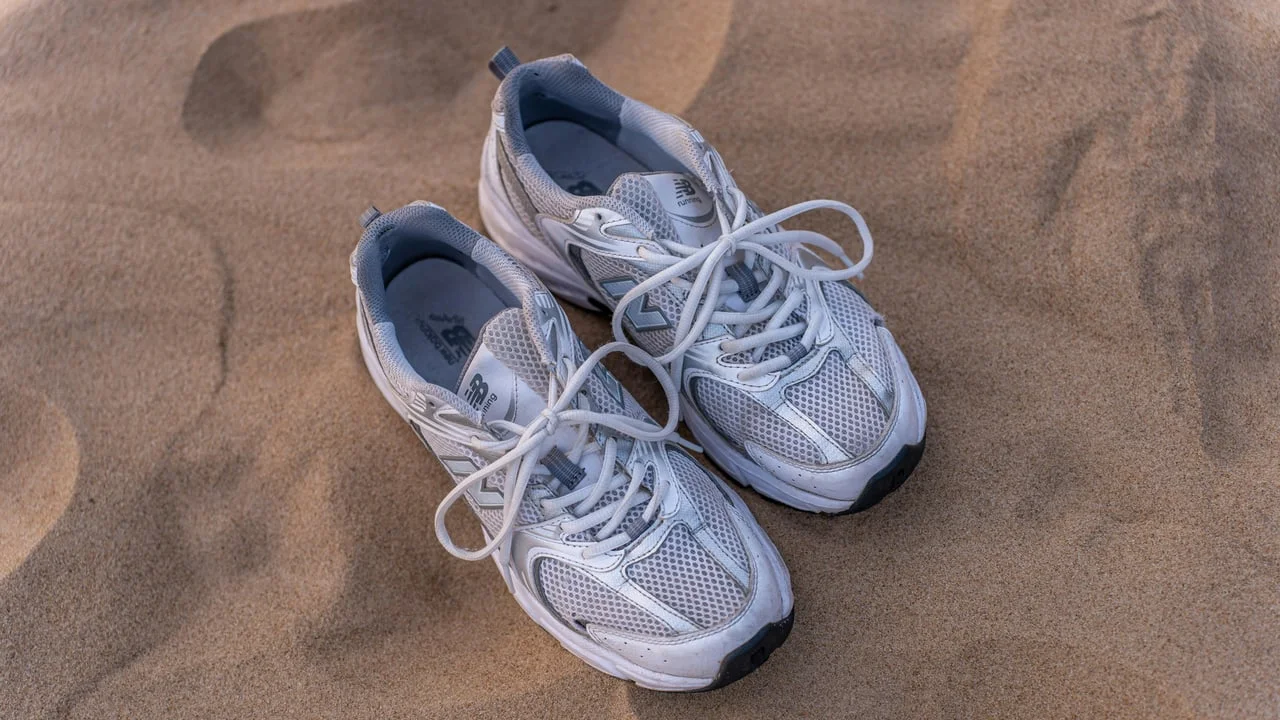
New Balance: The Arch Support Company That Survived Every Sneaker Era
In 1906, an Irish immigrant named William Riley opened a company in Boston to make arch supports — and kept a chicken foot on his desk to explain how they worked. In 1972, a 28-year-old named Jim Davis bought the entire six-person operation on Boston Marathon day. What followed was a brand that spent decades being mocked as the "dad shoe" choice while quietly building a loyal customer base, a Made in USA manufacturing identity, and the financial stability to absorb cultural irrelevance — until collaborations with Aimé Leon Dore and others turned New Balance into one of the most coveted names in sneakers. Revenue: $6.5 billion in 2023, still privately held.

In 1906, an Irish immigrant named William J. Riley founded a company in Boston with a specific, limited ambition: to make insoles that supported the arch of the foot better than anything else on the market. He named it the New Balance Arch Support Company. He kept a preserved chicken foot on his desk. When customers asked how the product worked, he pointed to the three-pronged foot and explained that its triangular weight distribution produced "new balance." He did not intend to build a sneaker empire.
Nearly 120 years later, the company that grew from that desk sells $6.5 billion worth of footwear and apparel annually, manufactures shoes in Massachusetts and Maine, has never taken private equity money, and is still controlled by the family of the man who bought it in 1972 for an undisclosed sum1. That combination — private, American-made, no celebrity endorsements for most of its history, profitable at every point — is almost impossible to engineer deliberately. New Balance didn't engineer it. It accumulated it.
From insoles to running shoes (1906–1972)
Riley's business spent its first fifty years selling specialized arch supports, mostly to athletes and workers who needed them. In 1927 he hired a salesman named Arthur Hall; in 1934 Hall became a partner. When Riley retired, he sold to Hall's daughter Eleanor and her husband Paul Kidd in 1956.
It was the Kidds who made the leap from insoles to footwear. In 1960, they designed the Trackster — the first running shoe ever produced in varying widths. Not different styles, not different sizes: different widths. The Trackster became the unofficial shoe of YMCA running programs and spread to track teams at MIT, Tufts, and Boston University through word-of-mouth. There were no advertisements, no retail presence to speak of. The company was small, careful, and largely invisible to the American consumer2.
By 1972, New Balance employed six people and made thirty pairs of shoes per day.
Jim Davis buys a six-person company on Boston Marathon day (1972)
On April 17, 1972 — the day of the Boston Marathon — a 28-year-old named Jim Davis walked into the New Balance Arch Support Company and bought it. He paid an undisclosed sum. His reasoning, as he later explained, was straightforward: he thought leisure-time products would grow fast3.
Davis timed it well. The Boston area was becoming ground zero for what would soon be called the running boom of the 1970s — the mass-participation movement triggered partly by Frank Shorter's Olympic marathon gold in Munich later that year, partly by a generation of postwar Americans who had discovered jogging as recreation. New Balance was positioned to catch it. The company expanded its product line, grew its retail presence, and opened a factory in Workington, England in 1982, later relocated to Flimby.
The company's growth in this period was real but unremarkable compared to what Nike and Adidas were doing. Davis had a different idea of what kind of company New Balance should be.
The 990 and the $100 shoe (1982)
In 1982, New Balance launched the 990 running shoe at a retail price of $100. That was roughly twice what most serious running shoes cost at the time, and more than $300 in today's dollars. The justification was explicit: the shoe was made in the United States, with premium materials, by workers earning American wages. If you wanted the performance, you paid the price4.
The 990 did not have a celebrity face. New Balance was operating on a principle that Davis would hold to for decades: pay for materials and labor, not for marketing. While Nike was building Air Jordan and Reebok was signing aerobics instructors, New Balance was investing in the physical product. The 990 was heavier than its competitors, built for serious runners rather than casual buyers, and priced in a way that made the positioning unavoidable.
The 99X series that followed — the 995, 996, 997, 998, and others — extended the same logic. Each iteration updated the cushioning system, the stability features, and the width options. Each cost more than the competition. New Balance was explicitly not trying to win on price.
The "dad shoe" phase and what it actually meant (1990s–2010s)
For approximately two decades, New Balance was the butt of a specific cultural joke. The 990 and its relatives became associated with a particular demographic: middle-aged men who cared about comfort and had stopped caring about fashion. "Dad shoes." The sneaker industry treated this as a liability.
It was, from one angle. Nike and Adidas were fighting for every cultural moment — Michael Jordan, Run-DMC, the Air Max 1. New Balance sponsored no musicians, few athletes, and ran no campaigns aimed at establishing cool. The brand's visibility among younger consumers cratered.
What the "dad shoe" narrative missed was that New Balance had built a genuinely loyal customer base who bought repeatedly over decades. The 990 remained in production continuously from 1982. By 2012, the New York Times was reporting on the shoe's "cult following" and noting that Steve Jobs had worn the 990 almost exclusively for years — a detail that got more attention than any deliberate marketing effort New Balance had made4. Jobs was not an endorsement deal. He just wore them because he liked them.
The brand was also generating real revenue. By 2013, global sales reached $2.73 billion. One quarter of every shoe New Balance sold was manufactured or assembled in the United States — a statistic no competitor could match5.
The Made in USA identity as competitive strategy
New Balance's manufacturing commitment was not nostalgia. It was a calculated bet that quality and speed-to-market would be worth the cost premium. By 2015, the company's five US factories — in Massachusetts and Maine — were producing over four million pairs annually, with production cycles shortened from eight days to three hours over thirty years5.
The Made in USA position came with a political dimension. In 2016, New Balance publicly opposed the Trans-Pacific Partnership, arguing the trade deal would undermine its domestic factories by making Vietnamese imports cheaper. The company's vice president of public affairs noted, perhaps awkwardly, that Hillary Clinton, Bernie Sanders, and Donald Trump all agreed the TPP was bad policy. Chairman Jim Davis donated nearly $400,000 to the Trump Victory Committee in September 2016. When a company spokesperson told a reporter the election result would move things "in the right direction," some media interpreted it as an endorsement. New Balance clarified that it had spoken specifically about trade, not politics. Shoes were briefly burned on social media. The episode was messy, but the underlying manufacturing commitment remained unchanged6.
The cultural pivot: Aimé Leon Dore and the rehabilitation (2019–2021)
The thing that changed New Balance's cultural standing was not a campaign. It was a collaborator.
Teddy Santis had built Aimé Leon Dore, a New York brand rooted in the streetwear and prep aesthetics of Queens in the 1990s, into something unusual: a label that felt genuinely old-school without being ironic about it. ALD selected collaborators based on shared sensibility rather than shared hype. In 2019, ALD launched its first New Balance collaboration on the 997, accompanied by a photo campaign that featured an older New York native in a wool topcoat and running shoes — not a streetwear influencer, not an athlete. The quiet confidence of the imagery landed precisely because it wasn't trying to be young7.
The 990 v2 and v5 followed in late 2019, followed by an archival revival of the 827 Abzorb in 2020. Then, in October 2020, ALD and New Balance revived the 550 — a basketball low-top from the late 1980s that had been out of production for decades — in four colorways with pre-yellowed soles. It sold out instantly. New Balance then made the 550 the centerpiece of its mainstream lineup in 2021, and it became one of the best-selling silhouettes of the year, sold without ALD branding but clearly owing its reentry to the collaboration7.
In April 2021, New Balance named Santis as creative director of its Made in USA premium line — a formal acknowledgment of what the partnership had produced. The announcement came from Robb Report, which summarized the appointment as New Balance recognizing that Santis had repositioned the brand "in the minds of sneaker culture" more effectively than any internal effort had managed1.
Other collaborations compounded the effect: KITH, Joe Freshgoods, Salehe Bembury, Paul Smith, Kawhi Leonard. Each one brought a different corner of cultural attention to a brand that had spent years being ignored by the people who decide what's cool.
From dad shoe to $6.5 billion (2021–2023)
The rehabilitation of New Balance's cultural identity coincided with, and almost certainly accelerated, a financial surge. Revenue grew from roughly $3.3 billion in 2018 to $4.5 billion in 2021. By 2023, New Balance reported $6.5 billion in annual sales — a number that placed it firmly behind Nike and Adidas but meaningfully ahead of Puma and Skechers in global sneaker revenue8.
The company remained fully private throughout. Jim Davis, now in his 80s, retained the chairmanship. His wife Anne Davis co-chairs the company. Joe Preston, who became CEO in December 2018 after two decades at the company, has continued the no-celebrity-endorsement policy as a default — though the ALD and athlete collaborations mark a shift toward selective, high-value creative partnerships rather than the blanket avoidance that defined earlier decades9.
The 990 is now on its sixth version. The 990v6 launched in 2022. The original 990 from 1982 still sells, in updated colorways, to the same mix of performance runners and people who just want to wear what Steve Jobs wore.
What New Balance didn't do
Most brand histories emphasize the decisive moves — the pivots, the launches, the hires. New Balance's history is as much about what the company didn't do.
It didn't go public. Every major competitor has either been public for decades (Nike since 1980) or sold to a conglomerate (Reebok to Adidas; Saucony to Wolverine). New Balance has had acquisition interest at various points and declined. This kept the company free from quarterly earnings pressure and allowed it to absorb the "dad shoe" years without being forced to fix a short-term cultural problem at the cost of the long-term brand.
It didn't abandon American manufacturing. When the economics of offshore production were most compelling — the 1990s and 2000s — New Balance kept factories in New England. The cost premium became, eventually, a differentiator rather than a handicap.
It didn't chase celebrity endorsements at scale. Nike's endorsement model works because Nike has Nike's marketing budget. For a company a fraction of Nike's size, the same strategy would have required compromising the product-quality investment that was the brand's actual foundation.
The result is a company that spent decades being underestimated and is now, at $6.5 billion in revenue, one of the largest privately held consumer brands in America — still controlled by the family of the man who bought a six-person insole company on Boston Marathon day, fifty-three years ago.
Sources: Wikipedia (New Balance), Footwear News, GQ, CNBC, Forbes, Robb Report, Wall Street Journal, Sneaker Freaker, New York Times.
参考ソース
- 1New Balance Wikipedia
- 2New Balance founding history, Culture Trip
- 3Jim Davis Forbes profile
- 4New Balance 99X Series history, Wikipedia
- 5New Balance US manufacturing, CNBC
- 6New Balance Trump controversy, WSJ
- 7ALD and New Balance history, GQ
- 8New Balance $6.5B revenue 2023, Footwear News
- 9Joe Preston CEO, ISPO
このコンテンツについて、さらに観点や背景を補足しましょう。