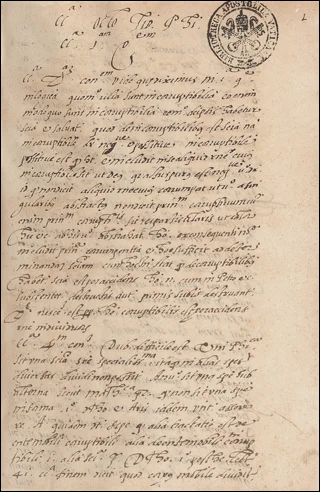
The physics lecture notes a 29-year-old friar wrote at the edge of a revolution
Vatican manuscript Ott.lat.2276, digitized June 2, 2026, is a 393-folio Latin manuscript of Praelectiones in Physicam — Aristotelian physics lectures written in 1581 by Alphonsus de Luna, a 29-year-old Dominican friar at the University of Salamanca, in the exact gap between Copernicus and Galileo. The manuscript passed through Cardinal Pietro Ottoboni's collection before the Vatican acquired it in 1748; never printed, it is now freely viewable on DigiVatLib.

In 1581, a Spanish friar named Alphonsus de Luna sat down at the University of Salamanca and began writing out his lectures on physics. He was about 29 or 30 years old, a member of the Dominican Order, attached to the Convent of San Esteban in the city that housed the greatest theological university in the Spanish Empire. 1 What he produced — 393 folios of Latin cursive script, dense with Aristotelian argumentation and marginal annotations — sat unpublished for his entire life. He died in 1596, not yet 45, leaving behind exactly one printed book. 2
Those lecture notes — Vatican shelfmark Ott.lat.2276, titled Praelectiones in Physicam — were digitized on June 2, 2026, as part of the Vatican Apostolic Library's ongoing Ottoboniani Latini digitization program. They are now freely viewable on DigiVatLib. 1
What de Luna was teaching
The subject was natural philosophy — what the 16th century called physica, following Aristotle's Physics and related texts (De caelo, De generatione et corruptione, Meteorologica). At Salamanca in 1581, this curriculum was firmly Aristotelian and geocentric. The Earth sat at the center of the cosmos; motion, matter, and change were explained through Aristotle's four causes and the four elements.
That date, 1581, places the manuscript in a specific and peculiar moment in the history of science. Copernicus had published De revolutionibus 38 years earlier, in 1543 — but heliocentrism had not entered Spanish university curricula. Galileo was 17 years old in 1581, studying medicine in Pisa; his telescopic observations were still 28 years away. Tycho Brahe was actively observing from his island observatory Uraniborg, quietly building the data that would eventually break the Ptolemaic model, but his geo-heliocentric synthesis was not yet published. And Giordano Bruno — who would spend the decade arguing for an infinite, Copernican universe — was about to print his first major works in Paris the following year, 1582.
De Luna's lectures sit precisely in that gap: after Copernicus, before Galileo, at a university where the old physics was still the only physics being taught.
His intellectual position within Salamanca's Dominican tradition adds another layer. The School of Salamanca was dominated by Thomistic scholasticism — systematic theology built on Aquinas. De Luna, according to the 18th-century bibliographer Nicolás Antonio (1617–1684), was praised for teaching the work of John Duns Scotus and Durandus of Saint-Pourçain, two scholastic thinkers who departed in notable ways from Aquinas. 2 Antonio wrote that de Luna was non mediocriter laudabatur — "not moderately praised," meaning he was well-regarded — during his teaching years. A young friar with Scotist leanings, teaching physics inside a Dominican stronghold: the intellectual tensions in that position are real, even if the manuscript's Latin requires a specialist to untangle them fully.
The manuscript itself
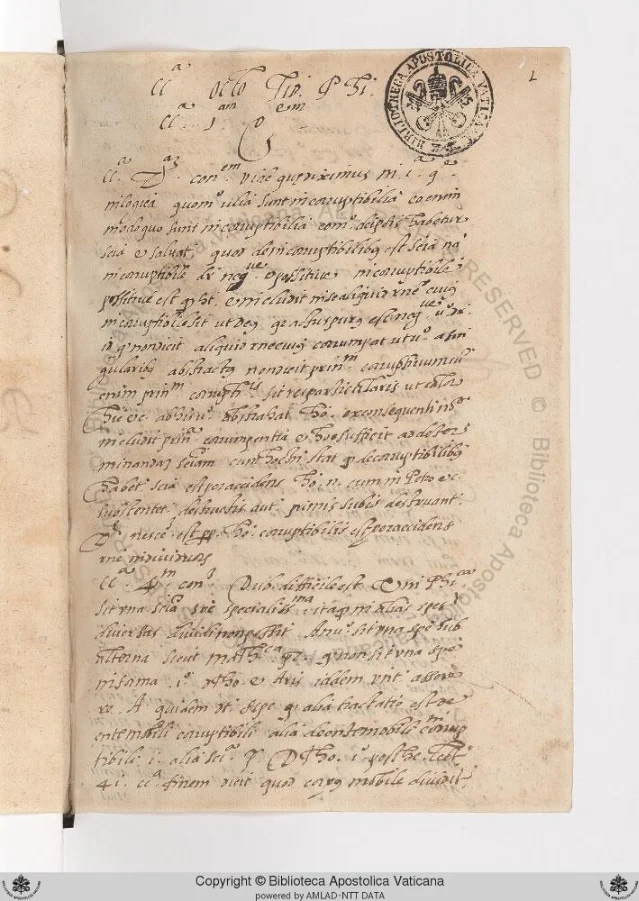
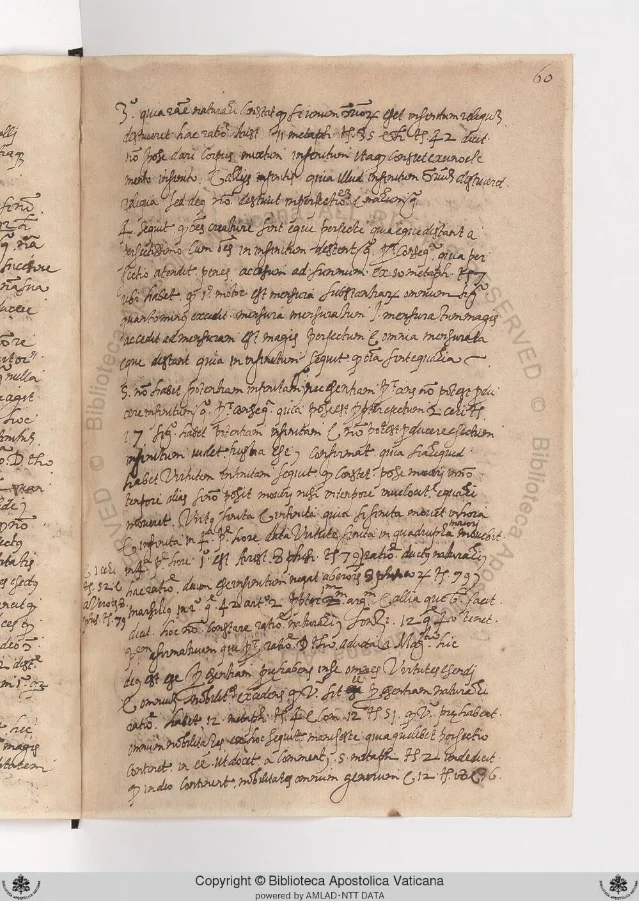
The 393 folios are written in a Latin cursive typical of 16th-century Spanish academic manuscripts — a flowing, practical hand designed for sustained reading rather than ceremonial display. Marginal annotations appear throughout, visible on the opening pages and running through the middle sections. Whether these are de Luna's own additions, a student's notes, or a later reader's commentary is not clear from the digitized images alone.
The full IIIF manifest (the open standard the Vatican uses to deliver zoomable page images) contains 802 canvases — covering the binding boards, pastedowns, flyleaves, and all text pages — which works out to the expected count for a double-sided folio manuscript of this size. 3 The physical pages measure approximately 200–210 mm wide by 290–300 mm tall, a standard folio format.
No dedicated scholarly study of Ott.lat.2276 appears to exist. The manuscript is cited in Charles H. Lohr's 1978 census of Renaissance Latin Aristotle commentaries (Renaissance Quarterly, Vol. 31, No. 4), 4 which is the standard reference for identifying manuscript witnesses to this tradition — but the full text sits behind JSTOR's paywall. For anyone working on the history of science education in 16th-century Spain or the Salamanca school's engagement with natural philosophy, this manuscript appears to be an unstudied source.
A long road to Rome
Ott.lat.2276 arrived at the Vatican the way most of the Ottoboniani Latini collection did. The Ottoboniani Latini is a group of 3,379 Latin manuscripts that originated as the private library of Cardinal Pietro Ottoboni (1667–1740), Cardinal Nephew of Pope Alexander VIII, and was purchased wholesale by the Vatican Library in 1748. 5 The specific chain of ownership before Ottoboni — whether this manuscript passed through Queen Christina of Sweden's collection as many in the group did, or came by another route — is not documented in the accessible online catalogs.
In 1797, French troops during the Napoleonic occupation confiscated around 500 manuscripts from the collection; all but 36 were eventually returned. 5 Of the approximately 3,379 items in the Latin collection, around 2,200 have now been digitized as of 2026 — Ott.lat.2276 among the most recent. 1
Now open on DigiVatLib
De Luna's Praelectiones in Physicam never saw print during his lifetime, and no printed edition appears to have followed after his death. His one published book — Novas Observationes in Expositionem Fratris Bartholomaei de Medina ad Tertiam Partem Sancti Thomae, a supplementary commentary on the work of Bartolomé de Medina (1527–1580), the leading Dominican theologian at Salamanca — came out in 1596, the year he died. 2 The physics lectures remained in manuscript form, passed through several collections, and ended up in a Roman cardinal's library.
The full manuscript is now viewable in the DigiVatLib IIIF viewer, which supports page-level zoom:
コンテンツカードを読み込んでいます…
What the viewer cannot do is read the Latin. The specific topics covered in the 393 folios — whether de Luna discusses motion, the void, the elements, celestial mechanics, or any of the other standard headings of Aristotelian physics — remain unknown without a reader who can work through the 16th-century cursive Latin and identify the philosophical content. The manuscript's digitization is the necessary first step; the scholarship, if it comes, is the second.
Cover image: first folio of Vatican manuscript Ott.lat.2276, © Biblioteca Apostolica Vaticana — free for personal and research use.
このコンテンツについて、さらに観点や背景を補足しましょう。