KVYO: Marketing SaaS at 0.55 PEG, 37% P/S discount — down 56% from its peak

KVYO: Marketing SaaS at 0.55 PEG, 37% P/S discount — down 56% from its peak

Klaviyo, Inc. (NYSE: KVYO, $4.52B market cap) passes all four hard screening filters on May 29, 2026 — market cap ✅, TTM revenue growth +30.27% ✅ (27 bps above threshold, caveat disclosed), PEG 0.55/0.60 dual-source verified ✅, TTM OCF +$237.92M ✅. The article covers Klaviyo's e-commerce marketing SaaS model (196K+ customers, NRR 110%), 5-quarter revenue trend showing growth deceleration, first GAAP-profitable quarter, peer valuation vs. BRZE/HUBS/SPT, $867M net cash balance sheet, $400M buyback, Anthropic AI integration catalyst, key risks (78% Shopify ARR concentration, CFO departure, decelerating growth), and analyst consensus: 23 analysts, Strong Buy, $29.23 average target (~94% implied upside).

Small-Cap Growth Pick: Revenue +30%, PEG < 1
2026/5/29 · 22:10
購読 1 件 · コンテンツ 10 件
Klaviyo, Inc. (NYSE: KVYO, $4.52B market cap) is today's pick — the channel's first marketing SaaS name — passing all four hard screening filters. 1 The stock trades at ~$15.05 as of May 29, 2026, down 56% from its 52-week high of $36.76, sitting 11% above the 52-week low of $13.53. 2
Klaviyo is an e-commerce-focused marketing automation platform. Its core products — email, SMS, mobile push, and reviews — let Shopify and other e-commerce merchants segment customers, trigger behavioral flows, and attribute revenue to campaigns, all inside a single data layer. The company went public in September 2023 and generated $1.31B in TTM revenue as of Q1 2026. 3

Hard filter scorecard

統計カードを読み込んでいます…
FilterThresholdKVYO resultSource
Market cap< $10B$4.52BStockAnalysis / Finviz / Yahoo (three-source) 1
TTM revenue growth> 30%30.27% ⚠️StockAnalysis / Finviz (dual-source) 1
PEG ratio< 10.55 (StockAnalysis) / 0.60 (Finviz)Dual-source verified 2
Operating cash flow (TTM)Positive$237.92MStockAnalysis / Yahoo (dual-source) 4
⚠️ TTM growth margin caveat: At 30.27%, Klaviyo clears the 30% threshold by just 27 basis points. Quarterly data shows the growth rate decelerating — Q1 2026 came in at +27.94% YoY, and Q2 2026 guidance implies +23–24%. If the current deceleration pace continues for two more quarters, the TTM rate will drop below 30%. This proximity to the threshold is a real screen-quality risk and should factor directly into any position sizing.
PEG methodology note — dual-source confidence: StockAnalysis reports PEG 0.55 using Forward P/E 16.99 divided by an implied growth rate of ~30.9%. Finviz reports 0.60 using Forward P/E 14.32 divided by a 5-year consensus EPS growth estimate of 23.96% (14.32 ÷ 23.96 = 0.597). The two platforms use different Forward P/E inputs and different growth denominators, yet both land below 1.0. Yahoo Finance shows PEG as "—" (no long-term EPS consensus available on that platform). The dual confirmation from independent methodologies increases confidence in the sub-1 reading. 1 2

Business model

Klaviyo's product sits at the intersection of customer data platform (CDP) and marketing execution. Merchants connect their Shopify or other e-commerce store; Klaviyo ingests every customer action — browse, cart add, purchase, churn — builds individual profiles, and fires personalized emails, SMS, and push notifications based on those behavioral triggers.
Revenue is entirely subscription-based, tiered by the number of contacts a merchant reaches. This creates natural revenue expansion as merchants grow their customer lists — Klaviyo earns more as its clients succeed. 5 Dollar-Based Net Revenue Retention Rate (NRR) of 110% as of Q1 2026 — up from 108% a year earlier — confirms this expansion dynamic is working: the existing customer base spent 10% more year-over-year. 5
The company had over 196,000 paid customers at Q1 end, with 4,175 customers above $50K ARR (+38% YoY) — the enterprise-ish tier that matters most for lifetime value. 5 International revenue was 36.6% of Q1 2026 revenue, adding a geographic diversification vector to a business that is still heavily anchored to North American Shopify merchants.

Revenue and earnings trend

チャートを読み込んでいます…
Five consecutive quarters of revenue growth, five consecutive quarters of decelerating YoY rates: +33% → +32% → +32% → +30% → +28%. 3 The quarterly revenue absolute value is still rising — $358.0M in Q1 2026 vs. $280.0M a year prior — but the growth rate compression is the market's central concern.
Q2 2026 guidance ($359–363M, +23–24% YoY) makes the deceleration explicit. QuiverQuant noted the Q2 range implies nearly zero sequential growth from Q1's $358M — a pattern that drove a 15% post-earnings stock decline. 6 Full-year FY2026 guidance was raised by $13M to $1,514–1,522M (midpoint +23% YoY). 5
On the earnings side, the picture is cleaner. Non-GAAP EPS beat analyst estimates for four consecutive quarters: 7
QuarterActual non-GAAP EPSAnalyst estimateBeat
Q2 2025$0.16$0.08+100%
Q3 2025$0.18$0.14+29%
Q4 2025$0.19$0.12+58%
Q1 2026$0.22$0.17+29%
Q1 2026 also marked Klaviyo's first GAAP-profitable quarter: GAAP net income of $9.0M, versus a net loss of $14.1M in Q1 2025. 5 On a TTM basis, EPS is still -$0.03 (near breakeven), which is why Trailing P/E is not applicable and Forward P/E (based on future EPS estimates) drives the PEG calculation.

Valuation breakdown

Current price (May 29, 2026): ~$15.05
MetricKVYOBRZEHUBSSPT
Market cap$4.50B$2.73B$10.49B$427M
Forward P/E16.8433.5614.497.36
P/S (TTM)3.363.343.090.89
EV/Sales2.702.952.650.76
P/FCF20.1039.9013.719.00
PEG0.551.030.470.24
Gross margin74.55%66.46%83.66%77.47%
FCF margin16.72%8.38%22.52%9.94%
TTM rev growth27.9%~20%~15%~10%
Peer identities: BRZE (Braze) is a cross-channel customer engagement platform; HUBS (HubSpot) is the broader CRM and marketing platform for SMBs and mid-market; SPT (Sprout Social) is a social media management and analytics tool. All data from StockAnalysis, same-day collection. 1 8 9 10
A few reads from this table: Klaviyo's P/S of 3.36x sits alongside HubSpot's 3.09x and Braze's 3.34x — the market is not currently awarding Klaviyo a growth premium despite its faster revenue rate than either peer. Against SimplyWallSt's broader peer pool (which includes ZETA, APPF, TTAN), KVYO's P/S of 3.4x compares to a 5.4x average — a 37% discount. 11 That peer pool includes names of mixed comparability, but the directional signal — that KVYO trades toward the lower end of its software cohort on P/S — holds.
Klaviyo's FCF margin of 16.72% is double Braze's 8.38%, despite similar P/S multiples. That means the market is pricing the two at the same revenue multiple but KVYO converts to cash at roughly twice the rate.
EV/EBITDA is not applicable: TTM EBITDA of -$29.19M is negative, so EV/EBITDA cannot be computed. 1 The Q1 2026 GAAP profitability was a quarterly milestone, not yet a sustained annual EBITDA-positive business.
FCF yield context: Free cash flow of $219.46M (OCF $237.92M minus CapEx ~$18.47M) against a $4.50B market cap gives an FCF yield of ~4.9%. Not as high as deeply discounted value names, but notable for a company still growing at ~30% TTM. 1

Balance sheet health

Klaviyo carries essentially no financial risk on the balance sheet. 1 12
  • Cash and equivalents: $984.59M
  • Total debt: $117.21M (primarily lease liabilities — no meaningful interest-bearing debt)
  • Net cash: $867.38M ($2.90 per share)
  • Current ratio: 4.23 (StockAnalysis) / 4.11 (Finviz)
  • Debt/Equity: 0.10
With net cash of $867M against a $4.5B market cap, roughly 19% of the company's enterprise value is backed by cash. The $500M share repurchase authorization announced in March 2026 — Klaviyo's first buyback since its 2023 IPO — was funded from this cash position. 5 The $100M accelerated share repurchase (ASR) executed at $18.87/share recovered 4,307,869 shares. At the current ~$15 price, the remaining $400M authorization can repurchase roughly 26.7M additional shares — about 9% of the current float.
One structural concern worth noting: shares outstanding grew +10.71% YoY to 299.28M, meaning stock-based compensation (SBC) is diluting at a pace that currently exceeds the buyback program's absorption rate. The $500M buyback can address roughly 1.5–2 years of dilution at current SBC levels (estimated), but is not a permanent offset. 1

Growth catalysts

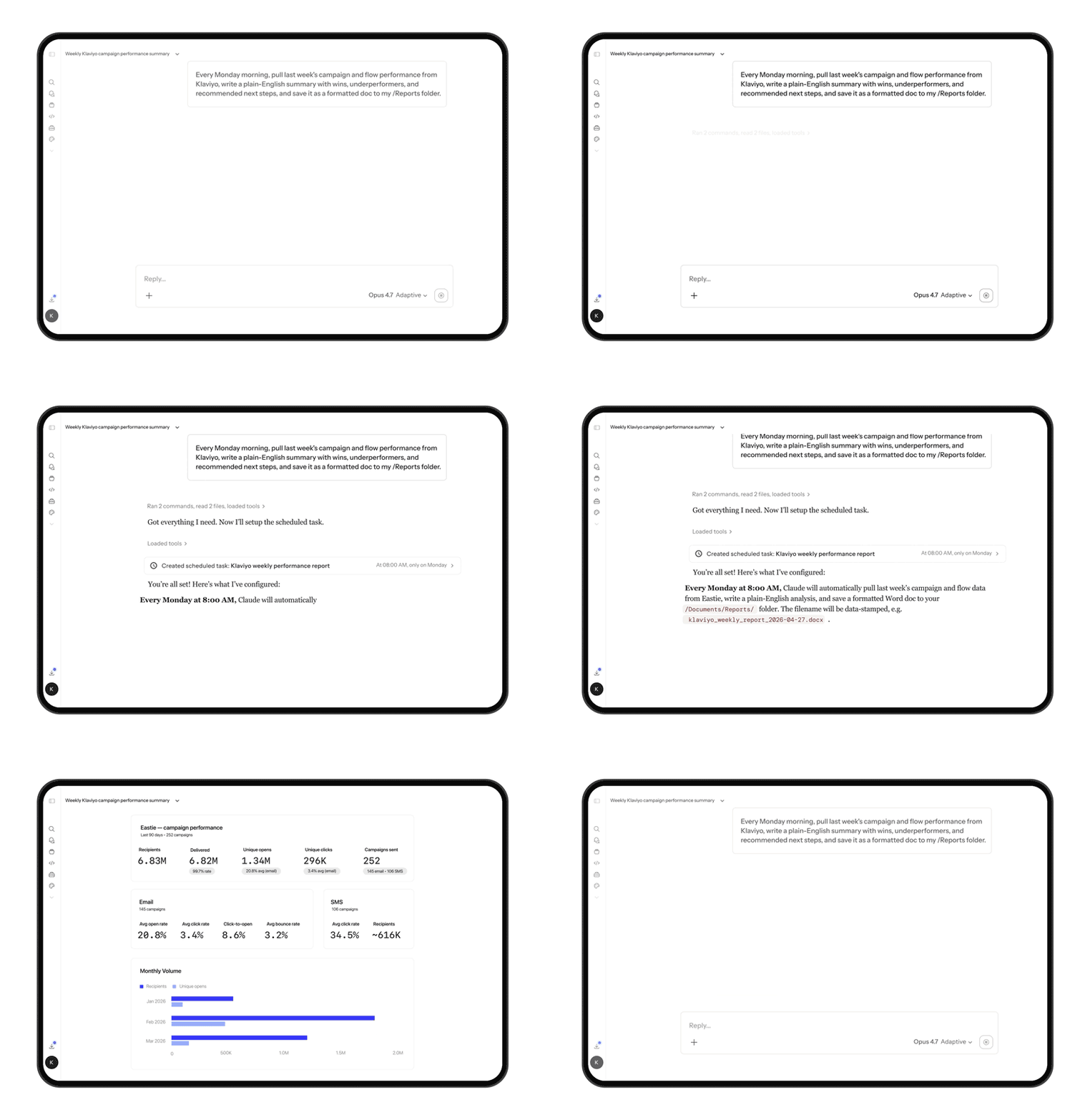
Anthropic Claude integration (May 7, 2026): Klaviyo launched an MCP Connector in the Claude Connector directory, enabling Claude Cowork to autonomously execute multi-step marketing workflows — pulling Klaviyo campaign data, generating weekly performance reports, auditing email flows, and drafting campaign briefs. Co-CEO Andrew Bialecki described it as "turning Claude into an agentic surface for Klaviyo, one that not only understands performance data, but also drafts the briefs, audits, and campaign assets that used to take hours." 13 This integration positions Klaviyo as an AI-native marketing layer rather than a legacy automation tool, a positioning relevant to defending and growing its Shopify ecosystem share against emerging AI-first competitors.
Klaviyo x Anthropic integration — Claude Cowork generating a Klaviyo weekly performance report
Klaviyo MCP Connector in Claude Cowork: autonomous marketing workflow demo 13
Enterprise customer expansion: The 38% YoY growth in >$50K ARR customers (to 4,175) is accelerating relative to total customer growth, a signal that Klaviyo is moving upmarket. Higher-ACV customers have longer contracts, lower churn, and more expansion potential — a structural mix shift that supports NRR improvement. 5
International expansion: International revenue at 36.6% of Q1 2026 totals means Klaviyo still generates roughly 63% of revenue from North America. The international segment has room to grow as Shopify continues its global merchant expansion. 5
$500M buyback at a 56% drawdown: Management's decision to initiate a buyback program — and execute a $100M ASR — at a time when the stock was down more than 50% from its 52-week high is a concrete signal that the board views the current price as materially below intrinsic value. 5 Whether the remaining $400M is deployed aggressively will be visible in Q2 filings.

Key risks

Shopify concentration (~78% ARR): According to SaaStr analysis, approximately 78% of Klaviyo's ARR comes from merchants who also use Shopify, and Klaviyo holds over 80% share within the Shopify marketing automation ecosystem. 14 This figure is a third-party estimate, not an official disclosure — Klaviyo has not quantified the exact share in public filings. The implication is structural: if Shopify were to change its partner incentive structure, acquire a competing marketing tool, or see a sustained decline in new merchant growth, Klaviyo's pipeline would be directly impaired. SaaStr estimates the 12-month KVYO-SHOP stock price correlation at 0.6–0.7, meaning investors holding both names are not diversified against Shopify-specific risk. If Shopify drops 10%, KVYO is likely to drop 6–12% from correlation and beta combined. 14 Potential revenue impact from a major Shopify policy change: $200M–$800M, depending on the affected customer percentage (15–60% range).
CFO departure (August 2026): Amanda Whalen announced her resignation on the same earnings call that delivered a Q1 beat and a guidance raise. The stock dropped ~15% the following day. 6 Whalen's last day is August 21, 2026, with an advisory period through November 16. The timing — simultaneous with a slowing guidance Q2 — amplified market anxiety. The new CFO's identity, background, and appetite for aggressive investment versus profitability optimization will be a key variable for FY2027 margin outlook. Until the replacement is named, this is an open-ended uncertainty.
Revenue growth deceleration: The long-run trend is unambiguous. Annual growth rates: FY2021 +62.66% → FY2022 +47.67% → FY2023 +34.29% → FY2024 +31.63% → Q1 2026 TTM +30.27%. 3 FY2026 guidance midpoint implies ~23% full-year growth, with analysts projecting a 5-year revenue CAGR of roughly 17.58%. For a stock with a P/S of 3.36x, the market will need to see the growth rate stabilize — rather than continue compressing — to hold the current multiple.
Co-CEO share sales: Andrew Bialecki sold 400,000 shares in February and March 2026 under a 10b5-1 plan for approximately $7.08M (at average prices of $16.76 and $18.64). 15 A 10b5-1 plan is pre-scheduled and does not necessarily reflect the co-CEO's current view of fair value, but the $7M scale and the timing (at prices materially above current levels) are worth monitoring. Bialecki retains a large position; insider ownership overall is 36.81%. 1
SBC dilution: Shares outstanding grew 10.71% YoY despite $100M in buybacks. 1 At an estimated SBC run-rate of $200–260M annually (based on SaaS industry norms for KVYO's revenue scale — exact SBC per-line detail is not readily available without parsing the full 10-Q), dilution is a ~8–12% annual headwind per share. The $500M buyback authorization addresses approximately 1.5–2 years of that dilution if deployed entirely; it is not a permanent structural fix.
Risk: profitability regression: The Q1 GAAP profit of $9M was achieved with non-GAAP operating margin of 16.4%. If growth investment accelerates — particularly in S&M to defend against Braze, Salesforce Marketing Cloud, Mailchimp (Intuit), and Attentive — the company could re-enter GAAP losses. A 5-percentage-point increase in S&M spend as a revenue percentage from current levels would cost roughly $65M+ annually in additional expense. 5

Analyst consensus

23 analysts cover KVYO. The consensus is Strong Buy with zero Sell ratings. 16
統計カードを読み込んでいます…
Current stock price: ~$15.05. Average 12-month target: $29.23 (implied +94% upside). Target range: $25–$46. 1
Analyst targets exist alongside a well-documented optimistic bias in sell-side research; treat the target range as a sentiment indicator. Post Q1 2026 earnings, multiple analysts cut targets: Barclays (Raimo Lenschow) cut from $31 to $25 (maintaining Overweight), Piper Sandler cut from $30 to $26 (Overweight maintained), KeyBanc cut from $40 to $35, Wells Fargo cut to $26. 16 Goldman Sachs maintained Buy with a $35 target. The cuts reflect CFO-transition and growth-deceleration concerns, not fundamental business deterioration. Barclays analyst Raimo Lenschow maintained Overweight despite the cut, characterizing the AI-driven growth narrative as intact over a longer time horizon. 16
FY2026 consensus revenue estimate: ~$1.518B (consistent with the company's own guidance midpoint). FY2027 analyst consensus revenue growth: estimated 17–20%.

Insider and institutional ownership

Holder categoryOwnership
Insiders (including founders)36.81% 1
Institutions (361 firms)53.61% 17
Short interest (as % of float)11.45% (15.95M shares, 3.76 days to cover) 1
Klaviyo has a dual-class share structure (Series A and Series B), with Series B shares holding stronger voting rights. This gives founders disproportionate governance control regardless of economic ownership. 1
Top five institutional holders (as of March 31, 2026): Summit Partners L.P. (13.38%, ~$283M), Capital International Investors (8.31%, ~$176M), FMR LLC / Fidelity (6.95%, ~$147M), Vanguard Portfolio Management (5.35%, ~$113M), Whale Rock Capital Management (4.84%, ~$102M). 17
The 11.45% short interest deserves attention. It reflects a sizable bear camp that is betting growth deceleration continues — or that the CFO transition signals deeper management instability than the market currently prices.

Upcoming catalysts

  • Jefferies Software, Internet, and AI Conference (May 28, 2026, yesterday): Co-Founder and Chief Strategy Officer Ed Hallen presented a fireside chat. 18
  • William Blair Growth Stock Conference (June 3, 2026): CFO Amanda Whalen is scheduled to present — one of her last public appearances before departure. 18
  • Q2 2026 earnings (expected August 4, 2026): Analyst consensus EPS estimate is $0.16 — a sequential decline from Q1's $0.22, reflecting Q2 non-GAAP operating margin guidance of 13–14% (vs. ~16% in Q1). 18 Key variables: revenue within the $359–363M guidance range, NRR trajectory, and any naming of the new CFO.

Consolidated view

KVYO sits at a fork. The bull case rests on five data points in tension with each other: a 0.55/0.60 PEG at a ~17x forward P/E, a 37% P/S discount to the broader SaaS cohort, an FCF margin (16.72%) double that of Braze at the same P/S multiple, a $867M net cash position, and a first GAAP-profitable quarter. The bear case is equally concrete: TTM growth at 30.27% is 27 bps above the screen's lower bound and decelerating toward the low-20s by Q2 guidance, the CFO is departing with no replacement named, the Co-CEO sold $7M in shares above current prices, short interest is at 11.45%, and Shopify concentration creates a structural dependency on a single ecosystem partner.
The stock's 56% drawdown from its peak does not automatically make it cheap — it means the market has repriced it twice: once for growth deceleration and once for the CFO shock. What the current price may not fully price is the FCF generation ($219M annualized) and the buyback authorization ($400M remaining at below-ASR-execution prices) acting as a floor. The growth rate question — specifically whether it stabilizes around 20–23% or continues compressing toward the analyst 5-year consensus of ~17% — is the deciding variable for whether the PEG of 0.55 is accurate or optimistic.
Cover image: Klaviyo x Anthropic integration announcement image — Klaviyo official blog 13

このコンテンツについて、さらに観点や背景を補足しましょう。

  • ログインするとコメントできます。