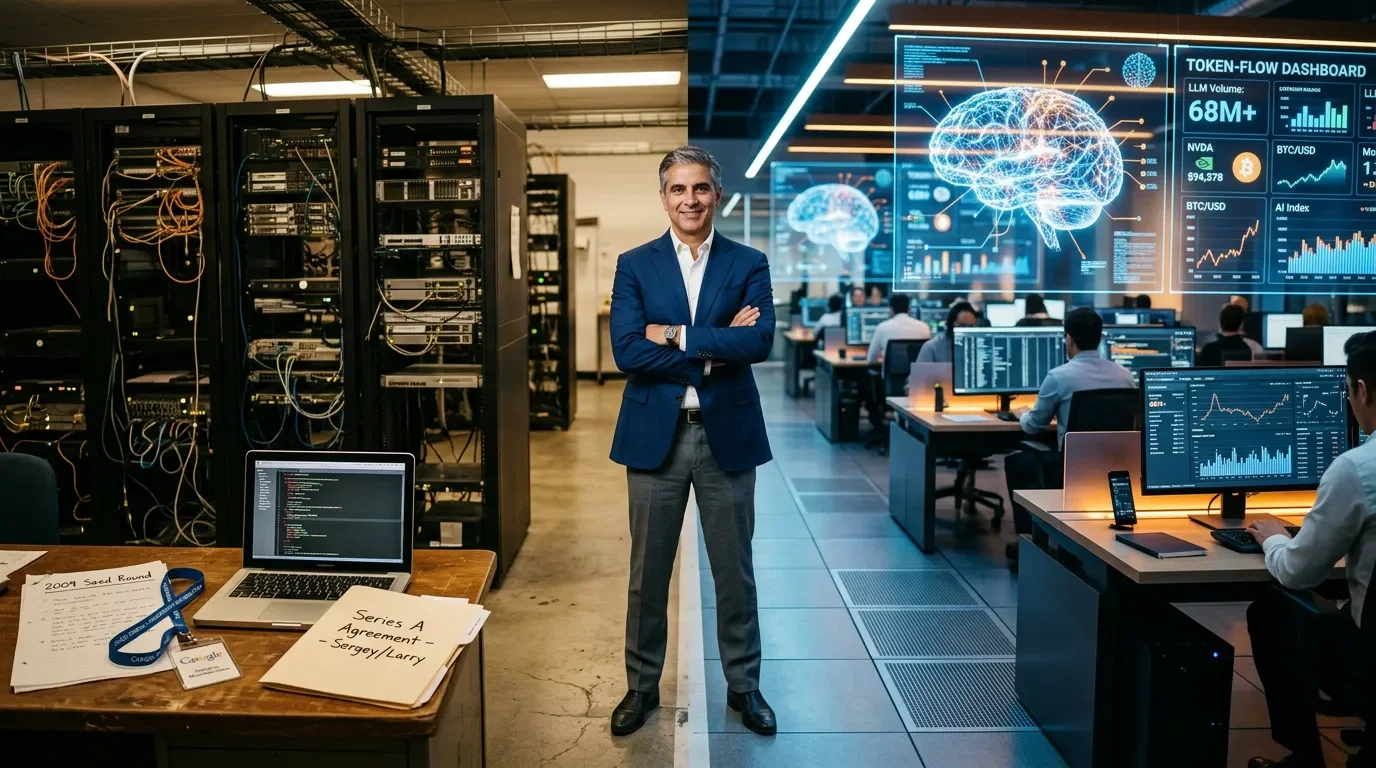
AI Is Still at Its Atari Stage — Bill Maris on Google's Pricing Weapon, the VC Fund Size Math, and Where He's Betting

AI Is Still at Its Atari Stage — Bill Maris on Google's Pricing Weapon, the VC Fund Size Math, and Where He's Betting

Bill Maris, founder of Google Ventures, joined the All-In Liquidity Summit to make four arguments worth unpacking: AI is in its Atari stage and the real bets are on enabling infrastructure, not bigger models; Google could rationally price-war OpenAI and Anthropic into existential trouble; small venture funds (under $750M) produce 4.76x DPI vs. 2.42x for large funds and account for 95% of top-decile performers; and VC incentive structures are broken at the GP, LP, and entrepreneur level simultaneously.

AI Podcast Insights
2026/6/11 · 8:12
購読 0 件 · コンテンツ 4 件
The best-known argument at the All-In Liquidity Summit on June 9, 2026 was not from one of the main hosts. Bill Maris — founder of Google Ventures (now GV), creator of Calico, and currently running Section 32 — sat down with Chamath Palihapitiya, Jason Calacanis, David Sacks, and David Friedberg for a 29-minute conversation that covered four distinct arguments worth unpacking. The central thread: the AI industry is repeating the exact arc of the gaming industry, and almost everyone is looking at the wrong part of it.
コンテンツカードを読み込んでいます…

AI is at its Atari stage — and the platform bets are what matter

Maris's cleanest provocation of the conversation was a direct comparison between today's AI landscape and the gaming industry of the early 1980s. 1
His argument: today's AI systems — even the most capable frontier models — have the same structural weaknesses as Zork and Planet Fall. Brittle turn-based responses. No persistent memory across sessions. Context resets. The interaction model is rigid in a way that makes the technology feel constrained despite its underlying capability.
The gaming industry solved these problems not by writing better stories, but by building new infrastructure: physics engines, dedicated GPUs, more expressive controllers. The resulting leap from Atari-era text adventures to photorealistic open-world games took roughly 20 years. Maris thinks the same transition will happen in AI in closer to five.
"I think we're at the Atari command line stage of AI and we're going to get to the PlayStation 10 stage in the next five years."
This has a direct implication for where he puts capital. Maris said he is not interested in investing in larger models — the equivalent of "better stories" in his gaming analogy. His bets are on the enabling layer: the physics engines, the controllers, the GPU-equivalent infrastructure that will make ambient, persistent AI possible. He named specific technical gaps that still need to be closed: persistent memory, session continuity, reliability under real-world conditions.
The analogy is worth taking seriously precisely because it narrows the investment thesis to something concrete. It's not "AI is the future" — it's a specific claim that the transition from current-generation AI to next-generation AI requires infrastructure investment that the current wave of model funding is not addressing.

If I were Google, that's what I'd do

The sharpest few minutes of the conversation came when Maris was asked about OpenAI's valuation problem. His answer veered into a scenario that nobody pushed back on, possibly because it's hard to refute.
The setup: Google has Gemini, one of the most capable model families in the world, and it operates inside a company that prints cash at a scale OpenAI and Anthropic cannot approach. 2 If Google chose to slash token prices to 20 cents on the dollar — offering what Maris described as a "basically identical product" at 80% less — it would create an existential pressure event for both companies.
He was asked directly whether this would happen. His answer was unambiguous: "If I were Google, that's what I'd do."
The mechanism is straightforward. An enterprise buyer choosing between equivalent models at equivalent quality will route on price. If Google makes that price gap wide enough — and has the balance sheet to sustain losses in the short term in the way Uber burned investor capital to build market share — the revenue assumptions underlying OpenAI's $300 billion valuation and Anthropic's similar trajectory become very difficult to model.
Maris did not frame this as Google being malicious. He framed it as rational competitive behavior by a company that has both the technical capacity and the financial capacity to execute. The question he left implicit: why hasn't Google done this yet?
His read on OpenAI's public market ambitions was equally blunt. He pointed to "$1 trillion in spend commitments against $60 billion in revenue" and raised the question of who the buyer for that paper will be once the IPO lockups expire. His answer: pension funds and ETFs that will be required to absorb shares once the companies enter major indices — in other words, retail savers who did not participate in the earlier value creation. He made a distinction between this outcome and the stated mission of benefiting humanity. "My objection is don't say you're doing this for the benefit of humanity and do the other thing."

The math on fund size doesn't lie

The four lessons Maris opened with were drawn from his own operational experience, but the most analytically dense was the argument about fund size. 1
His claim: small funds outperform large funds, not as a matter of opinion, but as a structural mathematical consequence of how venture economics work.
The data he cited: across the measured period, funds under $750 million averaged a 4.76x DPI (distributed to paid-in capital — actual cash returned, the only VC metric Maris says he cares about). Funds over $1 billion averaged 2.42x. Funds under $750 million represented 95% of top-decile performers. 1
統計カードを読み込んでいます…
The reason is the math of required exits. If you manage a $500 million fund and target owning 10% of each company, you need $5 billion in exits just to return principal. To hit a 3x return, you need $15 billion in exit value across your portfolio — difficult, but achievable over a ten-year fund life. Scale that to a $7 billion fund and the 3x target requires $210 billion in exits, a figure that exceeds the total venture-backed M&A and IPO value in most years.
He is running six funds at Section 32, averaging $400 million each. All six are performing in their top decile. His GV investments — the ones where he led the deal — showed returns he pegged at roughly 4x, with early bets like The Climate Corporation (acquired by Monsanto for $1 billion) and later investments in Crowdstrike, Coinbase, and Coherent.
The GV origin story he told was also worth noting. When he started the fund in 2009 with Google backing, he and co-founder Rich Miner (Android co-founder) wanted to use what they called "machine learning" — Google would not let them use the term "AI" at the time. They ran millions of portfolio construction simulations to determine optimal fund size and portfolio concentration. The resulting data, he said, is what the 4.76x vs. 2.42x split now reflects.

Incentive dysfunction runs deep in venture

One of the more uncomfortable observations Maris made was about the internal incentive structure of large venture funds. He walked through it as a series of misaligned interests rather than a single failure point.
For a GP managing a $5 billion fund that returns 1.01x: they collect a larger management fee than a GP managing a $500 million fund that returns 3x. The fee structure rewards scale, not performance — at least until DPI crystallizes, which can take a decade.
For an LP like a university endowment: they need to deploy large checks. A $200 million commitment to a $5 billion fund is manageable; a $200 million commitment to a $400 million fund represents 50% of that fund and is usually not permitted by concentration rules. The institutional infrastructure of the LP community is structurally biased toward larger funds.
For an entrepreneur: a large fund with a massive AUM can offer an inflated valuation at term sheet. Maris described the dynamic directly: "Your valuation is now 4 billion and we'll give you 250 million for a percent of your company" — offered to a first-time founder whose company might reasonably be priced at $100 million. First-time founders almost always take that deal. The economics look attractive, but the implications for ownership dilution and investor alignment are often not understood until much later.
His conclusion: the incentives are broken at every node of the chain, and the current moment — with a handful of late-stage companies generating spectacular paper returns — will produce a wave of headline fund performance that masks the underlying bimodal distribution. A small number of funds will have extraordinary results; the majority will continue to lose money.
Sacks, speaking from his experience at Craft Ventures, agreed: "75% of funds lose money" remains the structural baseline, and the current wave of late-stage IPOs will not change that.

What he's actually investing in

Set aside the macro critiques, and Maris's investment thesis resolves into two areas.
AI infrastructure: not models, but the enabling layers that will make current models substantially more useful. In his gaming analogy, these are the physics engines — the components that allow AI to have persistent state, reliable behavior, and real-world applicability. He did not name specific companies in this bucket.
Computational biology: Maris founded Calico in 2013 to pursue longevity research; he is now an investor in New Limit (co-founded by Brian Armstrong and Blake Byers) and several other companies in the space. His caveat was significant: even with breakthrough science, the FDA validation path for therapeutics requires five-to-ten years of safety testing after an initial compound discovery, meaning the timeline to returns in this sector is long even if the underlying biology proves out. He expressed interest in simulation-based shortcuts — "if we can achieve a realistic simulation of a human cell in silico" — as the path to accelerating that loop, but said the technology is not there yet.
He also made a point about what happens to US biotech competitiveness when basic research funding is cut and H-1B visa holders face uncertainty. His phrasing was direct: "We're losing." The brain trust that used to concentrate in American research institutions is now moving. China is recruiting actively from Europe and India. He did not frame this as political commentary; he framed it as an investment-relevant structural shift.

The full episode is available on the All-In Podcast. Bill Maris's fund, Section 32, manages approximately $2 billion in venture capital focused on frontier technology and life sciences. 3
コンテンツカードを読み込んでいます…

このコンテンツについて、さらに観点や背景を補足しましょう。

  • ログインするとコメントできます。