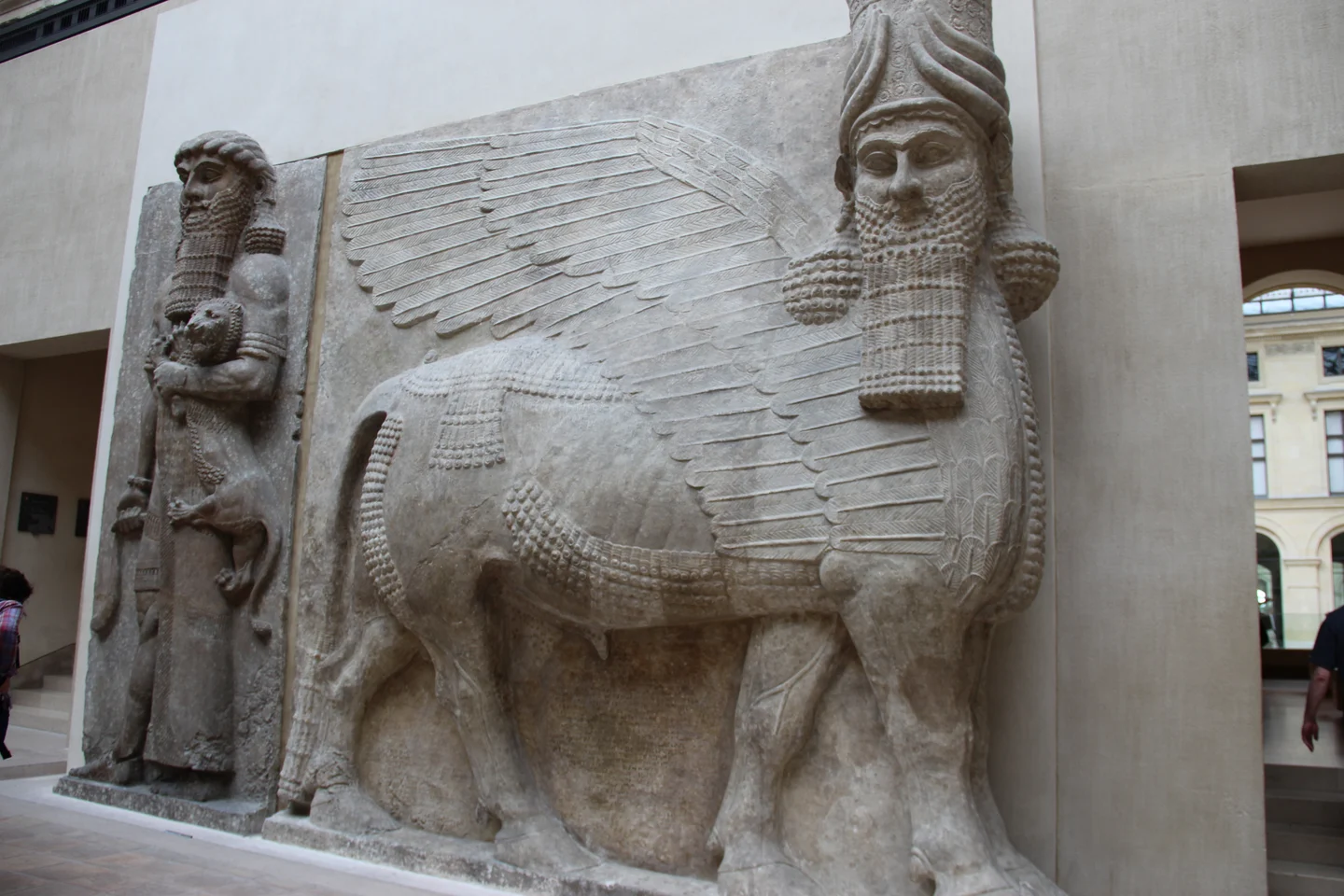
The guardian of Dur-Sharrukin: 2,700 years in the life of a bull
Neo-Assyrian lamassu AO 19858 at the Louvre: Sargon II's palace guardian, Botta's 1843 discovery, and the 1855 Qurnah river disaster.
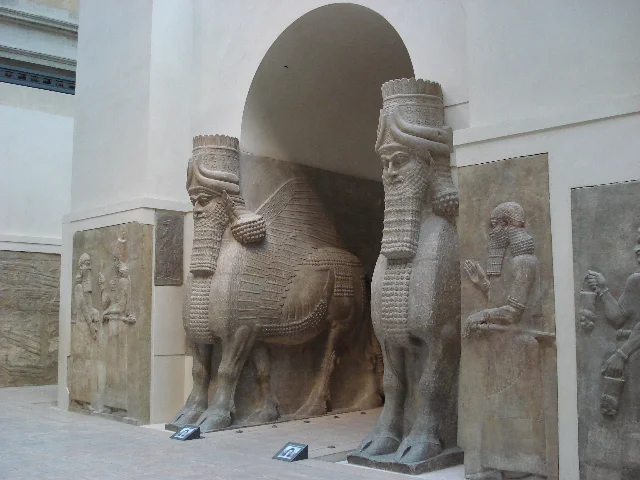
Stand in Room 229 of the Louvre's Richelieu wing on a clear morning, when light falls through the glass roof and crosses the stone floor in long pale slabs, and the effect is difficult to shake. On either side of a reconstructed arched gateway, two colossal creatures face outward. They are roughly 4.2 meters tall — taller than a double-decker bus is wide — carved from a single block of gypseous alabaster each, and they have been in this room long enough that the Louvre has given the gallery a formal name: the Cour Khorsabad.1 The creature on the left is accession number AO 19858. It has the head of a bearded man, the body of a bull, the wings of an eagle, and a horned crown. Between its legs, twenty lines of cuneiform script name the king who made it. If you stand directly in front of it, you see four legs — two front legs planted firmly side by side, a guardian at rest. Walk around to the side, and you see something different: all four legs in walking posture, the animal moving forward. Count the legs from that angle. There are five.
That optical trick was not an accident. Neither was anything else about it.
The king who built a city in a year
The man behind the inscription is Sargon II, who ruled the Neo-Assyrian Empire from 722 to 705 BCE.2 He almost certainly seized the throne from his brother Shalmaneser V in a palace coup, and spent most of his reign trying to prove he deserved it. He crushed rebellions in Syria, conquered Samaria and deported the Kingdom of Israel's population, pushed back the northern kingdom of Urartu, and eventually reconquered Babylonia from the Chaldean warlord Marduk-apla-iddina II. He modeled himself on Sargon of Akkad — the legendary empire-builder from 16 centuries earlier — and named himself the second Sargon: Šarru-kīn, "the legitimate king."2
Around 713 BCE, he made a decision that no Assyrian king before him had made: he would build a brand-new capital from scratch.3 He chose a site at the foot of Mount Musri in what is now northern Iraq — a village called Magganubba — and in his cylinder inscription he described why he chose it, in the flat bureaucratic confidence of an absolute monarch:
"None of the 350 earlier regents of Assyria realized its favorable location, understood the benefits of its settlement or commanded to dig a canal there. I planned and plotted day and night how to settle this city and to build a sanctuary as the seat of the great gods and palaces as the residence of my rule."3
He called the city Dur-Sharrukin — Fortress of Sargon. It was designed as a near-perfect square covering more than 300 hectares, enclosed by a wall 14 meters thick and 12 meters high.3 The palace at its northwest corner — which Sargon called "the Palace Without Rival" — contained more than 200 rooms and courtyards. Its outer walls were lined with alabaster slabs carved in relief from end to end. Seven pairs of lamassu guarded the threshold of the throne room.4
The logistics were staggering. Surviving letters document the king's instructions to governors across the empire: timber from Lebanon, stone from the mountains, labor from the furthest provinces. One letter to the governor of Kalhu gives a sense of the pace he demanded: "700 bales of straw and 700 bundles of reed, each bundle more than a donkey can carry, must arrive in Dur-Sharrukin by the first of the month Kislev. Should one day pass by, you will die."3
Construction began around 717 BCE. Sargon moved in during 706 BCE.2 He had barely a year in his palace. In 705 BCE, he was killed in battle against the Tabal people in Anatolia — and his army could not recover his body.2
That last detail mattered enormously. In Mesopotamian religion, a king who died without burial became a restless ghost for eternity, denied the underworld's imperfect peace. His son Sennacherib — who succeeded him and went on to destroy Babylon — interpreted his father's unbodied death as divine punishment. He distanced himself from Sargon's name, abandoned Dur-Sharrukin entirely, and moved the capital to Nineveh.2 The city Sargon had spent eight years building at the cost of thousands of lives was simply left. Within a generation, it was a ruin. Within a century, it was a mound.
Sargon II would remain almost entirely forgotten for the next 2,500 years. His name appears exactly once in the Bible — a single verse in Isaiah, chapter 20, noting that "the king of Assyria" sent his commander against the Philistine city of Ashdod.2 The lamassu he commissioned stayed buried under the dust of northern Iraq.
The five-legged guardian
To understand what those bulls were meant to do, you need to set aside the modern habit of treating ancient sculpture as decoration. The lamassu — the composite creature combining human intelligence, bull strength, and eagle swiftness — was a functional object, deployed at thresholds because thresholds were where power was most vulnerable.5 The Louvre's own guide to the Cour Khorsabad describes them as creatures who "combined the powers of the different animals in order to protect the city and its palace."1
The physical description of AO 19858 is worth going through slowly. The horned crown — the polos — carries four sets of double horns and a ring of feathers at the top, and its surface is decorated with rosettes, a motif tied to the goddess Ishtar and to divinity generally.4 The face is broad, with strong arched eyebrows that span the entire forehead and a thick beard braided into tight ringlets — so many ringlets that the beard nearly doubles the apparent size of the face. The bull's ears are pierced and fitted with earrings.
The wings rise up the flank of the animal in deep-cut overlapping layers, each feather incised with precision. The fur across the breast, back, and haunches is arranged in organized curling rows. Dr. Senta German of Smarthistory has written that "what is so awe-inspiring about these sculptures is not only their size but the powerful clarity with which they are sculpted and the terrifyingly precise repetition of forms" — and she is right that terrifyingly is not too strong a word.4 This is a sculpture that was never meant to be looked at carefully and at length from a foot away. It was designed to be approached through a massive arched gateway at distance and speed, and to stop people.
The five-leg design served this approach. From the front, the guardian was still — watching you. From the side, as you passed through the arch, the guardian was moving — keeping pace. The sculptor achieved this by treating front and side as independent pictorial planes. Dr. Steven Zucker of Smarthistory described the effect precisely: "As we approach, we see it still, watching us as we move. If we belong, if we're friendly and we're allowed to pass this gate, as we move through it, we see the animal itself move."4 The fifth leg was a structural necessity as much as an artistic choice: carving away the stone to make the fourth front leg visible from the side would have weakened the block's ability to bear the weight of the arch above.1
Between the legs and on the reverse, twenty lines of cuneiform — catalogued as RINAP (Royal Inscriptions of the Neo-Assyrian Period) 2.9.2 and 2.41.21 in Grant Frame's 2021 critical edition — declare Sargon's military victories and his piety toward the gods.4 The inscription closes with a curse on anyone who would damage the palace.4 A standard Assyrian formality, perhaps, but one that acquired a certain dark aptness given what eventually happened to much of Sargon's palace.
One more thing that is now invisible: color. Scientific analysis of Neo-Assyrian sculpture has identified microscopic traces of white calcium carbonate, bone black, hematite red, cinnabar, and cobalt blue on the alabaster slabs.4 The stone surface you see in the Cour Khorsabad today is the drained remnant; the original beast was painted.1 Traces of red and blue are still visible on the wall relief of Sargon's crown in the same room, if you look closely.
The man who found it by not looking for it
In 1842, a French naturalist and physician named Paul-Émile Botta (1802–1870) was appointed French consul to Mosul, then an Ottoman city in northern Iraq.6 He was a skilled Arabic speaker, a polymath who had sailed the world and collected plant specimens, and he was not primarily interested in archaeology. What interested Jules Mohl of the Société Asiatique in Paris, who encouraged Botta's expedition, was the possibility of finding the biblical city of Nineveh — one of the few Mesopotamian cities named in Scripture — buried somewhere near the ruins of the ancient mound system around Mosul.7
Botta began digging at Kuyunjik, the main mound opposite Mosul. Results were meager. Then, in early 1843, a man from a village called Khorsabad — about 15 kilometers northeast of Mosul — came to the consulate and told Botta that carved stones were protruding from the mound near his home.7 Botta sent a small team. Within days, they were finding carved reliefs. He transferred the full excavation to Khorsabad.
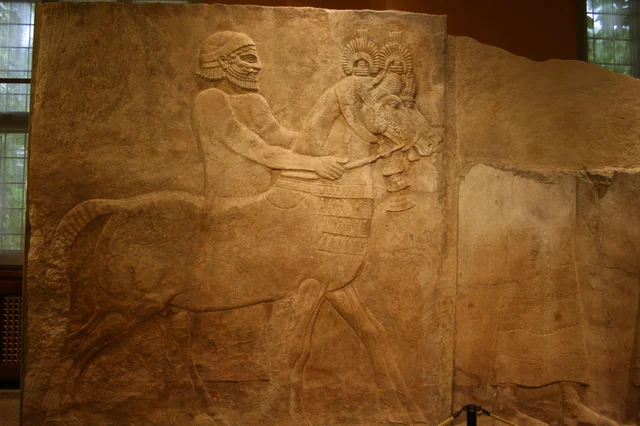
What he had stumbled onto was the Palace Without Rival — Sargon's magnum opus, abandoned for 2,500 years. Botta had no way to know this immediately; the cuneiform script on the walls could not yet be read. He was accompanied by the painter Eugène Flandin, who made drawings of each relief as it emerged, because many of them began crumbling the moment they were exposed to air.7 Working quickly, Botta had the most significant pieces — including the great lamassu — sawn into sections for transport. AO 19858 was cut into six plaques.8
Botta died believing he had found Nineveh. His 1849 publication was titled Monument de Ninive — the Monument of Nineveh — even though it was entirely about Khorsabad. It was a characteristic confusion of the age: he was looking for a city the Bible mentioned, and found an equally extraordinary one it had mostly forgotten. The Kuyunjik mound he originally surveyed and abandoned turned out, decades later, to be the genuine Nineveh.
On 1 May 1847, the Louvre inaugurated the world's first Assyrian museum, displaying Botta's finds from Khorsabad.7 AO 19858 — reassembled from its six transport plaques — stood among them. The discipline of Near Eastern archaeology had effectively begun with the opening of this room.
A race between empires
To understand what happened next, it helps to grasp what Mesopotamian archaeology was in the 1840s and 1850s: it was, at its core, a competition between France and Britain to fill the showcases of their national museums.9 Botta was the French consul and he was shipping to the Louvre. His rival, Austen Henry Layard, was a British excavator who began work at the Nimrud mound in 1845 and was shipping to the British Museum. The two men were not merely colleagues with different employers; they were, as the Biblical Archaeology Society has put it, "national agents, charged with bolstering the coffers of their countries' burgeoning imperial museums."9
When Botta left Khorsabad in 1844, he believed he had excavated the site's main features. His successor as consul, Victor Place, returned to Khorsabad in 1851 and found there was far more to discover. By 1855, Place's team had uncovered more than 200 rooms of the palace and extracted extraordinary materials: more lamassu, winged genie reliefs, glazed tiles, and hundreds of smaller objects.9
There was also a diplomatic subplot. The two nations had carved up the adjacent site of Kuyunjik — France got the north half, Britain the south — but in 1853, a British archaeologist named Hormuzd Rassam dug into the French zone and made spectacular finds, including the lion hunt reliefs of Ashurbanipal and cuneiform tablets that would later turn out to include the Epic of Gilgamesh. As partial restitution, the British agreed to give a portion of their Kuyunjik finds to France.9 By April 1855, this meant that both French and British archaeological material was aboard the same convoy heading downriver.
The Qurnah disaster
On 29 April 1855, Victor Place loaded eight keleks — flat wooden barges kept buoyant by inflated sheepskins — with the Khorsabad finds at Mosul and set off for Basra, where an ocean-going vessel would carry everything to France.10 The cargo was enormous: at minimum 235 crates weighing approximately 30 tonnes, including the Khorsabad materials, some 40 crates from French excavations at Babylon and Nimrud, 41 crates of British Kuyunjik material, and roughly 80 crates bound for Prussia as diplomatic gifts.9 Four of Sargon's largest stone sculptures — two lamassu and two winged genies — were too heavy for the barges and were fastened to smaller rafts towed alongside.10
In Baghdad, on 4 May, Place received orders to report immediately to a new consular posting in Moldavia — the Crimean War had reshuffled French diplomatic appointments across the region.10 He entrusted the convoy to a Swiss teacher named A. Clément, who had no experience moving cargo through the Ottoman river system.
What happened over the next two weeks is documented in enough detail to be painful. As the convoy moved south, armed men began boarding the barges, taking food, money, and goods. Clément, running short of cash for bribes and river tolls, had no authority and fewer options.9 Near Al-Qurnah, at the confluence of the Tigris and Euphrates, Sheikh Abu Saad of the Al-Muntafiq tribe launched a full attack. His vessel rammed the main cargo barge. Armed men swarmed aboard. The convoy was steered into the western bank, where the stern sank and crates of antiquities spilled into the river.9
The four stone-statue rafts escaped the initial attack — they were too heavy and slow to intercept easily. The attackers pursued them downstream. One raft was stripped of its wooden frame and its winged genie was dumped on the riverbank. A second sank. Two rafts carrying one lamassu and one winged genie ran aground near Al-Maqil, close to Basra, and were eventually recovered.10
Of the 235-plus crates of antiquities, only 28 reached Paris — arriving almost a year after the disaster.9 The rest — the British Kuyunjik material, the Babylonian finds, the Prussian diplomatic gifts, the bulk of Place's Khorsabad excavation — settled into the silt of the Tigris and Euphrates. Assyriologist C.J. Gadd wrote in 1936: "the loss was, literally, immense, for there is no longer any exact information as to what this vast cargo contained."10
The catastrophe ended serious French archaeological work in Mesopotamia for more than two decades.
In 1971–72, a Japanese survey team — the Japan Mission for the Survey of the Under-Water Antiquities at Qurnah, a collaboration between the Society for Near Eastern Studies in Japan, the Iraqi Directorate General of Antiquities, and the Chunichi Newspapers — used sonar to sweep 7 kilometers of the Euphrates riverbed near the disaster site.10 They identified 20 points of interest and sent divers down to examine them. All came back empty. Their conclusion, 117 years after the sinking: the wreck and its cargo were "undetectable, carried off by the river and distributed further down the watershed."9 It remains there now, wherever the shifting silt has taken it.
Paris, room 229
AO 19858 survived all of this. It had left Mosul on Botta's earlier transport, years before Place's ill-fated convoy, and was reassembled in the Louvre well before the 1855 disaster. Its companion in the Cour Khorsabad today — AO 19859, slightly taller at 428 centimeters, excavated by Victor Place himself from city gate no. 3 rather than the palace entrance — was among the pieces recovered from the Al-Maqil grounding: a survivor of the disaster by the margin of a single sandbar.11
The two bulls were acquired under the partage après fouilles — the post-excavation division of finds — the standard arrangement between 19th-century excavators and Ottoman authorities.8 AO 19858 entered the Louvre's collection formally in 1847, more than a century before modern international cultural heritage laws. As of May 2026, no active Iraqi repatriation claim exists for either piece.8
The Cour Khorsabad as it stands today is a reconstruction of the atmospheric conditions of an Assyrian palace courtyard rather than a scholarly attempt at exact replication. The glass roof is obviously modern. But the stone slabs lining the walls — relief-carved images of archers hunting, dignitaries in procession, servants carrying the king's wheeled throne on their shoulders, and expeditions to Lebanon for cedar wood — are genuine.1 Behind the lamassu gateway, a high-relief figure of a hero — Gilgamesh, or perhaps the king represented as Gilgamesh — stands more than 5 meters tall, effortlessly choking a lion. The daylight from above plays on the carved surfaces in exactly the way the Louvre says it does.12
The Chicago cousin
One postscript worth noting. In April 1929, during excavations conducted by the University of Chicago's Oriental Institute (now the Institute for the Study of Ancient Cultures, or ISAC) at Khorsabad — one of seven seasons the institute ran there between 1928 and 1935 — workmen uncovered the fragments of another colossal human-headed winged bull outside what was identified as the throne room.13 It had fallen face-down onto the pavement and been covered by debris, which had preserved it. Field director Edward Chiera sent an urgent cable to Institute founder James Henry Breasted in Chicago:
"FOUND WINGED BULL FIVE METERS BY FIVE FACE TURNING SIDE WAYS GOOD CONDITION STOP SHIPPING POSSIBLE MONTH MAY ONLY STOP COST TRANSPORTATION ABOUT TEN THOUSAND DOLLARS STOP DIVISION APRIL TWENTY SIXTH STOP SHALL WE ASK FOR BULL"13
Breasted cabled back immediately asking for the piece, despite having no funds to ship it. It now stands in the ISAC Museum in Chicago — a sister sculpture, from the same palace, made by the same craftsmen who made AO 19858, watching over a different room on a different continent.
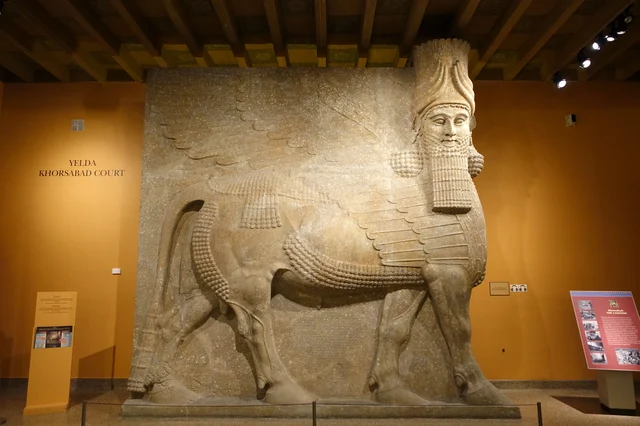
The lamassu in the Louvre has now stood guard over two doorways across roughly 2,700 years. First at the entrance to Sargon's throne room in Dur-Sharrukin, where it blocked the threshold against whatever a king's enemies — visible and invisible — might bring. Then here, in Paris, where it blocks nothing and guards only the threshold of a visitor's attention.
It survived Sennacherib's abandonment of the city, the collapse of the Assyrian Empire in 612 BCE, the centuries of burial, Botta's saw, and the river pirates of 1855. Of all the things Sargon built and declared and inscribed with warnings of divine retribution, this is what remains: a bull with a human face, five legs, earrings, and the careful traces of vanished blue paint.
The cuneiform inscription between its legs still reads — for those who can read it — as a curse on anyone who would damage the palace. The palace is gone. The curse persists.
Cover image: Lamassu (human-headed winged bull), Palace of Sargon II, Khorsabad. Photo by Gary Todd, CC0, via Wikimedia Commons.
参考ソース
- 1Musée du Louvre: The Palace of Sargon II – The Cour Khorsabad
- 2Wikipedia: Sargon II
- 3World History Encyclopedia: Dur-Sharrukin
- 4Smarthistory: Lamassu from the Citadel of Sargon II
- 5Wikipedia: Lamassu
- 6Encyclopaedia Britannica: Paul-Émile Botta
- 7French Ministry of Culture: Paul-Émile Botta's Discovery
- 8Louvre Collections: Lamassu AO 19858
- 9Biblical Archaeology Society: The Qurnah Disaster
- 10Wikipedia: Qurnah Disaster
- 11Louvre Collections: Lamassu AO 19859
- 12Musée du Louvre: Inside an Assyrian Palace
- 13ISAC: Excavations at Khorsabad
このコンテンツについて、さらに観点や背景を補足しましょう。